What is an AC Contactor? Working Principle, Types & Selection Guide
Published: Author: Wilmall
Understanding AC contactors for industrial motor control, from basic operation to selecting the right model for your application.
Imagine your factory’s electrical distribution system as a complex railway network. Trains (electric current) need signals to know when to proceed. The AC contactor acts as the signal controller—receiving commands from operators or automation systems and determining when power flows to motors, heaters, and other industrial equipment. This electromagnetic switch performs millions of operations over its lifetime, making it one of the hardest-working components in any industrial control panel.
What is an AC Contactor?
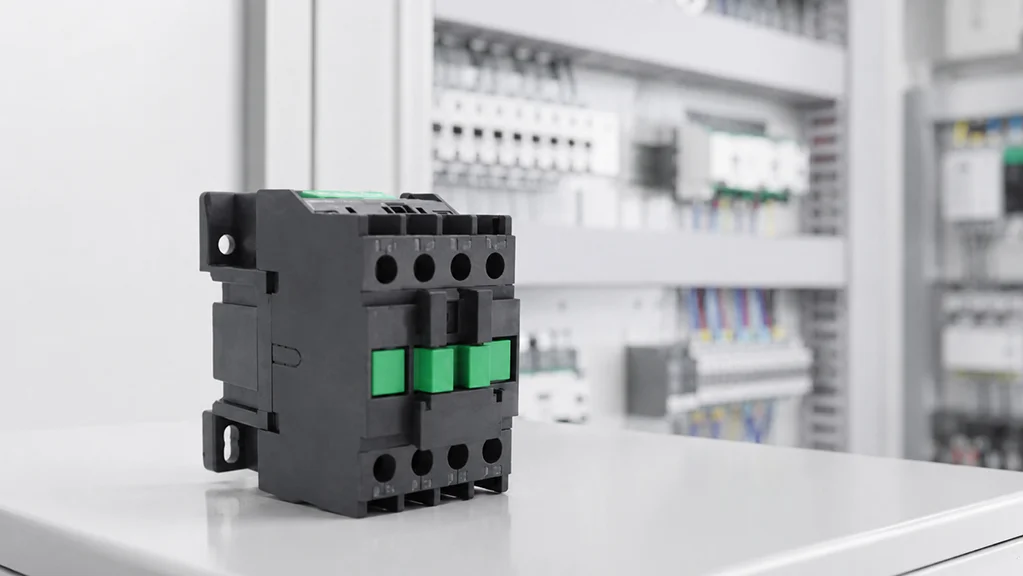
An AC contactor is an electrically operated switch designed for switching AC power circuits. Unlike a manual switch that requires someone to flip it, contactors respond to control signals from buttons, programmable logic controllers (PLCs), or automated systems. This remote operation capability makes them essential for industrial machinery, HVAC systems, pumping stations, and any application where operators need to control equipment from a safe distance.
The “AC” designation means these contactors specifically handle alternating current—the standard power type in homes and industries worldwide. DC contactors exist for battery and solar applications, but AC contactors dominate industrial settings due to their efficiency and the prevalence of AC power distribution.
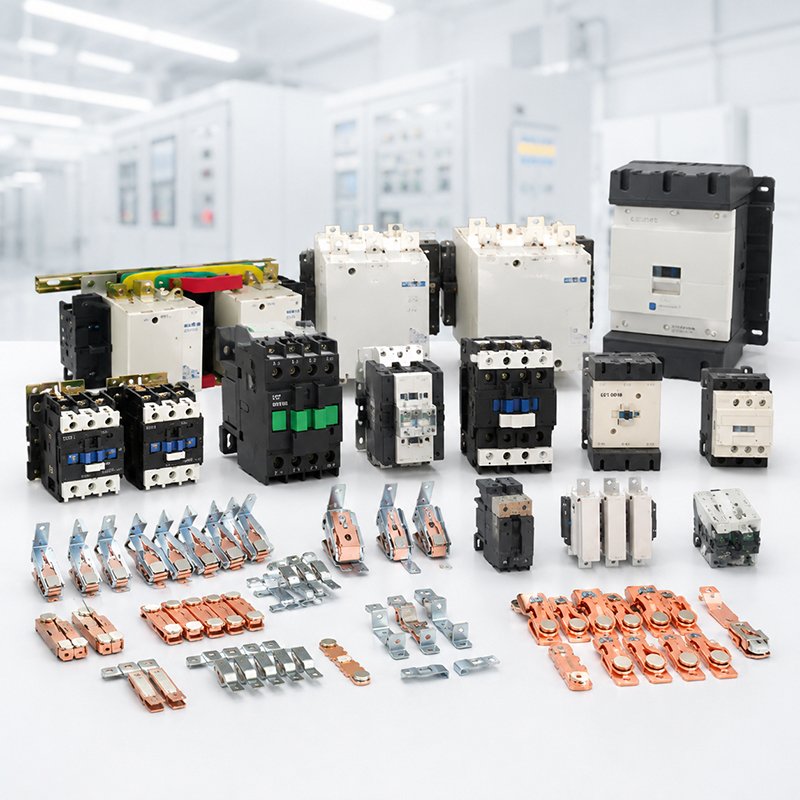
Wilmall manufactures and supplies AC contactors ranging from compact units handling 9 amps to heavy-duty models like the LC1-F630 series managing currents up to 630 amps. This broad range serves everything from small workshop tools to massive industrial compressors.
Basic Structure and Working Principle of AC Contactors
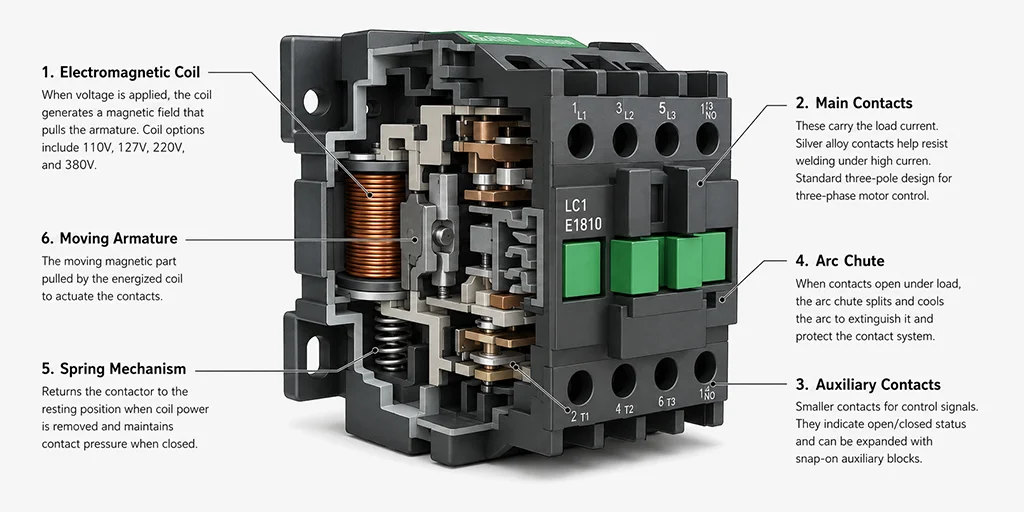
Understanding how a contactor works requires looking inside. Five main assemblies work together to create reliable switching:
Electromagnetic Coil: When you apply voltage to this coil, it generates a magnetic field. Think of it as an electromagnet that pulls metal parts together. Wilmall supplies replacement coils for various voltage levels—110V, 127V, 220V, and 380V—to match different control system requirements.
Main Contacts: These carry the actual load current. They use silver alloy materials to resist welding under high current. The LC1-F series from Wilmall features three main poles for standard three-phase motor applications, with optional auxiliary contacts for control circuits.
Auxiliary Contacts: Smaller contacts that handle signals rather than power. They tell other parts of your system whether the contactor is open or closed. Many Wilmall contactors offer snap-on auxiliary contact blocks that add 2 to 4 additional contacts without increasing the main unit size.
Arc Chute: When contacts separate under load, an electric arc forms. The arc chute splits and cools this arc until it extinguishes. Without proper arc management, contacts would burn and weld together within days of operation.
Spring Mechanism: Springs return everything to the resting position when you cut power to the coil. They also maintain contact pressure when closed—insufficient pressure causes heating and premature failure.
The operation sequence follows a simple pattern: Control voltage hits the coil → Magnetic field pulls the armature → Main contacts close → Motor receives power. Cut the control voltage → Springs separate the contacts → Power stops flowing to the motor. A complete cycle takes 30 to 100 milliseconds.
Key Terminology and Definitions Explained
Engineers and buyers need to speak the same language when discussing contactors:
Rated Current: The maximum continuous current the contactor handles without overheating. Always choose a contactor rated 15-20% above your motor’s full-load current. For example, a 100-amp motor needs at least a 115-amp contactor.
Coil Voltage: The control voltage required to activate the contactor. Common options include 24V DC, 110V AC, 220V AC, and 380V AC. Wilmall stocks coils for all standard voltages, with specific part codes like FG380 for 380V coils.
Utilization Category: Defines the switching duty. AC-3 covers standard motor starting and stopping under normal load. AC-4 handles more severe operations like jogging and plugging. The LC1-F series from Wilmall supports both categories depending on the specific model.
Mechanical Life: The number of operations without electrical load before mechanical wear limits function. Quality contactors reach 5 to 10 million cycles.
Electrical Life: Operations at rated load before contact replacement becomes necessary. This number always runs lower than mechanical life—typically 100,000 to 1 million cycles for standard AC-3 duty.
Breaking Capacity: The maximum current the contactor can safely interrupt. Motor starting currents reach 6 to 8 times running current, so breaking capacity must accommodate these surges.
Standard Motor Contactors (LC1-E Series): These handle everyday motor applications—pumps, fans, compressors, and conveyor systems. The LC1-E115 through LC1-E630 range covers motors from 55 kW to 335 kW at 400V. These units close under normal starting conditions and open when operators press stop or protection devices trip.
Wilmall LC1-E Series Highlights
Available in models E115, E150, E185, E225, E265, E330, E400, E500, and F630. Each model number corresponds to its rated current in amps. Holding power ranges from 12VA for smaller units to 30VA for the F630. All models feature modular designs allowing auxiliary contact and timer additions.
Compact Contactors (CJX2/CJX4 Series): For applications where panel space matters, these units pack full contactor functionality into smaller enclosures. Wilmall supplies replacement contacts for CJX2-D115, D150, and D170 models, along with CJX4 and CJ35 series compatible parts.
Capacitor Switching Contactors: Power factor correction systems require special contactors that handle capacitor inrush currents. These include pre-charge resistors or staged contact closure to limit current surges that can reach 50 times the rated capacitor current.
Reversing Contactors: Applications requiring motor direction changes—hoists, cranes, and some machine tools—use two contactors mechanically interlocked to prevent both from closing simultaneously. This arrangement swaps phase sequence for forward and reverse operation.
Series
Current Range
최상의 대상
주요 기능
LC1-E115 to F225
115A – 225A
Medium motors, pumps
Compact design, DIN rail mount
LC1-E265 to F400
265A – 400A
Large motors, compressors
High breaking capacity
LC1-E500 to F630
500A – 630A
Heavy industrial loads
Maximum durability, 30VA coil
CJX2/CJX4/CJ35
9A – 170A
Space-limited panels
Compact footprint, modular
Role of AC Contactors in Power Systems
AC contactors serve multiple critical functions beyond simple on/off switching:
Motor Control and Protection: The primary application. Contactors allow remote starting and stopping of motors from control stations, PLCs, or building automation systems. Combined with overload relays, they create a complete motor protection system—the contactor handles switching while the overload relay monitors current and trips if the motor draws excessive amperage.
Circuit Isolation for Maintenance: When technicians service equipment, opening the contactor provides visible proof that power no longer reaches the motor. Many safety protocols require this isolation before allowing hands-on maintenance work.
Load Management and Sequencing: Large facilities use contactors to stage motor starting, preventing simultaneous starts that would cause voltage dips. They also enable load shedding schemes where non-critical equipment drops offline during peak demand periods.
Integration with Automation: Modern contactors accept signals from PLCs, variable frequency drives, and IoT control systems. This integration enables smart manufacturing where equipment responds automatically to production schedules, energy pricing, and process conditions.
HVAC and Building Systems: Air conditioning compressors, fans, and pumps rely on contactors for cycling. The LC1-F series from Wilmall frequently appears in chiller plants, boiler systems, and large-scale ventilation installations.
Choosing the Right AC Contactor for Your Application
Selecting an appropriate contactor requires several calculations and considerations:
Step 1: Determine Motor Full-Load Current Check the motor nameplate for rated current. If unavailable, calculate using the motor power rating, voltage, and power factor.
Step 2: Apply Safety Margin Size the contactor at 115% to 125% of the motor current. A 100-amp motor needs a 115-amp or larger contactor.
Step 3: Select Utilization Category Standard motor starting uses AC-3. Applications involving jogging, plugging, or inching require AC-4 rated contactors. The LC1-F series supports both categories.
Step 4: Verify Coil Voltage Match the contactor coil to your available control voltage. Common options are 110V, 220V, and 380V AC. Wilmall stocks coils for all standard voltages.
Step 5: Consider Auxiliary Needs Count how many additional contacts your control scheme requires. Wilmall offers snap-on auxiliary blocks that add contacts without enlarging the main unit.
Wilmall Support Services
Wilmall provides more than just products—we offer engineering support for model selection, customization services for OEM/ODM clients, and wholesale pricing for bulk orders. Contact our team for assistance with unusual applications or large-scale procurement needs.
결론
AC contactors serve as the workhorses of industrial electrical systems, silently performing millions of switching operations over their service lives. Understanding their construction, operation, and selection criteria ensures you choose the right unit for your specific application.
Whether you need compact CJX2 series contactors for space-limited panels or heavy-duty LC1-F630 units for large industrial motors, selecting quality components from reliable suppliers matters. Proper installation, regular maintenance, and adherence to safety standards maximize service life and minimize downtime.
For buyers seeking factory-direct AC contactors with OEM/ODM capabilities, Wilmall offers the LC1-F and CJX2 series with comprehensive technical support, replacement parts availability, and competitive wholesale pricing.
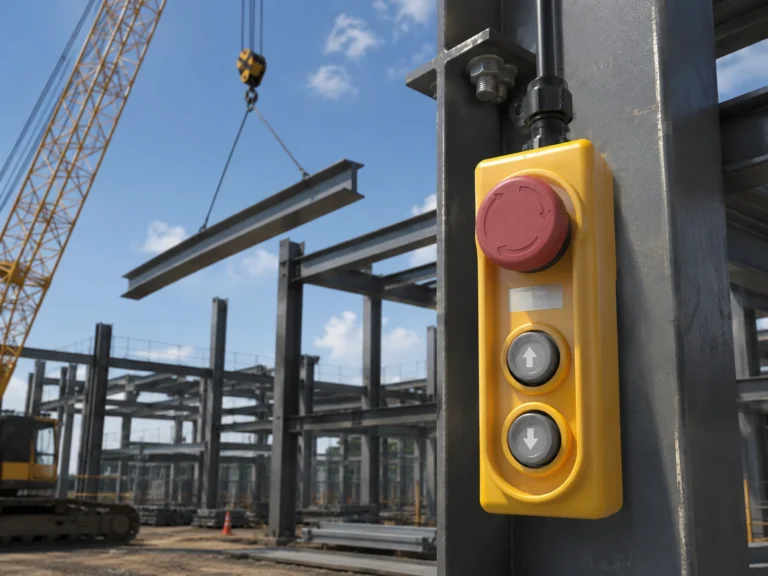
Choosing the right electric hoist push button switch is not just about finding a handheld control with a few buttons. In real lifting applications, the wrong choice can create wiring mismatch, poor operator control, replacement delays, or unnecessary safety risks during hoist and crane operation.
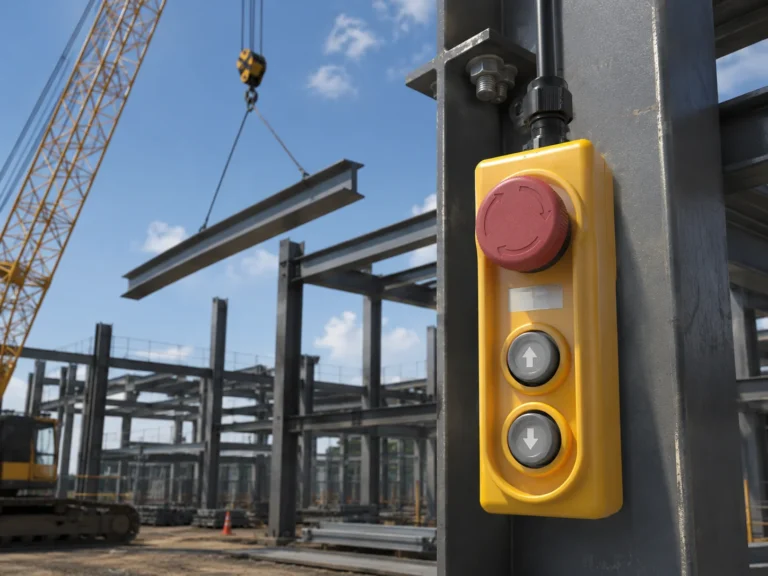
A 2 button pendant control is a hand-held control station designed for simple machine motion, looks simple, but choosing the wrong one can create real problems in hoist and lift applications.
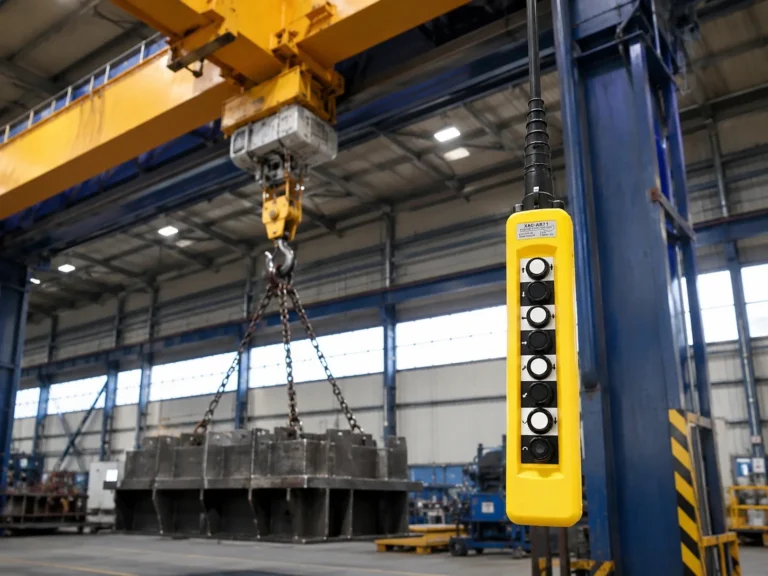
The XAC-A871 is commonly identified as an 8-way or 8 pushbutton pendant control station for single-speed hoisting applications.with a yellow polypropylene enclosure and double-insulated construction.