






Rotary Encoder Knob with Push Button and Detents
Wilmall supplies Rotary Encoder Knob for B2B buyers, wholesalers and exporters, with factory price, OEM/ODM, custom, private label and white label service.
Read More
Optical rotary encoders convert shaft rotation into precise electrical signals using non-contact optical sensing. Wilmall optical rotary encoders deliver proven reliability and advanced performance for a wide range of industrial automation applications.
| الميزة | الوصف |
|---|---|
| Sensing Technology | LED emitter with phototransistor/photodiode |
| Code Disc | Optical code disc / grating disc with fine lines |
| Output Signals | Quadrature channels: A, B, and optional Z (index pulse) |
| Voltage Range | Wide supply voltage compatibility (typ. 5 V to 24 V) |
| Resolution Range | 100 to 5000+ CPR/PPR options |
Wilmall optical rotary encoders combine advanced LED + phototransistor sensing with precision optical code discs, delivering reliable, high-resolution feedback ideal for industrial, robotics, CNC, and automation systems.
Optical rotary encoders mainly come in two types: Incremental Optical Rotary Encoders and Absolute Optical Rotary Encoders. Each type suits different applications and offers unique features.
| الميزة | أداة التشفير التزايدي | أداة التشفير المطلق |
|---|---|---|
| Position Retention | No (requires homing on startup) | Yes (keeps position data always) |
| Output Signals | Quadrature pulses (A/B, optional Z) | Digital position value (absolute) |
| القرار | Depends on pulses per revolution | Depends on bits or lines per rev |
| التطبيقات | Speed, direction sensing, simple position | Complex positioning, multi-turn tracking |
| Power Loss Impact | Position lost, needs recalibration | Position maintained |
For industrial setups, choosing the right optical shaft encoder means weighing whether persistent position data or relative measurement fits your system best.
For mounting and wiring, using proper cable glands improves durability — check out Wilmall’s range of corrosion-resistant metric cable glands to protect your sensor connections in tough environments.

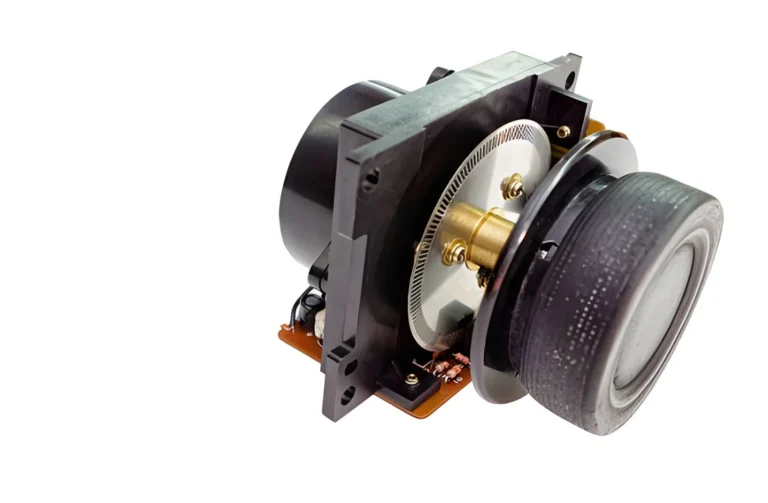
An optical rotary encoder uses a simple yet precise process to measure rotation. At its core, a small LED emitter shines light through a spinning optical code disc or grating disc. This disc has carefully etched patterns—lines or slots—that interrupt the light as it spins.
On the other side, a photodiode or phototransistor detects these light pulses. When the disc rotates, the light gets blocked and passed in a pattern, generating electrical signals. These signals are then processed to produce a quadrature output, which includes two channels—A and B—that are slightly out of phase. This allows the encoder not only to measure speed but also to determine the direction of rotation.
Resolution is key in an optical rotary encoder’s performance. It’s usually expressed in lines per revolution (LPR), Pulses Per Revolution (PPR), or Counts Per Revolution (CPR). The code disc’s line count defines how many pulses the encoder generates per complete turn of the shaft.
Using quadrature decoding, the effective output can be multiplied by four (x4), boosting the resolution from PPR to CPR, which significantly improves position accuracy—an essential feature for precision industrial applications.
For more details on the output signals and performance differences, check out our guide on the مشفر دوار تزايدي.
WilMall optical rotary encoders offer a broad range of technical specs to fit diverse industrial and motion control needs.
| الميزة | Details |
|---|---|
| القرار | 100 to 5000+ PPR/CPR; customizable lines per revolution for high precision |
| Output Types | Open collector, Push-Pull, Line Driver (RS-422), TTL/CMOS compatible |
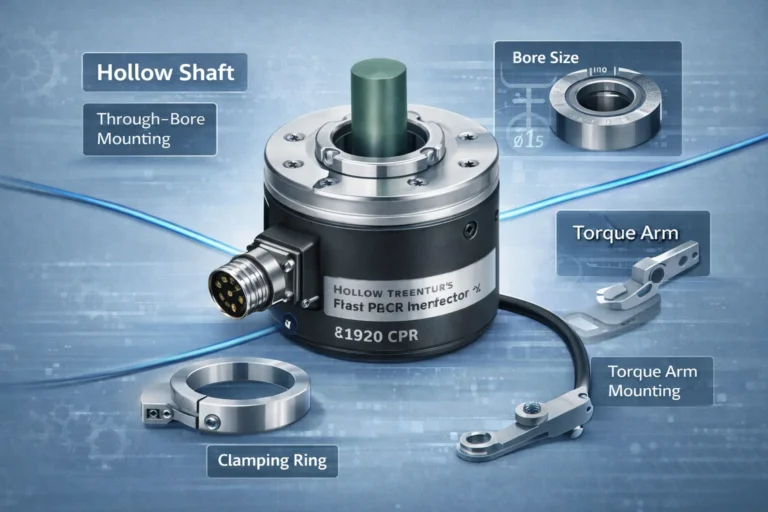
| قطر العمود | Standard sizes from 6mm to 20mm, includes solid shaft and hollow shaft options |
| Mounting Styles | Solid shaft, hollow shaft, panel mount, servo mount |
| جهد الإمداد | Typically 5 V to 24 V DC |
| Current Consumption | Low power use, generally under 50mA |
| الحد الأقصى لعدد الدورات في الدقيقة | Up to 12,000 RPM, suitable for high-speed applications |
| IP Rating | IP54 to IP67, robust for harsh industrial environments |
| Operating Temperature | -20°C to +85°C typical range |
| Shock & Vibration | High resistance designed for industrial shock and vibration levels |
| Signal Channels | A/B quadrature signals + optional Z index pulse for zero reference |
| Cable/Connector Options | MS connectors, M12 connectors, and custom cables available |
These specs ensure compatible use with a wide variety of machinery and control systems, making WilMall optical shaft encoders ideal for industrial rotary position sensing. For connectors that fit your application, explore our range of reliable aviation connectors designed to withstand industrial environments.
Understanding resolution is key when selecting an optical rotary encoder. The main terms you’ll come across are CPR (Counts Per Revolution), PPR (Pulses Per Revolution)و lines per revolution on the optical code disc. Here’s how they relate:
For quadrature rotary encoders, you can multiply the PPR by 4 to get the effective CPR, thanks to the four states generated in the A and B signal outputs. This means a 1000 PPR encoder actually delivers 4000 counts per revolution, drastically improving positioning accuracy.
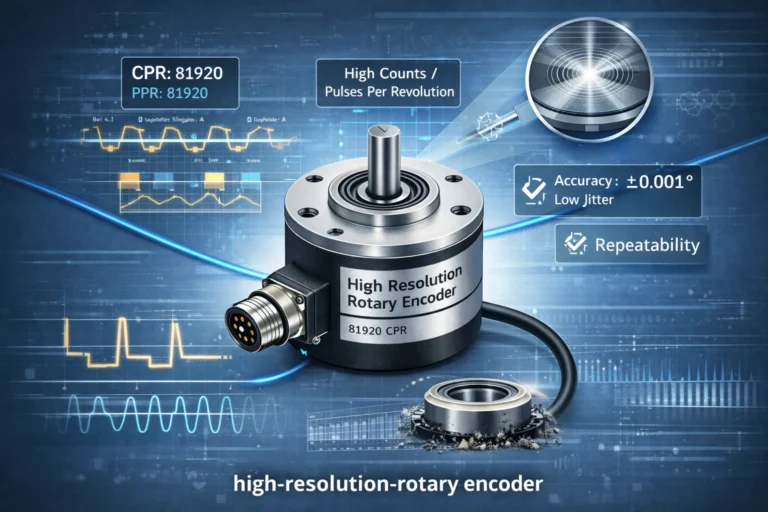
Wilmall optical rotary encoders offer high-resolution models going beyond 5000 CPR, ideal for applications requiring extreme precision in motor control, robotics, or CNC machinery. The higher the CPR, the smoother and more accurate your position feedback will be—critical in demanding industrial environments.
Choosing the right resolution depends on your specific needs, balancing accuracy, speed, and signal processing requirements to get the best performance.
Explore our full range of high CPR rotary encoders for precision solutions tailored to your project. For more detailed info on absolute encoder options, check out our guide on absolute rotary encoders.
Optical rotary encoders from Wilmall are designed to fit a wide range of applications requiring precise position and speed feedback. In industrial automation, they are essential for accurate motor feedback and control in conveyor systems, robotics, and CNC machines. These high resolution rotary encoders provide reliable, real-time data that keeps complex machinery running smoothly and efficiently.
In sectors like packaging equipment and elevators, optical encoders ensure precise positioning and safety by monitoring shaft rotation with high accuracy. They’re also widely used in wind energy systems for blade angle monitoring and performance optimization. The medical industry relies on these encoders too, where precise motion control is critical for devices such as surgical tools and diagnostic machines.
For hobbyists and prototyping, optical rotary encoders are popular in Arduino projects and other DIY motion control applications, thanks to their easy integration and clear quadrature output signals. Whether you’re developing a custom motor controller or automating a small project, these encoders offer dependable position sensing.
Explore more about our robust range of optical rotary encoders designed for these demanding environments and applications at Wilmall’s industrial rotary position sensor products.
Wilmall offers a wide range of optical rotary encoders to fit various industrial and automation needs. Our product lineup includes different incremental optical rotary encoders and absolute optical rotary encoders with options for single-turn and multi-turn capabilities. Here’s a quick overview of key specs by series:
| Model Series | النوع | Resolution (CPR/PPR) | Shaft Size (mm) | نوع الإخراج | نمط التركيب |
|---|---|---|---|---|---|
| WM-OptiInc-1000 | Incremental | 1000 CPR | 6, 8, 10 | Open Collector, TTL | Solid shaft, panel |
| WM-OptiAbs-ST | Absolute Single-turn | Up to 4096 positions | 8, 10 | Push-pull, RS-422 | Hollow shaft, servo mount |
| WM-OptiAbs-MT | Absolute Multi-turn | 14-bit to 22-bit | 10 | Line driver, TTL/CMOS | Solid shaft, flange |
To pick the right Wilmall optical rotary encoder for your project, consider these key factors:
Wilmall’s product range and customization options help match nearly any industrial application, from CNC machines to robotics and automation lines.
For additional mounting hardware or connector options, you might find our SD20 series aviation connectors useful for secure and reliable connections in demanding environments.
By evaluating these factors, you can confidently select the ideal optical rotary encoder from Wilmall that balances performance, durability, and cost-effectiveness.
Proper mounting and installation are key to getting the best performance from your optical rotary encoder. Follow these simple steps to ensure accurate position sensing and long-term reliability:
Using the right installation accessories like brackets and coupling adapters ensures longevity of your optical rotary encoder and stable output in industrial environments. This solid setup maximizes the benefits of high resolution and precise feedback for your motion control or automation needs.
Wilmall optical rotary encoders stand out for their superior build quality and competitive pricing, delivering excellent value for industries that demand precision and durability. We ensure fast delivery to keep your projects on schedule without compromise.
| الميزة | المزايا |
|---|---|
| High Resolution | Up to thousands of CPR/PPR for precise position feedback |
| Customization Options | Tailored resolution, shaft sizes, and output types to fit your application |
| Reliable & Durable | Tested for vibration, shock, and harsh industrial environments |
| Fast Turnaround | Quick delivery to support your production timelines |
Our encoders use advanced optical sensing with LED emitters and photodiode/phototransistor technology, ensuring accurate, non-contact measurement that reduces wear and extends sensor life. Whether you need incremental or absolute optical rotary encoders, our range covers a broad spectrum of industrial needs.
Choosing Wilmall means you get a partner who understands the demands of industrial automation, robotics, CNC machines, and other precision motion control sectors. We back every product with rigorous testing to guarantee dependability in the field.
For tailored solutions, explore our options and speak with our experts who can help you choose the right encoder based on your resolution, mounting style, and output requirements. Check out related resources on selecting pendant control stations and other industrial sensors to optimize your setup.
Explore high-quality options with Wilmall for your optical shaft encoder needs, combining precision, cost-effectiveness, and reliability all in one package.
CPR (Counts Per Revolution) usually refers to the number of discrete counts detected per full rotation when using quadrature decoding (often 4× the PPR). PPR (Pulses Per Revolution) is the number of pulses generated per revolution by the encoder’s output channel. Simply put, CPR = PPR × 4 for incremental optical rotary encoders with quadrature outputs, giving you a higher effective resolution.
Incremental encoders provide relative position data with signals like A/B quadrature and are simpler and cost-effective for speed or position tracking when power loss position retention isn’t critical. Absolute encoders provide a unique position value at power-up, either single-turn or multi-turn, essential for precise positioning and applications needing immediate position awareness without re-homing.
Yes, Wilmall encoders support industry-standard outputs such as open collector, push-pull, line driver (RS-422), TTL, and CMOS compatible signals. This makes them a versatile fit for most industrial rotary position sensor applications and motion control systems.
Absolutely. Wilmall offers flexible customization options on resolution—from low to high CPR/PPR values—and various shaft diameters or mounting styles to suit your installation needs.
If you want more tips on selecting proximity and position sensors, check out our detailed proximity switch sensor guide, perfect for complementing your rotary encoder setup.
To get the most out of your optical rotary encoder, having the right related products and accessories is key. We offer a variety of cables and connectors designed to ensure reliable signal transmission and easy installation. For example, our rugged SD20 series connectors provide secure electrical connections that fit perfectly with industrial rotary position sensors.
Mounting hardware like brackets, couplings, and servo flanges are also available to help stabilize your encoder setup in any environment, whether solid shaft or hollow shaft optical rotary encoder types.
If you’re looking for alternatives or want to compare technologies, we provide complementary sensors such as magnetic rotary encoders that offer a different approach to position sensing, ideal for harsh environments where optical systems might face challenges.
By pairing your optical encoder with the right accessories, installation becomes smooth, and long-term performance stays reliable. For complete solutions, check our mounting options and cable glands collections, including corrosion-resistant models that suit demanding industrial settings.
Access all the essential optical rotary encoder resources you need in one place. We offer detailed datasheets, precise CAD models, and clear manuals to help you select, install, and maintain your encoders with ease. For deeper insights into choosing the right encoder, our whitepapers on incremental optical rotary encoder and absolute optical rotary encoder selection provide valuable tips and comparisons.
Whether you’re working on an industrial automation project or integrating a high resolution rotary encoder into your system, these resources ensure you have the technical details at your fingertips. For specific application guidance and installation advice, download the files directly from our Wilmall product pages, which include helpful diagrams and installation notes.
Explore these resources now to make the best choice and optimize your optical shaft encoder setup. For additional related hardware like connectors, check options like the Aviation Connector vs Cable Connectors guide to complement your sensor installation.
Ready to improve your motion control system with a high-resolution optical rotary encoder? Whether you need an incremental optical rotary encoder or an absolute optical rotary encoder, Wilmall offers reliable, precision solutions built for industrial environments.
Explore our range and upgrade your automation with Wilmall’s trusted optical rotary encoders. For instance, check out our GLS38A05 incremental rotary encoders for industrial automation applications to get started.