







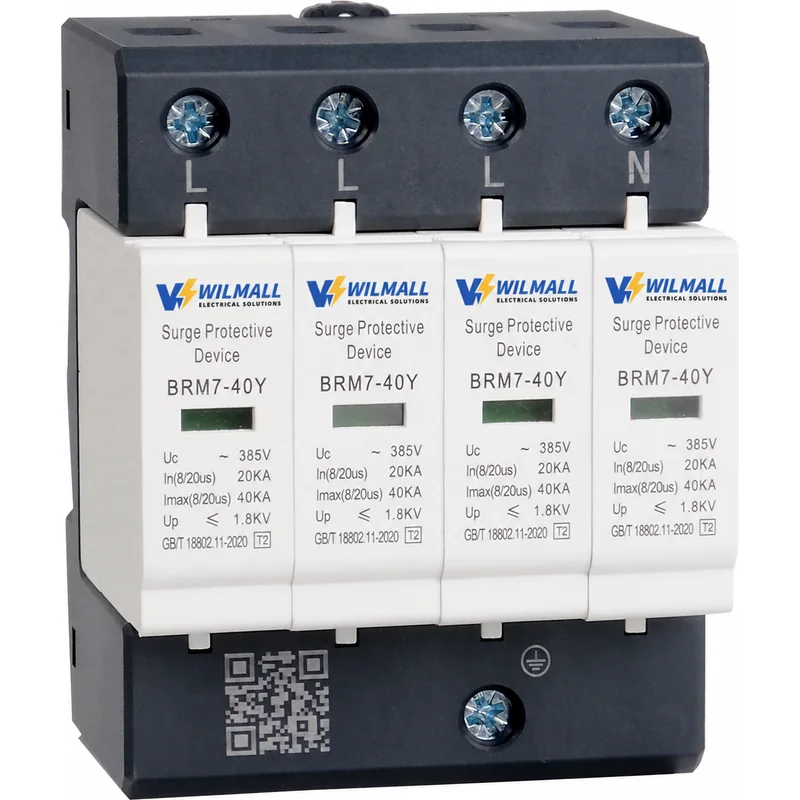
BRM7-40Y Type 2 Surge Protector for 385 V Boards
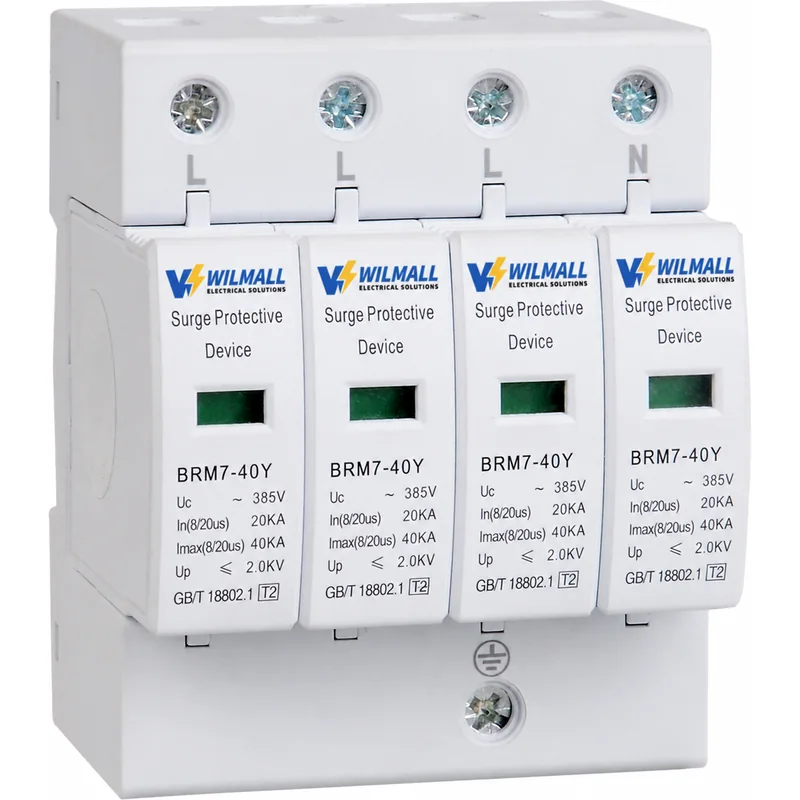
Surge protection works as a staircase, and every step has to be in the right place. A device at the service entrance takes the first, largest hit; a device further downstream takes what survives that first stage and clips it again, closer to the equipment. The BRM7-40Y is the second step — a Type 2 surge protector for 385 V systems, built into a four-pole module that clips onto a DIN rail inside a sub-distribution board.
Its nominal discharge current is 20 kA on an 8/20 µs waveform and its maximum discharge current is 40 kA, with a voltage protection level of 2.0 kV. Those figures place it in the class of device that protects a floor panel, a machine control cabinet or a small commercial distribution board, rather than the main incoming board of a factory.
Two Stages, Two Different Jobs
The distinction between a Type 1 and a Type 2 device is not marketing language; it follows from where the device is installed and what waveform it is expected to survive. A Type 1 unit sits at the origin of the installation, where part of the lightning current may arrive as a direct partial discharge with a 10/350 µs shape. It needs a high impulse current rating and an arc-quenching structure that can handle that energy in one event.
A Type 2 surge protector sits downstream, behind at least some length of cable. By the time the pulse reaches it, the waveform has been stretched and reduced by the impedance of the conductors, and the device is asked to absorb a series of 8/20 µs impulses over its life rather than one enormous strike. Asking a Type 2 module to do a Type 1 job is a common specification error, and it usually shows up as a failed cartridge after the first storm of the season.
How a 40 kA Cartridge Absorbs an Impulse
Conduction starts within nanoseconds
A metal oxide varistor is a voltage-dependent resistor. Below its threshold it behaves like an open circuit and the installation runs undisturbed. Once the voltage across it climbs past that threshold, its resistance collapses and the impulse is diverted to earth through the disc rather than through the load. The transition takes nanoseconds, which is fast enough that the downstream equipment never sees the full peak.
Then the follow current has to be cleared
During the moment of conduction, current from the supply itself also flows through the varistor. That follow current is what a Type 2 device has to interrupt once the impulse has passed, and it is the reason the internal disconnection mechanism matters as much as the disc. The varistor blocks again as the voltage falls back to normal, and the circuit returns to its quiescent state.
The thermal link is the last line of defence
A varistor that has absorbed too many events, or that has been subjected to a sustained overvoltage, can fail into a low-resistance condition. Left alone, that would mean continuous current through a failed element and eventually a fire. A thermal link soldered against each disc opens the circuit first, and the indicator on the front changes colour so the condition is visible during a routine walk-round.
Why Four Poles
In a TN-S system the neutral is a separate conductor that carries current in normal service, and a surge between phase and neutral has to be diverted as readily as a surge between phase and earth. A four-pole module puts a varistor across each phase-to-neutral path and each phase-to-earth path, so its performance does not rest on the neutral-to-earth bond being perfect at the moment of the event.
In a TT system, where the installation earth and the supply neutral are separated, the neutral still needs protection because it is part of the surge path through connected equipment. A Type 2 surge protector supplied in three-pole form leaves that path unguarded. For three-phase four-wire boards — which is what most commercial and light industrial distribution looks like — the four-pole version is the sensible default.
Decoding the Label
The values printed on each pole of a Type 2 surge protector tell you how the device will behave before you ever connect it. Uc is the maximum continuous operating voltage, and 385 V is the correct grade for a 230/400 V system because it leaves room for the supply running a little high without putting the varistor into continuous conduction. In is the impulse the device can absorb repeatedly, Imax is the single largest impulse it will survive, and Up is the residual voltage that appears at the terminals while it conducts — 2.0 kV here, which is the number to compare against the withstand rating of the equipment being protected.
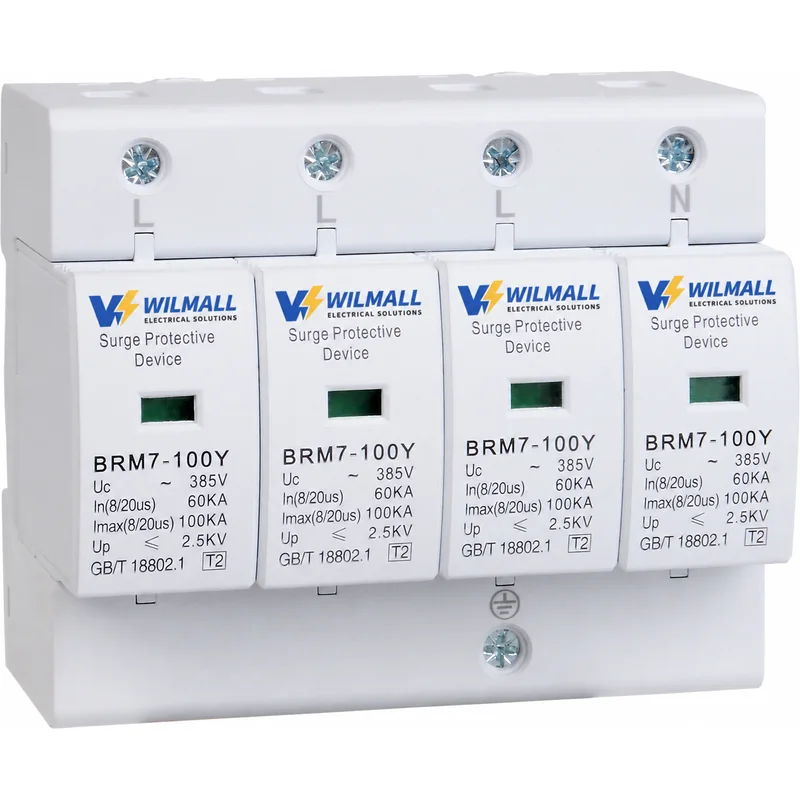
Two housing colours appear in the range. The light grey body and the dark grey body are the same electrical product with different front covers, which lets a distributor keep one stock line while matching the look of different panel brands. Both carry the same marking and the same T2 classification.
Replacing a Cartridge Without Disturbing the Wiring
The varistor cartridges plug into a fixed base, so a spent module comes out with the base and the field wiring left in place. That matters on a live site: there is no need to identify, disconnect and re-terminate four conductors during a maintenance window, and no risk of a conductor being put back on the wrong terminal afterwards. The replacement is a straight push fit, and the indicator on the new cartridge gives immediate confirmation that it is seated and healthy.
Coordinating With What Sits Upstream
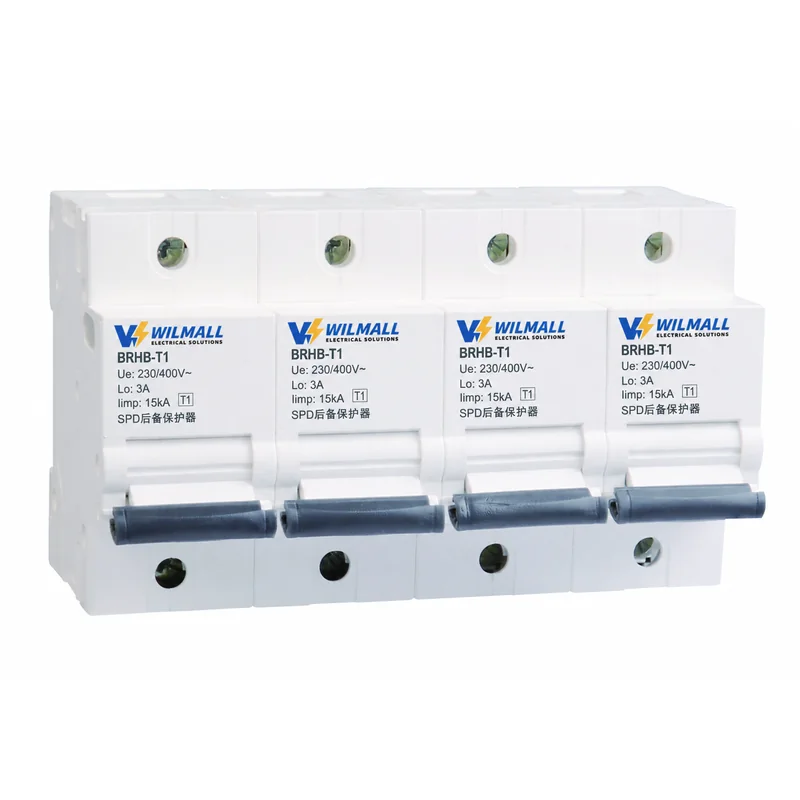
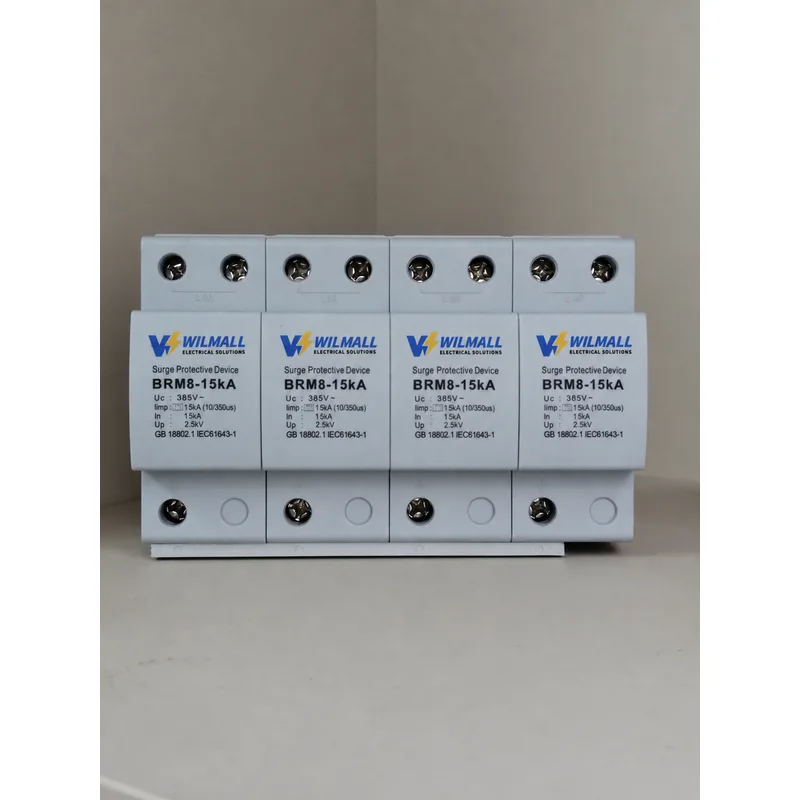
A surge protector needs a short-circuit protective device ahead of it, and the choice of that device is not arbitrary. A miniature circuit breaker chosen only for its current rating can trip on the impulse itself, taking the protected circuit offline precisely when the surge arrives. A dedicated SPD backup protector is built to ride through the impulse and still clear a genuine short circuit, which is why it belongs in series with this module. Where a Type 1 stage is being fitted at the origin of the same installation, the BRM8 Type 1 device covers the upstream position and the two are selected as a coordinated pair.
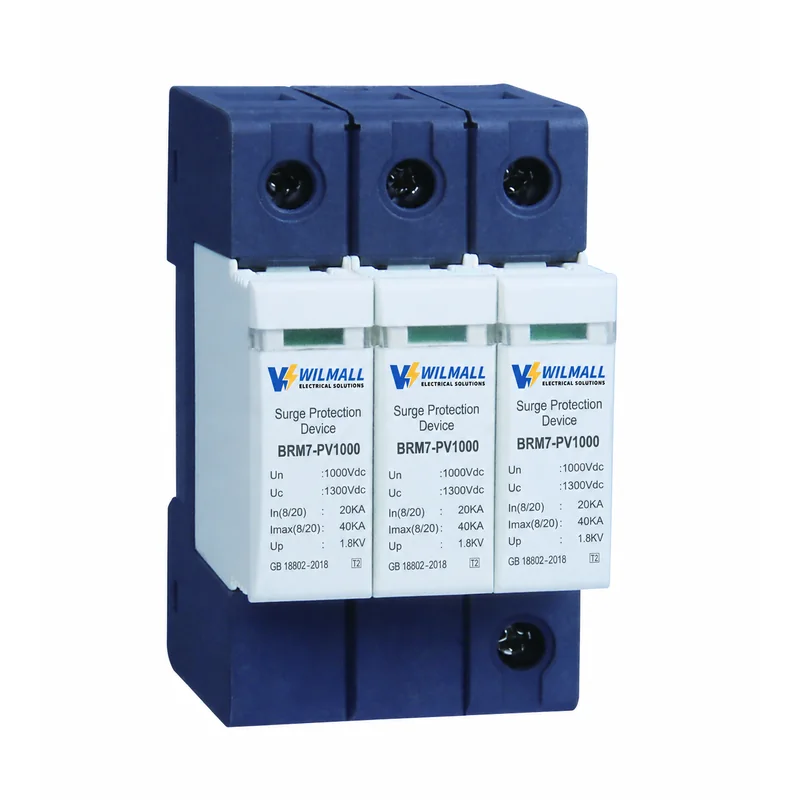
On the DC side of a photovoltaic plant the same logic applies with different hardware, and the BRM7-PV1000 direct current device handles the string side of that boundary.
Panel Fit and Connection Details
This Type 2 surge protector occupies four standard 18 mm ways on a 35 mm DIN rail. Conductors from 6 to 25 mm² are accepted at the terminals, and the earth connection should be a minimum of 16 mm² taken to the nearest equipotential bar. Leads should be kept short and straight; a coiled or looped earth conductor adds inductance that raises the effective clamping voltage at the equipment, which quietly undoes the benefit of fitting the device. The ambient range is −40 to +80 °C, and the enclosure is rated IP20, so the unit belongs inside a closed board rather than in an exposed outdoor position.
Supply Terms for Panel Builders
Every Type 2 surge protector in this range is produced in our own plant, tested before packing and can be marked with a customer’s own brand on the front cover for volume orders. Cartridges are available as separate spares so that a panel builder can supply the base with the first batch and restock consumables later without re-ordering the full assembly. Send the board voltage, the number of ways available and the annual quantity, and the model, marking and packing list are settled in one reply.
For BRM7-40Y price, datasheet, spare cartridge or OEM supply information, contact our sales team with the panel specification.
الأسئلة الشائعة
When is a Type 2 device enough on its own?
It is enough where the board is fed from a service entrance that already has a Type 1 device, or where the building has no direct strike exposure and the incoming cable run is long enough to attenuate the impulse. If the board is the first point of entry in a building with an overhead supply, a Type 1 stage belongs in front of it.
What is the difference between the 40Y and the 100Y?
Discharge capacity. The 40Y carries 20 kA nominal and 40 kA maximum with a 2.0 kV protection level; the 100Y carries 60 kA nominal and 100 kA maximum with a 2.5 kV level. The 100Y suits a board with a large connected load or a location with frequent storm activity.
Can a spent cartridge be replaced on site?
Yes. The cartridge plugs into a fixed base, so the field wiring stays where it is and only the module is exchanged. That avoids re-terminating four conductors during a maintenance window and removes the risk of a conductor going back on the wrong terminal.
Do I need a dedicated backup device ahead of it?
A short-circuit protective device is required, and a miniature breaker chosen only by current rating may operate on the impulse itself. A dedicated backup unit is built to ride through the impulse and still clear a failed varistor, which is why it is the recommended companion rather than an optional extra.
Why is 385 V the right voltage grade for a 230/400 V system?
Because the supply is allowed to run above its nominal value without putting the varistor into continuous conduction. A device rated at exactly 400 V would sit too close to its knee point and would age prematurely on a supply that runs a little high.
Are the two housing colours different products?
No. The light grey and the dark grey front covers sit on the same electrical module with the same marking and the same classification. The choice is cosmetic, which lets a distributor keep one stock line while matching the look of different panel brands.
Request Quote
Tell us your specifications, quantity, or application scenario and we will reply with a tailored quote.