AC Contactor Market: Standards, Segments and Sourcing Regions
A structural map of the AC contactor market: the IEC, UL and NEMA standards worlds, four demand segments, and what each sourcing region is actually good at.
Read More
AC-3 is the utilization category for squirrel-cage motor duty: starting the motor and switching it off while it is already running. On the nameplate it tells you the rated operational current Ie the contacts can make and break under exactly that duty — and it is almost always lower than the thermal current printed next to it. A “32 A” contactor may only carry 32 A in AC-3 at 380 V, driving a 15 kW motor, while the same frame carries far more in AC-1.
This page is the reference sheet for that number: what AC-3 means, why it is different from every other category on the label, the full 9 A to 630 A rating chart, and the three steps that take you from a motor nameplate to the right frame. If you need the full selection procedure instead, the contactor sizing guide walks it end to end.
IEC 60947-4-1 splits switching duty into utilization categories, and each category carries its own making and breaking capacity requirement. AC-3 covers the most common industrial case: a squirrel-cage motor started direct-on-line, then switched off while running at speed.
The physics behind the numbers is asymmetric. Making happens against a locked or nearly locked rotor, where inrush current reaches 5 to 8 times the rated current — so the contactor must close against 8 × Ie without welding. Breaking under AC-3 happens while the motor is spinning and acting as a generator, so the current at the instant of separation is lower — the standard requires 6 × Ie. That asymmetry (8 in, 6 out) is the signature of AC-3, and it is why an AC-3-rated contactor is not automatically fit for plugging or inching duty.
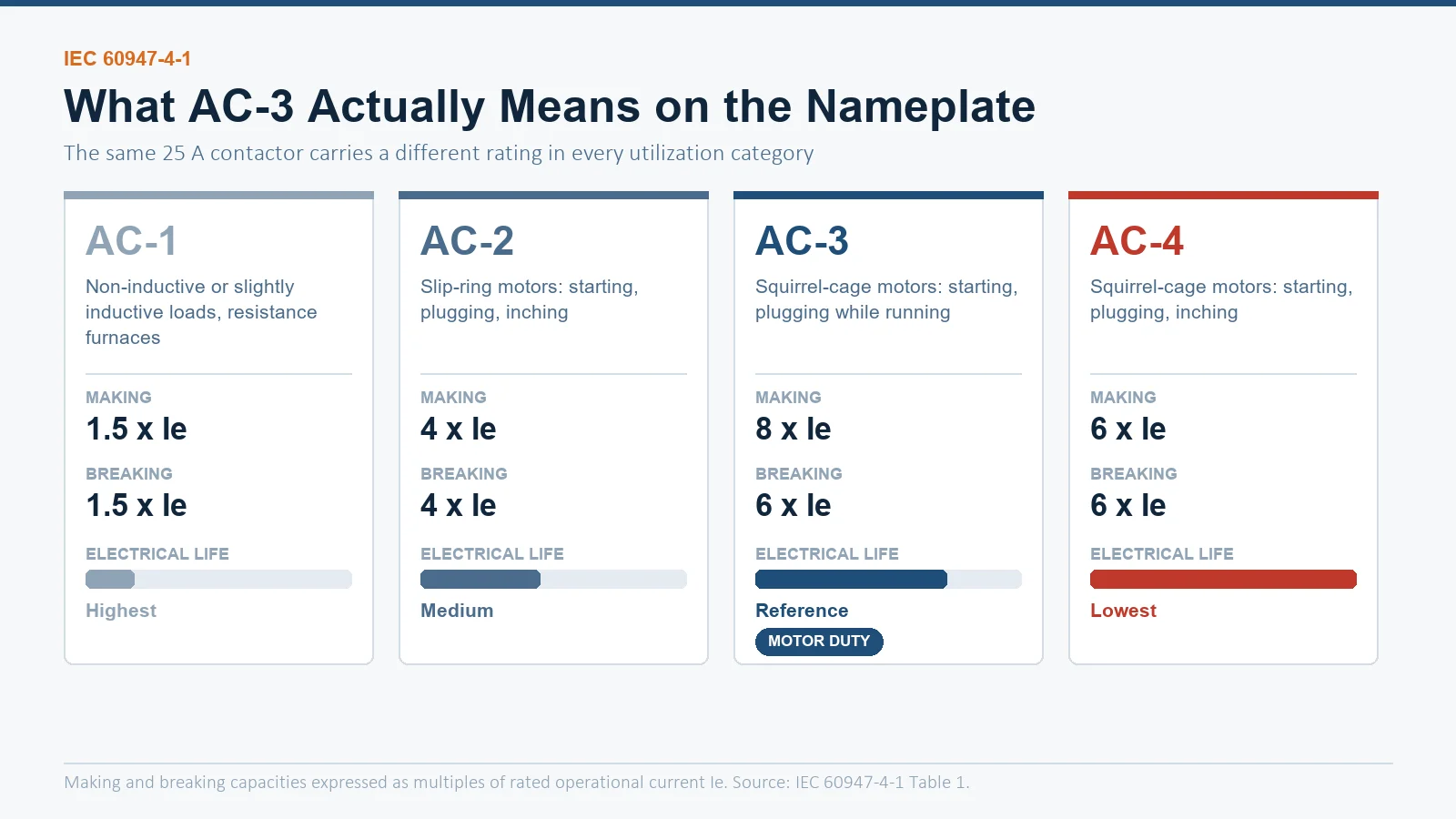
| Category | Duty | Typical load | Making | Breaking |
|---|---|---|---|---|
| AC-1 | Non-inductive or slightly inductive | Heaters, resistance furnaces, distribution | 1.5 × Ie | 1.5 × Ie |
| AC-2 | Slip-ring motor: start, plug, inch | Winding machines, hoists with slip-ring motors | 4 × Ie | 4 × Ie |
| AC-3 | Squirrel-cage: start, break while running | Pumps, fans, compressors, conveyors | 8 × Ie | 6 × Ie |
| AC-4 | Squirrel-cage: start, plug, inch | Hoists, cranes, frequent jogging | 6 × Ie | 6 × Ie |
The practical consequence shows up in electrical life. The same contactor switching the same motor lasts roughly ten times longer in AC-3 than in AC-4, because AC-4 interrupts current at every speed from zero upward. If your application inches or plugs more than occasionally, do not buy a bigger AC-3 frame as a workaround — read the AC-3 vs AC-4 comparison and size for the real duty.
A contactor datasheet prints two currents that buyers routinely confuse:
For small frames the two numbers coincide, which is why the confusion survives. From 40 A upward they diverge: a frame with Ith = 80 A may carry Ie = 50 A in AC-3 at 660 V, because the arc energy at break — not the steady-state heat — sets the limit. The rating chart below exists precisely so you never have to guess which of the two a supplier has quoted.
The chart lists the standard IEC frame ladder — the same sizes used by the CJX2 series and by every major IEC family — with rated operational current in AC-3 and the matching motor power at 220 V, 380 V and 660 V.
| Frame | Ie AC-3 (A) | kW @ 220 V | kW @ 380 V | kW @ 660 V |
|---|---|---|---|---|
| 9 A | 9 | 2.2 | 4 | 5.5 |
| 12 A | 12 | 3 | 5.5 | 7.5 |
| 18 A | 18 | 4 | 7.5 | 10 |
| 25 A | 25 | 5.5 | 11 | 15 |
| 32 A | 32 | 7.5 | 15 | 18.5 |
| 40 A | 40 | 11 | 18.5 | 22 |
| 50 A | 50 | 15 | 22 | 30 |
| 65 A | 65 | 18.5 | 30 | 37 |
| 80 A | 80 | 22 | 37 | 45 |
| 95 A | 95 | 25 | 45 | 55 |
| 115 A | 115 | 30 | 55 | 75 |
| 150 A | 150 | 40 | 75 | 90 |
| 185 A | 185 | 45 | 90 | 110 |
| 225 A | 225 | 55 | 110 | 132 |
| 265 A | 265 | 75 | 132 | 160 |
| 330 A | 330 | 90 | 160 | 200 |
| 400 A | 400 | 110 | 200 | 250 |
| 500 A | 500 | 132 | 250 | 315 |
| 630 A | 630 | 160 | 315 | 400 |
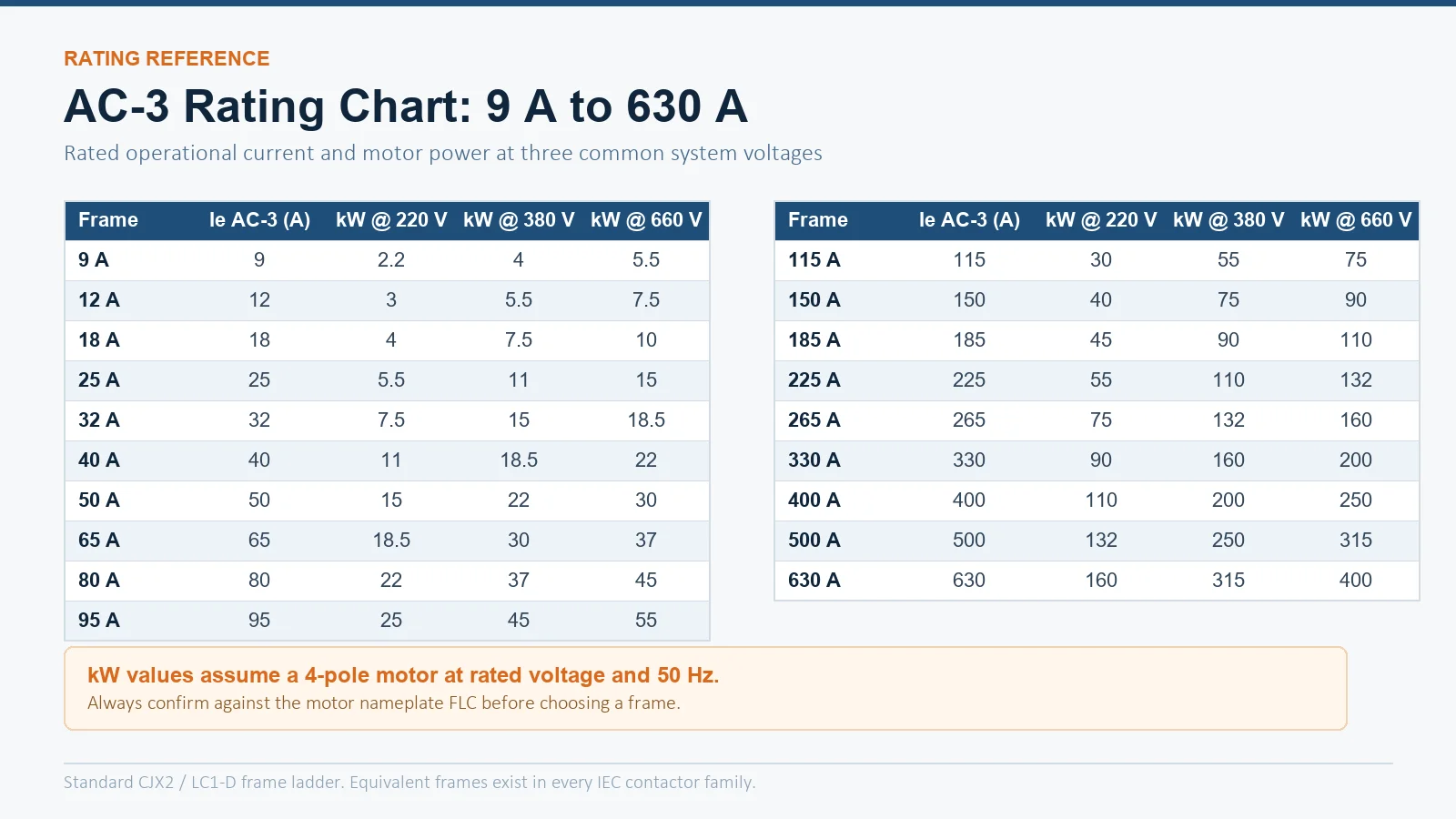
Two reading rules keep this table safe. First, the kW columns assume a 4-pole motor at the stated voltage — a 6-pole motor of the same kW draws more current and needs the next frame up. Second, the current column is what actually selects the contactor: always verify against the motor’s full load current, never against its kW alone.
The nameplate gives both. Current (FLC) is the selection quantity because it already encodes the voltage, pole count, efficiency and power factor of that specific motor. A 15 kW 4-pole 380 V motor draws roughly 30 A; the same 15 kW at 220 V draws about 52 A and lands two frames higher.
Find the smallest frame whose Ie in AC-3 at your system voltage meets or exceeds the motor FLC. IEC practice is to select so that Ie ≥ FLC, with a margin for voltage tolerance handled by the network, not by oversizing the frame. If the supply dips below 0.85 × coil voltage during starting, fix the supply — the contactor will drop out regardless of its current rating, as explained in the coil voltage guide.
IEC frames are built around up to roughly 15 starts per hour in AC-3. A crusher or hoist cycling far more often lives partly in AC-4 territory even if it never plugs deliberately. Count starts per hour before you commit; if the number is high, derate or move to a contactor rated for the real duty — the derating guide covers temperature, altitude and dust on top of this.
Nameplate: 15 kW, 380 V, 4-pole, FLC 29.5 A, direct-on-line start, 6 starts per hour. The 32 A frame (Ie = 32 A AC-3, 15 kW @ 380 V) meets the duty with the least margin — and in practice it is exactly the frame this motor gets. The 25 A frame is rejected on current, not on kW. The compressor runs unattended, so the buyer also specifies an overload relay set to the nameplate FLC rather than a manual reset in a locked room.
| Mistake | What happens | Prevention |
|---|---|---|
| Selecting by kW at the wrong voltage | Undersized frame on 220 V or 660 V systems | Use FLC against Ie, confirm kW column voltage |
| Treating Ith as the AC-3 rating | Frame carries the load but welds on start | Quote the category with the current, every time |
| Using AC-3 frames for jogging duty | Contacts erode in weeks instead of years | Count starts per hour; check the AC-4 life curve |
| Ignoring ambient above 40 °C | Nuisance trips and premature coil failure | Apply the derating factors for heat and altitude |
| Assuming one brand’s frame equals another’s | Substitution fails on terminal spacing or coil | Use a cross-reference and verify coil and mounting |
The last row matters more than it looks: frame numbers are standardized, but terminal geometry, coil voltages and auxiliary contact arrangements are not. The cross-reference guide and the model number decoder cover the details a datasheet headline hides, and the terminal numbering guide explains what A1, A2, 13/14 and 95/96 mean once the contactor is in the panel.
For squirrel-cage motors started and stopped normally, yes — AC-3 is the motor-duty category. But the motor rating a contactor can handle still depends on voltage and poles, so “30 kW contactor” is meaningless without the voltage. Quote it as “30 kW at 380 V, AC-3”.
Yes, and with headroom: AC-1 duty is gentler than AC-3, so any AC-3-rated frame carries its AC-1 current comfortably — often a size or two higher than its AC-3 value. The reverse is never true.
Because the current limit is fixed by the contacts, but power scales with voltage. At 660 V the same 95 A moves proportionally more power — 55 kW versus 25 kW at 220 V — for identical contact stress.
Not the rating itself, but the electrical life. Above roughly 15 starts per hour, or with any plugging, you are operating partially in AC-4 and the frame’s life expectancy drops by an order of magnitude. Size for AC-4 or accept a shorter service interval deliberately.
They are a pair: Ie is only valid at the stated Ue. A contactor may carry 50 A in AC-3 at 380 V but only 35 A at 690 V, because higher voltage stretches the arc after break. Always read Ie and Ue together on the nameplate.
Look for the rating block printed on the side of the housing: it lists Ie per category at two or three voltages. If a supplier cannot produce that block photo for the exact model, treat the quote as unverified — the same discipline that applies to any IEC contactor purchase from a new source.