AC Contactor Market: Standards, Segments and Sourcing Regions
A structural map of the AC contactor market: the IEC, UL and NEMA standards worlds, four demand segments, and what each sourcing region is actually good at.
Read More
Roughly a third of “AC contactor manufacturer” quotes in cross-border trade come from companies that never touch a production line. They buy finished goods, re-box them, and answer your engineering questions one day late. The product may still be fine — but you pay a margin for it, wait longer for anything non-standard, and inherit no control over certificates, spare parts or design changes.
This page gives you six discriminators that separate a real factory from a trader, a twelve-point pre-order checklist, and the quotation structure that reveals where a supplier actually sits. It complements the modular contactor sourcing guide, which covers supplier archetypes for the DIN-rail segment specifically.
For a standard 9 A to 95 A frame in a catalog box, a competent trader is a workable source: stock is deep, prices are competitive, and the product needs no interpretation. The risk concentrates in four situations where the intermediary layer fails:
Each test below can be run before you place a purchase order, and most need nothing more than a video call and a document request. One failed test proves nothing — three or more together almost always mean you are talking to an intermediary.
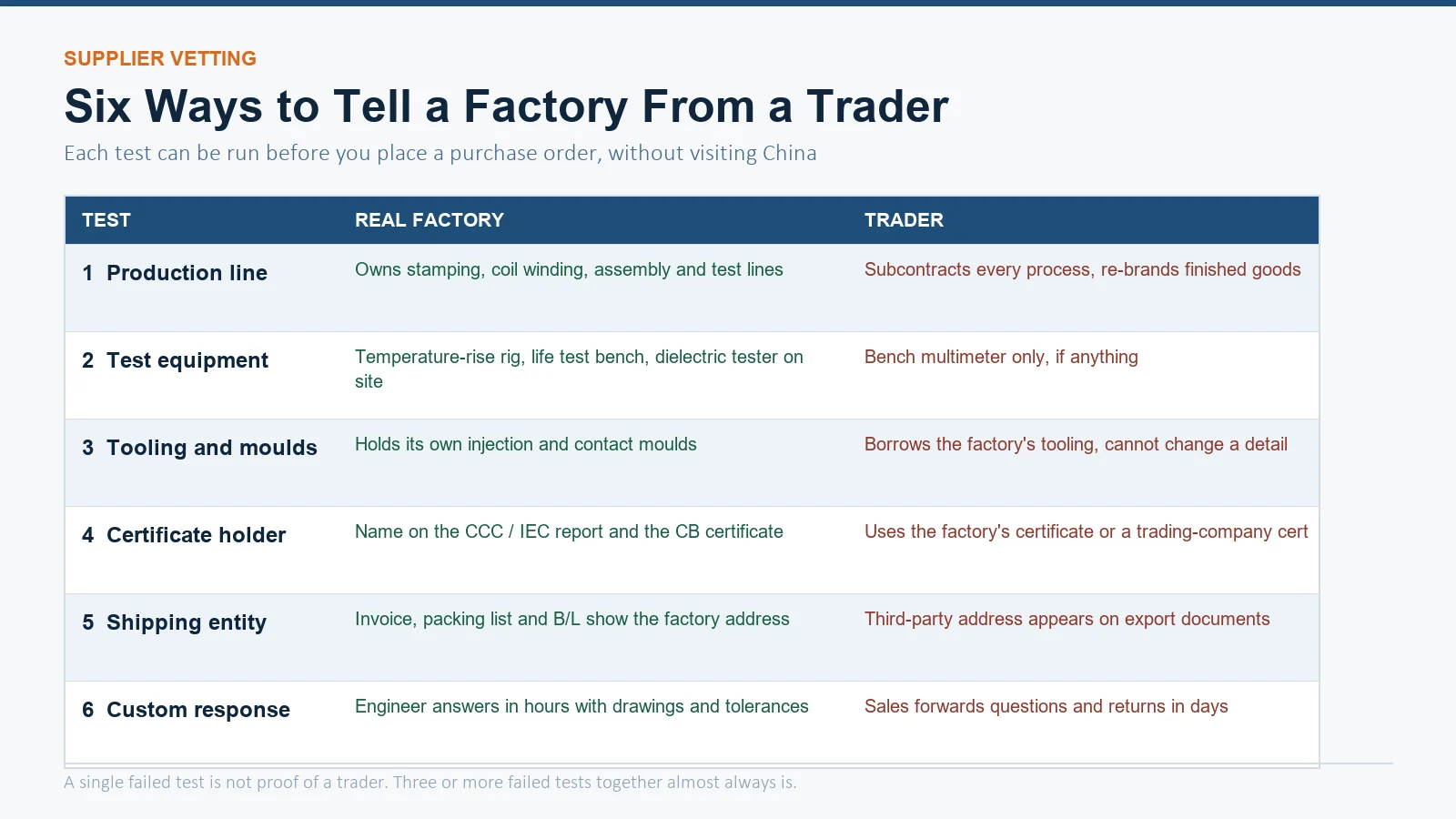
| # | Test | Real factory | Trader |
|---|---|---|---|
| 1 | Production line | Owns stamping, coil winding, assembly and test lines | Subcontracts every process, re-brands finished goods |
| 2 | Test equipment | Temperature-rise rig, life test bench, dielectric tester on site | Bench multimeter only, if anything |
| 3 | Tooling and moulds | Holds its own injection and contact moulds | Borrows the factory’s tooling, cannot change a detail |
| 4 | Certificate holder | Named on the CCC / IEC report and CB certificate | Uses the factory’s certificate or a trading-company cert |
| 5 | Shipping entity | Invoice, packing list and B/L show the factory address | Third-party address appears on export documents |
| 6 | Custom response | Engineer answers in hours with drawings and tolerances | Sales forwards questions and returns in days |
Ask for the CCC certificate (for the domestic Chinese market) or the IEC type test report and CB certificate (for export), and read the holder field, not the test lab field. A certificate naming “Yueqing X Import & Export Co.” tells you the same thing test 6 does, just earlier. If the holder is a different factory, ask directly whose production line makes your product — the answer tends to end the ambiguity. This matters doubly for the European market, where CE is a self-declaration and the technical file behind it is only as strong as the company that signed it, as covered in the brand and certification comparison.
Use this as the evidence list for a first order from a new supplier. Six items can be verified remotely from documents; the other six need photos, video or a third-party inspection — all routine before a container commitment.
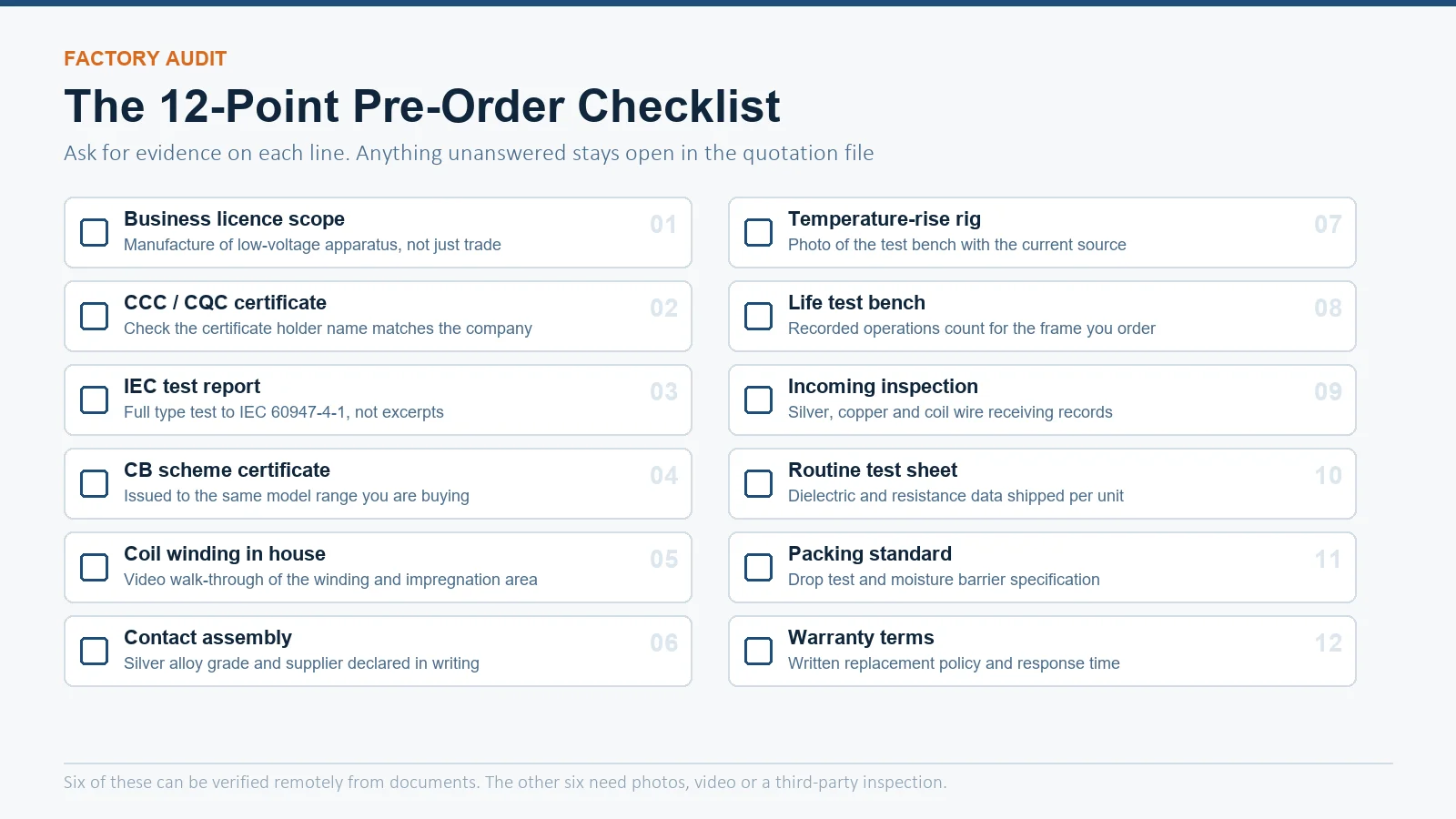
Items 5, 6 and 9 correlate most strongly with what you will find in the field. Silver grade decides contact life — the contact material guide explains why a 30 % cheaper quote usually means a thinner or lower-grade tip — and incoming inspection records tell you whether the factory controls its own metallurgy or simply assembles whatever arrives.
A supplier’s price sheet has a structure, and the structure discloses the role. Ask for a quotation on one mid-range frame, itemized, and sort the answers into three tiers:
| Quotation feature | Factory tier | Trader tier |
|---|---|---|
| Price basis | FOB from a named port near the plant, negotiable on volume | Fixed “delivered” price, little volume sensitivity |
| MOQ | Tied to a production batch (often 200–500 pcs per frame) | Tied to warehouse stock (any quantity, any mix) |
| Lead time | 3–6 weeks, quoted from production scheduling | “In stock” today, vague after the first order |
| Sample policy | Samples from the line, sometimes with test data attached | Samples from a distributor shelf, no data |
| Custom quote | Engineering response with drawings inside days | “Let me ask the factory” |
None of these traits is dishonest. The failure mode is mismatch: buyers who need customization, certificate continuity or failure analysis paying an intermediary price and getting none of the direct-line benefits. If your requirement is purely standard frames at moderate volume, price the trader tier honestly against it — sometimes it wins.
Factory visits are not always practical before a first order. Three remote methods close most of the gap:
Vetting does not end at the purchase order. The first three orders are when a supplier’s real behavior shows, and a short evidence routine keeps the file honest:
Suppliers who pass all three earn the volume consolidation that makes direct sourcing pay. The ones who drift — certificate names change, test sheets stop arriving, response times lengthen — are telling you their role changed before your price does.
No. For standard frames in small or mixed quantities, a trader’s stock position and logistics can beat a factory’s MOQ math. The problem is only when you need factory-level capabilities while paying a trader-level margin.
Yes — export subsidiaries are common and legal. The test is whether the subsidiary sits inside the group with real access to engineering and test data, or is an unrelated company reselling. Ask for the group structure; real groups answer immediately.
CB certificates are verifiable through the IECEE system using the certificate number, and most national certification bodies publish lookup portals. Verify the number, then check the holder and the model range against your order.
There is no fixed threshold, but once annual consumption of a frame family crosses a few hundred pieces, direct sourcing typically pays for its own management overhead — and buys the customization rights that intermediaries cannot grant.
Before. The twelve-point checklist takes one inspection day, and its findings set the warranty terms you negotiate — reversing that order means auditing your own losses after the fact.
No. Some traders price above factories to signal quality. Judge by the six discriminators and the quotation structure, not by the number itself.