AC-1 to AC-4 Utilization Categories Explained: IEC 60947-4-1
Published: Author: Lisa
اختيار المناسب AC contactor starts with understanding utilization categories. The IEC 60947-4-1 standard defines categories AC-1 through AC-4 to classify the electrical stress a contactor can handle based on the type of load it switches. Pick the wrong category and you risk contact welding, premature failure, and even motor damage. This guide breaks down each category, explains the technical differences, and shows you how to select the right one for your application.
Whether you are building a motor control panel for a fan, a compressor, or a crane with frequent plugging, the utilization category determines the contactor’s rated current, electrical life, and suitability for your load. Let’s walk through what AC-1, AC-2, AC-3, and AC-4 mean and how they differ in practice.
What Are Utilization Categories in IEC 60947-4-1?
Utilization categories are defined by the International Electrotechnical Commission in standard IEC 60947-4-1 (contactors and motor-starting equipment). Each category specifies the make-and-break conditions the contactor must withstand: the current magnitude relative to rated current, the power factor of the load, and the typical duty cycle. These parameters directly affect contact erosion, arc duration, and the contactor’s mechanical and electrical lifespan.
In simple terms, the category tells you how hard the contacts have to work. A contactor rated 25 A under AC-1 might only be rated 9 A under AC-3, because AC-3 demands far more from the contacts during motor inrush. This is why you cannot simply match a contactor’s current rating to your motor’s full-load current without checking the utilization category.
AC-1: Non-Inductive or Slightly Inductive Loads
AC-1 applies to resistive loads or loads with a power factor of 0.95 or higher. Think electric heaters, incandescent lighting banks, and resistance furnaces. The current is essentially steady-state with no significant inrush, so the contactor makes and breaks the full rated current under near-unity power factor conditions.
Rated current: Highest among all categories for the same contactor frame
Because there is no inrush current or reactive component to deal with, contact wear is minimal. A contactor used only for AC-1 duty will typically achieve its maximum electrical life. This makes AC-1 the least demanding category.
AC-2: Slip-Ring Motor Starting and Breaking
AC-2 covers starting, switching off, and braking of slip-ring (wound-rotor) induction motors. These motors use external resistance in the rotor circuit to limit starting current, so the inrush is moderate. The power factor during switching typically ranges from 0.65 to 0.85, and the contactor must handle up to 2.5 times the rated current during making and breaking.
Typical loads: Slip-ring motors with rotor resistance starters
Power factor: 0.65–0.85
Current stress: Moderate — up to 2.5× rated current at make/break
Applications: Crushers, mills, conveyor drives with slip-ring motors
AC-2 is less common today because squirrel-cage motors with variable frequency drives have largely replaced slip-ring motors in new installations. However, if you are maintaining legacy equipment with wound-rotor motors, AC-2 rated contactors are the correct choice.
AC-3: Squirrel-Cage Motor Starting and Running Break
AC-3 is the most widely used category for industrial motor control. It applies to starting squirrel-cage induction motors and switching them off during normal running conditions. The contactor makes the circuit while the motor is stationary (drawing 6–7 times rated current as inrush) and breaks it when the motor is up to speed and the current has dropped to the rated full-load value. The power factor during starting is typically 0.35–0.65.
Power factor: 0.35–0.65 (at start), improving as motor reaches speed
Current stress: High inrush at make (6–7× rated), break at rated current
Applications: Standard motor starters across virtually all industries
For most motor control panels, AC-3 is the correct and default choice. If you are sizing a contactor for a standard motor, the AC-3 rated current is the number you match to the motor’s full-load current. The CJX2-D170 170A AC contactor, for example, carries an AC-3 rating of 170 A, suitable for motors up to approximately 90 kW at 400 V.
AC-4: Squirrel-Cage Motor Inching, Jogging, and Plugging
AC-4 is the most demanding category. It covers inching, jogging, and plugging of squirrel-cage motors. The contactor must make and break currents up to 6–7 times the rated current, and because the motor may be counter-rotating during plugging, the actual breaking current can approach 8–10 times rated. The power factor remains low (0.35–0.65) throughout the operation.
Typical loads: Cranes, hoists, machine tools, positioning systems
Power factor: 0.35–0.65
Current stress: Very high — 6–10× rated current at make and break
Applications: Frequent starting, stopping, reversing, and inching
Key terms to understand:
Plugging (reverse-current braking): The motor is stopped or reversed by applying reverse voltage while still rotating forward. This creates the highest electrical stress.
Jogging / Inching: Brief, repeated contactor operations to move a motor a small distance for positioning. Each operation causes a full inrush cycle.
Under AC-4 duty, contact erosion is severe. The same contactor that carries 25 A under AC-1 may only be rated 5–6 A under AC-4. For applications requiring frequent inching or plugging, you can either select an AC-4 rated contactor or step up to a larger AC-3 frame size. Some manufacturers also publish AC-4 ratings alongside AC-3, so always check the datasheet.
AC-1 to AC-4 Comparison Table
The table below summarizes the key parameters across all four categories:
Category
Load Type
Power Factor
Make/Break Current
Relative Rating*
AC-1
Resistive or slightly inductive
> 0.95
1× rated
Highest (e.g., 25 A)
AC-2
Slip-ring motor
0.65–0.85
2.5× rated
High (e.g., 16 A)
AC-3
Squirrel-cage, running break
0.35–0.65
6–7× make, 1× break
Medium (e.g., 9 A)
AC-4
Squirrel-cage, inching/plugging
0.35–0.65
6–10× make and break
Lowest (e.g., 5 A)
*Same contactor frame, different utilization category ratings. Actual values vary by manufacturer.
How to Choose the Right Utilization Category
Follow this practical selection process:
Identify your load type. Resistive loads (heaters) → AC-1. Slip-ring motors → AC-2. Standard squirrel-cage motors for normal start/stop → AC-3. Motors with frequent inching, jogging, or plugging → AC-4.
Determine the motor’s full-load current. Read it from the motor nameplate. This is your baseline for contactor sizing.
Check the contactor datasheet for the relevant category rating. Never assume the AC-3 rating applies to AC-4 duty. The same contactor may have dramatically different current ratings across categories.
Add a safety margin. For AC-3, select a contactor with an AC-3 rated current at least equal to (ideally one frame size above) the motor full-load current. For AC-4, either pick an AC-4 rated unit or select an AC-3 contactor two sizes larger.
Consider the duty cycle. Frequent operations accelerate contact wear. If the contactor will switch more than 600 times per hour, consult the manufacturer’s electrical life curves for the specific category.
If you need help with the full installation process, see our guide on how to wire a contactor including power, coil, and auxiliary contacts.
Common Mistakes to Avoid
Using AC-3 rating for plugging duty. Plugging generates near-full-voltage reverse current. An AC-3 rated contactor will suffer rapid contact erosion and may weld within months.
Ignoring the power factor. Low power factor loads cause longer arcing times during break. A contactor sized purely on current without considering power factor may fail prematurely.
Mixing up “rated operational current” and “thermal current.” The thermal current (Ith) is the maximum continuous current the contactor can carry without overheating — it is NOT the AC-3 switching rating. Always use the utilization-category-specific rated operational current (Ie) for sizing.
Overlooking electrical life vs. mechanical life. A contactor may have a mechanical life of 10 million operations but an electrical life of only 1 million operations at AC-3. Under AC-4, the electrical life drops further — sometimes to 100,000 operations or less.
الأسئلة المتداولة
What is the difference between AC-3 and AC-4?
AC-3 breaks the motor current while the motor is running at normal speed (rated current). AC-4 breaks the motor current during inching, jogging, or plugging, when the current can be 6–10 times the rated value. AC-4 contactors must withstand far higher electrical stress, so the same contactor frame carries a lower current rating under AC-4.
Can I use an AC-3 contactor for an AC-4 application?
Yes, but only if you derate it significantly — typically by selecting a contactor two frame sizes larger than what the motor full-load current suggests. Even then, the electrical life will be much shorter than under AC-3 duty. For frequent plugging or jogging, an AC-4 rated contactor is the correct and economical choice long-term.
What does IEC 60947-4-1 cover?
IEC 60947-4-1 is the international standard for contactors and motor-starting equipment. It defines utilization categories (AC-1 through AC-4 and DC-1 through DC-3), rated voltages, rated currents, making and breaking capacities, and test procedures. Compliance with this standard ensures that contactors from different manufacturers can be compared on a consistent basis.
Why does the same contactor have different current ratings for different categories?
The current rating depends on how much electrical stress the contacts endure during making and breaking. AC-1 loads have no inrush, so the contacts handle low stress and can carry the most current. AC-4 loads cause severe arcing at 6–10× rated current, eroding contacts rapidly, so the same contactor is only rated for a much lower current to maintain acceptable contact life.
How do I find the utilization category on a contactor nameplate?
Look for the rated operational current (Ie) followed by the category designation, e.g., “Ie: 170A AC-3” or “AC-4: 100A.” The utilization category and its corresponding current rating are always listed together. If only one category is shown, it is typically AC-3 for motor-rated contactors.
Understanding utilization categories is essential for reliable motor control. Match the category to your load, size the contactor to the correct rated current for that category, and your installation will deliver the electrical life the manufacturer designed it for. For help with sizing, wiring, or selecting the right contactor, explore our AC contactor range or contact our technical team.
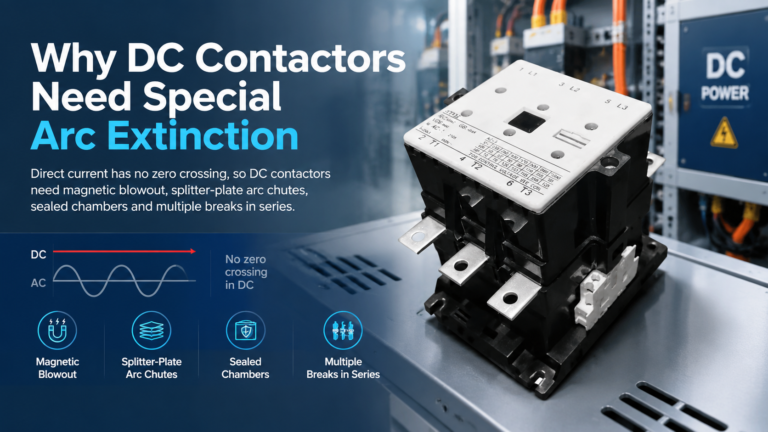
DC contactors need special arc extinction because DC current has no natural zero crossing. See how magnetic blowout, arc chutes and series breaks kill a DC arc — and how to specify one correctly.
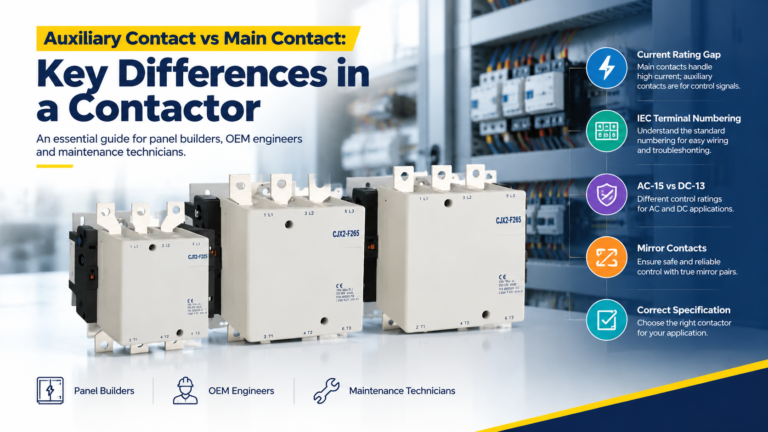
Main contacts carry the motor current; auxiliary contacts carry control signals. Learn the real rating gap, IEC terminal codes, and how to spec both correctly.
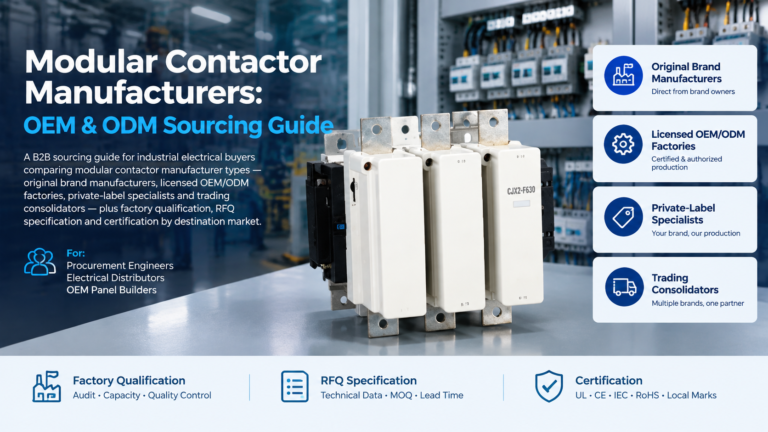
A sourcing guide to modular contactor manufacturers: match the four supplier archetypes, qualify any factory with a nine-point framework, and send an RFQ that gets comparable quotations.