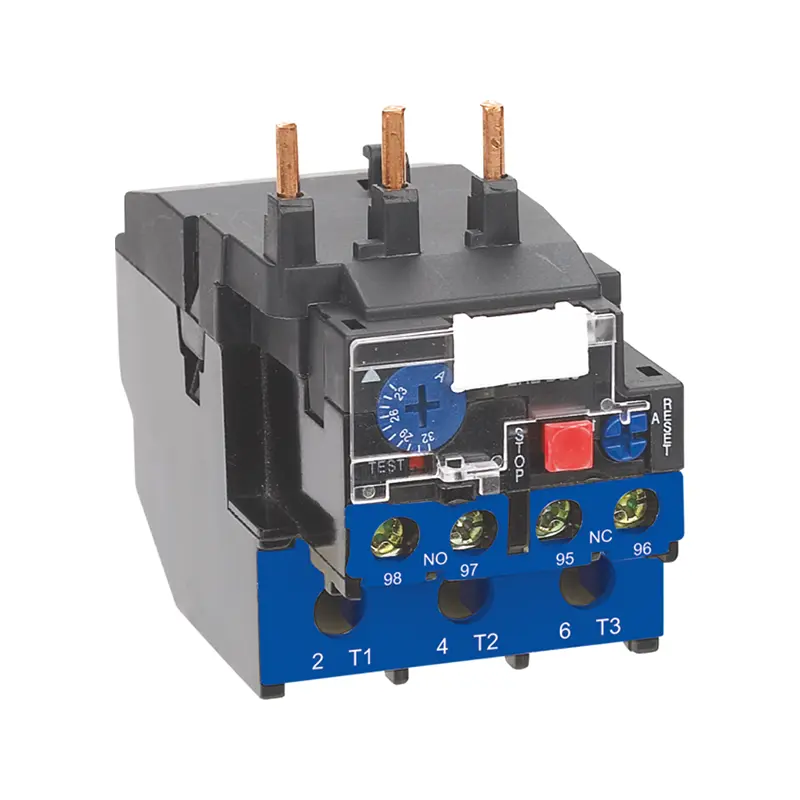








ETL3-63MH 6-63A RCBO
Earth leakage is the fault that hides. A cable crushed behind plasterboard, a heating element drawing damp into its insulation, a power tool with a frayed lead — none of them disturb an ordinary breaker, because current is still flowing. It is simply returning along a path nobody intended. The ETL3-63MH 6-63A RCBO exists to notice that.
One module-width unit, three duties. It senses earth leakage, it protects against sustained overload, and it disconnects a short circuit — the three jobs that would otherwise be split between a residual current device and a circuit breaker wired one after the other. Ratings run from 6 A to 63 A across 1P+N and 3P+N circuits, with 10 kA of rated short-circuit capacity behind them. Everything else in our circuit protection range is designed around the same principle: no protective gap between devices.
Three Faults, One Enclosure
Combining functions does not mean bolting a sensor onto a breaker. Two separate measuring systems sit inside the same moulding, and each is responsible for a failure mode the other cannot see.
A toroidal core watches the imbalance
All live conductors are threaded through a ring-shaped core. On a healthy circuit the outgoing and returning currents cancel each other magnetically and the core stays quiet. Let part of that current divert to earth — through failed insulation, through water, through a body — and the balance is broken. The core registers the difference and releases the trip mechanism. The threshold is a property of the variant you specify: 30 mA, 100 mA or 300 mA.
A bimetal strip and a coil share the current duty
Overcurrent arrives at two very different speeds, and one sensing element cannot cover both. A gradual overload warms a bimetal strip until it distorts enough to unlatch the mechanism; the calibration holds the device back at 1.13 times its rating for a full hour, and guarantees operation inside that hour once current reaches 1.45 times. A short circuit gives nothing time to warm up, so a magnetic coil acts directly on the current peak instead. Which peak triggers it depends on the curve: Type B reacts somewhere between 3 and 5 times rated current, Type C between 5 and 10.
Picking the Sensitivity: 30, 100 or 300 mA
This is the number buyers misjudge most often, usually by assuming that a larger figure is inherently safer or a smaller one inherently better. Neither holds. Each value answers a different question about the circuit.
A 30 mA threshold belongs on final circuits feeding socket outlets and equipment people handle, where the concern is electric shock. A 100 mA device is chosen where leakage from many connected loads would keep disturbing a more sensitive unit. A 300 mA threshold targets fire risk and the incoming position, where the aim is to catch insulation failure before ignition rather than to protect a person directly.
More sensitive does not mean better
Put a 30 mA device at the head of a sizeable installation and it will nuisance-trip repeatedly, because ordinary leakage across dozens of appliances accumulates past the threshold. Fit a 300 mA device to a socket circuit and the shock protection a person expects is not there. The right figure comes from the device’s position in the distribution hierarchy, not from picking whichever number sounds more protective.
Where It Gets Installed
Any final circuit that needs shock-risk protection and its own overcurrent backup can use an RCBO:
- Domestic consumer units and distribution boards
- Socket outlet and lighting final circuits
- Commercial and office sub-distribution
- Machine supply points in industrial plants
- Workshop and garage circuits
- Public buildings and facility installations
- Marina, campsite and outdoor power points
- Small-scale generation and solar connection points
Designers frequently pair it with miniature circuit breakers on ways that need overcurrent protection without leakage sensing, and with residual current transformers where leakage is monitored centrally at the incomer instead of at every outgoing way.
Wiring, Mounting and Panel Layout
The moulding clips to a standard 35 mm DIN rail, occupying the width that a separate residual current device plus circuit breaker pair would consume twice over. In a consumer unit where available rail space — not budget — sets how many ways you can install, that single saving decides the layout. Terminals accept cable, pin-type and fork-type busbar ends, and take 16 mm² flexible or 25 mm² rigid conductors at a maximum tightening torque of 2.5 N·m.
Two details repay their cost during commissioning and later fault-finding. Supply may be brought in from either end, so there is no fixed orientation to work around when a panel is laid out. And the front carries two status windows: a contact position indicator showing green when open and red when closed, plus a leakage flag that remains white in normal service and switches to blue once the trip was caused by earth leakage rather than overload. At a callout that single colour tells an electrician whether to look at an appliance or at a circuit that is simply overloaded.
Confirming the Right Variant Before You Order
The series is a matrix, not one fixed item: poles, current rating, sensitivity, curve and breaking capacity are all chosen independently, and the model designation shifts with each combination. Four points are worth settling first — whether the circuit is single-phase 1P+N or three-phase 3P+N; the continuous current it will really carry; the sensitivity demanded by whichever installation standard governs your site; and the prospective short-circuit current available at the intended mounting position, which is what decides whether 6 kA or 10 kA is sufficient.
Anything we can verify about this model appears in the specification block alongside this text. If a project calls for another pole configuration, another sensitivity, or paperwork aligned to a specific market, describe the operating conditions and we will put the exact variant in writing before anything ships.
Own-Brand Marking and Wholesale Terms
Branding, packing and paperwork can all be adapted. Buyers ordering under a name of their own receive own-label marking, artwork supplied by them, and documentation matched to their market; distributors order on ordinary trade terms. Volume and destination decide which of these apply, and the quotation spells it out rather than leaving it to assumption.
Shipments can also be spread across a schedule instead of sent in one block, which suits wholesalers holding stock against projects that are already confirmed.
Matching Protective Devices Across a Panel
Protective devices are chosen as a set, because a gap anywhere in the chain undoes the rest of it. Alongside this RCBO, the range includes molded case circuit breakers for feeders and main incomers at higher currents, and manual motor starters for three-phase motor duty. Send us the single-line diagram for a panel and we will help line the ratings up across the whole set.
What Buying Factory-Direct Actually Gets You
An RCBO is a safety device, so sourcing one across borders is really a question of whether the unit is what it claims to be. Ours is built to IEC/EN 61009-1 and supplied factory-direct, with sensitivity, curve, pole configuration and breaking capacity confirmed on paper before the order is released. Commercial terms — how long it takes, how it is packed, what can be customised — are quoted alongside the unit price rather than left until later.
Give us the circuit details, the order quantity and the port of destination, and a quotation follows with the technical confirmation and the customisation choices that fit your order.
Contact us for ETL3-63MH 6-63A RCBO price, technical specifications, datasheet, bulk quantity, and OEM supply information.
الأسئلة الشائعة
What is an RCBO, and how does it differ from an RCCB?
An RCBO handles three duties inside one housing: earth-leakage sensing, overload protection and short-circuit disconnection. An RCCB covers only the leakage duty, so overload and short circuit still require a separate breaker. Where rail width is tight, the combined unit replaces two components with one.
How do I choose between 30 mA, 100 mA and 300 mA sensitivity?
The choice follows from where the device sits in the installation. Final circuits feeding socket outlets and equipment people handle are normally protected at 30 mA. A board where leakage from many connected loads accumulates is often set at 100 mA, and 300 mA is used for fire-risk protection or at the incoming position. Tell us the circuit and the standard that applies and we will confirm the level.
Should I order Type B or Type C tripping?
Type B operates somewhere between 3 and 5 times the rated current, which suits resistive and lightly inductive loads such as socket and lighting circuits. Type C operates between 5 and 10 times, tolerating the higher inrush that small motors and transformers draw on start-up. Send us the load list if you would like help splitting the two across a panel.
Can this RCBO be used on a three-phase circuit?
Yes. The ETL3-63MH comes in 3P+N as well as 1P+N, with the three-phase version rated for 400/415 V~ systems. Leakage sensing works the same way whichever pole count you order, because all live conductors pass through the same core.
What is the difference between the ETL3-63M and the ETL3-63MH?
Housing, current range and sensitivity options are identical; the rating that changes is short-circuit capacity. The ETL3-63M is rated 6 kA and the ETL3-63MH is rated 10 kA. Which one fits depends on the prospective short-circuit current measured where the device will be fitted.
How is the unit installed and wired inside a distribution board?
It clips onto 35 mm DIN rail and accepts cable, pin-type and fork-type busbar terminations, taking 16 mm² flexible or 25 mm² rigid conductors. Supply can be brought in from either end, so no single orientation is imposed on whoever mounts it.
Can the ETL3-63MH be supplied under our own brand?
Yes. Own-label marking, packing produced from your artwork and market-specific documentation are all available, whether you are running an OEM or ODM programme or ordering as a distributor. Give us the quantity, the destination and the branding you need, and the quotation will set out which of those options apply.
Request Quote
Tell us your specifications, quantity, or application scenario and we will reply with a tailored quote.