Safety Contactor vs Standard Contactor: Force-Guided Contacts
Safety contactor vs standard contactor: how force-guided and mirror contacts work, how feedback monitoring catches welded contacts, and when a standard contactor is allowed.
Read More
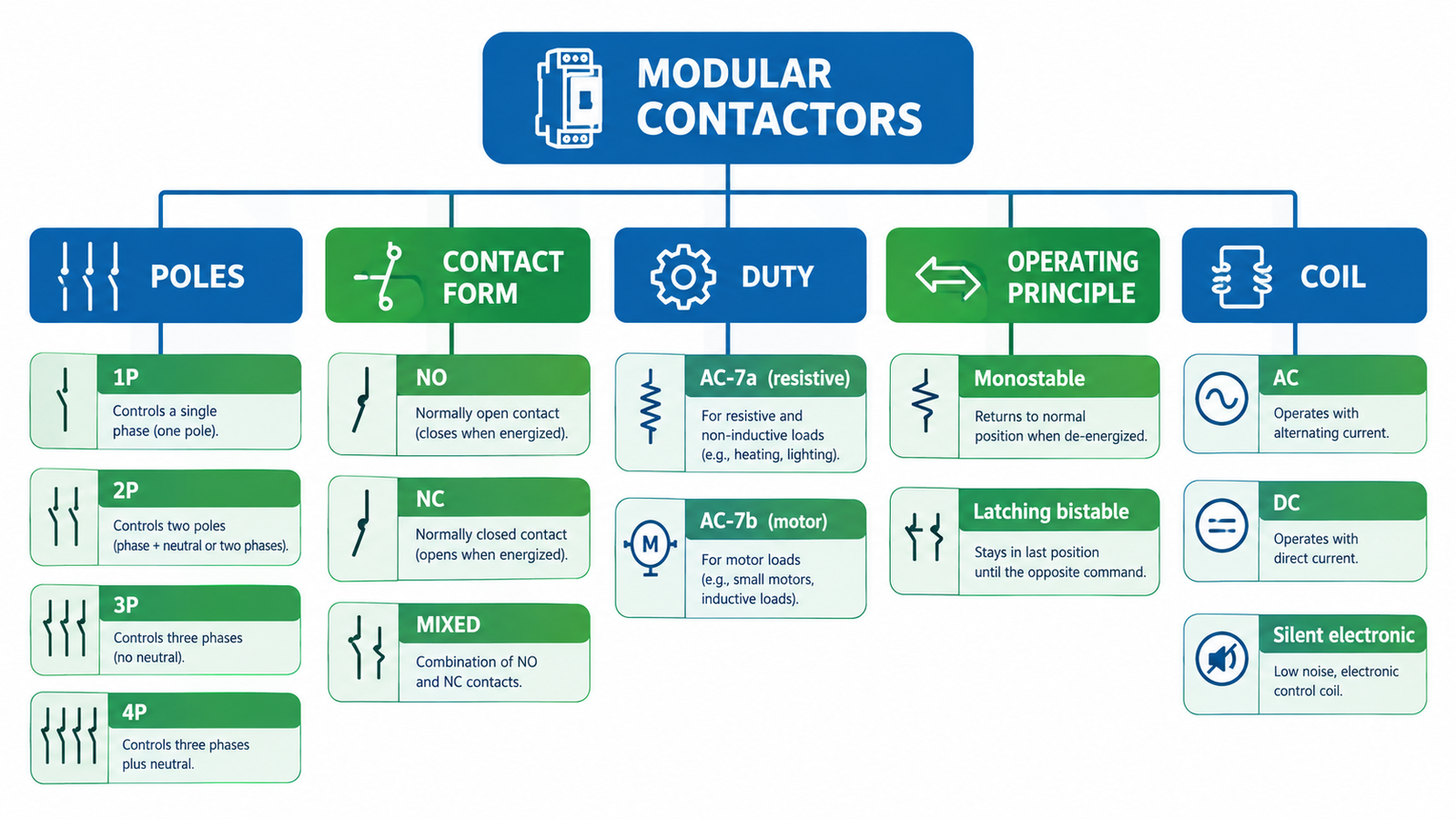
The main types of modular contactors divide along three axes: pole configuration (1P to 4P), contact duty (AC-7a resistive versus AC-7b motor loads), and contact form (normally open, normally closed, or mixed). A fourth, smaller family — latching or bistable types — trades coil-holding energy for pulse control. Choosing the wrong type is rarely a wiring problem; it is a duty problem, a fail-safe problem, or both. This guide walks through each type, what it is built for, and how to match one to heating, ventilation, water-heating and light motor circuits — and where the modular family ends and a true industrial AC contactor begins.
A modular contactor is a compact switching device built to the 17.5 mm module grid and sized for household and light-commercial installations, governed by IEC 61095 rather than the industrial IEC 60947-4-1. The scope boundary matters: modular contactors handle AC-7a duty (resistive and slightly inductive loads — heating, lighting, water heaters) up to 63 A, and AC-7b duty (motor loads such as heat-pump and ventilation compressors) at reduced ratings. They are not industrial contactors in a smaller box: the standards, endurance expectations and short-circuit context differ. The structural contrast is laid out in the modular vs traditional contactor comparison; here we stay inside the modular family itself.
Pole count follows the circuit, not preference.
| Pole type | Typical circuit | Notes |
|---|---|---|
| 1P (1 NO or 1 NC) | Single-phase resistive loads: water heaters, storage heaters, lighting banks | Smallest footprint, one 17.5 mm module |
| 2P | Single-phase loads where both line and neutral are switched, split-phase supplies | Full isolation of the load; common on water heaters |
| 3P | Three-phase resistive loads and light three-phase motors | AC-7b ratings apply for motor duty |
| 4P | Three-phase four-wire loads, loads needing neutral switching | Widest body; also used for transfer-style switching |
A recurring residential mistake is using a 1P device where the load genuinely needs 2P switching — most often on storage water heaters where both poles must open for safe service. Switching the neutral costs one more module and removes an entire class of service-work hazard.
Most buyers expect normally open contacts, and most modular contactors are exactly that: energise the coil, the circuit closes. The normally closed family exists for a deliberate reason.
Choosing NO when the application demands NC inverts the fail-safe behaviour silently: everything works on the bench and the failure mode is wrong. This is the single most consequential type decision in the family, and it is worth confirming at the schematic stage, not at installation.
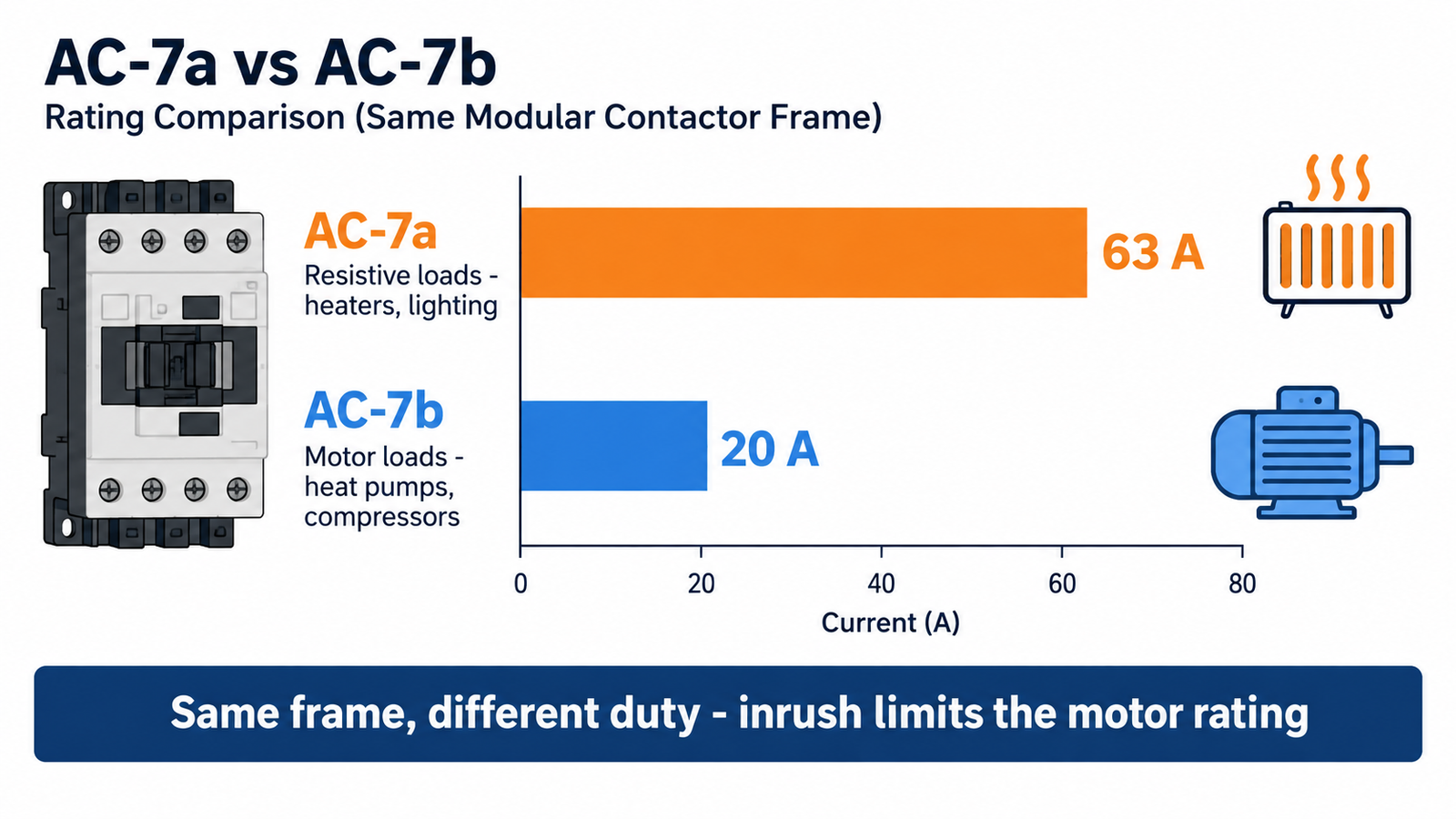
IEC 61095 divides the work into two utilisation categories, and the same body can carry very different ratings for each.
| Category | Load character | Typical applications | Sizing note |
|---|---|---|---|
| AC-7a | Resistive, slightly inductive; no meaningful inrush | Heaters, ovens, lighting, water heaters | Rated up to the frame current (25/40/63 A) |
| AC-7b | Motor loads with inrush of several times rated current | Heat pumps, ventilation compressors, small pumps | Rated well below the AC-7a figure on the same frame |
A 63 A modular contactor is not a 63 A motor starter. Its AC-7b rating might be a fraction of that, because motor inrush stresses the contacts far beyond what a heater bank ever does. If a motor load exceeds the AC-7b capability of the largest modular frame, the correct move is a compact industrial contactor — the same logic that separates household and industrial families is covered in the modular contactor selection guide. For light-duty industrial motor circuits just beyond the modular envelope, compact frames such as the LC1-D series pick up where AC-7b ratings end, and the utilization categories themselves are explained in the AC-1 to AC-4 guide.
The standard modular contactor is monostable: the coil must stay energised for the contacts to stay closed, and the device drops out on power loss. The latching or bistable type holds its state mechanically after a short coil pulse, which changes three things:
In building automation, the choice interacts with the control architecture: bus-controlled systems with maintained outputs pair naturally with monostable types, while conventional impulse-button installations pair with latching types. The system-level view of these devices inside a control chain is covered in the modular contactors overview.
Coil options divide into AC-operated and DC-operated (or electronic) coils. The practical difference shows up in two places. First, noise: AC coils hum at the supply frequency, and in bedrooms, hotel corridors and offices the hum of a bank of contactors becomes a complaint ticket. Electronic-coil “silent” types eliminate it, which is why they dominate premium residential specifications. Second, control compatibility: PLC triac outputs and low-current controllers prefer DC/electronic coils because holding current is small and predictable — though leakage current through a triac output must still stay below the contactor’s drop-out threshold, a trap covered in the selection guide. Coil voltage is a type characteristic, not an accessory: order the device with the coil voltage of the control circuit, because retrofitting is rarely economical.
| Aplicación | Poles | Contact form | Duty | Usual coil choice |
|---|---|---|---|---|
| Storage water heater | 2P | NO (or NC for fail-on heating) | AC-7a | Silent AC or DC |
| Space heating bank | 1P–4P | NC — must stay on if control fails | AC-7a | AC, compensated |
| Lighting circuits | 1P–4P | NO | AC-7a (check lamp inrush) | AC or latching |
| Heat pump / ventilation compressor | 3P | NO | AC-7b | Silent AC/DC |
| Freeze-protection trace heating | 2P | NC — fail-on | AC-7a | AC |
| Multi-point impulse control of one load | 1P–2P | NO latching | AC-7a | Pulse-operated bistable |
| Small three-phase pump | 3P | NO | AC-7b, size carefully | AC |
| Mistake | Consequence |
|---|---|
| Using the AC-7a rating for a motor load | Contacts erode under inrush; premature welding and sticking follow within months. |
| Specifying NO where the load must be fail-on | A control failure silently shuts down heating or protection circuits. |
| Switching only the line on a serviceable load | Neutral stays live during maintenance; shock hazard during service work. |
| Choosing a latching type where power-loss must mean off | The load remains energised after an outage, defeating the intended fail-safe. |
| Ignoring LED lighting inrush on AC-7a ratings | High peak inrush from large LED banks welds contacts sized by steady-state current alone. |
Modular contactor types are not a product-range accident — each axis (poles, contact form, duty, latching behaviour, coil technology) answers a specific installation question. Read the load’s fail-safe requirement first, its duty category second, and the pole count third, and the type chooses itself. When the load outgrows AC-7b, step up to a compact industrial frame rather than stretching the modular rating.
They divide by pole configuration (1P–4P), contact form (NO, NC or mixed), duty category (AC-7a resistive vs AC-7b motor), operating principle (monostable vs latching/bistable) and coil technology (AC, DC or silent electronic coils).
When the load must stay energised if the control circuit or coil fails — heating circuits, freeze protection and some ventilation systems. The NC type is a fail-on device by construction.
Only within its AC-7b rating, which is lower than its AC-7a rating on the same frame. Small heat-pump and ventilation compressors are typical AC-7b loads; larger motors need a compact industrial contactor.
A standard type requires continuous coil power and drops out on power loss; a latching type holds its state after a short pulse and consumes no holding current. The latching type is not fail-safe off, so it suits lighting and multi-point control rather than protective switching.
AC coils vibrate at the supply frequency. It is normal but undesirable in occupied spaces; silent types with electronic DC coils eliminate the noise. Persistent loud chatter on any type indicates a low coil voltage or a mechanical fault.
IEC 61095 covers electromechanical contactors for household and similar applications, defining the AC-7a and AC-7b categories. Industrial contactors fall under IEC 60947-4-1 with the AC-1 to AC-4 categories.