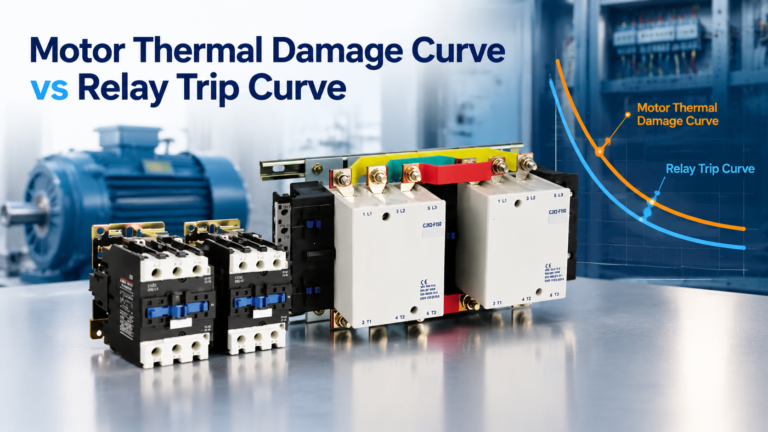
Motor Thermal Damage Curve vs Relay Trip Curve
Six points, two lines, three conditions. Plot the thermal damage curve against the relay trip curve and know exactly what the overlaps mean.
Read More
A contactor model number is a compressed specification, and almost every ordering error comes from reading one field and assuming the rest. CJX2-2510 e CJX2-2501 have identical current ratings and different wiring functions. CJX2-2510 e CJX2-2510 220V may be the same device, or may not be, depending on whether the voltage was ever written down. This guide decodes the string field by field, then covers the two other naming systems you will meet when replacing a European or Japanese device.
Once the model is decoded, the next question is usually whether an equivalent from another brand will fit. That is a separate exercise covered in contactor cross-reference.
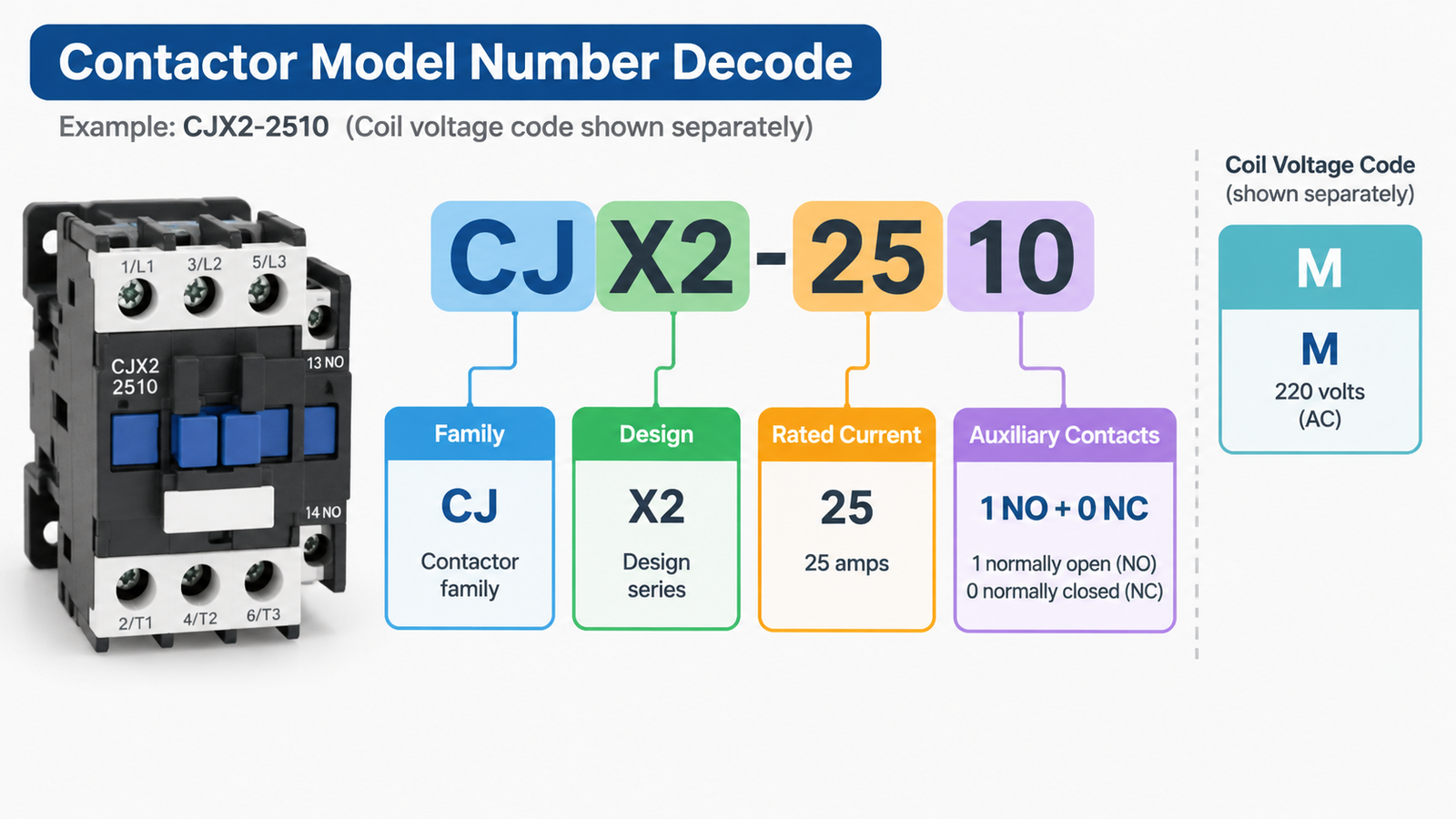
Take CJX2-2510 as the example. The string breaks into a family code, a design generation, a current rating and an auxiliary contact configuration:
| Field | Value | Meaning | What happens if you get it wrong |
|---|---|---|---|
| CJ | Family | AC contactor (交流接触器) | Wrong device type entirely — DC coil or relay instead of contactor |
| X2 | Design generation | Compact design, second generation; the series modelled on the LC1-D family | Mounting and accessory compatibility change between generations |
| 25 | Corrente nominal | 25 A rated operational current (AC-3 duty at 380–400 V) | Undersized contactor welds contacts; oversized one wastes money and panel space |
| 10 | Auxiliary contacts | One normally open, zero normally closed | Circuit does not work — no self-hold, or no interlock |
The current field is a rating, not a measurement of what the device will pass. A 25 A contactor switched at AC-3 duty carries motor current; the same device on a resistive load has a much higher AC-1 rating. If the load is not a standard motor, the current field alone does not size the device — the utilization category does, as covered in AC-1 to AC-4 utilization categories.
This is the field that causes the most returns. The two digits after the current rating describe the factory-fitted auxiliary contact block, in the order NO then NC.
| Suffix | NO | NC | Uso típico |
|---|---|---|---|
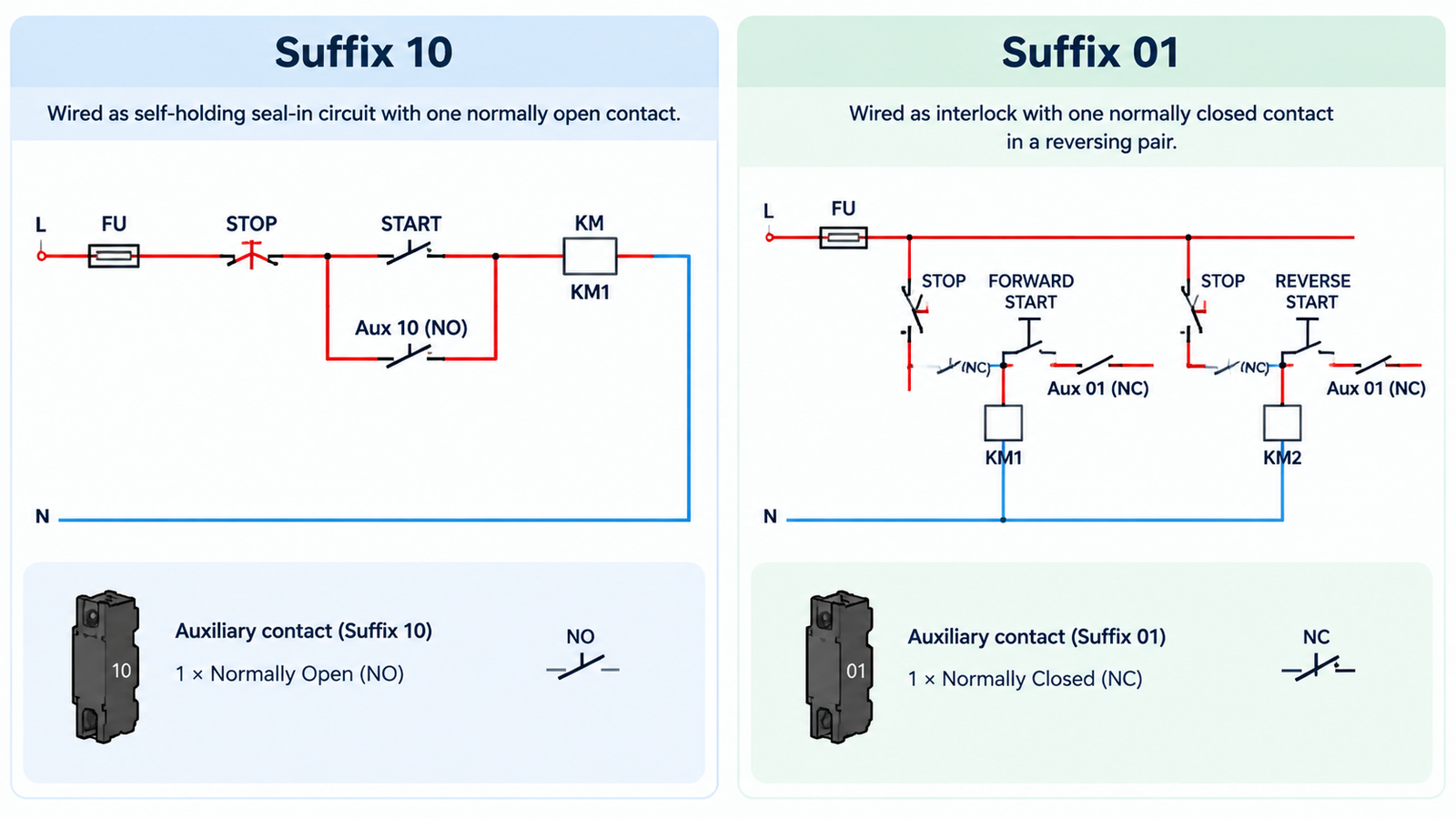
| 10 | 1 | 0 | Self-holding (seal-in) circuit — the contact holds the coil after the start button is released |
| 01 | 0 | 1 | Interlocking — the NC contact drops out the opposing contactor in a reversing pair |
| 11 | 1 | 1 | Both functions in one device; common on 40 A frames and above |
| 20 | 2 | 0 | Two independent signal circuits, no interlock |
| 02 | 0 | 2 | Two interlocks, e.g. a reversing pair where each blocks the other |
| 22 | 2 | 2 | Signal plus interlock on both sides |
So CJX2-2510 and CJX2-2501 are both 25 A contactors, and they are not interchangeable in a circuit that uses the auxiliary contact. One gives you a self-hold, the other gives you an interlock. In a reversing starter the difference is the difference between a working interlock and a phase-to-phase short when both contactors pull in together. If the aux contact is unused, they swap freely; if it is used, they do not.
Note also the ordering convention: some manufacturers print NO first, others print NC first, and a few use a single digit with a letter. Confirm against the terminal markings — 13/14 is NO and 21/22 is NC on IEC-style devices — rather than trusting the digit order. The terminal language itself is covered in contactor terminal numbering.
The model number often does not contain the coil voltage, and that is the single most common cause of a correct contactor that will not pull in. In full ordering codes the coil is specified by a letter or a numeric suffix:
| Code | Coil voltage | Where you meet it |
|---|---|---|
| B | 24 V AC | Control circuits from a 24 V transformer or PLC supply |
| C | 36 V AC | Safety-voltage control, older panels |
| F | 110 V AC | North American control circuits, machine tools |
| M | 220 V AC | Most common single-phase control supply |
| Q | 380 V AC | Line-to-line control, common in Asian panels |
| V | 400 V AC | European line-to-line control |
A separate digit or letter states coil frequency — 50 Hz, 60 Hz, or a dual-frequency coil. A 50 Hz coil on a 60 Hz supply has higher impedance and may chatter or fail to pick up; a 60 Hz coil on 50 Hz draws more current and runs hot. Where the frequency is not marked, assume it is not dual-rated until the datasheet says otherwise.
Larger contactors carry a frame letter between the series and the current: CJX2-D115, CJX2-F225. The letter is not cosmetic. It denotes a different physical family, generally corresponding to a different original design:
Two consequences follow. First, the same nominal current can appear in both families, and the devices are not the same size, do not share accessories and do not share mounting dimensions. Second, an overload relay or auxiliary block bought for one family will not fit the other. If you are replacing a device in an existing panel, the frame letter matters as much as the amps.
European and Japanese-influenced ranges use completely different logic, and reading them with CJX2 rules produces nonsense.
| System | Exemplo | How the number reads |
|---|---|---|
| CJX2 (Chinese GB lineage) | CJX2-2510 | 25 = amps directly; 10 = aux configuration |
| TeSys style (Schneider lineage) | LC1D25M7 | 25 = amps; M7 = 220 V 50 Hz coil code; aux is a separate suffix or module |
| ABB A-series style | A26-30-10 | 26 = amps; 30 = three poles; 10 = one NO aux |
| Siemens 3TB / 3TF | 3TB42, 3TF52 | Frame number encodes a current band, not the amps — 3TB42 is 16 A, 3TF52 is 170 A |
The Siemens case is the one that catches people out: there is no arithmetic that turns 3TF52 into 170 A. The number identifies a frame, and the frame’s rating comes from the catalogue. Treat any model number whose digits do not map to amps as a frame reference and look it up.
Most wrong shipments trace back to a purchase request that specified a model number and nothing else. Six fields remove almost all ambiguity:
Field two is the one that gets skipped. A contactor is a coil plus contacts; get the coil wrong and the device is a paperweight with a correct current rating.
Read the model number in four parts — family, frame, amps, auxiliary configuration — then look for the coil voltage that the number probably does not contain. The last two digits decide whether the circuit self-holds or interlocks, and the frame letter decides whether the device fits the panel you are putting it in. Everything else is catalogue detail.
For the current-to-frame mapping across the range, the CJX2 series contactor pages list AC-3 ratings per frame; the AC contactor category covers the full family including the larger D and F frames.
CJX2 is the series, 25 is the 25 A rated operational current, and 10 means one normally open auxiliary contact and no normally closed. The coil voltage is specified separately and is not in that string.
Only where the auxiliary contact is unused. 2510 gives one NO contact for a self-hold circuit; 2501 gives one NC contact for interlocking. In a circuit that uses the aux contact they perform opposite functions.
One normally open plus one normally closed auxiliary contact. It appears on larger frames where both a seal-in and an interlock or signal contact are commonly needed.
Usually you cannot. In CJX2 ranges the coil is given by a letter code in the full ordering code (M for 220 V, Q for 380 V, B for 24 V), or written separately as text. Always specify voltage and frequency explicitly on the order.
Different physical frame families. D is the compact range equivalent to LC1-D; F is the larger range equivalent to LC1-F. They cover overlapping currents but differ in size, mounting, accessories and thermal capacity.
Within one family, yes. Across naming systems, no — a Siemens 3TF52 is 170 A while 3TB42 is 16 A, because those numbers identify frames rather than amps. Check the catalogue before assuming.