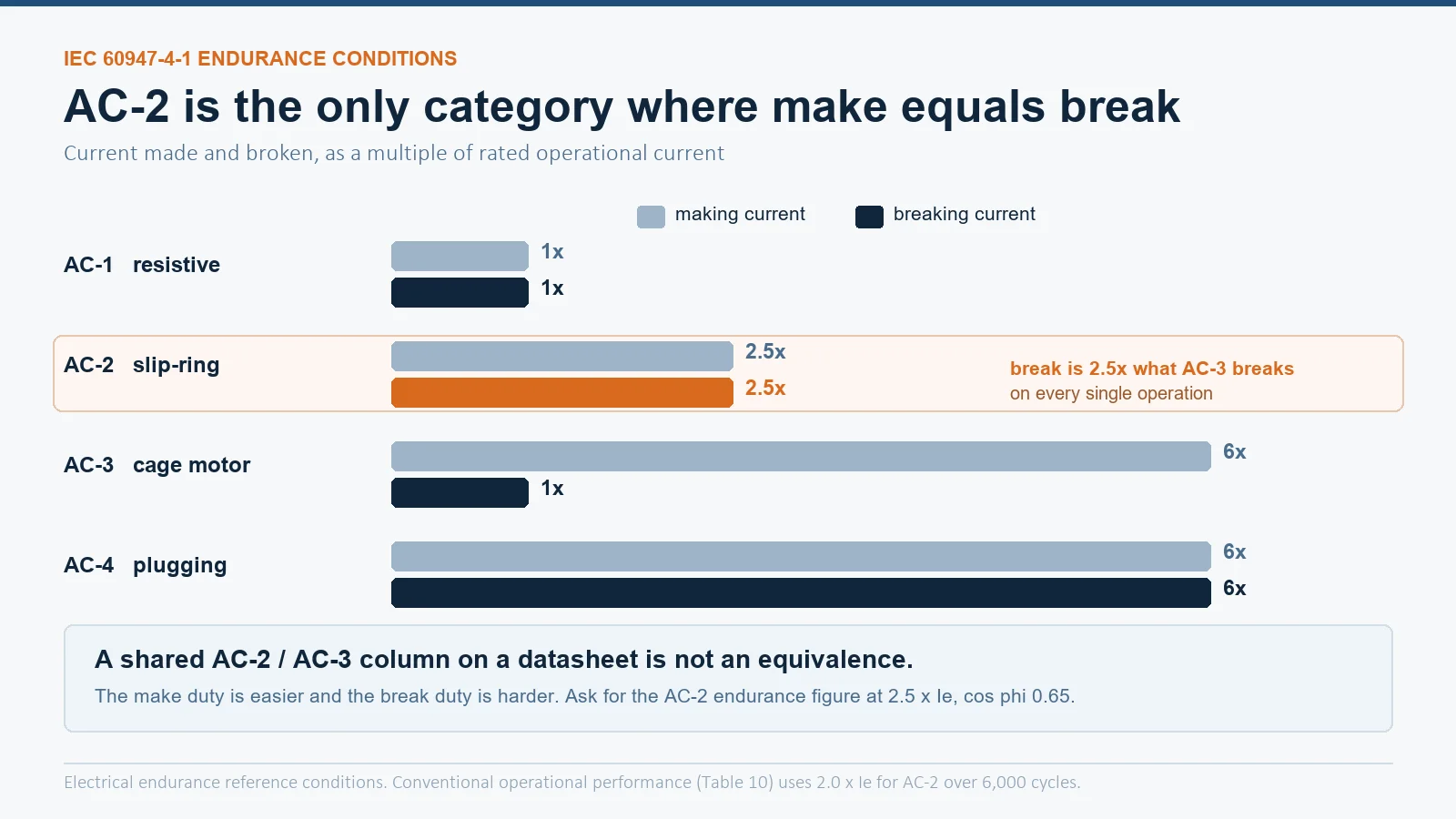
Quick answer: AC-2 is the IEC 60947-4-1 utilization category for slip-ring (wound-rotor) motors — starting, plugging and inching. It is referenced at 2.5 × Ie making and 2.5 × Ie breaking at cos φ 0.65, with 6,000 operating cycles in the conventional operational performance table. The trap is the break duty: AC-2 opens at 2.5 times rated current where AC-3 opens at 1.0, so an AC-3 rating is not automatically an AC-2 rating. Read the datasheet column, then size on the hoist’s real inching frequency rather than its kilowatt label.
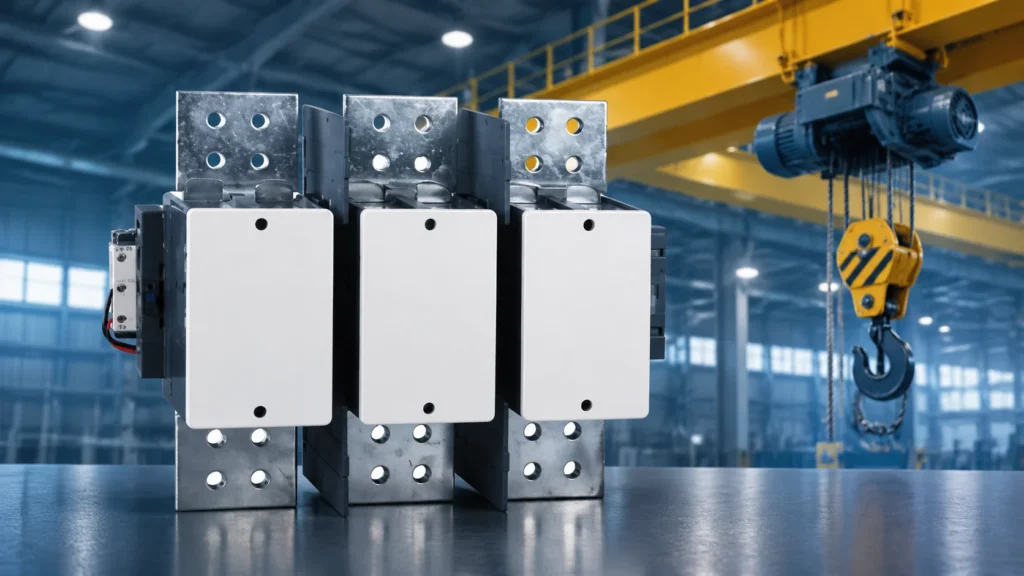
Cranes, hoists, shipyard winches and mill auxiliaries are the last large installed population of slip-ring motors, and they are almost all specified in AC-2. Yet the category gets one line in most selection guides and no worked example anywhere.
That gap matters because AC-2 duty breaks current in a way AC-3 never does. A squirrel-cage motor is switched off at speed, so the contactor opens against running current. A wound-rotor motor on a hoist is plugged, inched and held on a resistor step — every one of those operations puts load current across the contact face at the moment of opening. Contactors that look correctly sized on the nameplate still fail in months.
This page covers what AC-2 actually specifies, why cranes keep using wound-rotor machines, what the rating means on a real datasheet, how to size the stator and rotor contactors separately, and where AC-2 stops being the right answer. If you are still choosing a frame, the AC contactor range is the starting point.
What AC-2 covers, and what it does not
AC-2 is defined as the starting, plugging and inching of slip-ring motors. Three words carry all the difficulty:
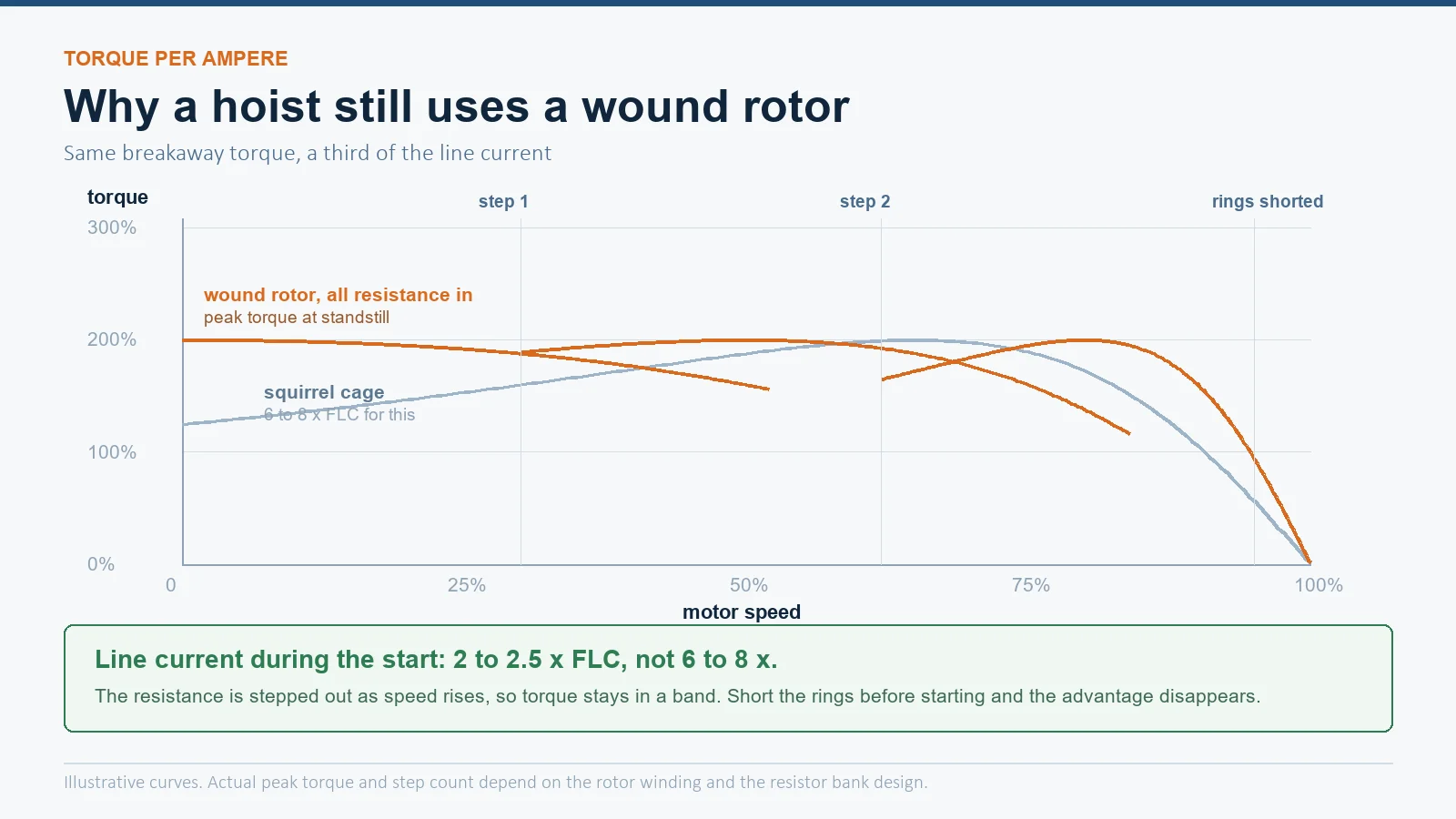
- Starting — closing onto a rotor circuit that is deliberately resistive, which limits line current to roughly 2 to 2.5 times full load instead of the 6 to 8 times a cage motor draws.
- Plugging — reversing two stator phases while the rotor is still turning, to brake. The machine acts as a generator during the transition and the current at the instant of break is not the same as the current at the instant of make.
- Inching — short, repeated pulses to position a load. Electrically each pulse is a start, so the contactor accumulates operations at a rate no pump or fan ever sees.
AC-2 does not cover a cage motor that is jogged. That is AC-4, and the two are frequently confused because both are described as “heavy duty”. The difference is the current at break: AC-4 breaks at 6 to 8 times rated current, AC-2 at 2.5. AC-4 is the harder duty by a wide margin. The comparison across categories is laid out in AC-1 to AC-4 utilization categories.
The numbers in the standard, and why three of them exist
Almost every article on AC-2 quotes “2.5 times rated current” and stops. The standard actually carries three different AC-2 conditions, and knowing which one a datasheet is quoting prevents a mis-sized order.
| Where it appears | Make | Break | cos φ | Cycles | What it proves |
|---|---|---|---|---|---|
| Electrical endurance reference conditions | 2.5 × Ie | 2.5 × Ie | 0.65 | Manufacturer declared | The life figure in the catalogue |
| Conventional operational performance (Table 10) | 2.0 × Ie | 2.0 × Ie | 0.65 | 6,000 | The device works at all at this duty |
| Making and breaking capacity verification | 4 × Ie | 4 × Ie | 0.65 | Occasional operations | It survives an abnormal break |
Read the table as a ladder, not a contradiction. The 6,000-cycle test is a capability floor. The 2.5 × Ie pair is the condition the endurance figure is measured under, so it is the number that predicts service life. The 4 × Ie pair is the occasional-duty capacity — the plugging event, the jam release, the operator who reverses the hoist at full speed.
Two practical consequences follow. First, when a catalogue says “AC-2: 2.5 × Ie”, it is telling you the endurance test condition, not a limit you can exceed. Second, a contactor that passes the 4 × Ie making capacity test is not thereby rated for 4 × Ie continuous plugging — capacity is a survival test, endurance is a life test.
Why cranes still use slip-ring motors
A squirrel-cage motor cannot break a loaded hoist away from rest without drawing five to eight times full load current to make perhaps 1.5 to 2 times full load torque. On a weak supply, or with several drives on the same transformer, that is not acceptable.
A wound rotor changes the arithmetic. Bringing the rotor winding out through slip rings lets you insert external resistance in the rotor circuit. At standstill, the rotor reactance is at its highest and the rotor current lags badly, which is why a low-resistance rotor makes poor torque per ampere. Adding resistance shifts the impedance triangle so that resistance dominates, the rotor current comes into phase with the induced voltage, and the torque per ampere rises sharply. Choose the resistance so that rotor resistance equals rotor reactance at standstill and the machine develops its pull-out torque at the moment of starting — high breakaway torque, with line current held near 2 to 2.5 times full load.
That single characteristic explains the whole category. It also gives the operator something a cage motor cannot: by leaving resistance in the rotor circuit, running speed can be held below synchronous speed under load. A crane can creep, feather and position without a drive.
There is one failure mode worth stating plainly, because it destroys motors and contactors together: never start a wound-rotor motor with the rotor shorted. With the rings shorted the machine behaves like a cage motor with an unusually poor rotor design — locked-rotor current can reach roughly 14 times full load while locked-rotor torque falls to around 60%. The contactor closes into a current it was never sized for and the motor may not turn at all.
What the AC-2 rating looks like on a real datasheet
Here is the detail that catches buyers. Many IEC contactor datasheets publish AC-2 and AC-3 in the same current column. A frame listed at 16 A AC-1 might show 9 A against “AC-2, AC-3” at 380/440 V. Nothing is wrong with that — the two duties stress the contacts differently and happen to land on similar currents for that frame.
The asymmetry is the reason:
- AC-3 makes at 6 to 10 times rated current and breaks at 1.0 times. The hard part is closing.
- AC-2 makes at 2.5 times and breaks at 2.5 times. The hard part is opening.
Arc energy at break scales with the current being interrupted and the recovery voltage across the gap. AC-2 asks the contactor to extinguish an arc at 2.5 times rated current on every single operation, at a power factor of 0.65 rather than the 0.35 of a motor circuit. A design optimised for AC-3 — heavy making capacity, light breaking duty — is being asked to do something different.
So the honest reading of a shared column is: this frame has been tested at both, and both figures are valid at the declared endurance. It is not a licence to assume AC-3 equivalence in general. If a supplier quotes only an AC-3 rating and you need AC-2, ask for the AC-2 endurance figure at 2.5 × Ie, cos φ 0.65. If it does not exist, the frame is not qualified for crane duty regardless of what the ampere number says.
Sizing the stator contactor for a hoist
Work from the motor nameplate, not the kilowatt rating. Take a 45 kW, 415 V, 6-pole slip-ring hoist motor with a nameplate stator current of 85 A, rotor voltage 320 V and rotor current 82 A.
- Category. The hoist is plugged and inched, so the duty is AC-2, not AC-3. Write that on the requisition.
- Current. The stator contactor must carry 85 A continuously and break it at every operation. Its AC-2 rating at the site voltage must be at least 85 A.
- Frame. Go to the next standard frame above the AC-2 figure rather than the AC-1 figure — for an 85 A duty that means a 115 A frame, not a 95 A one. The margin buys endurance, and endurance is what the hoist consumes.
- Operations per hour. Check the declared maximum switching frequency for AC-2. Datasheets in this class commonly state 600 operations per hour for AC-2 and AC-3. A container crane inching a spreader can exceed that in a single shift, and no frame size fixes an exceeded frequency — that is a duty-cycle problem, covered in contactor duty cycle.
The stator contactor is only half the panel. On a wound-rotor drive the rotor circuit has its own contactors, and they are usually the ones that fail first.
The rotor-circuit contactors are a different problem
Acceleration on a slip-ring motor is a sequence of resistance steps. Graded shorting contactors cut out sections of the resistor bank in turn, keeping torque inside a band as speed rises, until the final contactor shorts the rings and the brush-lifting gear takes the brushes off. From that point the machine runs as an ordinary induction motor.
Those contactors see rotor current at rotor voltage — a different duty point from the stator device, and one where the current is high and the voltage is low. Three things follow:
- Do not substitute a stator frame. The rotor contactor’s rating is tied to rotor current, which is not the same number as stator current. A 45 kW machine can have a rotor current close to its stator current, or quite different, depending on the rotor winding design.
- Step count is a reliability decision. More steps means smoother torque and less mechanical shock, but more contactors and more operations per start. Fewer steps loads each contactor harder.
- Sequence protection is not optional. If a rotor contactor welds closed, the motor starts with part of the resistance already shorted — the exact condition described above, with the current spike and the torque collapse that go with it.
For the reversing and interlocking logic that sits around these contactors on a hoist, the arrangements in reversing contactor wiring apply directly; the difference is that a wound-rotor hoist usually reverses the stator while the rotor circuit stays energised.
Where AC-2 contactors actually die
Three failure patterns account for most field returns, and none of them is a manufacturing defect.
Plugging at speed. Reversing the stator to brake a falling load produces a break at a current that can approach or exceed the motor’s locked-rotor value, well above the 2.5 × Ie endurance condition. Occasional plugging is what the 4 × Ie making capacity test covers. Continuous plugging is a duty the category does not describe, and no AC-2 rating implies it.
Inching on the same two contacts. Jogging a hoist into position always closes and opens the same poles, and if the control circuit does not rotate the poles used, contact erosion becomes uneven. The wear pattern is visible on inspection long before failure — the treatment is in contactor contact wear.
Rotor shorted at start. As above. The stator contactor is blamed, but the cause is a welded rotor contactor or a control sequence that closes the shorting contactor before the stator.
When AC-2 is the wrong answer
Slip-ring motors persist because they solve a torque-per-ampere problem without electronics. A variable frequency drive solves the same problem more flexibly, and on new installations it usually wins: no brushes, no slip rings, no resistor bank, no bank of shorting contactors, and speed control across the whole range rather than in steps.
AC-2 remains the right specification in three situations:
- Replacement in kind. The motor, resistor bank and panel exist and work. Rebuilding the drive is a capital project; replacing a contactor is maintenance.
- Hostile or hot environments where a drive’s electronics would need a cooled enclosure the crane does not have.
- Very high breakaway torque with a weak supply, where the wound rotor’s torque per ampere is still the cheapest way to move the load.
If the answer is a drive, the contactor question changes completely — it becomes an input or output contactor question, which is a separate discipline.
Mistakes worth checking before you order
| Mistake | What it causes | Fix |
|---|---|---|
| Sizing on the AC-1 or AC-3 column | Short contact life under plugging and inching | Size on the AC-2 rating at the site voltage |
| Assuming AC-2 is gentler than AC-3 | Under-sized frame, because AC-3 breaks at only 1.0 × Ie | Compare break duty, not the ampere number alone |
| Ignoring operations per hour | Thermal failure with no visible contact damage | Check declared AC-2 switching frequency; count real inching cycles |
| Using a stator frame in the rotor circuit | Rotor contactor overload or welded contacts | Size rotor contactors on rotor current and rotor voltage |
| Starting with the rotor shorted | Current spike near 14 × FLC, torque collapse, welded stator contacts | Sequence the stator to close only with full resistance inserted |
| No interlock on the reversing pair | Phase-to-phase short on a plugging command | Mechanical plus electrical interlock, as for any reversing starter |
PERGUNTAS FREQUENTES
What does AC-2 mean on a contactor?
AC-2 is the IEC 60947-4-1 utilization category for the starting, plugging and inching of slip-ring (wound-rotor) motors. It is referenced at 2.5 times rated operational current for both making and breaking, at a power factor of 0.65.
Is AC-2 heavier duty than AC-3?
It depends which half of the duty you compare. AC-2 breaks at 2.5 times rated current where AC-3 breaks at 1.0, so the break is harder. AC-2 makes at 2.5 times where AC-3 makes at 6 to 10, so the make is easier. Many datasheets publish the same current for both categories for that reason — but the endurance figures are not interchangeable.
Can I use an AC-3 contactor on a slip-ring motor?
Only if the manufacturer publishes an AC-2 rating for that frame at or above your duty current, or confirms the substitution in writing. The contactor may physically work; the question is how many operations it will survive at 2.5 × Ie break with a 0.65 power factor, and that number has to come from the maker.
Why does my hoist contactor fail even though it is rated above the motor current?
Because the failure is driven by operations and break current, not continuous current. Inching and plugging at a frequency above the declared AC-2 switching rate, or plugging at currents above the 2.5 × Ie endurance condition, will consume the contacts regardless of the frame’s ampere rating.
What is the difference between AC-2 and AC-4?
AC-2 is slip-ring motor duty and breaks at 2.5 times rated current. AC-4 is squirrel-cage motor duty with plugging and inching, and breaks at 6 to 8 times rated current. AC-4 is substantially harder, which is why a frame rated AC-3 for a motor cannot simply be re-labelled AC-4. The full comparison is in AC-3 vs AC-4 contactor.
Do I still need a thermal overload relay on a slip-ring motor?
Yes, in the stator circuit, set to the nameplate stator current with allowance for the duty cycle. The rotor resistance starter protects the motor during acceleration; it does not replace running overload protection.
What to do next
Three numbers decide the order: the motor’s nameplate stator current, the declared AC-2 rating of the frame you are considering at your site voltage, and the operations per hour the crane actually performs. If the third number is larger than the datasheet’s AC-2 switching frequency, no frame size will fix it.
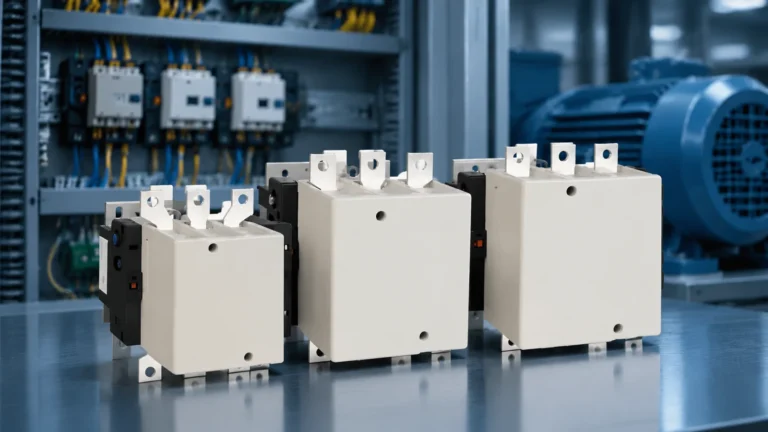
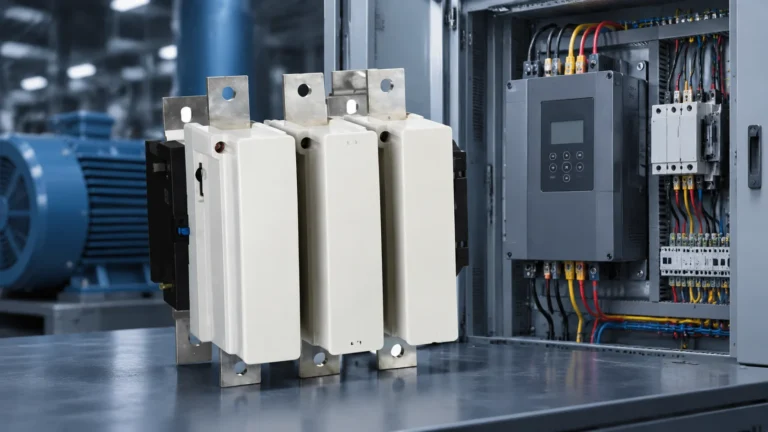
For the stator position, the CJX2-F series from 115 A to 800 A covers the frame sizes crane and hoist drives land in, and the CJX2-F225 three-pole contactor covers the mid-range where most 45 to 75 kW hoist motors sit. Send the motor nameplate, the rotor voltage and current, the resistor step count and the inching frequency, and we will check the AC-2 duty against real numbers instead of the kilowatt label.