






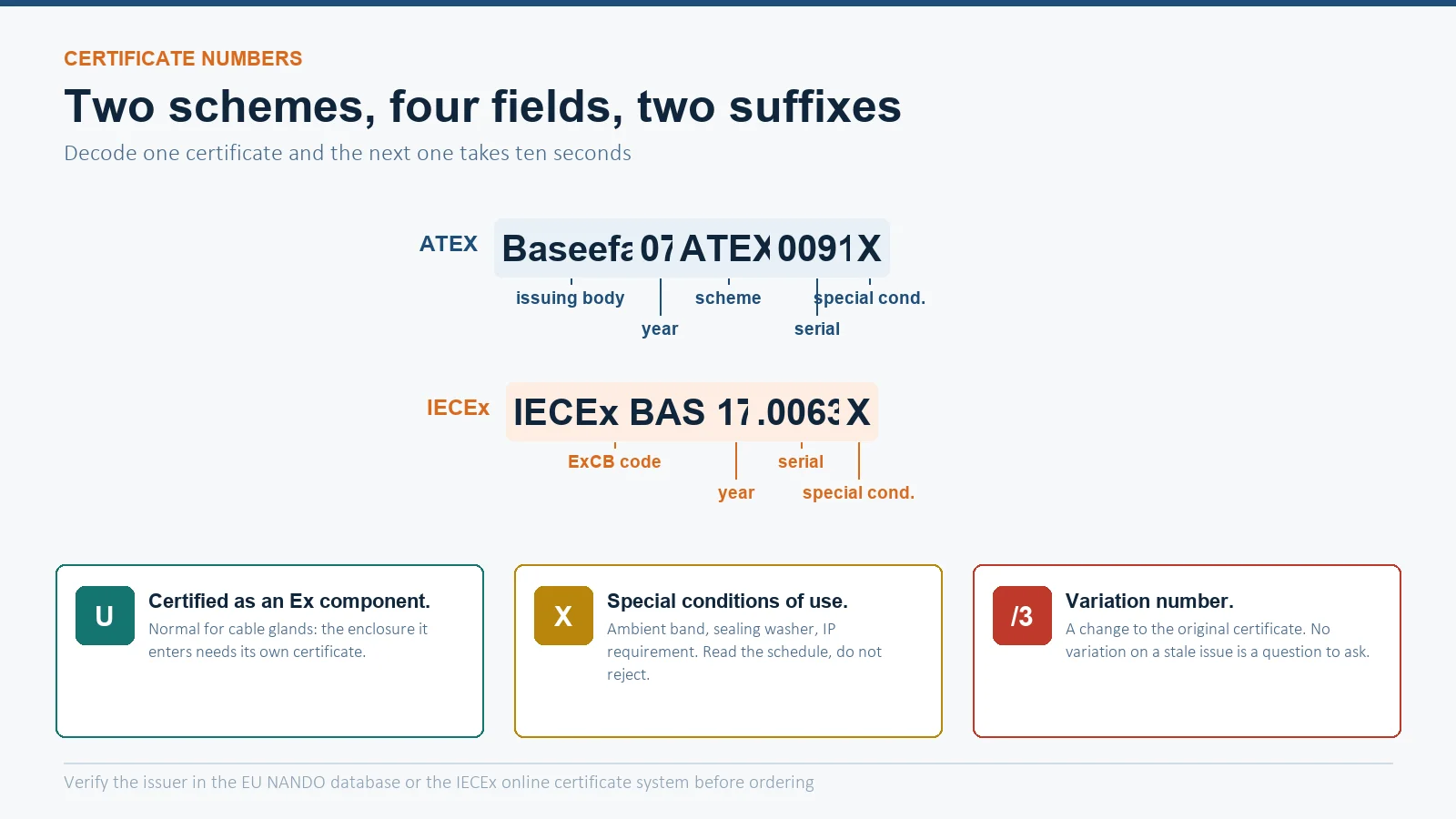
An ATEX cable gland certificate is only valid for the exact model, size and thread form printed in its schedule, and the certificate number on the document must match the number marked on the gland body. Read the number in four parts: issuing body, year of issue, the word ATEX, then the running number. Then check the two suffixes. An X means the certificate carries special conditions of use that must be followed. A U means the gland is certified as a component, which is normal for cable glands and not a limitation on quality. Verify the issuer in the EU NANDO database or the IECEx online certificate system before the order goes out, not after the container lands.
Most hazardous area projects do not fail at the gland. They fail at the paperwork layer, when a buyer accepts a PDF that says “ATEX certified” and later discovers the certificate covers a different size, a different thread, or a certificate that was superseded two standards revisions ago. The gland in the box may be perfectly made. The document is what a third-party inspector will read, and it is what decides whether the installation is accepted.
This guide walks through the certificate pack for [ATEX and IECEx cable glands](https://wilmall.com/product-category/wiring-and-connection/cable-glands/) the way a procurement engineer should read it: what each document proves, how to decode the numbers, how to read the marking on the gland, and the seven checks that catch almost every bad certificate before money changes hands.
What an ATEX cable gland certificate actually is
Under Directive 2014/34/EU, three different documents get called “the ATEX certificate” in daily conversation. They are not interchangeable, and only one of them is legally mandatory.
| Document | Who issues it | What it proves | Status under 2014/34/EU |
|---|---|---|---|
| EU Declaration of Conformity (DoC) | The manufacturer | The product meets the directive; lists the harmonised standards applied | Mandatory. This is the document the law requires to accompany the product |
| EU-Type Examination Certificate | A Notified Body | An independent body examined the design against the standards | Supporting evidence. Held in the technical file, not legally required to be supplied to the buyer, but always requested in practice |
| Quality Assurance Notification (QAN) | A Notified Body | The factory’s production quality system is audited, so every unit matches the examined type | Required for Category 1 and 2 equipment, referencing EN ISO/IEC 80079-34 |
The QAN is the document buyers forget. A Category 2 gland for Zone 1 needs both a type examination certificate for the design and a notified body audit of the manufacturing system. A certificate number of the form “Sira 11 ATEX M518” is a quality assurance notification, not a product certificate, and seeing one is good news: it means somebody audits the plant. Seeing only a product certificate with no QAN for a Zone 1 product is a question worth asking.
IECEx works on a parallel three-document structure: an ExTR (test report), a CoC (certificate of conformity) and a QAR (quality assessment report). The test report is the transferable part. An IECEx ExTR can support national approvals elsewhere, but the report itself is not an approval and cannot be presented as one.
Why cable glands are usually “U” components
A cable gland has no function on its own. It seals and clamps a cable where that cable enters an enclosure, and the explosion protection only exists once the gland, the enclosure and the cable entry are assembled correctly. That is why the certificate carries a U suffix: the gland is certified as an Ex component, and the enclosure it threads into must be certified for the same protection concept, the same gas group and the same equipment protection level.
A U suffix is not a downgrade. It is the correct certification route for the product type, and every serious gland manufacturer uses it.
Decoding the certificate number
Both schemes print an identifier that decodes field by field. Once you have read two of them, the structure is obvious and inconsistencies stand out immediately.
| Element | ATEX example | IECEx example |
|---|---|---|
| Issuing body | Notified body name or abbreviation: Baseefa, Sira, Intertek, DEKRA | ExCB letter code: BAS for SGS Baseefa, SIR for Sira, ITS for Intertek |
| Year of issue | Two digits before the word ATEX: Baseefa07ATEX0091X | Two digits after the body code: IECEx BAS 17.0063X |
| Running number | After the word ATEX: Baseefa07ATEX0091X | After the year: IECEx BAS 17.0063X |
| Suffix X | Special conditions of use — read the schedule before installing | Same meaning |
| Suffix U | Certified as an Ex component, not complete equipment | Same meaning |
| Variation | Appended as a slash and a number, e.g. Sira 08ATEX0123/3 | Handled by a new issue rather than a slash |
The X suffix deserves a note because it is widely misread. It does not mean the product is second rate or that its use is restricted to a laboratory. It means the certificate contains conditions that matter to the installer: an ambient range narrower than the default, an instruction that the gland must be used with an approved sealing washer, a note that the enclosure must carry a specific IP rating. Because most Ex d glands and most IP66 assemblies end up with some condition attached, an X on a gland certificate is close to routine. Read the schedule, do not reject the document.
The four-digit number under the CE mark
On Category 1 and 2 equipment, the CE mark is followed by the four-digit identification number of the notified body that supervises production. Some examples of bodies active in Ex certification, all of which should be confirmed in NANDO for current scope after the UK’s exit from the EU:
| Body | Number | Notes |
|---|---|---|
| Sira Certification Service (CSA Group) | 0518 | ExCB and ExTL under IECEx as well as an EU notified body |
| SGS Baseefa Ltd | 1180 | Widely used for Ex d and Ex e glands |
| Intertek Testing & Certification | 0359 | Issues both ATEX and IECEx certification |
Category 3 equipment, for Zone 2 and Zone 22, carries no notified body number under the CE mark, because the manufacturer self-declares. If you see a Zone 1 product with no four-digit number, either the marking is incomplete or the product is not Category 2. Both are reasons to stop.
Reading the marking on the gland
The marking string is the compressed version of the whole certificate. A typical Category 2 gas group gland for a flameproof enclosure reads:
CE 1180 II 2G Ex db IIC T6 Gb Tamb -60 °C to +80 °C
| Field | Exemplo | What it tells you |
|---|---|---|
| CE plus four digits | CE 1180 | Notified body 1180 supervised production. No number means self-declared Category 3 |
| Equipment group | II | Group I is mining, Group II is all other surface industries |
| Category and atmosphere | 2G | Category 2, gas. Category 2 maps to Zone 1; Category 1 to Zone 0; Category 3 to Zone 2 |
| Protection concept | Ex db | Flameproof enclosure with an internal component protected to a defined level. Ex e is increased safety, Ex nR restricted breathing, Ex tb dust protection by enclosure |
| Gas group | IIC | The hardest group, covering hydrogen and acetylene. A IIC gland can be used where IIA or IIB is required, never the reverse |
| Temperature class | T6 | Maximum surface temperature 85 °C. T5 is 100 °C, T4 is 135 °C |
| Equipment protection level | Gb | Ga, Gb and Gc are the EPL counterparts of Categories 1, 2 and 3 |
| Ambient range | Tamb -60 °C to +80 °C | The certified band. If nothing is marked, the default is -20 °C to +40 °C and nothing wider may be assumed |
Two field habits worth building. First, check that the certificate number itself appears on the gland body or its label. A datasheet claim with no marking on the product has nothing behind it once the goods are on site. Second, compare the marking string on the gland with the marking string on the enclosure it enters. A mismatch in gas group or EPL voids the assembly, even if every individual document is genuine.
Seven checks before you accept a certificate
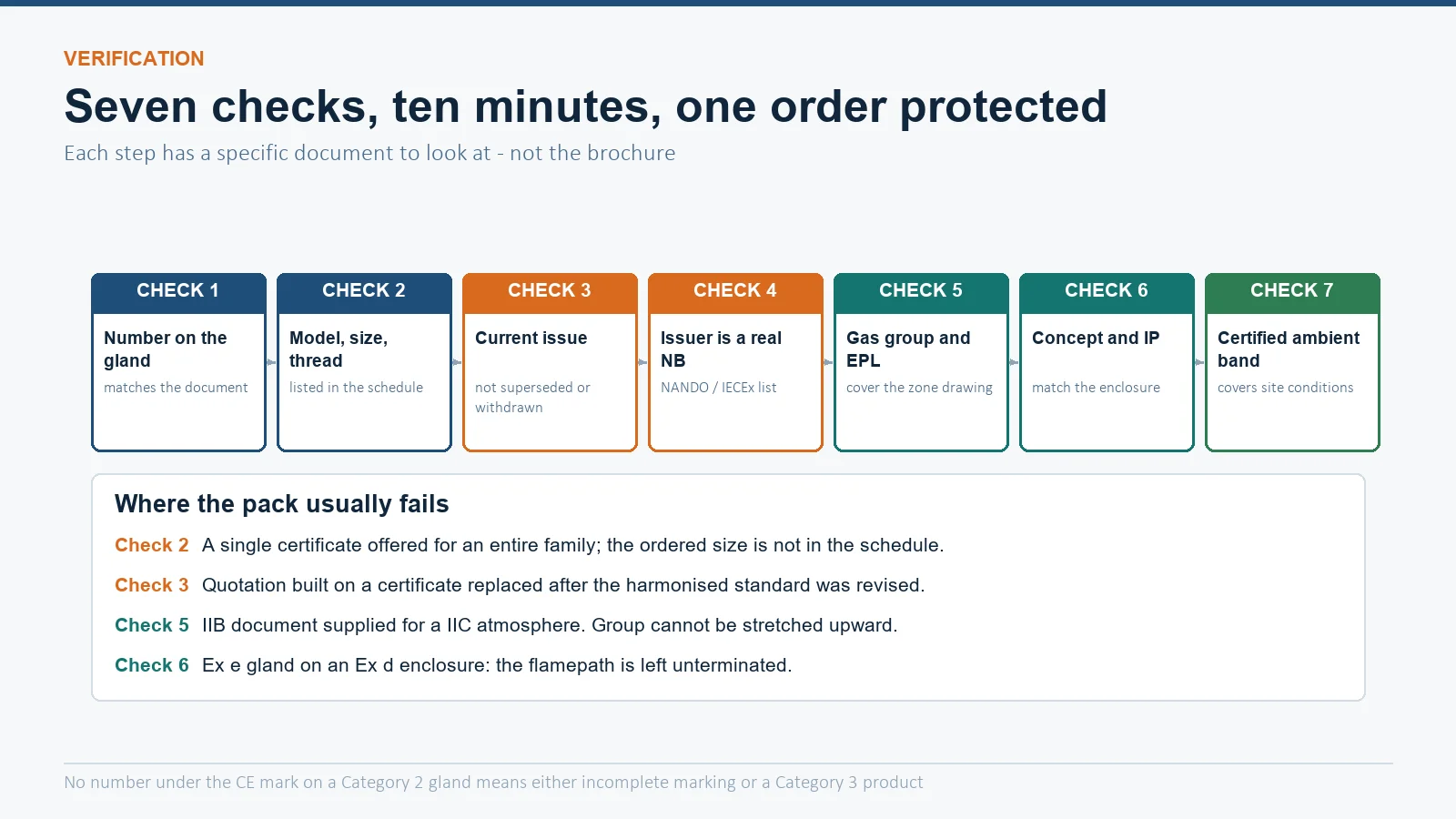
This is the sequence that catches the practical failures. It takes about ten minutes per certificate pack and it does not require hazardous area qualifications, only attention.
| # | Check | Where to look |
|---|---|---|
| 1 | The certificate number on the document matches the number marked on the gland | Gland body, label, or the sealed bag label |
| 2 | The exact model, size and thread form appear in the schedule | Schedule of the type examination certificate, not the marketing brochure |
| 3 | The certificate is the current issue, not superseded or withdrawn | Notified body certificate database, or the IECEx online certificate system |
| 4 | The issuing body is genuinely designated for Ex certification | EU NANDO database for ATEX; the IECEx list of accepted ExCBs |
| 5 | Gas group and EPL cover the zone on the area classification drawing | Marking string compared against the zone drawing |
| 6 | The protection concept and IP rating match the enclosure it enters | Enclosure certificate, plus the gland’s X conditions |
| 7 | The certified ambient band covers site conditions, including solar gain inside a cabinet | Marking string and the certificate schedule |
Checks 2 and 3 are where most problems appear. Check 2 fails when a supplier sends one certificate for a whole family and the actual size is not listed. Check 3 fails when a quotation is built on a certificate from 2011 that was replaced after the standard was revised.
Scope traps: size, thread and gas group
A certificate is not a range. It is a list. The schedule names the sizes, the thread forms and the cable ranges that were examined, and it does not stretch beyond them.
- Size is part of the scope. A certificate issued for an M20 brass gland does not cover the M25 in the same family, even though the drawing looks similar and the factory builds both.
- Thread form is a separate entry. A parallel metric entry such as M20 × 1.5 and a tapered NPT entry such as 3/4″ NPT are different certifications, not different labels. This is the single most common mismatch on multi-market orders, and the [thread conversion chart](https://wilmall.com/the-ultimate-cable-gland-size-chart-you-must-use-today/) is the wrong tool for deciding it: conversion tells you which sizes are close, not which are certified.
- Material can split the scope. Brass, nickel-plated brass and stainless steel are frequently certified under separate numbers, because the mechanical and corrosion behaviour differs.
- Gas group cannot be stretched upward. A IIB certificate does not permit use in a IIC atmosphere. Downward is allowed.
- Temperature class is bound to the assembly. A T6 gland installed with a sealing compound that is rated to T5 gives you a T5 assembly.
Two installation rules that void certificates when ignored
The first is thread engagement. Flameproof entries need a defined number of full threads engaged in the enclosure wall, commonly five full threads and at least 8 mm of engagement for metric entries under IEC 60079-14. A gland that only catches three threads is not the assembly that was certified, and a locknut on the outside does not restore the flamepath.
The second is concept matching. An increased safety (Ex e) gland on a flameproof (Ex d) enclosure breaks the flameproof barrier, because the flamepath is meant to be terminated by a certified Ex d entry device. Increased safety installations also have an IP floor: an Ex e enclosure is not permitted below IP54, so a gland that seals to IP44 has no place on one. If you are comparing protection concepts across product types, the same logic is set out for [ATEX pendant stations and their zone marking](https://wilmall.com/atex-iecex-class-1-div-2-pendant-stations/).
Red flags in a supplier document pack
| What you see | Why it is a problem |
|---|---|
| “ATEX certified” with no certificate number anywhere in the pack | No number, nothing to verify. The claim cannot be checked and should not be accepted for a Zone 1 scope |
| One certificate presented for an entire product family | The schedule lists specific sizes and threads. A family claim usually means the sizes you ordered are outside the scope |
| Certificate carrying another manufacturer’s name or logo | Certificates are not transferable. A copy of a competitor’s document is a misrepresentation, not a compliance shortcut |
| Certificate issued before the current edition of the harmonised standard with no variation | Designs must be reviewed when standards change. An old issue with no update trail is at best a paperwork delay |
| Category 2 product with no four-digit notified body number under the CE mark | Either the marking is incomplete or the product is Category 3 self-declared |
| Issuer is an “EU testing laboratory” absent from NANDO | Only designated notified bodies can issue an EU-Type Examination Certificate |
| DoC with no list of harmonised standards, or a generic list unrelated to Ex | The declaration must reference the standards the product was assessed against |
| Ambient temperature simply absent | The default becomes -20 °C to +40 °C, which fails most outdoor and many tropical installations |
What to request with the quotation
Ask for the document pack at quotation stage, while the order can still be changed without rescheduling. The pack for a hazardous area gland order should contain:
- EU Declaration of Conformity for the exact model, listing the standards applied.
- EU-Type Examination Certificate with the schedule pages, not just the cover sheet.
- Quality Assurance Notification number for Category 1 and 2 products.
- IECEx CoC and QAR if the destination market or the EPC specification calls for IECEx.
- Certificate of origin and material certificates for the brass or stainless body, if the project has a traceability requirement.
- The HSN classification used for the invoice, which for cable glands is normally under heading 8536 and is covered separately in the [cable gland HSN code guide](https://wilmall.com/cable-gland-hsn-code/).
Regional acceptance differs, and a single ATEX certificate rarely covers a multi-country shipment:
| Market | What is normally required |
|---|---|
| European Union and EEA | ATEX to Directive 2014/34/EU — mandatory; EU DoC plus type examination certificate |
| Great Britain | UKCA and UKEX, closely aligned with ATEX; CE recognition has been extended, so both packs are usually supplied |
| India | PESO approval for flameproof equipment, with IECEx increasingly quoted alongside it |
| Middle East, Australia, Southeast Asia, Brazil, South Africa | IECEx is the usual route |
| United States and Canada | Neither scheme applies; Class and Division or Zone certification through UL, FM or CSA is the requirement |
| China | GB 3836 series with CCC Ex marking |
For a dual-certified order, the [CMP-style flameproof gland range](https://wilmall.com/cmp-cable-glands-atex-certified-explosion-proof-armoured-industrial/) is the type of product to compare against when a specification asks for both ATEX and IECEx on the same item, and a [nickel-plated brass IP68 gland](https://wilmall.com/brass-cable-gland-nickel-plated-ip68-waterproof-industrial-grade/) shows the same construction in a general purpose version for the safe-area side of the same plant.
The practical takeaway
A cable gland certificate is a small, specific, checkable document. It names one issuer, one year, one serial, one set of sizes and threads, one gas group and one ambient band. Almost every dispute about hazardous area glands traces back to somebody treating it as a general statement of quality rather than a scoped claim.
The discipline that pays off is simple: decode the number, read the schedule, match it to the marking on the body, confirm the issuer still exists in the database, and compare the marking string against the enclosure it threads into. Ten minutes at quotation stage prevents a rejected delivery, a re-test, and a site visit that nobody wants to pay for.
PERGUNTAS FREQUENTES
Does an ATEX certificate expire?
Not on a fixed date. A certificate stays valid until it is withdrawn, superseded by a new issue, or the harmonised standard changes enough that the design has to be reassessed. Notified bodies publish the current status, which is why check 3 in this guide exists. A certificate from 2011 with no later variation is a document to question rather than to reject outright.
Is an IECEx certificate accepted in Europe instead of ATEX?
No. There is no conversion in either direction. An IECEx CoC does not satisfy EU product law, and an ATEX certificate is not an IECEx certificate. What travels between the schemes is the underlying test evidence, which often makes a second approval cheaper, but never replaces it.
Why does my cable gland certificate have a U after the number?
U means the gland is certified as an Ex component rather than complete equipment. Cable glands, empty enclosures, terminals and pushbuttons are normally certified this way, because they only function as part of an assembly. The enclosure the gland enters still needs its own certification for the same protection concept, gas group and EPL.
What does the X on an ATEX certificate number mean?
It means the certificate contains specific conditions of use. Common examples are an ambient range narrower than the default -20 °C to +40 °C, a requirement that the gland be fitted with an approved sealing washer, or a condition on the enclosure IP rating. Those conditions are mandatory for the installer, not advisory.
Can I use an Ex e gland on an Ex d enclosure?
No. The flameproof barrier of an Ex d enclosure has to be terminated by a certified Ex d entry device. Fitting an increased safety gland leaves the flamepath open to the surrounding atmosphere and voids the assembly certification, regardless of what the individual documents say.
How do I check whether a certificate number is real?
Two lookups. For ATEX, confirm the issuing body in the European Commission’s NANDO database and then use that body’s own certificate register. For IECEx, search the certificate number in the IECEx online certificate system, which lists the CoC, the ExTR reference and the QAR. Both lookups take a minute and neither requires an account.