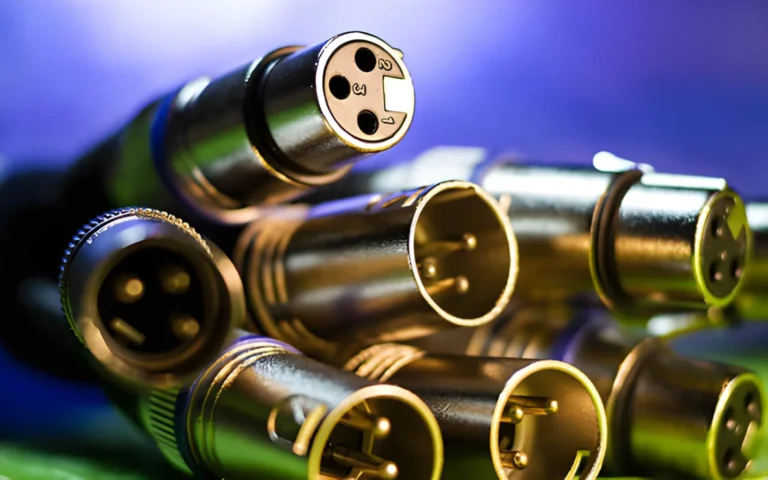
Aircraft vs Aerospace vs Aviation Connectors: What Buyers Actually Mean
What aircraft, aerospace and aviation connectors actually mean in procurement, which standards govern each, and where industrial circular connectors fit.
Read More
Search for any circular industrial connector and you will meet three names for what looks like the same product: GX16, GX12, и LD16. Buyers ask for one and get quoted another, then discover the flange hole they drilled does not fit. The confusion is real and it has a simple cause: GX12/GX16 are the traditional Chinese-standard naming for threaded circular connectors, while LD and SD describe modern moulded-shell series that use the same mounting footprint but a different locking and sealing construction.
This guide gives you the dimension and pin-count tables for each family, the mounting-hole sizes you actually need to drill, and a decision path for choosing between them. All figures refer to the common 2- to 12-pin industrial grades; audio-market versions of “GX16” follow different dimensions and should not be mixed into industrial panels.
| Series | Shell style | Locking | Panel hole (typ.) | Pin range | Rated current (typ.) | Best fit |
|---|---|---|---|---|---|---|
| GX12 | Metal screw shell, 12 mm thread | M12×1 thread | 12.2–12.5 mm | 2–7 | 3–5 A | Compact sensors, signal panels |
| GX16 | Metal screw shell, 16 mm thread | M16×1 thread | 16.2–16.5 mm | 2–10 | 5–10 A | General industrial power + signal |
| GX20 / GX25 | Larger screw shells | M20×1 / M25×1 | 20.5 / 25.5 mm | 2–10 | 10–20 A | Higher current feeds |
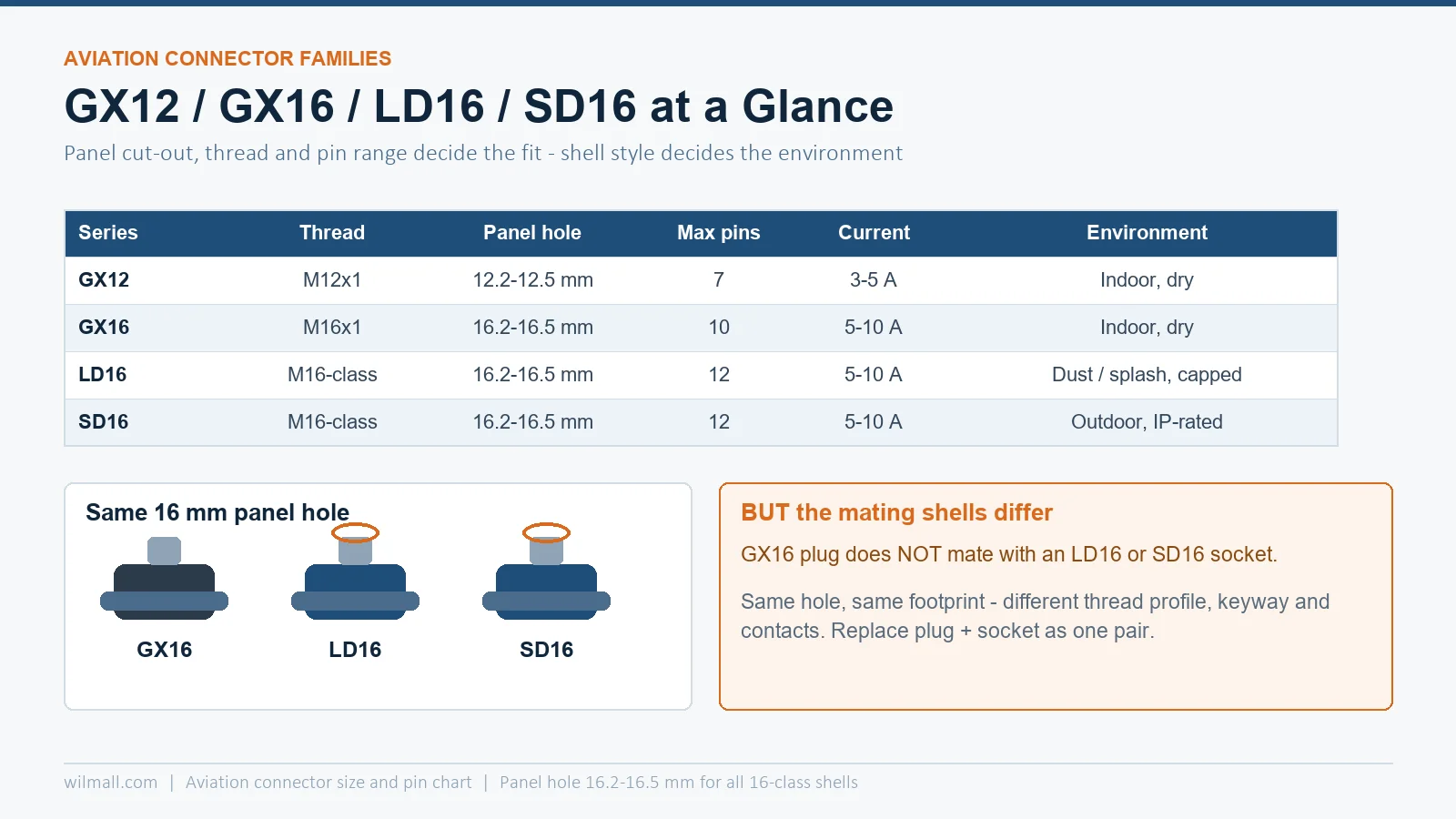
| LD series (LD16) | Moulded plastic/metal hybrid | M16-class threaded ring, with sealing cap | 16.2–16.5 mm | 2–12 | 5–10 A | Wet, dusty or outdoor panels |
| SD series (SD16) | Moulded shell, bayonet-assisted cap | Threaded + weather cap | 16.2–16.5 mm | 3–12 | 5–10 A | IP-rated outdoor connections |
The practical takeaway from the table: GX12, GX16, LD16 and SD16 all mount in the same 12 mm or 16 mm panel hole. The differences are the shell material, the sealing system, and how much current the contact cluster tolerates. That is why a buyer who designed a panel around “a GX16” can usually accept an LD16 as the delivered part — and why the substitution must still be confirmed, not assumed.
 ” />
The GX family is named by its shell thread size in millimetres. Everything else — panel hole, gland range, contact capacity — scales from that number. The table below lists the sizes that appear in industrial purchasing, with the dimensions that decide whether a connector fits your enclosure.
| Модель | Thread | Panel cut-out | Shell Ø (approx.) | Max pins | Typical current | Cable range |
|---|---|---|---|---|---|---|
| GX12 | M12×1 | 12.2–12.5 mm | ~15 mm | 7 | 5 A | 3–6 mm |
| GX16 | M16×1 | 16.2–16.5 mm | ~19 mm | 10 | 5–10 A | 4–8 mm |
| GX20 | M20×1 | 20.4–20.8 mm | ~23 mm | 10 | 10–15 A | 6–10 mm |
| GX25 | M25×1 | 25.4–25.8 mm | ~29 mm | 10 | 15–20 A | 8–12 mm |
Three dimensions cause nearly all field problems:
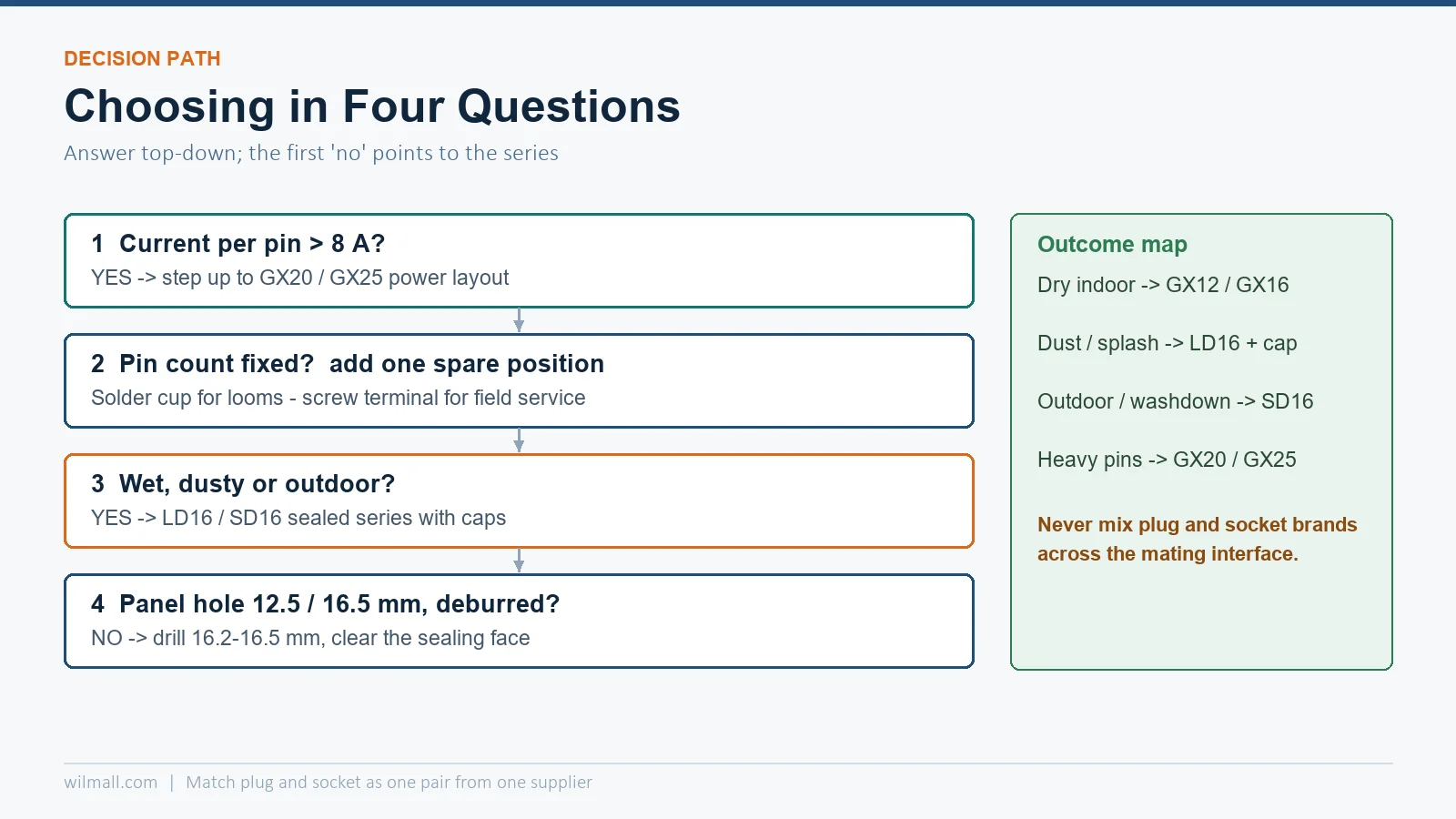
The two sizes differ in more than diameter. GX12 carries fewer pins (up to 7) and smaller contacts, which caps continuous current around 3–5 A for the common pin layouts. GX16 with 8 pins or fewer typically carries 5–10 A depending on the supplier’s contact plating and the pin diameter used. If your load is a 24 V sensor or a valve solenoid, GX12 is usually enough and saves panel space. If you are feeding a small motor, a heater band or a light bar that draws several amps, GX16 is the safer default and costs only a few cents more.
One more practical difference: because GX12’s shell is smaller, its solder cups are tighter. Field-wiring 1.5 mm² conductors into a 7-pin GX12 is awkward; GX16 handles 1.5 mm² comfortably in most pin counts. For serviceable panels — anything a technician may rewire — the larger shell pays for itself.
Pin count is where ordering mistakes concentrate, because the same model number covers very different internal layouts. The industry convention arranges pins in rings: a centre pin for the first, then an inner ring, then an outer ring. The table shows the common industrial arrangements.
| Pins | Arrangement | Common use | Wire note |
|---|---|---|---|
| 2 | Centre + 1 | Single-phase power, LED feeds | Power pair, no signal |
| 3 | Centre + 2 | Sensor with supply, small motors | Keep signal away from power pin |
| 4 | Centre + 3 | RS-485, encoder feedback, DC power + PE | our dedicated 4-pin wiring guide |
| 5 | Centre + 4 | Stepper motors, 3-phase signal + PE | Largest single search volume — see note below |
| 6 | Centre + 5 | Motor with brake, multi-sensor looms | Check current per pin, not total |
| 7 | Centre + 6 (GX12 max) | Control looms, joystick feeds | Pin spacing tight; use ferrules |
| 8 | Centre + 3 + 4 | Mixed power/control | Assign power to centre + inner ring |
| 10 | Centre + 3 + 6 | Encoder + power + spare | Outer-ring pins share current path |
Why 5-pin dominates search. Five pins is the natural layout for a three-phase signal pair plus earth, for a stepper motor (two coils = four wires + shield), and for countless 4-wire sensor plus drain combinations. If you are standardising a panel on one pin count and have no reason otherwise, 5-pin GX16 is the most widely supported and the easiest to source replacement parts for.
GX12/GX16 connectors ship in two termination styles. Solder cups suit factory looms: a trained assembler, a temperature-controlled iron, and heat-shrink over each joint. Screw-terminal rear shells suit field service: no soldering iron on site, wires under a screw, done in minutes. If your maintenance team will ever re-terminate in the field, order the screw-terminal version even if the unit price is higher — the alternative is cutting back a moulded loom.
Сайт LD16 series aviation plug keeps the M16-class mounting footprint of a GX16 but replaces the all-metal screw shell with a moulded body and an integrated sealing cap. That construction change buys three things a bare GX16 does not have:
Сайт SD16 aviation cable connectors push the same idea further with IP-rated sealing on both plug and socket, aimed at outdoor cabinets, agricultural equipment, and marine-adjacent installations. For a comparison of the sealed ranges, the SD13 (M13 footprint) and SD20 (M20 footprint) cover the panel sizes on either side of 16 mm.
| Situation | Substitution OK? | What to verify |
|---|---|---|
| New panel design, hole already 16.2–16.5 mm | Yes | Pin count and contact rating match the loom |
| Replacing a failed GX16 on an existing loom | Usually | Mating socket must also be LD/SD — shells do not interchange |
| Existing GX plug must mate with existing GX socket | No | Thread profiles and keyways differ between families |
| High vibration, moving cable | Yes, preferred | Moulded strain relief outperforms the GX rear gland |
| Potentially explosive or food-washdown areas | Not by default | Requires certified connector families, not a shell swap |
The rule that matters most is the third row: LD and SD plugs do not mate with GX sockets, even though the panel holes match. If half your plant is wired with GX and you want to standardise on LD, plan the changeover per complete connection pair — plug plus socket together.
 ” />
No. XLR is a latching audio connector with a different shell and contact system. Some audio-market products are sold as “GX16” but follow XLR-like dimensions. Industrial GX16 is a threaded M16×1 connector; buy from industrial suppliers and check the dimension table before drilling.
Typically 5 A per pin continuous for standard contacts, with some suppliers rating 10 A on larger-diameter pins. De-rate if the loom is bundled, inside a hot enclosure, or at altitude — the same thermal derating logic that applies to any connector applies here.
No. The panel cut-outs are the same but the thread profiles, keyways and contact systems differ. Always replace plug and socket as a pair.
SD16 (or LD16 with sealing caps) — the moulded shell and caps keep water and dust out of the contacts both mated and unmated. A bare metal GX16 relies on the thread joint alone and has no unmated protection.
16.2–16.5 mm for the standard flange. Clear paint from the sealing face and debur the edge so the O-ring seats flat.