Bypass Contactor and Soft Starters: Wiring, Sizing and When You Need One
Why a soft starter bypass contactor saves 4.5 W per running amp, when AC-1 is enough, when it must be AC-3, and the wiring and control settings that keep it alive.
Read More
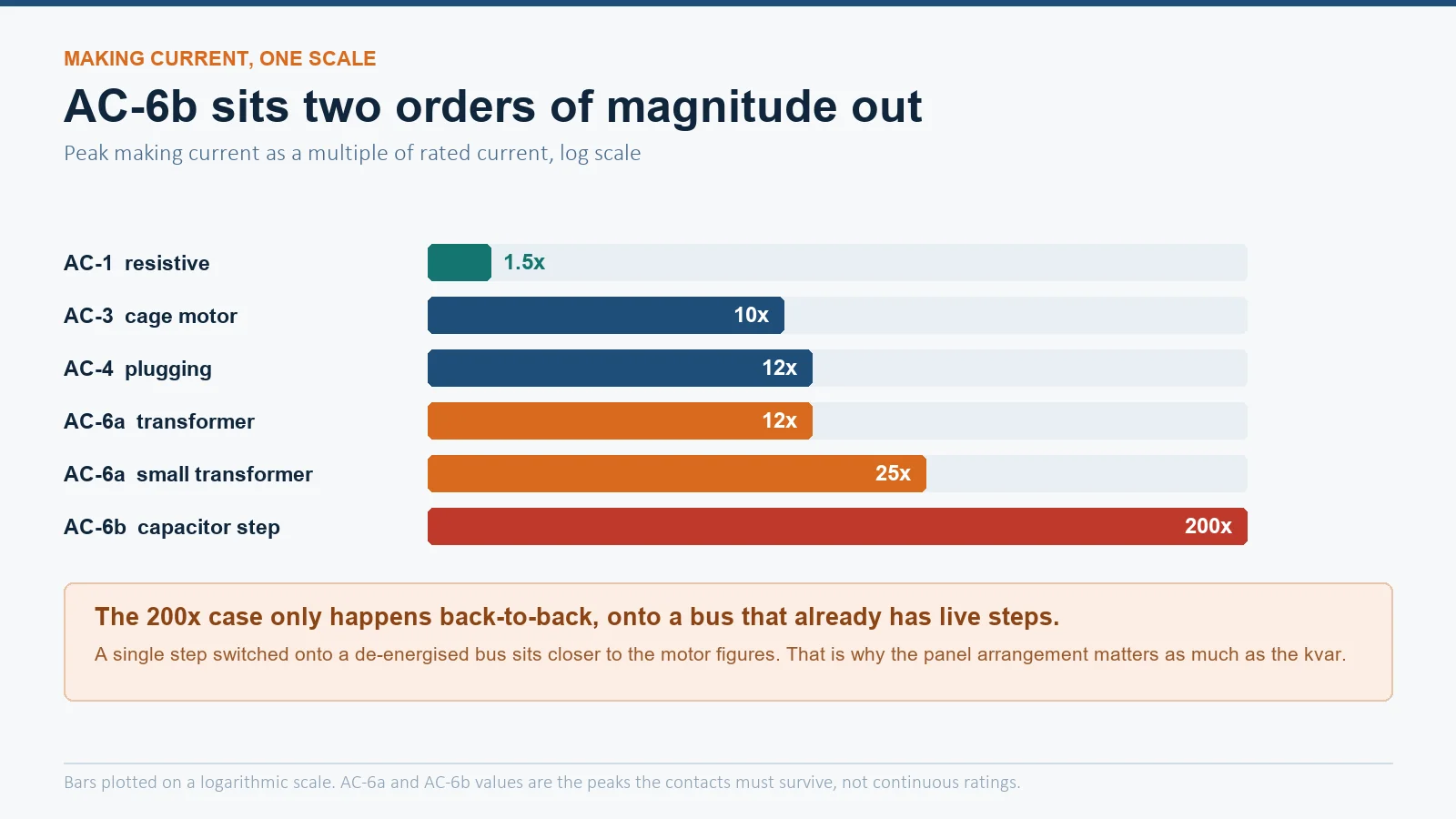
Quick answer: AC-6a covers transformers, where magnetising inrush peaks at roughly 8 to 12 times rated current. AC-6b covers capacitor banks, where the peak can reach 200 times the capacitor’s rated current when a step closes next to an already-energised step. A standard AC-3 contactor can serve AC-6a if it carries a published AC-6a rating. It must never be used for AC-6b — capacitor duty needs a contactor with pre-insertion resistors.
Most buyers meet these two categories the hard way. A contactor that has run a pump for years is moved to a transformer feeder or a power factor correction panel, and within a month the contacts are welded shut. Nothing was overloaded and nothing was miswired. The device was simply asked to make a current it was never tested to make.
This page covers what AC-6a and AC-6b actually test, why IEC 60947-4-1 gives neither category a single conversion factor, and how to pick a frame for a transformer feeder versus a capacitor step. If you are working through the rest of the AC contactor utilization categories, this is the pair that sits outside the motor world entirely.
These are not variants of AC-3. They are separate qualifications with their own test duties.
| Артикул | AC-6a | AC-6b |
|---|---|---|
| Load switched | Transformer primary or secondary | Shunt capacitor bank, single step or back-to-back |
| What dominates the stress | Magnetising inrush with DC offset | Capacitive discharge current between steps |
| Typical peak current | 8–12 × rated (20–25 × on small transformers) | Up to 200 × rated capacitor current |
| Duration of the peak | First half-cycle, decaying over 0.05–0.3 s | One to a few milliseconds |
| How the rating is established | Transformer test, or derived from AC-3 by formula | Test with a bank, formula given in the standard |
| Operating cycles in the test | 6,000 | 6,000 |
For AC-3 the standard is generous with arithmetic: make at 10 times rated current, break at 8. AC-4 makes at 12 and breaks at 10. You can check a datasheet against those numbers in your head.
AC-6 does not work that way. The making and breaking current ratios are left to the manufacturer, with a note stating that the AC-6a rating is either verified by testing with a transformer or derived from AC-3 values using the standard’s calculation. AC-6b has its own calculation clause based on capacitor power rather than a current multiple.
Two consequences follow, and both are commercial:
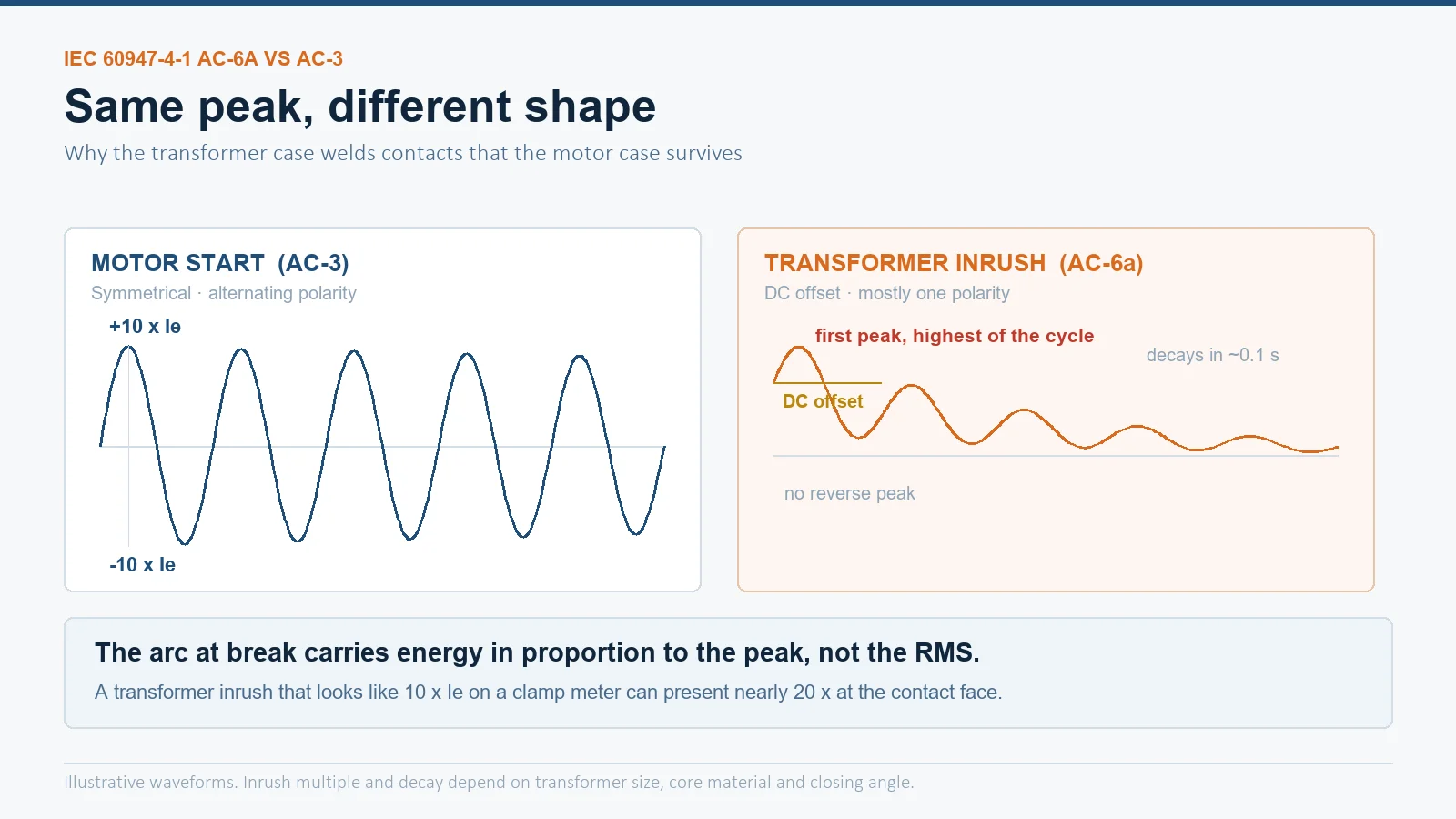
Energising a transformer is not like starting a motor. At the instant of closing the core has no established flux, and depending on where in the voltage wave the contacts touch, it can be driven deep into saturation. The current is unidirectional for the first few cycles — a DC offset riding on the AC waveform — before it decays to normal magnetising current.
That asymmetry is what damages contacts. A symmetrical 10 times current is survivable. The same current with full offset produces a peak roughly twice as high, and the arc at the first break carries energy in proportion. Add contact bounce, which re-strikes the arc several times in the first millisecond, and you have the mechanism behind most welded transformer-feeder contactors.
Three points follow. Small transformers are worse, not better — high winding resistance shortens the decay but the multiple climbs to 20 times or more. Closing angle is random, so you design for the worst case; a contactor that survived twenty switch-ons can fail on the twenty-first. And secondary-side switching is the harder duty, because the contactor carries the inrush reflected through the turns ratio.
To size an AC-6a application, start with the transformer’s rated primary current — kVA divided by √3 times line voltage, so a 400 kVA unit at 400 V is 578 A. Then select a contactor whose published AC-6a rating at that voltage meets it. For a transformer energised several times an hour, step up one frame rather than running the published figure at its limit. The AC-3 rating chart gives the frame-by-frame currents you are stepping up from.
Switching a single capacitor step onto a de-energised bus is relatively gentle — the inrush is limited by supply impedance and lands at a few times rated current.
Switching a step onto a bus that already has energised steps on it is a different event. The new capacitor sees the other capacitors as a near-zero-impedance source, and only a short run of busbar limits the current. Capacitor-duty datasheets state the resulting limit plainly: the device must withstand a peak of up to 200 times the rated capacitor current without welding.
That current lasts one to a few milliseconds, which is why it does not blow fuses and does not show on a clamp meter. It is long enough to melt and bridge a contact face.
Capacitor-duty contactors handle it mechanically rather than with bigger contacts. Leading contacts close first in series with damping resistors; the main contacts follow a few milliseconds later and short the resistors out. Datasheets describe the result as an inrush suppression capability of roughly 20 times rated current through the resistor path, against the 200 times the main contacts survive when the sequence works.
Two installation details belong here: the bank’s discharge resistors must be allowed to bring it down before a step is re-energised, and in harmonic-rich networks a detuned reactor changes the waveform the contactor sees. A reactor lowers the peak; it does not convert a standard contactor into a capacitor-duty device.
| Situation | Standard AC-3 contactor acceptable? | What to do |
|---|---|---|
| Transformer feeder, occasional switching | Yes, if an AC-6a rating is published | Select on AC-6a current at line voltage; get the rating in writing |
| Transformer feeder, frequent switching or high-inrush transformer | Marginal | Step up one frame, or specify a device with a declared AC-6a rating at the next size |
| Capacitor step switched alone | Not recommended | Capacitor-duty contactor; the risk is cumulative erosion, not immediate failure |
| Capacitor step, back-to-back in an APFC panel | No | Capacitor-duty contactor with pre-insertion resistors, sized by kvar |
| Capacitor step with detuned reactor | No | Capacitor-duty contactor; the reactor lowers the peak, it does not qualify the device |
Note the asymmetry in failure modes. A wrong AC-6a choice shows up as premature contact wear, rising resistance and nuisance trips — the stuck-closed contactor is the end state. A wrong AC-6b choice welds on the first back-to-back close and takes the capacitor step with it.
Capacitor current is not the current a motor of similar frame would draw. A 63 A frame used as a motor contactor is a 63 A AC-3 device; the same physical frame built for capacitor duty is typically rated around 43 A in AC-6b. Roughly two-thirds, because the switching duty is harder even though the running current is easier.
Start from the step size in kvar and the system voltage, then read the contactor’s own table. Current equals kvar divided by √3 times line voltage, so a 50 kvar step at 400 V draws 72 A. Published ranges line up with that:
| Contactor frame | Ie in AC-6b | kvar at 230 V | kvar at 400 V | kvar at 690 V |
|---|---|---|---|---|
| Smallest | 17 A | 6.7 | 12.5 | 18 |
| — | 29 A | 15 | 25 | 36 |
| — | 43 A | 20 | 33.3 | 48 |
| — | 72 A | 35 | 50 | 92 |
| — | 87 A | 40 | 60 | 100 |
| Largest | 130 A | 52 | 90 | 130 |
Two adjustments before ordering. In networks with significant harmonic content, add 20 to 30 percent to the kvar figure and take the next frame up. And check the permissible operating temperature against the inside of the panel, not the room — an APFC panel in a tropical plant runs well above ambient, and capacitor contactors are commonly rated to 55 °C rather than the 60 to 70 °C of a general-purpose device. The same logic is covered under contactor derating for temperature and altitude.
| Mistake | What happens | Fix |
|---|---|---|
| Sizing the capacitor contactor by AC-3 amps | Device runs at 140% of its AC-6b rating | Size by kvar and the AC-6b column |
| Assuming AC-3 implies AC-6a | No qualified rating; liability sits with the panel builder | Ask for the AC-6a declaration in writing |
| Re-energising a step before it has discharged | Inrush multiplied by residual voltage; welding | Respect the controller’s discharge delay |
| Mixing capacitor-duty and standard contactors in one panel | Standard units fail first and get replaced with the same part | Standardise on the capacitor-duty part |
| Using a capacitor contactor as a motor contactor | Rated only for capacitor current; starting exceeds it | Match the category to the load, not the frame to the terminal size |
For the wider picture, the AC-1 to AC-4 utilization categories guide covers the motor side and the AC-7a vs AC-7b comparison covers domestic loads. If your application is auxiliary circuits rather than main power, the AC-15 vs DC-13 ratings explain why control contacts collapse to a fraction of an amp on DC.
AC-6a is transformer switching, where the stress is magnetising inrush with a DC offset — typically 8 to 12 times rated current decaying over a tenth of a second. AC-6b is capacitor bank switching, where the stress is a very short capacitive discharge between steps, peaking at up to 200 times the rated capacitor current.
Only if the manufacturer publishes an AC-6a rating for that device. The standard allows the rating to be derived from AC-3 test values, but the derivation is the manufacturer’s declaration, not something a buyer can calculate from a nameplate.
Usually one of three causes: a standard contactor was installed instead of a capacitor-duty device, the step was re-energised before the bank discharged, or the panel is harmonic-rich and the contactor was sized on fundamental kvar alone. A contactor with failed pre-insertion resistors behaves like a standard contactor and welds the same way.
No. A reactor reduces the peak and changes the waveform, which is why it is required in harmonic-rich networks, but the contactor still has to be qualified for AC-6b. The two solve different problems and are normally specified together.
The IEC test duty for AC-6a and AC-6b is 6,000 operating cycles, far below the 100,000-plus mechanical life of a general-purpose contactor. Capacitor-duty ranges typically publish 100,000 to 250,000 electrical operations with a limit on operations per hour. In an APFC panel switching a few dozen times a day that is years of service; in a transformer feeder switched hourly it is months.
Decide which load you actually have before opening a catalogue. A transformer feeder is a sizing exercise: find the primary current, then buy a contactor with a published AC-6a rating at that voltage. A capacitor step is a category exercise: no standard contactor qualifies, and the only variable is which capacitor-duty frame your kvar and voltage point to.
If you are specifying a transformer feeder and need a frame sized against the inrush case rather than the running current, the CJX2-F225 three-pole contactor is rated through 660 V and is the usual starting point for medium transformer duties. Send the transformer kVA, primary voltage and switching frequency, and we will confirm whether a standard frame is enough or the duty calls for a capacitor-duty style device.