








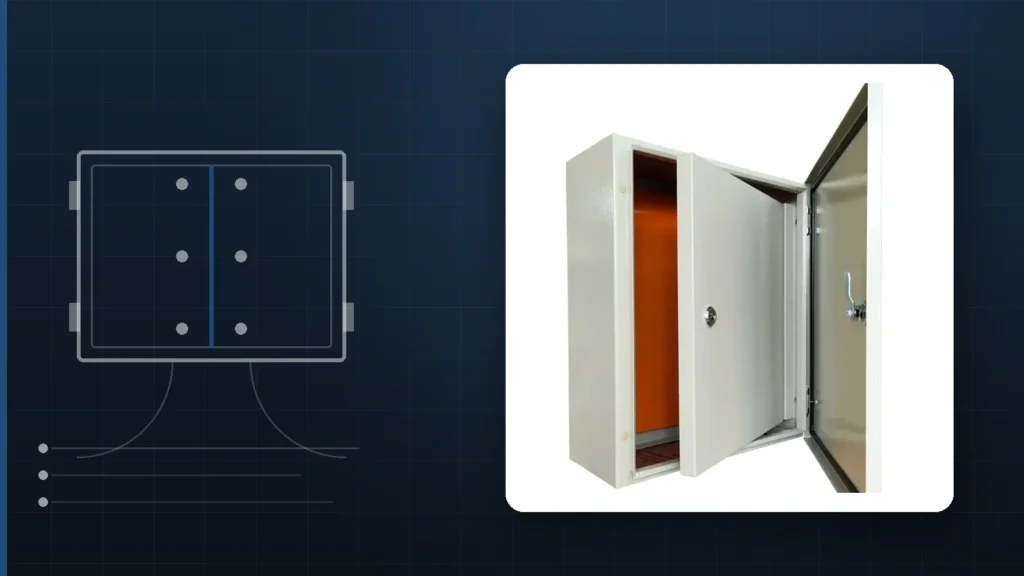
Short answer: a double door modular enclosure exists for one reason — once the cabinet face passes roughly 800 mm, a single leaf becomes too heavy to keep aligned on its hinges and needs more clear aisle than most switch rooms have. Splitting it into two leaves halves the weight and the swing arc, but it also adds a vertical centre joint, which is why the same maker will rate a single-door cabinet IP66 and its double-door sibling IP55. Size the enclosure by internal width first, then confirm the IP rating on the two-leaf version specifically — not on the single-door datasheet.
A double door enclosure is a metal cabinet whose front face is closed by two leaves instead of one. The extra leaf is not a styling choice: it changes hinge load, gasket geometry, locking hardware and the achievable ingress protection, and it changes what you can mount on the door. This guide covers the width at which two doors start to make sense, the size sequence you will actually be quoted, what the centre joint does to IP65, and the build details worth writing into a purchase order.
When a Cabinet Width Forces Two Doors
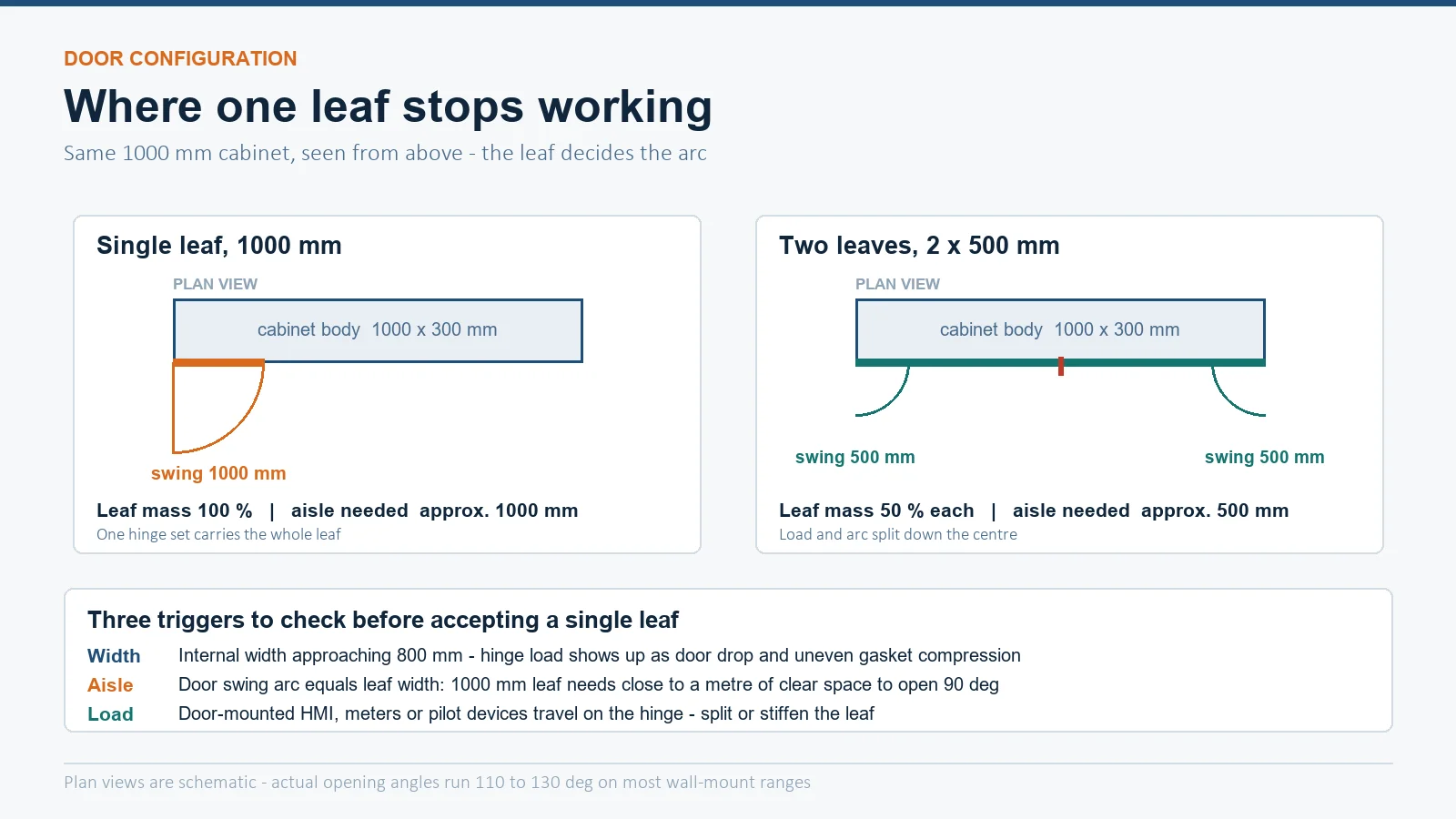
The usual engineering trigger is internal width. Around 800 mm a single door leaf carrying a 1.5–2 mm steel skin, a lock, a door-mounted instrument and a wire duct starts to load the hinges in a way that shows up as door drop: the leaf sags at the free edge, the lock no longer lines up with the keeper, and the gasket stops being compressed evenly along the bottom edge. Once the seal compression varies, the IP rating is nominal rather than real.
The second trigger is the room in front of the cabinet. A door hinged on one side sweeps an arc roughly equal to its own width. A 1,000 mm single leaf needs close to a metre of clear space to open 90°, and more than that to open to its full travel. Two 500 mm leaves need half of that each, which is often the only way a wide cabinet fits a narrow switch room, a corridor or a container-based power unit.
Three practical triggers are worth checking before you accept a single-door design:
- Door-mounted devices. If buttons, meters, HMIs or indicators live on the door, that mass travels with the leaf. A wide leaf with a heavy HMI needs a door stay and a stiffened door pan.
- Full-face access to the mounting plate. Wide distribution and control layouts are easier to wire when the whole face opens rather than half of it.
- Line-up consistency. In a row of joined cabinets, keeping the same door configuration across the row avoids one odd-width unit in the middle.
Enclosure Size Range from 200 mm to 1200 mm
Most stock double door ranges are quoted as a height × width × depth sequence, with the model code built from the same three numbers. The range below is our own EWJ series, and it shows where the practical split falls: two-leaf configurations appear from about 800 mm of width upward, while everything narrower is a single leaf or a small wall box.
| Модель | Height (mm) | Width (mm) | Depth (mm) | Typical door configuration |
|---|---|---|---|---|
| ME302015 | 300 | 200 | 150 | Single leaf, small junction box |
| ME404020 | 400 | 400 | 200 | Single leaf |
| ME504025 | 500 | 400 | 250 | Single leaf |
| ME606020 | 600 | 600 | 200 | Single leaf |
| ME705030 | 700 | 500 | 300 | Single leaf, deepest of the narrow group |
| ME806025 | 800 | 600 | 250 | Single leaf, at the practical width limit |
| ME808025 | 800 | 800 | 250 | Single or two leaves depending on build |
| ME1008025 | 1000 | 800 | 250 | Two leaves |
| ME12010030 | 1200 | 1000 | 300 | Two leaves, widest standard frame |
Two things follow from the sequence. First, the model code is readable: ME1008030 means 1200 mm high, 800 mm wide, 300 mm deep — height first, then width, then depth. Second, depth is the dimension people under-specify. A 250 mm deep cabinet holds a mounting plate and a shallow component layer; a 300 mm deep cabinet is what you need once contactors, terminals and cable loops share the same volume.
What the Centre Joint Does to the IP Rating
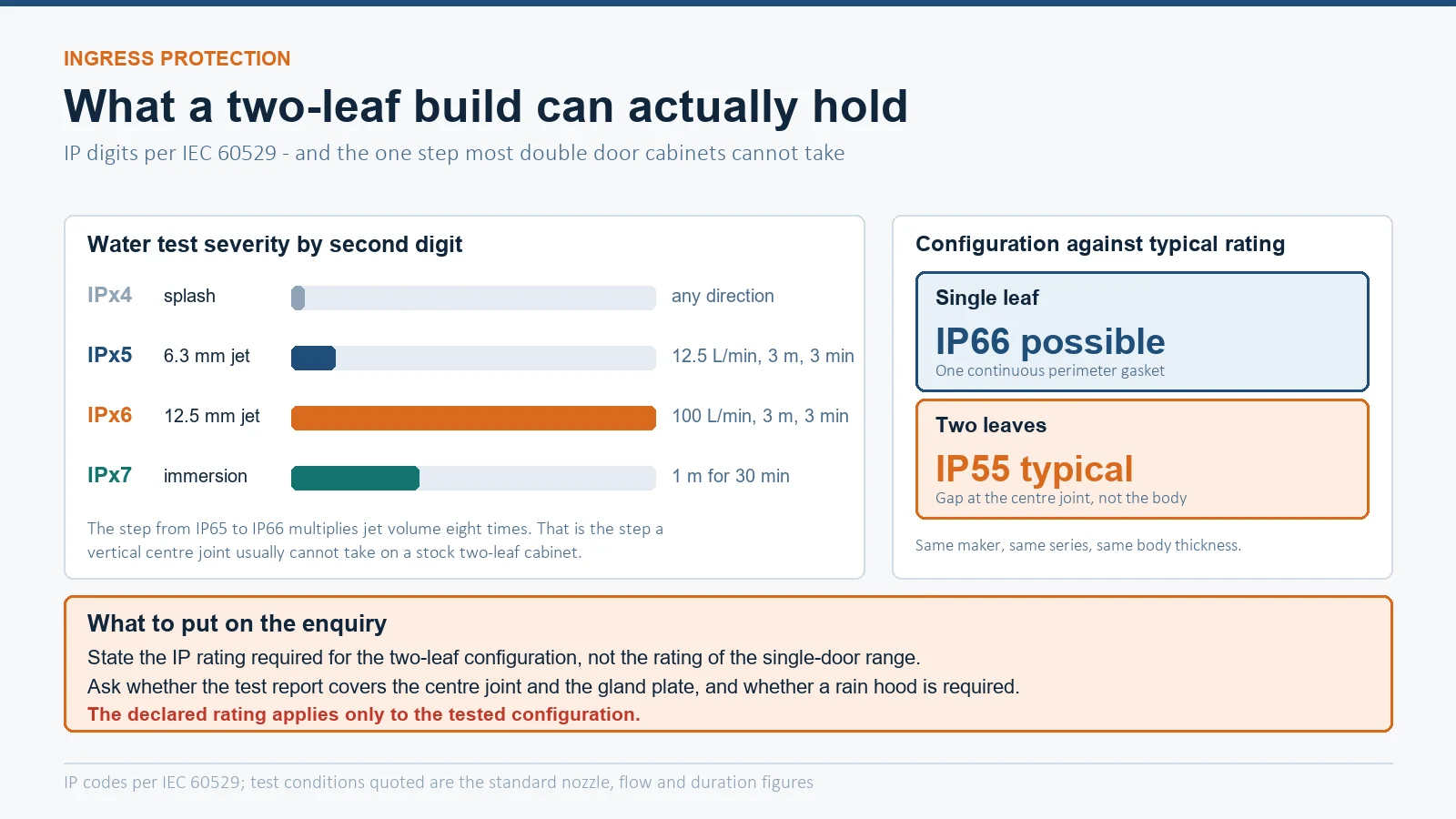
A single-door cabinet seals on one continuous perimeter gasket. A two-leaf cabinet adds a vertical joint between the leaves, and that joint is the hardest line on the whole enclosure to keep sealed, because neither leaf can be pressed against a rigid frame along its middle. This is not a manufacturing defect — it is a geometry problem, and it shows up in published data. Makers who rate a single-door range to IP66 publish the equivalent double-door cabinet at IP55.
The joint is solved in three ways, and a good cabinet uses all three:
- Overlapping leaf edge. One leaf closes first and carries a return flange; the second leaf closes onto it. The overlap hides the gap from a direct water jet.
- Labyrinth path. The overlap is shaped so water has to change direction more than once before it can reach the gasket, which dissipates jet energy instead of relying on rubber thickness alone.
- Three-point locking on both leaves. Locking points at top, middle and bottom pull each leaf flat against the frame, so gasket compression at the joint matches the compression at the corners.
So when a datasheet says IP65, read which variant that figure belongs to. The test conditions behind the digits are what you are actually comparing:
| Rating | Dust | Water test condition (IEC 60529) | Where it is enough |
|---|---|---|---|
| IP54 | Dust protected, not dust-tight | Splashing water from any direction | Indoor plant rooms, covered areas |
| IP55 | Dust protected | Water jets, 6.3 mm nozzle, 12.5 L/min, 3 m, 3 min | Sheltered outdoor, most double-door cabinets |
| IP65 | Dust-tight | Water jets, 6.3 mm nozzle, 12.5 L/min | Hose-down walls, dusty indoor areas |
| IP66 | Dust-tight | Powerful jets, 12.5 mm nozzle, 100 L/min | Exposed outdoor, washdown perimeter |
| IP67 | Dust-tight | Temporary immersion, 1 m for 30 min | Pits, sumps, flood-risk locations |
The step from IP65 to IP66 is not a small one: the jet volume goes up eight times. If your specification says IP66 on a wide two-leaf cabinet, ask for the test report for that exact configuration, including the centre joint and the gland plate. For the underlying mapping between the IEC digits and the North American NEMA types, see NEMA versus IP ratings for electrical enclosures.
Body, Door and Gasket Build for a Two-Leaf Cabinet
Sheet thickness is the number buyers check first and the one that matters least on its own. A 1.2 mm body with a properly folded edge and continuous seam weld is stiffer than a 1.5 mm flat panel. What does matter is that the door is thicker than the body, because the door has to stay flat across its span to keep gasket pressure even.
| Компонент | Typical thickness | What it decides |
|---|---|---|
| Body and sides | 1.2 mm up to about 700 × 500 × 250; 1.5 mm from 800 × 600 upward | Rigidity, cut-out quality, resistance to panel deformation at gland torque |
| Doors (each leaf) | 1.5–2.0 mm | Flatness across the leaf, gasket compression, door-mounted load capacity |
| Mounting plate | 1.5–2.5 mm, galvanised | Device weight, sag between fixings |
| Gland plate | 1.5 mm, removable | Cable entry planning and re-work without cutting the body |
| Gasket | Foamed-in-place polyurethane, full perimeter | IP life; typical range −40 °C to +80 °C |
| Finish | Polyester powder coat, 80–120 µm, RAL 7035 standard | Corrosion life, colour matching across a line-up |
| Hinges | Concealed, removable, captive pin | Door opening angle (110–130° typical) and field removal |
| Locking | Three-point espagnolette per leaf | Even gasket compression at the centre joint |
Two build details are worth insisting on. The first is folded edges on all four sides of the body from 800 mm upward — a flat side panel that size deflects when a gland is torqued into it. The second is press-welded studs for the mounting plate rather than tapped holes: studs let you reposition the plate in depth later without re-drilling, and M8 studs are the usual size on a cabinet this width.
Sheet Steel, 304 and 316 for the Site Chemistry
Material choice is a site-chemistry decision, not an upgrade ladder. Painted sheet steel is the right answer for most indoor and sheltered installations and is the cheapest per unit of stiffness. Stainless gets bought when the atmosphere attacks the coating, not when the duty is heavier.
| Material | Where it holds up | Where it fails |
|---|---|---|
| Powder-coated sheet steel | Indoor plant rooms, covered outdoor, dry industrial | Coastal salt spray, chlorides, frequent washdown, scratch-exposed edges |
| Galvanised sheet steel | Damp indoor, sheltered outdoor, buried services areas | Acid atmospheres; cut edges still need protection |
| Stainless 304 | Food and beverage, pharmaceutical, humid process areas | Chloride-rich or marine air; 304 pits where 316 does not |
| Stainless 316L | Marine, offshore, chemical plants, coastal outdoor | Cost; still not immune to concentrated chlorides or crevice corrosion |
The useful general pattern from published enclosure data is that 304 gives roughly 500–800 hours of salt-spray resistance and 316L more than 1,000 hours, while painted carbon steel sits well below either. Treat those figures as indicative only — the actual coating system, the number of cut edges and the site atmosphere dominate, and the maker’s test certificate governs. For the structural comparison between wall-mount, floor-standing and modular formats, see which type of metal enclosure you need.
Panel Layout: Mounting Plate, Gland Plate and Door Load
A double door cabinet is usually bought because the layout inside it is dense, so the internal furniture decides whether the enclosure works. Plan four things before the order:
- Plate position in depth. Fixing the plate hard against the rear wall wastes the depth you paid for. Adjustable plate position lets you set a wiring zone behind the plate and a device zone in front.
- Gland plate quantity and position. Bottom-entry gland plates at the rear of the base give the shortest path to the mounting plate. On a wide cabinet, two plates are easier to work than one long one.
- Cable entry sizing. The gland holes have to match the glands, which are sized on cable outside diameter rather than conductor size. Work the entry list out against a cable gland size chart before the plate is punched, and confirm the sealing principle in what a cable gland actually seals and anchors.
- Door loading. Put HMIs, meters and pilot devices on the lighter leaf where you have a choice, and add door profiles or a stay if the door-mounted mass is significant. Heavy items belong on the mounting plate, not on a hinge.
If the cabinet is one unit in a larger distribution scheme, the enclosure decision has to follow the board design, not the other way round. The selection logic in how to choose the right distribution box covers that upstream step.
Earthing and Door Bonding on a Painted Cabinet
Powder coat is an insulator. A painted door sitting on painted hinges has no dependable electrical path to the body, no matter how tight the hinge pin is, and a fault inside the cabinet can leave the leaf at a potential that only shows up when someone opens it. Every leaf needs its own braided bonding strap from the door to an earth stud on the body, with the paint removed at both landing points.
Three requirements make the bond real rather than nominal:
- A dedicated earth stud per leaf — typically M6 on a wall cabinet, M8 on the wider frames — not a self-tapping screw into the door skin.
- Bare-metal landing. Mask or clean the coating at the strap terminals. A strap bolted onto paint is decoration.
- A measured result. Protective circuit continuity is a declared characteristic under IEC 62208, and the assembly inherits the requirement from IEC 61439. Verify with a low-resistance ohmmeter at commissioning and record the reading; a fraction of an ohm is the target, not “it beeps”.
Heat Load Check Before You Order
A sealed IP65 cabinet is a sealed box, so every watt dissipated inside it raises the internal temperature above ambient. Before confirming the size, add up the losses of the devices going in — contactor coils, a control transformer, a power supply, VFD standby losses — and compare that total with the dissipation the enclosure can shed at the site’s maximum ambient, not at 20 °C.
The working rules that hold up in practice:
- Keep a margin of about 20% between the calculated internal load and the enclosure’s rated dissipation capacity.
- Above roughly 300 W of internal loss, passive dissipation on a painted steel surface is usually not enough, and a heat exchanger, filter fan or air conditioner becomes part of the design.
- Vents and louvres trade IP for airflow — a louvred panel is not IP65. If the rating has to hold, use a heat exchanger or cooling unit rated to the same IP as the enclosure.
- Derate the devices themselves if the internal temperature rise pushes them past their own ambient limit. A contactor that is fine at 40 °C may need the next frame up at 55 °C.
Ordering Checklist for a Two-Leaf Enclosure
Most specification errors on double door cabinets are omissions rather than wrong numbers. The list below is what a quote needs to be unambiguous.
| Артикул | What to state on the enquiry |
|---|---|
| Size | Height × width × depth in mm, plus the required internal clear depth for the plate and devices |
| IP rating | The rating required for the two-leaf configuration, and whether a test report is needed |
| Material | Painted steel, galvanised, 304 or 316L; colour code and coating thickness if it matters |
| Door hardware | Lock type, keying (all-alike or unique), opening direction, hinge side |
| Internal furniture | Mounting plate thickness and position, DIN rail, cable management rails, partitions |
| Cable entry | Gland plate quantity, thread types and sizes by entry, blanking plugs for unused holes |
| Earthing | Earth stud size per leaf, door bonding straps, whether an earth bar is required |
| Thermal | Total internal dissipation, maximum ambient, any cooling accessory |
| Окружающая среда | Indoor or outdoor, rain hood needed, coastal or chemical exposure |
| Documentation | Outline drawing, door and lock point drawing, material certificate |
Часто задаваемые вопросы
What width needs a double door enclosure?
Around 800 mm of cabinet width is the usual crossover. Below that, a single leaf stays light enough to keep aligned and its swing fits a normal aisle. Above it, splitting the face into two leaves reduces hinge load, halves the swing radius and gives full-face access to the mounting plate.
Is a double door enclosure still IP65?
It can be, but confirm it on the two-leaf build. The vertical centre joint is the limiting feature, and makers commonly publish IP55 for the double-door version of a range whose single-door cabinet reaches IP66. Ask for the rating of the exact configuration you are buying, including the centre joint and the gland plate.
What does “modular” mean for an enclosure?
In practice it means the cabinet is assembled from a standard frame, standard leaves, standard plates and standard accessories so that size, door configuration, plate position and cable entry can be varied without a one-off fabrication. It is what allows a 1,000 × 800 cabinet and a 1,200 × 1,000 cabinet to share hinges, locks, gaskets and mounting plates.
Can I mount a VFD or HMI on the door?
Yes, provided the leaf is stiffened and the load is specified. Door-mounted mass travels on the hinges, so a heavy drive or large HMI needs door profiles, a door stay and a leaf thickness at the top of the range. Keep the heaviest components on the mounting plate.
Painted steel or stainless for an outdoor cabinet?
Painted steel with a rain hood is adequate in sheltered outdoor locations away from chlorides. Coastal, marine or chemical atmospheres justify 316L, and 304 covers humid process areas such as food and beverage. Coating integrity and cut-edge protection matter as much as the base material.
Next Step
Work the selection in this order: internal width decides the number of leaves, the site chemistry decides the material, the internal layout decides plate and gland plate placement, and the internal wattage decides whether the cabinet needs cooling. If you would rather start from a known frame and vary the details, the customised double door metal enclosure range is built this way — IP65, powder-coated iron or stainless steel, from 300 × 200 × 150 up to 1,200 × 1,000 × 300 mm. The wider stock of boxes and cabinets sits in the same category, and if you send the internal layout, the site conditions and the cable entry list, we can confirm the frame, the plate position and the door configuration against it.