Contactor Coil Voltage: Why Does My Contactor Say 24V and 600V?
Published: Author: Lisa
If you have stared at an AC contactor and wondered how one device can carry both a “24V” and a “600V” marking, you are not alone. The answer is simpler than it looks: the contactor nameplate lists two independent voltage ratings for two separate circuits inside the same device. The 24V rating belongs to the coil (the control circuit), while the 600V rating belongs to the main contacts (the load circuit). Confusing the two is one of the most common reasons contactors get mis-ordered, mis-wired, or burn out in the field. This guide explains what each number means, how to read a contactor coil voltage rating correctly, and how to choose the right coil for your control circuit.
What Do the Two Voltages on a Contactor Mean?
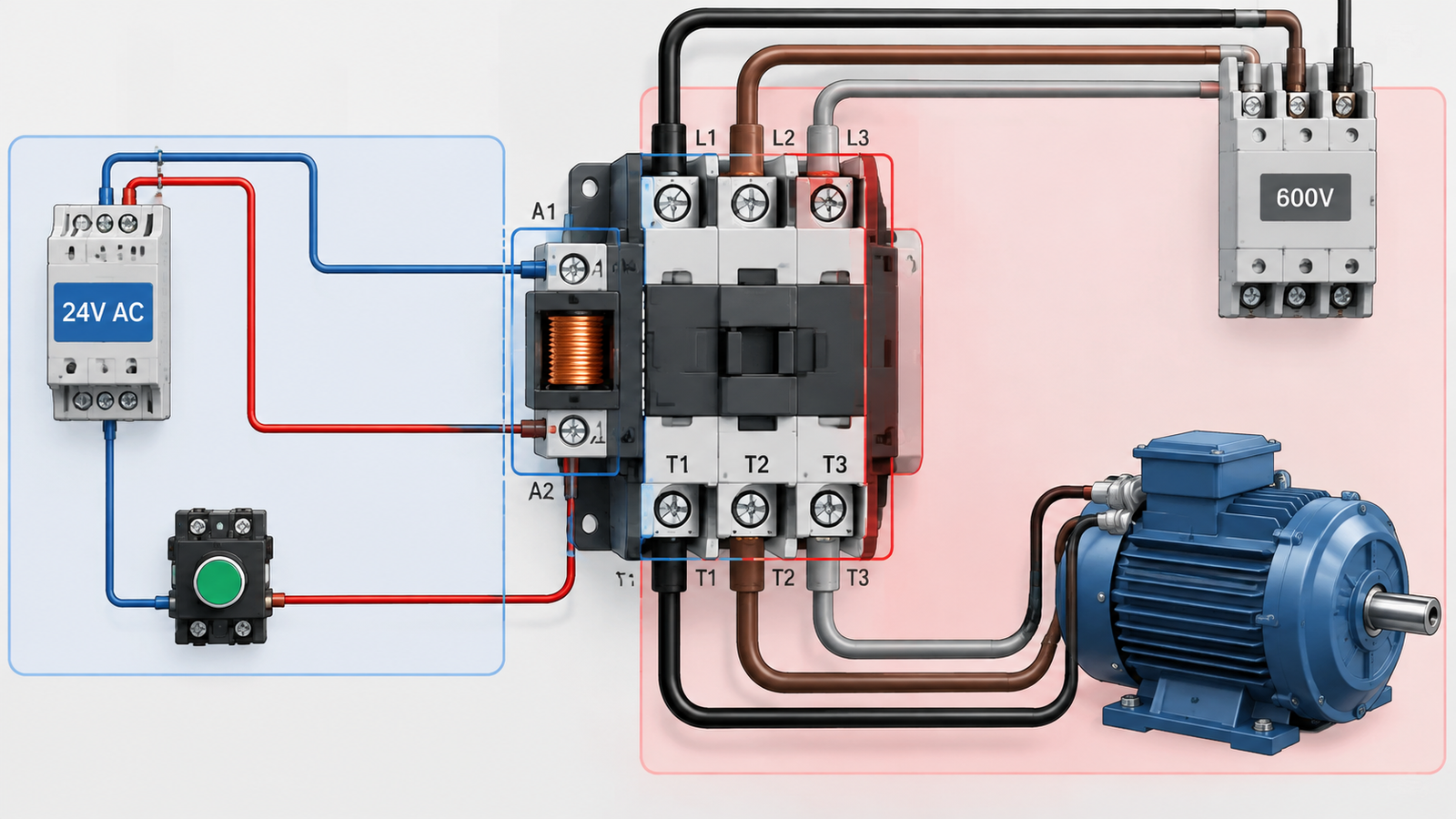
A contactor is effectively two electrically isolated systems sharing one housing. The “brain” is the coil, which needs only a low-voltage control signal. The “muscle” is the set of main contacts, which switches the high-power load. Each system has its own rating, and those ratings appear side by side on the nameplate.
The Control Circuit: the 24V Coil Rating
The lower voltage, such as 24V, is the coil voltage. It is printed near terminals A1 and A2 and tells you what control supply the electromagnet needs to pull the contacts closed. Typical coil ratings include 24V, 110V, 120V, 220V, 230V, 380V and 400V AC, plus 12V, 24V, 48V and 110V DC. The coil is powered from a control transformer, a PLC output, a relay, or a push-button circuit — never from the load side. If you want to understand how that control wiring fits together, our contactor wiring guide walks through coil and main-contact connections step by step.
The Load Circuit: the 600V Contact Rating
The higher voltage, such as 600V, is a rating of the main contacts, not a supply voltage. It appears near the power terminals (L1/T1, L2/T2, L3/T3) and states the maximum voltage the contacts are designed to switch safely. A 600V-rated contactor can interrupt a 480V motor circuit, for example, with comfortable margin. It does not mean the contactor receives 600V on its coil. For a refresher on what each terminal actually does, see our guide to L1, L2, T1 and T2 terminal markings.
Why the Two Ratings Are So Different
The gap between 24V and 600V is intentional. It is what makes a contactor safe and useful. A PLC, thermostat, or push button operates at low voltage where it is inexpensive, safe to touch, and easy to protect. The motor, heater, or compressor it controls operates at line voltage where the real power flows. The contactor translates one world to the other: a small control signal energizes the coil, and the coil’s magnetic field closes heavy-duty contacts that switch the large load.
This separation also protects control components. Without it, a 24V thermostat or PLC output would have to carry motor current directly — and would fail almost immediately. Keeping the control circuit low-voltage means the expensive automation hardware never touches the high-power path.
Standard Contactor Coil Voltage Ratings
When someone asks “what voltage contactor do I need?”, they are asking about the coil voltage. Common values differ by region and control architecture:
Control power type
Common coil voltage ratings
Typical control source
AC coil
24V, 110V, 120V, 220V, 230V, 380V, 400V AC
Control transformer, push-button circuits, traditional panels
DC coil
12V, 24V, 48V, 110V DC
PLC outputs, automation panels, battery-backed systems
AC frequency
50Hz, 60Hz, or 50/60Hz
Match the local utility or the control transformer supply
Notice that “24V” alone is not a complete specification. A 24V AC coil and a 24V DC coil are not interchangeable, even though the voltage number is identical. AC and DC coils have different impedance, inrush behaviour, and holding characteristics. If you are comparing options, our article on AC vs DC contactor coils explains why the distinction matters before you order.
What Happens If the Coil Voltage Is Wrong?
Applying the wrong voltage to A1/A2 is one of the fastest ways to damage a contactor or make a machine behave unpredictably.
Coil voltage too low: the magnetic field may be too weak to pull the armature fully closed. The contactor can chatter, buzz, or fail to seal, which causes arcing on the main contacts and rapid overheating of the coil.
Coil voltage too high: the coil draws excess current, insulation overheats, and the coil eventually burns open. The armature also slams in harder, accelerating mechanical wear.
Wrong AC/DC type: a DC coil fed with AC can overheat or fail to hold; an AC coil fed with DC can overheat badly because there is no impedance limiting current after pull-in.
Wrong frequency: an AC coil rated for 50Hz operated on 60Hz usually works, but the reverse or wide deviation can cause noise, vibration, and unreliable pull-in.
Many “broken contactor” cases are actually a coil supply problem. If yours is buzzing, chattering, or dropping out intermittently, our contactor troubleshooting guide covers how to isolate a coil fault from a contact fault.
How to Choose the Right Contactor Coil Voltage
Choosing the correct coil voltage is a five-step process. Work through it in order and you will not end up with an incompatible unit.
Identify the control supply. Measure or confirm the voltage available at the control circuit. A PLC output is commonly 24V DC; a control transformer may deliver 110V, 220V, or 230V AC; a thermostat circuit is usually 24V AC.
Confirm AC or DC. The number alone is not enough. Match both the voltage value and the current type of your control power.
Check the frequency for AC coils. On export equipment or mixed 50/60Hz markets, prefer a coil marked 50/60Hz to avoid inventory and compatibility errors.
Account for voltage drop. In long control runs, the voltage at the coil terminals can be several volts lower than at the source. For a 24V coil, even a 3-5V drop can push the coil below its reliable pick-up range.
Think about safety and spares. Lower control voltages (24V AC/DC) are safer for maintenance staff and easier to integrate with modern control gear. Standardising on one coil voltage across a panel simplifies spares holding.
Once the coil voltage is settled, the contactor itself must still be sized for the load current and utilization category. For heavy three-phase motor loads, a high-current frame such as the CJX2-D170 170A AC contactor is an example of the frame sizes available once the coil specification has been locked down.
How to Check the Coil Voltage on a Contactor
If the nameplate is readable, the coil rating is normally printed directly on it, sometimes repeated on the coil itself or beside the A1/A2 terminals. Look for a code such as “AC 220V 50/60Hz”, “24V DC”, or “coil 110V 50Hz”. When the marking is worn or unclear, the safest confirmation is a voltage measurement across A1 and A2 while the control circuit is energised, using the correct AC or DC meter mode. Do not guess from the size of the device: a large frame can carry a small coil voltage, and a compact contactor can carry a 380V coil.
الخاتمة
The next time a contactor reads “24V and 600V”, read it as two separate statements: the coil needs a 24V control supply, and the main contacts are rated to switch circuits up to 600V. Get the coil voltage, current type, and frequency right, and the contactor will pull in cleanly, hold reliably, and switch its load for years. When you are ready to spec a unit, browse the full range of AC contactors and match the coil option to your control circuit.
الأسئلة الشائعة
Why does my contactor say both 24V and 600V?
Because the two ratings describe different circuits. 24V is the coil voltage for the control circuit (A1/A2 terminals); 600V is the maximum rated voltage of the main contacts (L1/T1 terminals). They are electrically isolated.
Can I apply 600V to a contactor coil marked 24V?
No. Never do this. The coil would draw excessive current and burn out, often within seconds. The 600V rating applies only to the main contacts, never to the coil terminals.
Is a 24V AC coil the same as a 24V DC coil?
No. AC and DC coils have different impedance and holding behaviour and are not interchangeable. Always match both the voltage and the current type of your control supply.
What voltage do most HVAC contactors use?
Most residential and light commercial HVAC contactors use a 24V AC coil because that is the standard supply from the thermostat control transformer.
How do I know the coil voltage if the label is worn off?
Measure the voltage across A1 and A2 while the control circuit is energised, with the meter set to the correct AC or DC mode. Alternatively, match the replacement by the manufacturer’s model code and datasheet.
Can a 230V coil run on 220V?
Usually yes. Coils are designed to operate across a tolerance band, commonly around 85-110% of the rated voltage, and the two standards are close enough for most applications. Check the datasheet for the exact range.
Input side sees harmonics, output side sees PWM — and neither contactor should do the drive's job. Selection margins, sequencing rules, bypass interlocking, and the DC paths where AC contactors must not go.
The full reversing starter: power wiring with two phases swapped, cross-coupled NC electrical interlock, mechanical interlock backstop, 50–100 ms dead time, and why weld detection is the layer no interlock provides.
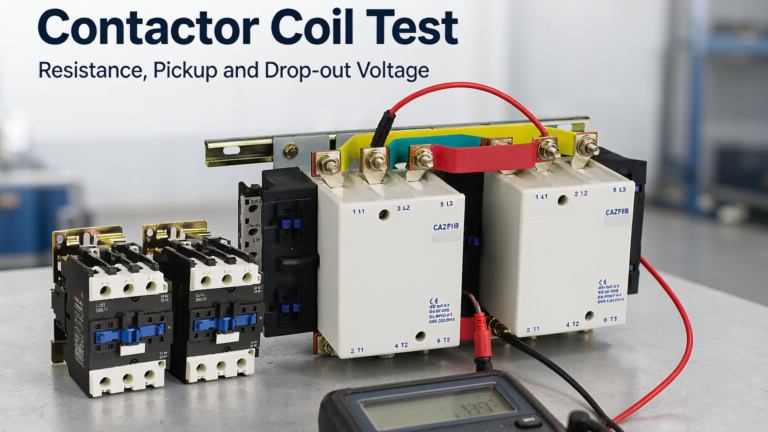
Resistance screens the winding, pickup voltage proves it will seat on a sagging bus, drop-out proves it will release. Reference bands, IEC windows, and the five root causes behind burnt coils.