Bypass Contactor and Soft Starters: Wiring, Sizing and When You Need One
Why a soft starter bypass contactor saves 4.5 W per running amp, when AC-1 is enough, when it must be AC-3, and the wiring and control settings that keep it alive.
Read More
If you are shipping contactors to India, the HSN code on the invoice is not paperwork — it decides the tax rate, the customs duty your buyer pays, and whether their input tax credit survives an audit. The short answer: contactors are classified under HSN heading 8536, most commonly as 8536 50 10 (“control and switch gear”) or 8536 49 00 (“other relays”), at 18% GST. The longer answer is that the right line depends on what the device is, how it is packaged, and whether you are invoicing a contactor, a coil, or a starter panel.
This guide covers the codes, the rate, the 8-digit rule for exporters, and the five classification mistakes that generate the most GST notices on AC contactor shipments.
| What you are shipping | HSN code | GST / IGST |
|---|---|---|
| AC contactor, power contactor, modular contactor | 8536 50 10 | 18% |
| Contactor described and sold as a relay, contactor coil | 8536 49 00 | 18% |
| Relay or contactor rated 60 V or below | 8536 41 00 | 18% |
| Overload relay, thermal relay | 8536 49 00 | 18% |
| Starter panel, control panel, distribution board with two or more devices fitted | 8537 10 00 | 18% |
| Spare coil, contact kit, arc chute sold as a part | 8538 90 00 | 18% |
Every line above sits in the 18% slab, so the rate rarely changes the answer. The code still matters, because a wrong code on a Bill of Entry is a customs problem and a wrong code on a tax invoice can cost your buyer their credit.
8536 covers electrical apparatus for switching or protecting electrical circuits, or for making connections to or in electrical circuits, for a voltage not exceeding 1,000 V. The heading names switches, relays, fuses, surge suppressors, plugs, sockets, lamp-holders, connectors and junction boxes. A contactor is an electrically operated switch, so it lands here.
Two boundaries matter more than the definition:
This is the decision that actually causes arguments. Both are 18%, both are defensible, and Indian practice splits roughly as follows.
8536 50 10 — “control and switch gear”. This is the tariff line that names contactors directly in the CBIC product descriptions. If you are invoicing an AC contactor, a power contactor or a modular contactor as a switching device, this is the most precise match. It sits under 8536 50, the subheading for “other switches”.
8536 49 00 — “other relays”. This is the subheading for relays above 60 V, and it is widely used in Indian trade for contactors because a contactor is an electromagnetically operated switch with a coil. Large manufacturers list contactors under this code, and it is also the natural home for contactor coils and overload relays. If your product is described and marketed as a relay-type control device, this line is defensible.
The practical rule: pick the code that matches the description on your invoice and your datasheet, and use it consistently across shipments. Changing codes between consignments of the same product is what draws scrutiny. A buyer’s customs broker will usually prefer the code their own past Bills of Entry used, so ask before you print the invoice.
Three related lines complete the picture:
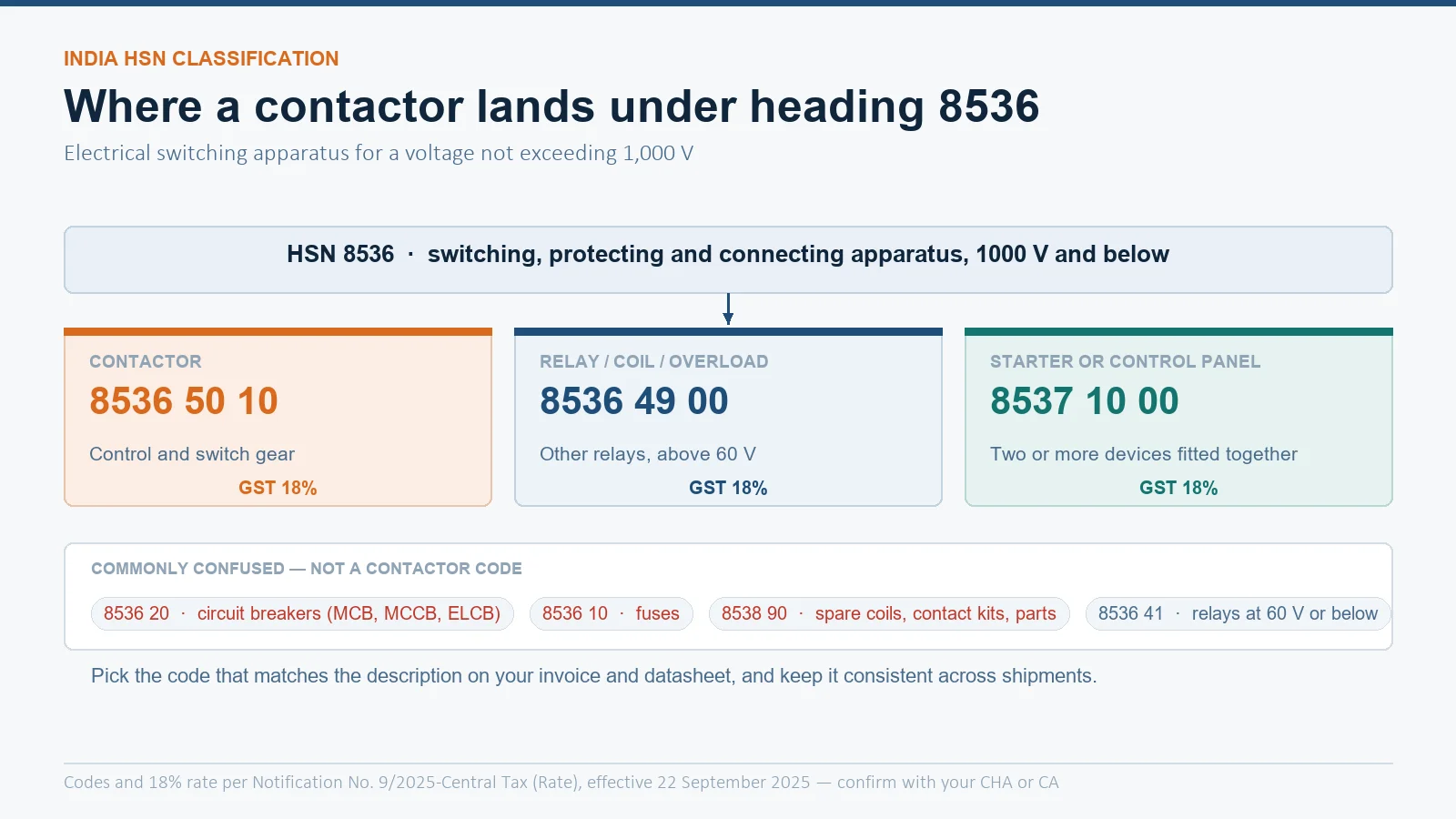
Heading 8536 sits in the 18% GST slab. Under Notification No. 9/2025-Central Tax (Rate), effective 22 September 2025, the rate structure was consolidated, and 8536 remained at 18%. On a domestic Indian supply that is 9% CGST + 9% SGST intra-state, or 18% IGST inter-state.
For an exporter the mechanics are different from the rate:
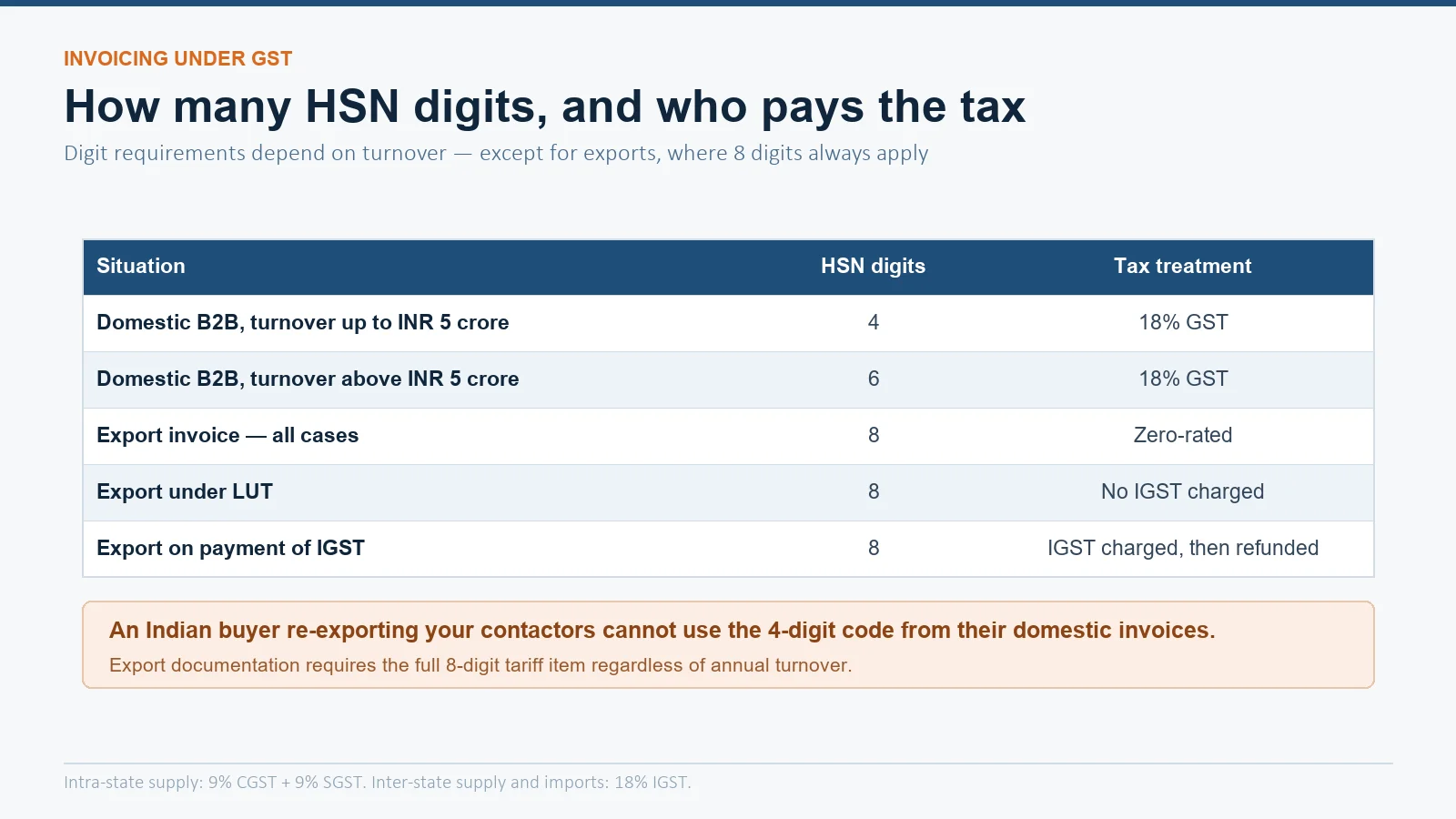
| Situation | HSN digits required | Tax treatment |
|---|---|---|
| Domestic B2B invoice, turnover up to ₹5 crore | 4 digits | 18% GST |
| Domestic B2B invoice, turnover above ₹5 crore | 6 digits | 18% GST |
| Export invoice, all cases | 8 digits | Zero-rated |
| Export under LUT | 8 digits | No IGST charged |
| Export on payment of IGST | 8 digits | IGST charged, then refunded |
Two points trip people up. First, 8 digits are mandatory on export documentation regardless of turnover — so an Indian buyer re-exporting your contactors cannot use the 4-digit code their domestic invoices carry. Second, export under a Letter of Undertaking is zero-rated with no IGST collected, which means the invoice must carry the correct endorsement (“SUPPLY MEANT FOR EXPORT UNDER LUT WITHOUT PAYMENT OF IGST”) rather than a tax line. Getting the endorsement wrong invalidates the document even when the code is right.
Importers also ask about basic customs duty. BCD for 8536 50 10 is commonly quoted in the 10% band, and preferential rates exist under several FTAs — including, for some origins, a nil rate through ASEAN agreements. Treat any duty figure you see online as indicative and confirm the current tariff line before you quote landed cost.
A description that survives scrutiny does three things: it names the product, it states the rating, and it matches the code. For example:
AC contactor, 3-pole, 95 A, 220 V AC coil, IEC 60947-4-1, AC-3 duty — HSN 8536 50 10 — 18% IGST
Compare that with “electrical goods — 8536”, which tells a customs officer nothing and tells your buyer’s accountant less. If you ship a mixed consignment, split the lines by code: contactors on one line, spare coils on another under 8538, panels on a third under 8537.
The specification details that make the description credible are the same ones buyers check anyway — rated current, coil voltage, pole count and standard. The ratings are easiest to read straight from the AC contactor range. Our contactor model number decoder shows how those ratings are encoded in a catalogue reference, and the IEC 60947-4-1 explainer covers what the standard actually requires a device to prove.
HSN classification is a self-assessment. The codes and the 18% rate above reflect the position after the September 2025 consolidation, but tariff lines, notifications and state-level practice change, and a classification that is defensible is not the same as one that is guaranteed. Confirm the 8-digit code and the rate with your customs house agent or chartered accountant before the first consignment, and keep the classification rationale on file — the note that explains why you chose 8536 50 10 rather than 8536 49 00 is what protects you if the code is ever questioned.
If you are pricing a mixed order, the contactor price list by frame size gives the value bands that drive the duty calculation, and the supplier vetting guide covers the documentation questions worth asking before you commit to a shipment. The pendant control station HSN guide applies the same method to another product family and is a useful cross-check on how the 8536 subheadings behave in practice.
Contactors fall under heading 8536. The most common 8-digit codes are 8536 50 10 (“control and switch gear”), which names contactors directly, and 8536 49 00 (“other relays”). Both attract 18% GST.
18% — charged as 9% CGST plus 9% SGST on an intra-state supply, or 18% IGST on an inter-state supply. The rate was unchanged by the September 2025 consolidation under Notification No. 9/2025-Central Tax (Rate).
A contactor on its own is 8536. Once it is built into a starter panel or control panel with two or more apparatus of heading 8535 or 8536 fitted on a common base, the assembly is classified under 8537 — 8537 10 00 for voltages up to 1,000 V.
8538 90 00, the heading for parts suitable for use solely or principally with the apparatus of headings 8535, 8536 or 8537. A coil is a part, not a switching apparatus, so it does not belong in 8536.
Eight, in all cases. The 4-digit and 6-digit thresholds apply only to domestic GST invoices and depend on annual aggregate turnover — up to ₹5 crore requires 4 digits, above ₹5 crore requires 6. Exports, imports and e-invoices always require the full 8-digit code.