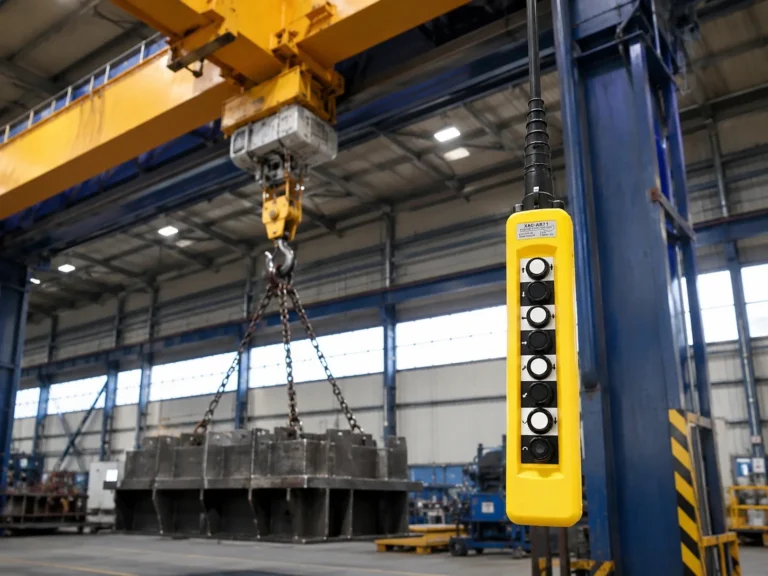
How to Choose an Electric Hoist Push Button Switch
Published: Author: Lisa
Escolhendo o caminho certo electric hoist push button switch is not just about finding a handheld control with a few buttons. In real lifting applications, the wrong choice can create wiring mismatch, poor operator control, replacement delays, or unnecessary safety risks during hoist and crane operation. This article will help you understand what this product usually refers to, how it differs from a pendant station, which parameters matter before purchase, and how to make a better sourcing decision for OEM, replacement, wholesale, or bulk procurement projects.
What is Electric Hoist Push Button Switch
In industrial buying language, an electric hoist push button switch usually refers to the handheld control interface used to send motion commands such as up, down, stop, or auxiliary actions to a hoist or crane system. In practice, buyers may also use related terms such as crane pendant push button switch, hoist pendant control, industrial pendant control, or crane pendant station, but these terms do not always describe exactly the same product level.
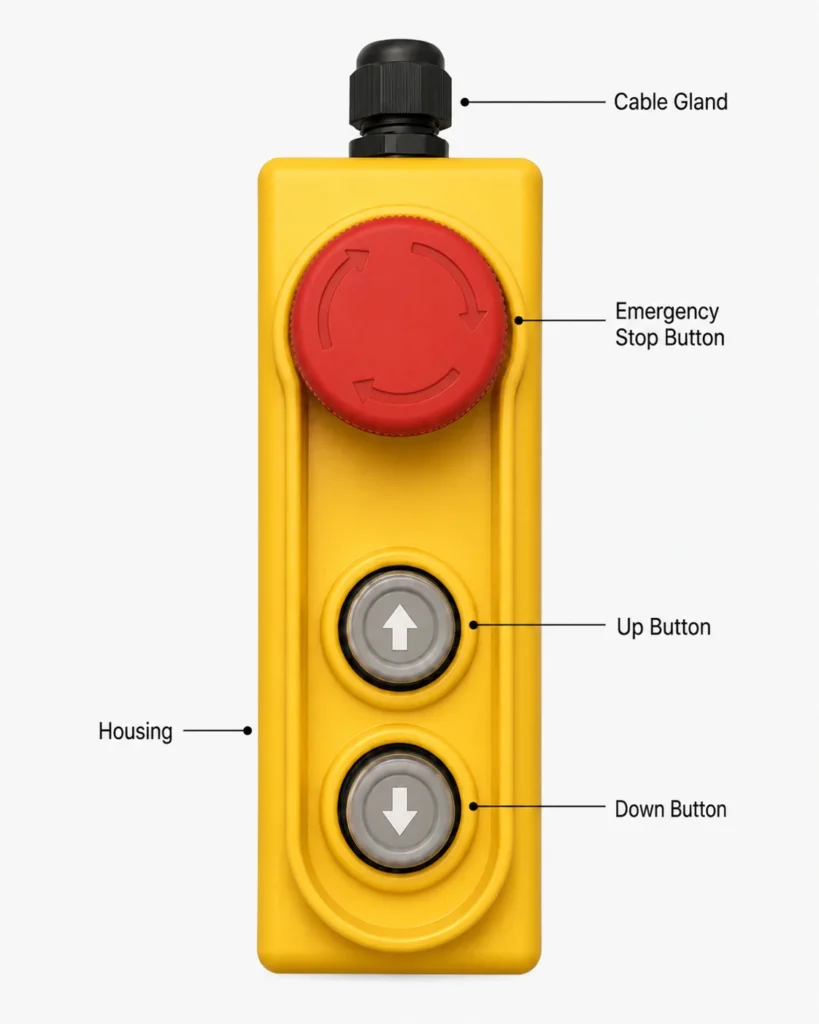
The first buying mistake is treating a switch, a pendant control, and a pendant station as interchangeable terms. A switch may refer to one control element or one push button function, while a pendant station usually refers to the complete handheld control assembly with enclosure, multiple buttons, and sometimes an emergency stop function.
Term
What it usually refers to
Typical buying context
Electric hoist push button switch
Handheld control used for hoist motion commands
General product search, replacement search
Crane pendant push button switch
Pendant-style push button control for crane or hoist use
Crane-related sourcing or retrofit
Hoist pendant control
Broader term for handheld hoist control assembly
Technical selection, OEM discussion
Pendant station for crane
Complete pendant housing with button layout
Full assembly purchase, project procurement
This distinction matters because vague search terms often lead to vague RFQs, and vague RFQs usually lead to mismatched quotations, especially when the buyer actually needs a complete pendant assembly rather than a single control component.
Common Configurations and What They Mean
An electric hoist push button switch is not one fixed product. The actual configuration depends on how many motions the equipment has, whether speed control is simple or staged, whether emergency stop is required, and whether the control is meant for a new machine or a replacement job.
Common configurations include 2-button, 4-button, and 6-button layouts, as well as versions with single-speed or two-speed control logic. A smaller configuration may work for a basic electric hoist that only needs up and down movement, while a more complex pendant station may be necessary when the operator also controls travel direction, auxiliary functions, or emergency stop requirements.
Configuration
Typical function
More suitable for
2-button
Up / down basic motion control
Simple electric hoists
4-button
Lift plus extra directional or auxiliary control
Small crane or lifting systems
6-button or more
Multi-motion control
Overhead crane or integrated handling equipment
Single-speed
One motion speed per direction
Basic lifting tasks
Two-speed
Better control for movement and positioning
Applications needing finer operation
Single speed control is often enough when the load path is simple and the operator does not need delicate motion control. Two speed control makes more sense when positioning accuracy matters, when the load must be handled more smoothly, or when the operator benefits from slower approach control instead of full-speed-only movement.
An emergency stop should not be added just because it sounds better on paper. It should be considered based on the control scheme, equipment risk level, operating distance, and the actual use environment of the hoist or crane.
Application Scenarios for Electric Hoist Push Button Switches
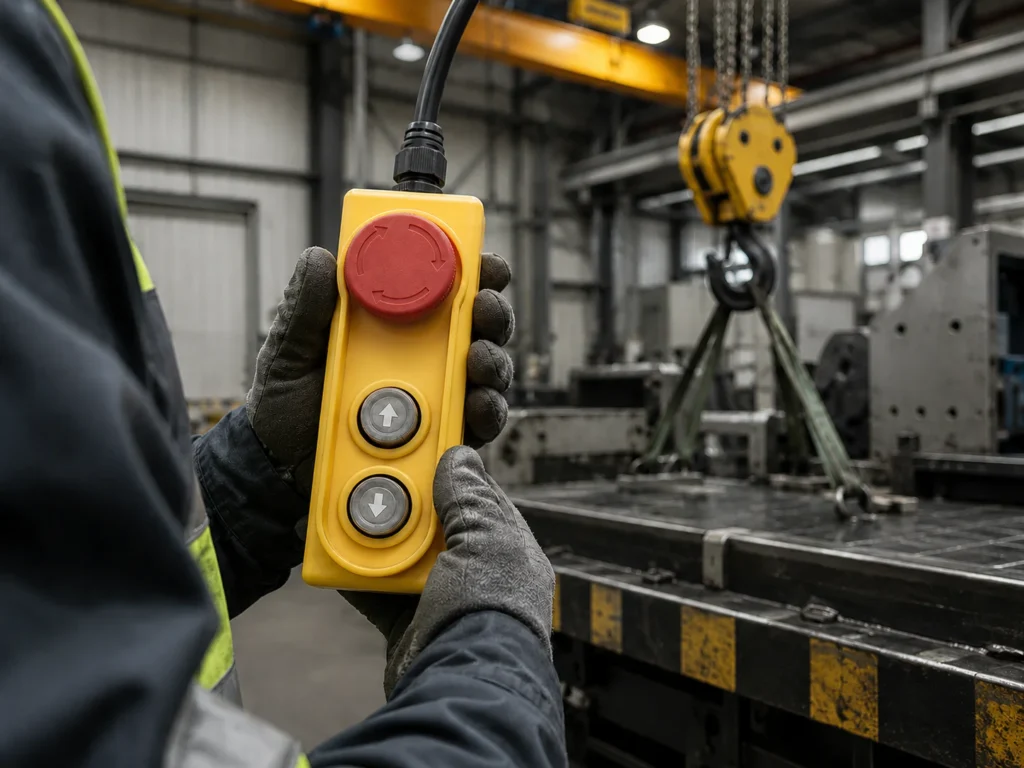
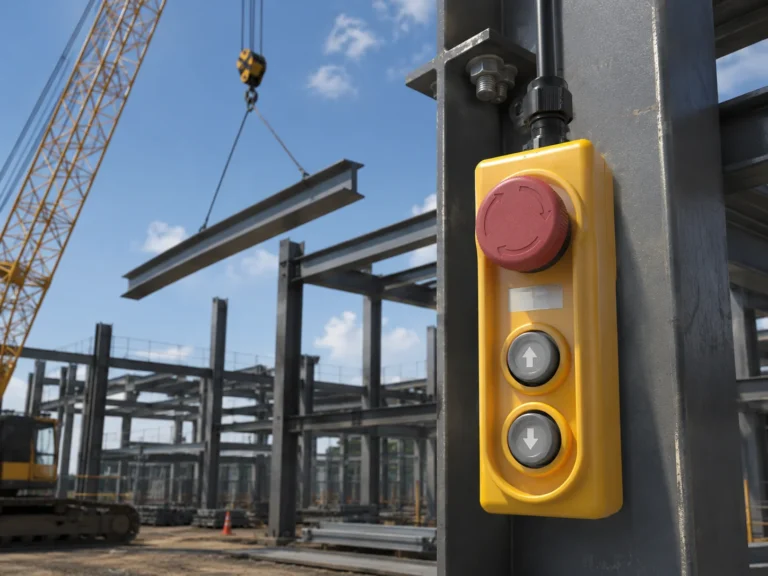
The most common application is electric hoist operation in factory lifting points, workshop handling tasks, and equipment stations where the operator needs direct manual control close to the load path. They are also relevant in overhead crane systems, suspended lifting devices, compact gantry setups, and retrofit projects where the original pendant control has become damaged, outdated, or incompatible with current operating needs.
For OEM equipment manufacturers, the control choice is part of the machine design process. For replacement buyers, the logic is different: the pendant may look similar from one supplier to another, but mismatch in button layout, contacts, wiring, enclosure size, or cable entry can make installation more difficult than expected.
Aplicativo
Control need
What buyers usually focus on
Electric hoist
Basic lift control
Up/down logic, durability, handling comfort
Overhead crane
Multi-motion control
Button count, speed stages, emergency stop
Replacement project
Compatibility with existing system
Wiring, layout, enclosure fit
OEM equipment build
Standardization or customization
Function definition, consistency, branding
Bulk procurement
Cost and repeatability
MOQ, lead time, uniform specifications
This is also where B2B search intent becomes clear. An engineer may search for function and compatibility, while a purchaser, distributor, exporter, or wholesale buyer may focus more on supplier capability, batch consistency, customization support, and quotation efficiency.
Key Selection Factors Before You Buy
The best way to choose an electric hoist push button switch is to stop looking at the housing first and start with the control task. Buyers should confirm what motion commands are required, how many buttons are needed, whether single-speed or two-speed control is necessary, and whether the operator needs an emergency stop or additional functions in the same handheld unit.
The second step is electrical and mechanical compatibility. That means confirming control voltage, contact arrangement, wiring compatibility, cable entry direction, enclosure strength, operator grip, and whether the product will be used in dusty, oily, humid, or glove-operation conditions. These details affect not only whether the control can be installed, but also whether it can be used comfortably and safely over time.
Parâmetro
Why it matters
What to confirm
Button count
Determines available control functions
Required motions and spare functions
Speed logic
Affects handling precision
Single-speed or two-speed requirement
Emergency stop
Affects operator safety response
Whether the application needs it
Electrical compatibility
Prevents control mismatch
Voltage, contacts, wiring logic
Enclosure form
Affects handling and durability
Size, grip, mechanical protection
Use environment
Affects service life and operation
Dust, moisture, oil, glove use
For B2B buyers, the next layer is supplier-side confirmation. If the project involves wholesale, export, OEM, ODM, private label, or bulk procurement, the buyer should also ask about MOQ, customization range, lead time, price drivers, export packaging, and whether the factory can keep layout consistency across repeated orders.
When the requirement moves beyond a basic control concept and into full handheld assembly selection, it is more natural to compare complete pendant control station options and then narrow down button layout, enclosure style, and sourcing path for standard, custom, OEM, or bulk orders.
Electric Hoist Push Button Switch vs Pendant Station
This comparison matters because many buyers search for electric hoist push button switch when they actually need a complete pendant station. The first term often reflects a general product idea, while the second usually points to the full assembly that the operator holds and uses in daily equipment control.
Aspect
Electric hoist push button switch
Pendant station
Product level
General control switch concept
Complete handheld control assembly
Function scope
May refer to one or several button functions
Usually includes enclosure and multi-button layout
Buying stage
Early search or replacement inquiry
Detailed selection and procurement
Best for
Concept search, basic control need
Full control setup, OEM, retrofit, project use
A complete Handheld Control Station becomes the more logical choice when an application requires the execution of multiple operations, more structured operational control, the integration of emergency stop functionality, or the establishment of repeatable specifications for factory production and project procurement. It also makes more sense when the buyer is working with a manufacturer, supplier, exporter, distributor, or China factory on batch supply, because a full station definition reduces ambiguity in quotation and production communication.
Common Buying Mistakes
One common mistake is choosing by appearance only. A pendant may look close enough to the original unit, but if the button logic or wiring arrangement is different, the replacement process may become slower and more expensive than expected.
Another mistake is assuming all hoist pendant controls are universal. In real applications, replacement work often fails because the buyer did not confirm control logic, contact structure, cable entry, mounting assumptions, or environmental exposure before placing the order.
A third mistake is focusing on price too early. Price matters in wholesale and bulk purchasing, but if compatibility is still unclear, comparing quotations too soon can push the decision toward the cheapest option rather than the most suitable one. If you are preparing an RFQ for OEM, distribution, or batch procurement, it helps to confirm button layout, control functions, and installation conditions before asking for a final quote.
Common mistake
Likely result
How to avoid it
Buying by appearance only
Poor fit or wiring mismatch
Confirm function and compatibility first
Treating all pendant controls as universal
Installation or operation problems
Check logic, contacts, and layout
Comparing price before specs are clear
Wrong sourcing decision
Define requirements before quotation
Ignoring the use environment
Reduced durability or poor handling
Check dust, moisture, oil, and glove use
PERGUNTAS FREQUENTES
What is an electric hoist push button switch?
It is the handheld control interface used to send lift-related commands such as up, down, or stop to a hoist system. In many buying contexts, the term may also overlap with hoist pendant control or crane pendant switch terminology.
Is a crane pendant push button switch the same as a pendant station?
Not always. A crane pendant push button switch may be used as a general search term, while a pendant station usually refers to the full control assembly with housing and multiple buttons.
How do I choose the right hoist pendant control for a replacement project?
Start by confirming button functions, speed logic, wiring compatibility, enclosure form, and installation constraints instead of matching appearance alone. Replacement purchases fail most often when the original control logic is not checked early.
When do I need a two-speed crane pendant station?
Two-speed control is more useful when the operator needs better movement control or finer positioning instead of full-speed-only operation. For simple lifting tasks, single-speed control is often enough.
Should a hoist pendant control include an emergency stop button?
It depends on the equipment risk level, control scheme, and operating environment. The decision should be based on actual application needs rather than a default assumption.
What should I confirm with a supplier before bulk ordering pendant switches?
For bulk orders, ask about MOQ, customization, OEM or private label options, lead time, export packaging, and whether the supplier can keep layout consistency across production batches.
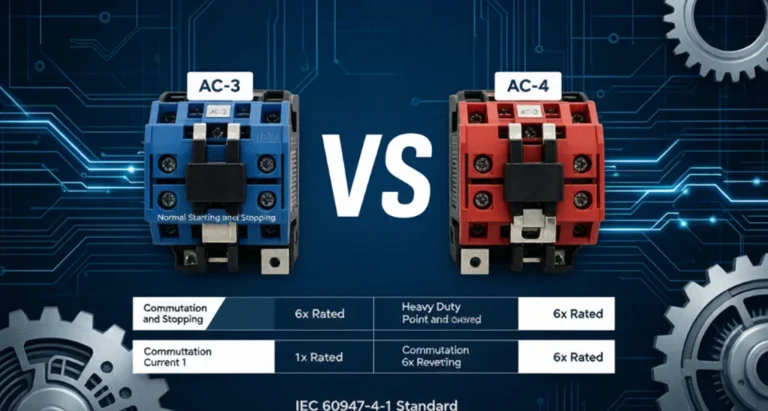
Why Utilization Categories Matter for Contactor Selection Specifying a contactor by rated current alone is one of the fastest ways to end up with welded contacts, short electrical life, and unplanned downtime. The contactor utilization category—defined in IEC 60947-4-1—tells you what kind of load the contactor can switch and how severe that switching duty is. Two […]
A 2 button pendant control is a hand-held control station designed for simple machine motion, looks simple, but choosing the wrong one can create real problems in hoist and lift applications.
The XAC-A871 is commonly identified as an 8-way or 8 pushbutton pendant control station for single-speed hoisting applications.with a yellow polypropylene enclosure and double-insulated construction.