CT Polarity, P1/P2 and S1/S2: Marking, Wiring and Field Testing
What P1, P2, S1 and S2 mean on a current transformer, the wiring rules that keep polarity consistent, and a battery flick test you can run in the field.
Read More
Reading a current transformer nameplate is easy until you reach the accuracy class: 0.5, 0.2S, 5P10, 5P20. These codes are not interchangeable — metering classes and protection classes answer two different questions, and putting the wrong one into a circuit causes either lost revenue (billing errors) or failed protection (a relay that never trips). This guide decodes every part of the class code, explains what “5P10 ct meaning” actually specifies, and gives you a selection table by application.
CT accuracy classes come in two families, and the code tells you which one you are holding:
%composite error P accuracy limit factor: a 5P10 CT keeps its error at or below 5% even when the primary current is 10 times rated current.So “5P10” means: composite error ≤ 5% at up to 10 × rated primary current. “5P20” holds that same 5% line up to 20 × rated current. The accuracy limit factor (ALF) is the whole point — it defines how far into the fault range the CT stays linear, which is exactly what an overcurrent relay needs.
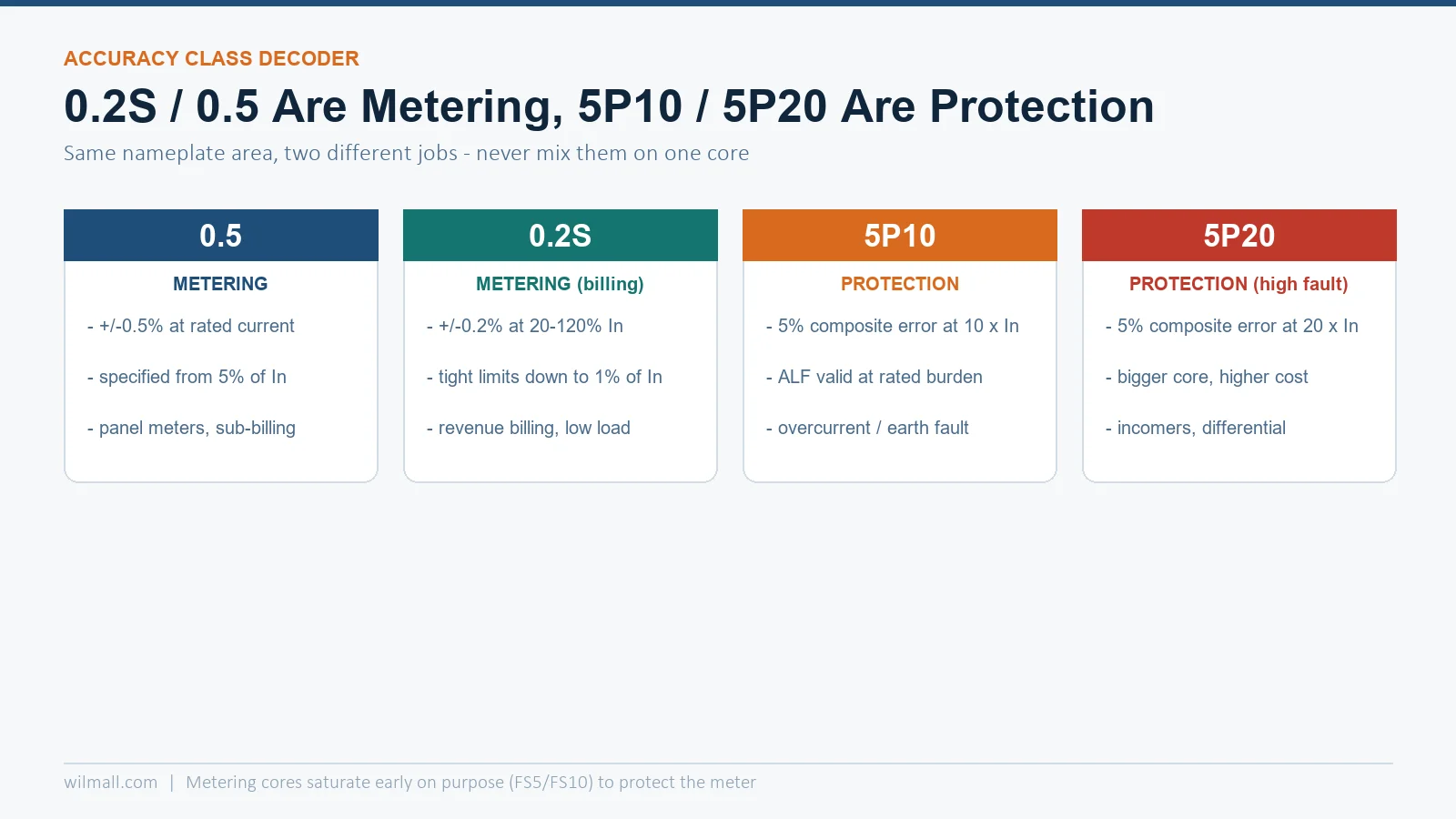
Metering classes define ratio error and phase displacement at defined load points of rated current (IEC 61869-2, formerly IEC 60044-1). The practical meaning:
| Class | Ratio error at rated current | Behaviour below rated current | Типичное использование |
|---|---|---|---|
| 0.5 | ±0.5% | Specified from 5% of In upward | Industrial kWh billing, panel meters |
| 0.2 | ±0.2% | Specified from 5% of In upward | Precision sub-metering, test benches |
| 0.2S | ±0.2% at 20–120% of In | Tight limits down to 1% of In (±0.75% at 1%) | Revenue billing where loads swing low (toll-quality metering) |
| 0.5S | ±0.5% at 20–120% of In | Tight limits from 1% of In (±1.5% at 1%) | Commercial billing with low overnight load |
The “S” is what matters for billing. A plain 0.5 class CT can be ±1.5% at 5% load and is simply unspecified below that — overnight a 0.5-class CT feeding a lightly loaded feeder can miss a meaningful slice of energy. If the tariff depends on it, 0.2S is the standard answer, and dedicated metering products such as the 0.2S class current transformer series are built and tested exactly for those low-load error points.
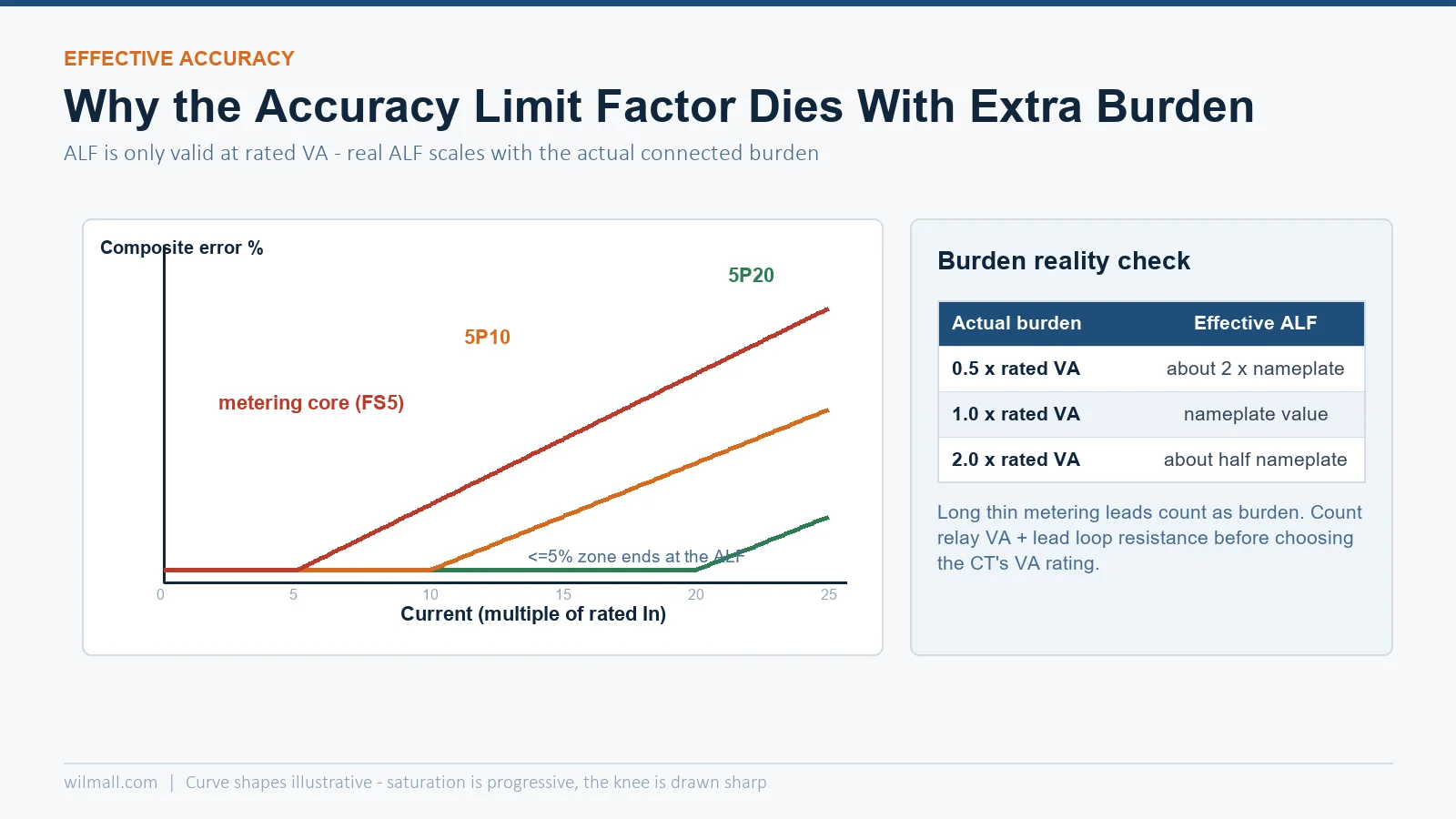
Metering CTs also carry an instrument security factor (FS) — usually FS5 or FS10. It caps how much the CT saturates during a fault: an FS5 metering CT starts distorting heavily at 5 × In, which protects the meter rather than the relay. That early saturation is a feature for metering and a defect for protection.
Protection classes are tested for composite error (ratio error plus phase error plus harmonics) at multiples of rated current:
| Class | Composite error at ALF | Where it stays accurate | Typical application |
|---|---|---|---|
| 5P10 | ≤5% at 10 × In | Up to 10 × rated current | Standard overcurrent and earth-fault relays |
| 5P20 | ≤5% at 20 × In | Up to 20 × rated current | Feeders where fault current is high or relay reach is critical |
| 10P10 | ≤10% at 10 × In | Up to 10 × rated current | Less critical indications, thermal alarms |
Here is the field rule most buyers miss: the ALF printed on the nameplate is only valid at the rated burden. The real, effective ALF scales with the actual connected burden — an actual burden of half the rated VA gives you roughly double the effective ALF, and an over-connected burden collapses it. A 5P10 CT loaded to twice its rated burden may behave like a 5P5, and a relay set to see 12 × In will then read a saturated, badly distorted signal and can under-reach.
That is why selecting a protection CT means three numbers together: class, ALF and rated burden (VA) — matched against the relay burden and lead resistance of the actual loop, not just copied from the datasheet.
| You are measuring / protecting… | Class to specify | Why |
|---|---|---|
| Revenue billing on a feeder with wide load swings | 0.2S, FS≤5 | Accurate from 1% of In; meter safe during faults |
| General panel metering and sub-billing | 0.5 | Cost-effective ±0.5% at working load |
| Standard overcurrent / earth-fault protection | 5P10 | Linear through the relay’s pickup-to-max range |
| Main incomer, differential or distance protection | 5P20 (or class PX) | Stays linear at 20 × In so the relay sees the true fault |
One CT cannot serve both masters. A metering-core CT saturates at FS5 and cannot feed a relay; a protection-core 5P20 is ±1% or worse at low load and cannot bill. That is why medium-voltage CTs are commonly dual-core (one metering core + one protection core) — the DX-series low voltage current transformers cover the metering-and-light-protection range in a single window-type body, which is usually enough for low-voltage switchboards. For the naming and symbols on schematics that show these CTs, the current transformer symbols guide maps every variant you will meet on drawings.
It is a protection-class CT that keeps its composite error at or below 5% when the primary current is up to 10 times the rated current. The 5 is the error percentage, P means protection, and 10 is the accuracy limit factor.
Only the accuracy limit factor: 5P20 stays within 5% composite error up to 20 × rated current, while 5P10 saturates beyond 10 ×. 5P20 needs a larger core and costs more; specify it where fault currents or relay reach demand it.
At low loads, yes — 0.2S holds tight error limits from 1% of rated current, while a plain 0.5 class is only specified from 5% and drifts badly below 20%. At full rated current both meet ±0.2%/±0.5% respectively.
No. Metering cores saturate early by design (FS5/FS10) to protect the meter, so a relay fed from them will under-read faults. Use a 5P-class core, or a dual-core CT with one of each.
Check the connected burden. The ALF is only valid at rated VA; excessive relay burden plus long lead resistance reduces the effective ALF. Measure the loop burden and re-specify the CT’s VA rating if needed.