Contactor HSN Code 8536 and GST Rate for Export Invoicing (India)
Contactors ship to India under HSN 8536 - usually 8536 50 10 or 8536 49 00 - at 18% GST, with 8 digits required on export invoices. Here is how to pick the right line.
Read More
Two current numbers on a modular AC contactor label decide whether the device survives ten years or ten months: the AC-7a rating and the AC-7b rating. On the same 63 A frame those two numbers typically read 63 A and 25 A. A buyer who orders on the bigger figure and wires a pump to it has installed a 25 A motor contactor and is asking it to carry 63 A. That gap is not a printing error — it is the difference between two utilization categories in IEC 61095, and it is the most common way small contactors fail in the field.
Both categories belong to IEC 61095, the standard for electromechanical contactors for household and similar purposes — the family sold as “modular” or “installation” contactors that clip onto a DIN rail. The current edition is IEC 61095:2023, and it is a different document from IEC 60947-4-1, which governs industrial contactors and motor starters.
The scope ceilings matter as much as the definitions. IEC 61095 covers contactors up to 440 V AC, up to 63 A in AC-7a but only 32 A in AC-7b, AC-7c and AC-7d, with conditional short-circuit current of 6 kA or less. The standard itself caps motor duty at 32 A — beyond that you are in IEC 60947-4-1 territory. The 2023 edition added AC-7d for LED loads, whose capacitive driver inrush neither AC-7a nor AC-7b describes.
The category is not a description of the load. It is a description of the switching test the device passed, and IEC 61095 sets two separate tests:
| Test | Category | Making / breaking current (Ic/Ie) | Test power factor | Operating cycles |
|---|---|---|---|---|
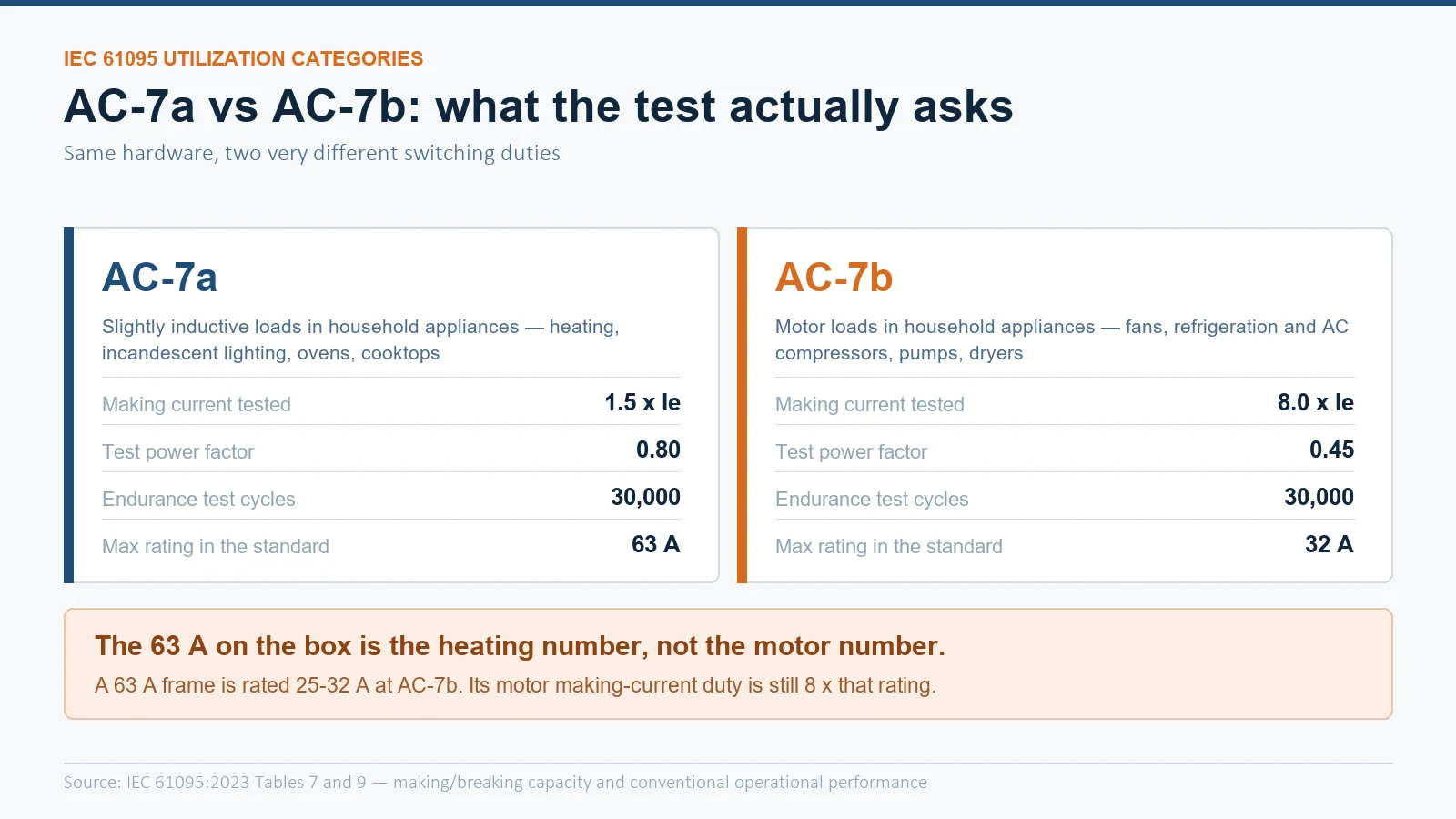
| Making and breaking capacity (Table 7) | AC-7a | 1.5 × | 0.80 | 50 |
| Making and breaking capacity (Table 7) | AC-7b | 8.0 × | 0.45 | 50 |
| Conventional operational performance (Table 9) | AC-7a | 1.0 × | 0.80 | 30,000 |
| Conventional operational performance (Table 9) | AC-7b | 6.0 × making, 1.0 × breaking | 0.45 | 30,000 |
An AC-7a device must close and open into 1.5 times its rating at a power factor of 0.80 — a nearly resistive circuit that produces a short, weak arc. An AC-7b device must do it at eight times its rating at 0.45, which is a motor starting into a locked rotor. The power factor matters as much as the multiplier: at 0.45 the current lags voltage by roughly 63°, so the arc is still conducting as the supply reverses and re-strikes instead of extinguishing at a current zero. Contact erosion scales with arc energy and duration, which is why the same silver alloy behaves very differently in the two categories.
IEC 61095 also sets a cooling-off interval between test operations — 10 seconds up to 100 A of broken current, 20 seconds to 200 A, 30 seconds above. That is a practical warning: repeated motor starts on a small frame are thermally limited, not just electrically limited.
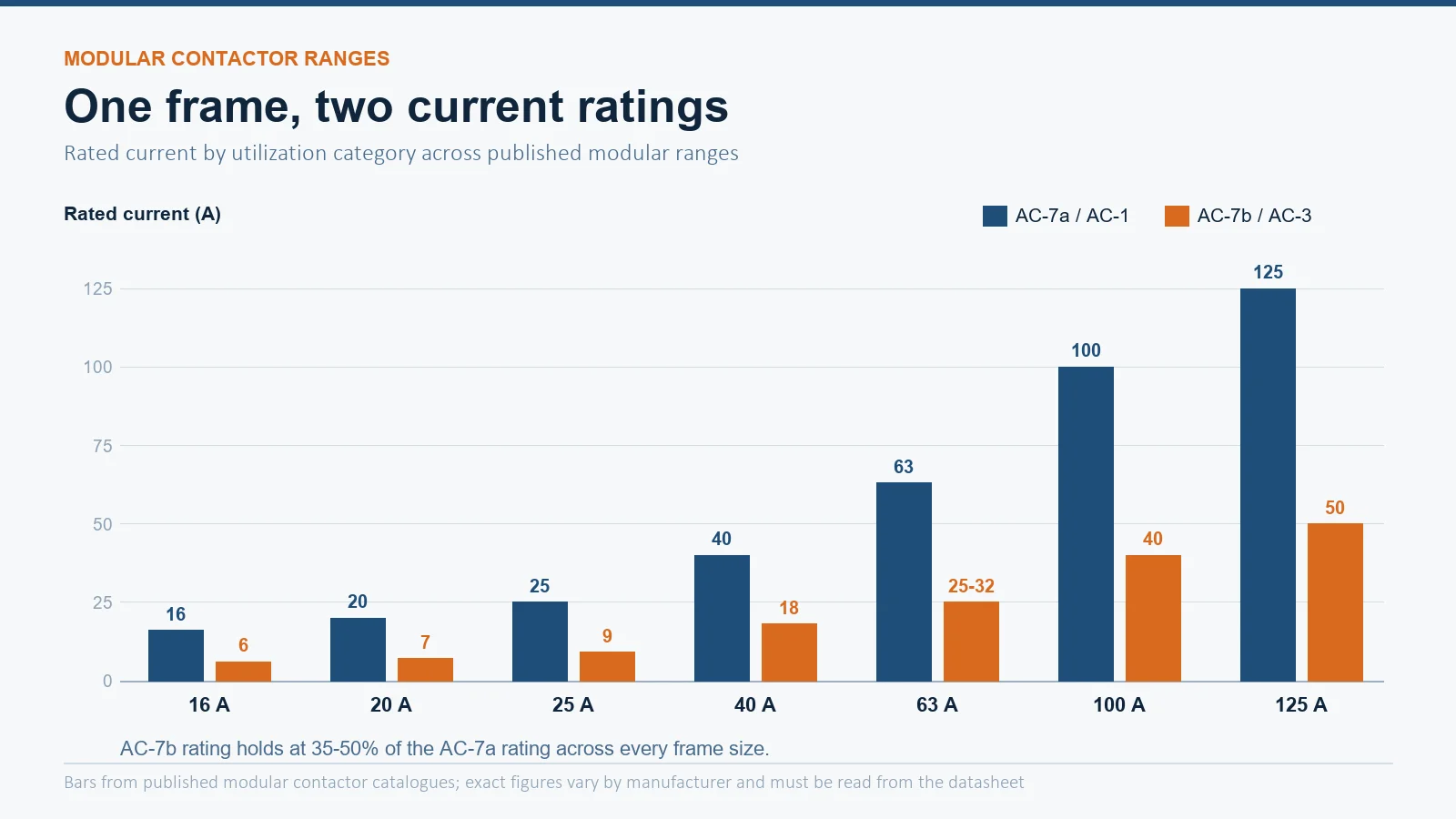
Because the tests differ so much, manufacturers publish two ratings for one device. Here is the pattern across real modular contactor ranges, from catalogue data:
| Frame / thermal current | Rated current, AC-7a (AC-1) | Rated current, AC-7b (AC-3) | AC-7b as % of AC-7a |
|---|---|---|---|
| 16 A | 16 A | 6 A | 38% |
| 20 A | 20 A | 7 A | 35% |
| 25 A | 25 A | 9 A | 36% |
| 40 A | 40 A | 18 A | 45% |
| 63 A | 63 A | 25–32 A | 40–51% |
| 100 A | 100 A | 40 A | 40% |
| 125 A | 125 A | 50 A | 40% |
The AC-7b rating lands consistently at 35–50% of the AC-7a rating. The spread at 63 A — 25 A on some ranges, 32 A on others — is real, and reflects how much silver and arc control each design carries. One widely sold 63 A installation contactor publishes 63 A at AC-7a, 32 A at AC-3, 21.5 W dissipation at rated current and a 62.5 VA coil inrush on the same sheet.
The ordering consequence is blunt: the headline ampere figure on the box is the lighting-and-heating figure. If the load is a motor, work from the AC-7b line, which is roughly half the number you read first.
Take a 63 A frame. On AC-7a duty it is tested to make 1.5 × 63 = 94.5 A. Apply the same device to AC-7b duty at its 25 A rating and the requirement becomes 8 × 25 = 200 A; at the 32 A variant, 256 A.
So the motor duty asks for two to three times more making current than the heating duty, on a device whose current rating just halved. That is why “63 A” modular contactors weld on pump circuits drawing a perfectly reasonable 15 A running current. The running current was never the problem; the closing event was.
The endurance test follows the same logic: over 30,000 operations an AC-7b device must make 6 × its rating and break 1 ×, the profile of a motor started loaded and switched off while running. An AC-7a device only makes and breaks its own rating, because a heater has no inrush.
| Load | Category | Why |
|---|---|---|
| Resistance heating, ovens, cooktops, water heaters | AC-7a | Near-resistive; cold-element inrush is modest |
| Incandescent and halogen lighting | AC-7a | Brief cold-filament inrush, resistive steady state |
| Fans, extractors, air handlers | AC-7b | Induction motor, 5–8× starting current |
| Refrigeration and AC compressors | AC-7b | Highest inrush of the household loads |
| Washing machines, dryers, dishwashers | AC-7b | Motor plus heater — design for the motor |
| Central vacuum, pool and circulation pumps | AC-7b | Motor load with frequent starts |
| LED lighting with drivers | AC-7d | Capacitive inrush, not a motor profile |
Mixed appliances are the trap. A washing machine has both a heater and a motor; a dishwasher has a pump and a heating element. The correct category is the harshest load the circuit switches — the motor, AC-7b. Sizing on the heater’s comfortable AC-7a number is how a contactor welds inside an appliance that was “only” drawing 10 A.
It is tempting to treat AC-7a as the household name for AC-1 and AC-7b as the household name for AC-3. That is broadly right in spirit — ABB’s application literature describes AC-7a as comparable to AC-1 under household conditions and AC-7b as corresponding to AC-3 under household conditions — but dangerous as a purchasing shortcut.
The standards have different life targets. IEC 61095 verifies AC-7a and AC-7b at 30,000 operating cycles; industrial AC-3 contactors under IEC 60947-4-1 are routinely published with electrical lives an order of magnitude higher, tested against a different table of conditions. A device that passes AC-7b is not thereby qualified for industrial AC-3 duty.
The families are built for different fault levels. Modular devices are coordinated with an upstream MCB at around 6 kA. Industrial contactors sit in motor circuits with dedicated overload relays and higher conditional short-circuit ratings. Substituting a modular AC-7b device for an AC-3 starter is not a rating question — it is a protection-coordination question. The modular versus traditional contactor comparison maps that boundary, and the AC-1 to AC-4 utilization category guide covers the industrial side.
For a modular device built for the duties described here, the EKMF7 16–125 A AC/DC modular contactor covers everything from lighting circuits to small three-phase motor loads with a coil that accepts AC or DC control supply. The types of modular contactors guide and the seven specifications that decide a modular contactor order both start from the same question this article does: which duty is the device actually being asked to survive?
AC-7a covers slightly inductive household loads such as heating and incandescent lighting, tested at 1.5× rated current at 0.80 power factor. AC-7b covers household motor loads such as fans, compressors and pumps, tested at 8× rated current at 0.45 power factor. The same contactor carries a much lower current rating in AC-7b.
No. Motor starting current is 5–8 times running current and an AC-7a device was never tested to close into that. Contacts pit, then weld. Use the AC-7b rating, or an industrial AC-3 contactor if the motor exceeds 32 A.
Because the ratings come from different tests on the same hardware. The AC-7b test closes and opens into eight times rated current at a 0.45 power factor, producing a long, energetic arc. To survive that repeatedly, the manufacturer publishes roughly 35–50% of the AC-7a figure.
Typically 25 A to 32 A depending on manufacturer. Always read the AC-7b or AC-3 line on the specific datasheet — the spread across brands at this frame size is wide enough to change the order.