For a contactor, the North American standard is now UL 60947-4-1 — the US/Canada/Mexico harmonisation of IEC 60947-4-1. Since 27 January 2017 every new electromechanical contactor and motor starter has had to be certified to it, and the old UL 508 listing no longer applies to new designs, although existing UL 508 listings stay valid and the two remain interchangeable in a panel. What changes for a buyer is not the physics but the paperwork: a horsepower rating at 60 Hz instead of a kW/AC-3 figure, auxiliary contacts rated A600 / B300 instead of AC-15 / DC-13, and a UL 508A short-circuit current rating (SCCR) that has to be met at panel level, not component level.
Every second RFQ we receive from North America contains the same line: “Must be UL listed, 5 HP at 480 V.” The buyer is not being difficult — that sentence is the compressed form of three different requirements that live in three different standards. A contactor can be perfectly safe, mechanically identical to the one on the customer’s panel, and still be rejected at commissioning because the label carries 4 kW instead of 5 HP, because the auxiliary block has no pilot-duty designator, or because the assembled panel cannot hold its SCCR.
This article untangles the four documents that get quoted interchangeably (UL 508, UL 508A, UL 60947-4-1 and IEC 60947-4-1), shows how the same device ends up with two rating languages, and gives the sourcing checklist we use before quoting a North American order.
Four Documents, Four Different Jobs
The confusion starts because “UL 508” is used to mean both a component standard and, loosely, the whole North American control-panel world. They are not the same document.
| Document | Applies to | What it certifies | Who needs it |
|---|---|---|---|
| UL 508 — Industrial Control Equipment | Individual control components rated 1500 V or less: relays, switches, manual motor controllers, pressure switches | Construction, spacings, temperature rise, dielectric withstand, endurance, marking | Component makers with legacy listings |
| UL 508A — Industrial Control Panels | Assembled panels and MCCs built from listed components | Wiring practice, enclosure, and the panel’s SCCR per Supplement SB | Panel builders — and the end user, via NEC Article 409 |
| UL 60947-4-1 | Electromechanical contactors, motor starters, overload relays, up to 1000 V AC / 1500 V DC | IEC 60947-4-1 requirements plus US, Canadian and Mexican national differences | Every new contactor or starter sold in North America |
| IEC 60947-4-1 | The international parent standard, same product scope | Utilisation categories, test currents, endurance, coordination | Everyone outside North America — and the technical basis above |
Two details are worth memorising because they answer most customer objections:
- UL 60947-4-1 is not a different performance level from IEC 60947-4-1. UL’s own summary of the harmonisation is that once the national differences are taken into account the two are “essentially technically identical”. The add-ons are North American: horsepower ratings, 60 Hz data, AWG conductor ranges, 75 °C terminations, and the markings a US inspector expects to read.
- A listed contactor does not make a listed panel. UL 508A evaluates the assembly. The component’s SCCR is an input to the panel’s SCCR, not a substitute for it. This is where cheap imports fail most often — the contactor certificate is genuine, and the panel still cannot be labelled.
If you want the clause-level view of what the IEC document actually requires, we wrote a separate walkthrough of what IEC 60947-4-1 requires. The rest of this article is about the North American overlay.
The 2017 Transition: What Actually Changed
The dates matter for anyone holding old certificates or old drawings.
| Date / state | What it means in practice |
|---|---|
| Before 27 January 2017 | Electromechanical contactors and starters were certified to UL 508, with horsepower ratings taken from the UL 508 full-load-current table (Table 50.1) — the same numbers that appear in NEC Table 430.250. |
| After 27 January 2017 | New contactor and starter designs must be certified to UL 60947-4-1. UL stopped accepting new UL 508 motor-controller submissions. |
| Existing UL 508 listings | Remain valid with no expiry. Devices already in the field and already in stock stay acceptable. |
| Interchangeability | A UL 508-listed contactor and a UL 60947-4-1-listed contactor can be used in the same panel. The two standards are treated as technically equivalent for the product. |
| Auxiliary contact blocks | Evaluated as control-circuit devices under UL 60947-5-1, which is why the auxiliary data often appears on a separate certificate from the main poles. |
The practical consequence for sourcing: a supplier who says “our contactor is UL 508 approved” is not necessarily wrong — but if the certificate was first issued after 2017 for a motor contactor, the correct citation is UL 60947-4-1. Ask for the UL file number (the E-number) and read the standard named on the certificate, not the logo on the carton.
One Device, Two Rating Languages
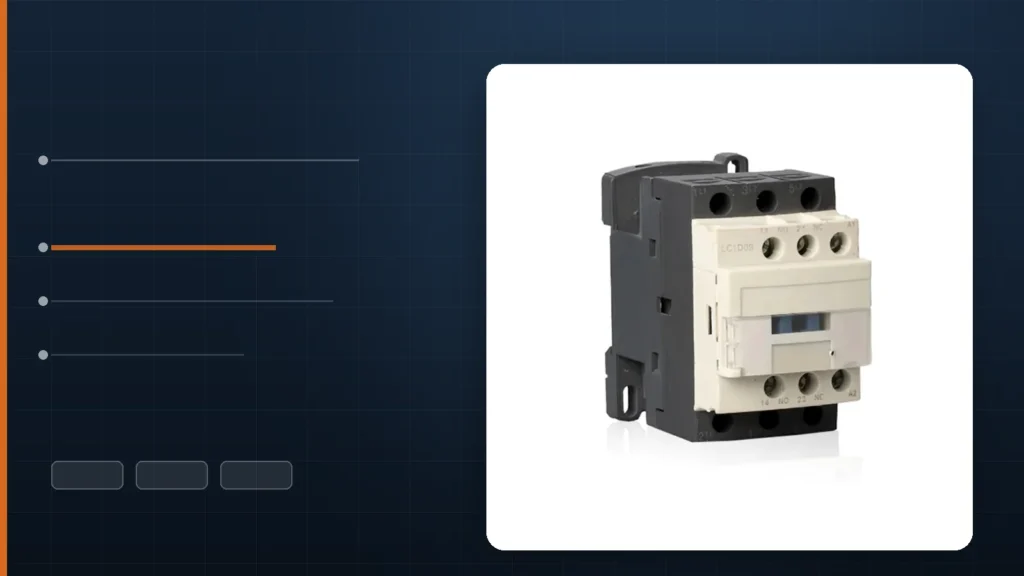
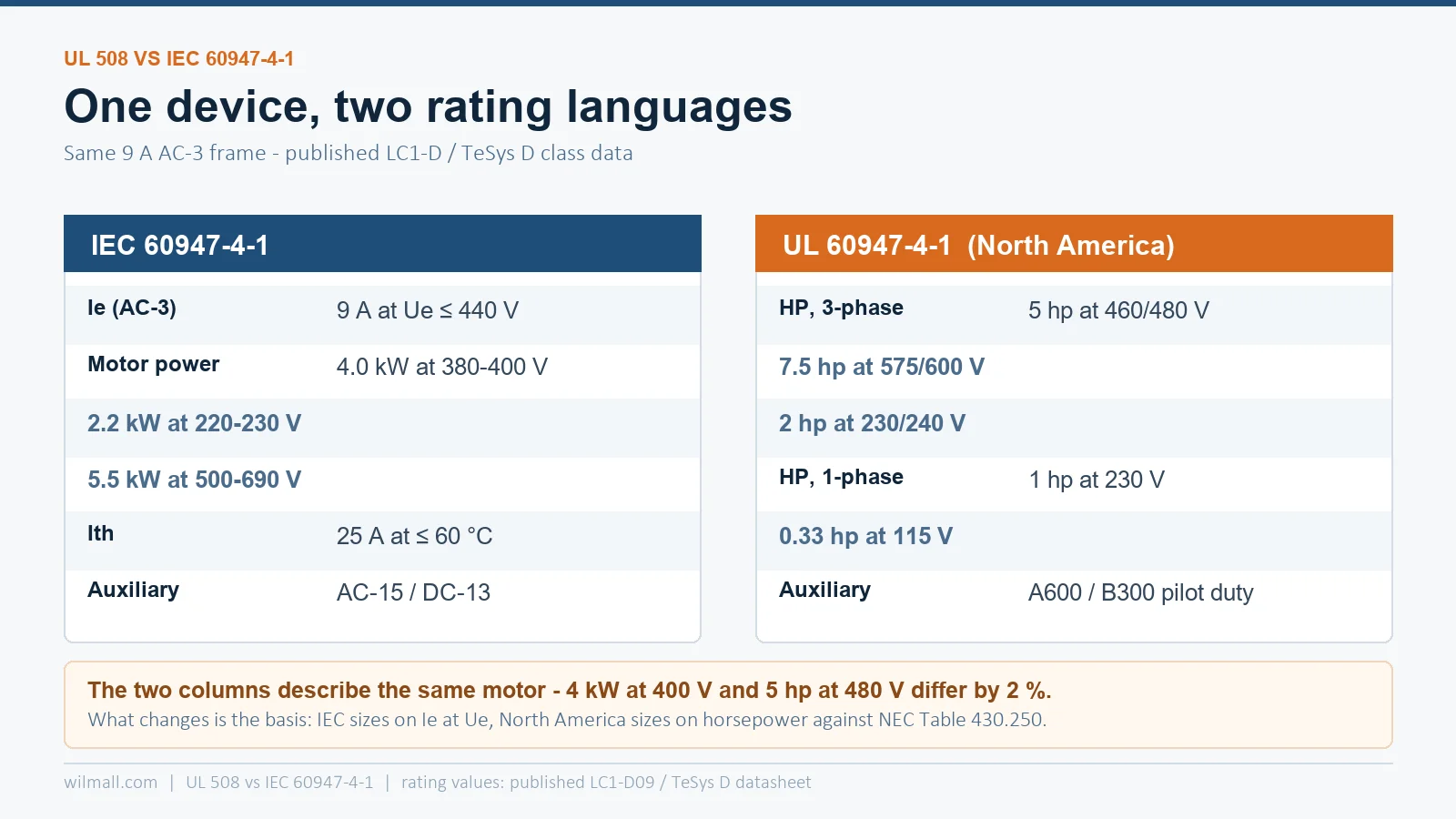
Here is the single most useful table to keep on your desk. It is the same 9 A frame, read through both standards — the data is from a published TeSys D / LC1D09 datasheet, and our LC1-D series contactors follow the identical rating structure.
| Rating line | IEC reading | North American reading |
|---|---|---|
| Rated operational current | 9 A AC-3, Ue ≤ 440 V | — (HP rating is used instead) |
| Motor power, 400 V class | 4 kW at 380–400 V AC-3 | 5 hp at 460/480 V, 3-phase |
| Motor power, 230 V class | 2.2 kW at 220–230 V AC-3 | 2 hp at 230/240 V 3-phase; 1 hp at 230/240 V 1-phase |
| Motor power, 600 V class | 5.5 kW at 500–690 V AC-3 | 7.5 hp at 575/600 V, 3-phase |
| Low-voltage single-phase | not quoted | 0.33 hp at 115 V, 1-phase |
| Thermal current | Ith 25 A at ≤ 60 °C | Same, plus a lighting rating: 20 A ballast at 600 V, 20 A tungsten at 480Y/277 V |
Notice that 4 kW and 5 hp are the same shaft power to within 2 % (4 kW = 5.36 hp). The IEC figure is quoted at 400 V and the UL figure at 460/480 V, and the North American number is deliberately conservative because it is tied to the code current table rather than to a motor’s nameplate.
That is the mechanism you need to understand:
- IEC sizes the contactor on Ie at Ue in the relevant utilisation category. You look up the motor current on the datasheet’s AC-3 row for your voltage and pick the frame above it.
- UL / NEC sizes the controller on motor horsepower. NEC 430.83 requires the controller to carry a horsepower rating not less than the motor’s nameplate horsepower — a floor, not a method. The horsepower rating itself is derived from the full-load current in NEC Table 430.250 (fed from the UL 508 table), which is slightly higher than a modern IE3 motor’s actual current.
So the same physical device can look generously sized on one side of the Atlantic and tight on the other. A 9 A AC-3 frame covers a 4 kW motor at 400 V (about 8.5 A) with normal margin, and covers 5 hp at 480 V (NEC FLC 7.6 A) with more. It does not cover 7.5 hp at 480 V (FLC 11 A), even though the 9 A figure “looks” close — and no amount of arithmetic on amps will convince a US inspector, because the label does not say 7.5 hp at 480 V.
Horsepower, Full-Load Current and the Number That Decides
Because the controller is chosen on horsepower, the conversion table between horsepower, NEC full-load current and the contactor frame is the working document for any North American quote. Extract from NEC Table 430.250 (three-phase, 60 Hz):
| Motor | FLC at 460 V | FLC at 575 V | Contactor HP rating needed (min.) | Typical IEC frame that satisfies it |
|---|---|---|---|---|
| 5 hp | 7.6 A | 6.1 A | 5 hp @ 480 V | 9–12 A AC-3 |
| 7.5 hp | 11 A | 9.0 A | 7.5 hp @ 480 V | 12–18 A AC-3 |
| 10 hp | 14 A | 11 A | 10 hp @ 480 V | 18–25 A AC-3 |
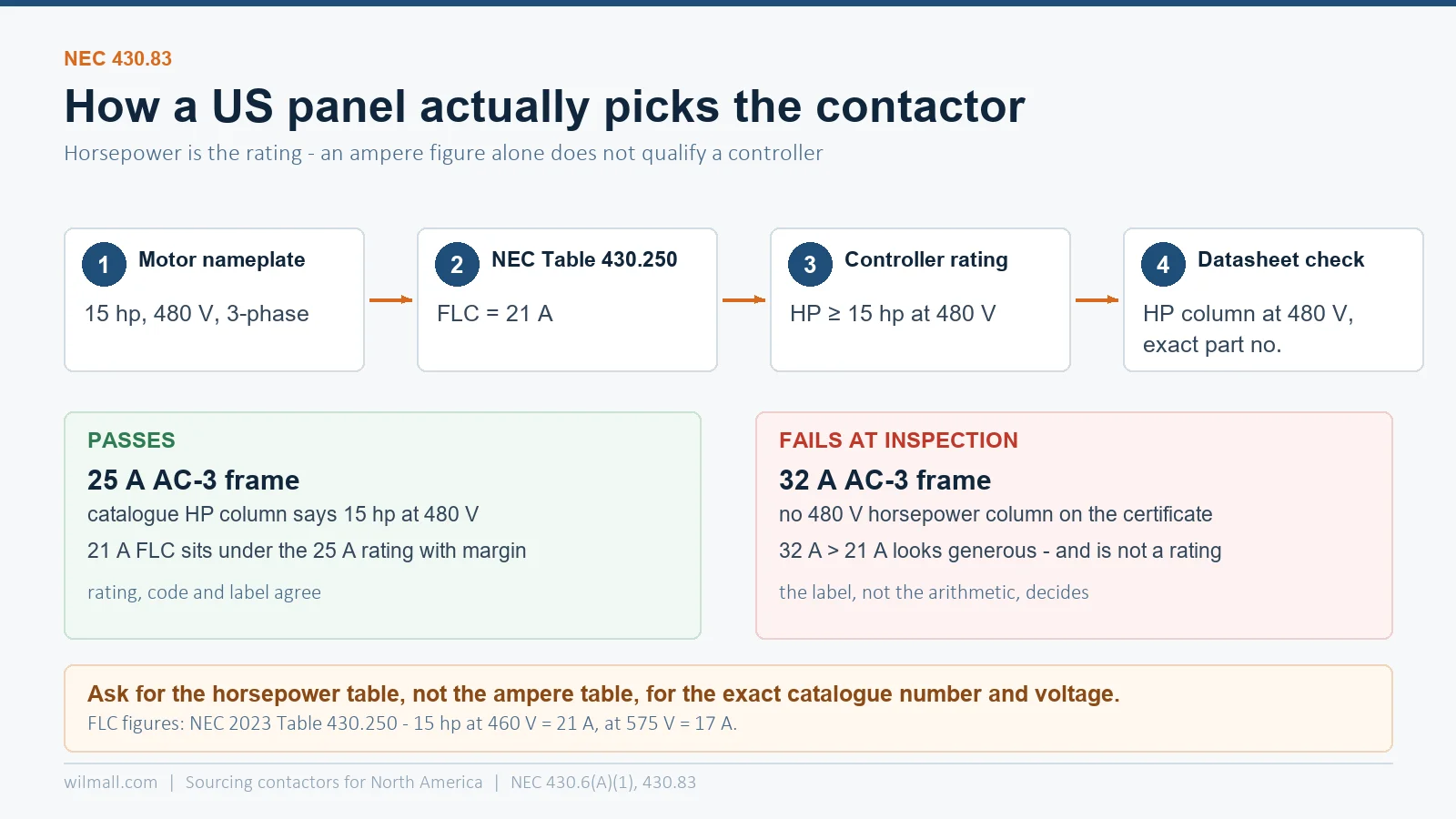
| 15 hp | 21 A | 17 A | 15 hp @ 480 V | 25–32 A AC-3 |
| 20 hp | 27 A | 22 A | 20 hp @ 480 V | 32–40 A AC-3 |
| 25 hp | 34 A | 27 A | 25 hp @ 480 V | 40–50 A AC-3 |
| 30 hp | 40 A | 32 A | 30 hp @ 480 V | 50–65 A AC-3 |
The right-hand column is the trap. The frame that covers 21 A in AC-3 is not automatically labelled 15 hp at 480 V — manufacturers publish the horsepower column per catalogue number, and the same 25 A frame sold into two markets can carry different HP ceilings at 575 V than at 480 V. Always ask for the horsepower table for the exact catalogue number, at the exact voltage, from the exact certificate.
Two more code points keep the arithmetic honest:
- Use the table current, not the nameplate. NEC 430.6(A)(1) requires the FLC from Tables 430.247–430.250 for conductor ampacity and for sizing switches and branch-circuit protection. The nameplate current is used for the overload relay setting. A modern high-efficiency motor often draws less than the table value, and that does not let you reduce the controller rating.
- Overload protection is a separate standard. In North America the overload relay is selected and set on nameplate FLA and evaluated under UL 60947-4-1 (or the older UL 508 heater tables). Our comparison of NEMA Class 20 vs IEC Class 10 covers where the trip curves diverge.
Auxiliary Contacts: A600 and B300 Are Not Decoration
The second-most-common rejection at commissioning is the auxiliary contact. IEC data sheets quote auxiliary ratings as AC-15 and DC-13; North American drawings quote a letter-plus-number designator from UL 508. They describe the same contact from two directions, and the numbers are not interchangeable in conversation.
| UL 508 designator | Max. make VA | Max. break VA | Continuous current | Типичное использование |
|---|---|---|---|---|
| A600 | 7200 VA | 720 VA | 10 A | Heavy pilot duty to 600 V AC — sealing circuits, coils of larger contactors |
| B300 | 3600 VA | 360 VA | 5 A | Standard pilot duty to 240–300 V AC |
| C600 | 1800 VA | 180 VA | 2.5 A | Light pilot duty, indicator circuits |
Read the two VA columns as two different jobs, because they are:
- Make VA decides whether the contact can close into the load. A contactor coil pulls 6–15× its holding VA for the first 50–200 ms — a 100 VA sealed coil can present 600–800 VA at pickup. A contact rated 360 VA make cannot do it, no matter what its continuous current says.
- Break VA decides whether it can interrupt the load without sustained arcing.
This is exactly the mechanism behind the classic “PLC output welded to a contactor coil” failure, which we covered from the coil side in contactor coil power consumption. If a North American drawing specifies A600, it is asking for 7200 VA make capability — an order of magnitude above a light-duty block. For the IEC side of the same question, see AC-15 vs DC-13 auxiliary contact ratings.
The Panel Level: UL 508A and SCCR
This is the requirement that catches importers who did everything else right. A contactor can be listed and still be unusable, because the panel it goes into has its own short-circuit current rating.
- NEC 409.110 requires an industrial control panel to be marked with its short-circuit current rating.
- NEC 409.22 requires the available fault current at the installation point not to exceed that rating.
- UL 508A Supplement SB is the method used to establish the SCCR: the weakest component in the power circuit sets the ceiling unless a tested combination is used.
In practice the contactor’s contribution is usually not the limiting factor — the fuse or breaker combination is. That is why the useful datasheet line is not “SCCR: 5 kA” but a coordination table: contactor + overload + specific fuse class and rating = Type 1 or Type 2 at a stated prospective current. For a 9 A frame, a 20 A gG fuse at ≤ 690 V is a common Type 1 pairing; larger prospective currents need current-limiting devices and a tested combination.
Type 1 and Type 2 are then the two answers the panel designer can give the customer:
| Coordination | After a short circuit | When specified |
|---|---|---|
| Type 1 | No danger to people or installation, but the contactor and/or overload may be damaged and need replacement | General machinery, non-critical duty where downtime is acceptable |
| Type 2 | No damage except light contact welding that is easily separated; the starter is fit for further use | Process plants, water treatment, continuous duty — needs current-limiting SCPD |
A supplier who cannot produce a coordination table for the exact fuse you intend to use has not finished the UL work, whatever the certificate says.
Sourcing Checklist Before You Quote
This is the list we run before releasing a price for a North American order. It takes ten minutes and it prevents the RFQ bouncing back.
- Certificate, not logo. UL file number and standard named on the certificate: UL 60947-4-1 for new contactors, UL 60947-5-1 for auxiliary blocks. Check whether the listing is UL, cUL or cULus — Canada is a separate market.
- Horsepower table at 480 V and 600 V. Not the kW column. Confirm the exact catalogue number against the exact voltage; 575/600 V ratings are frequently one frame higher than 480 V.
- Auxiliary pilot duty designator. A600 or B300 with both make and break VA stated. “10 A” alone is not a rating.
- Coil data at 60 Hz. 120 V and 208–240 V coils, inrush and sealed VA, and the 85–110 % pickup window. A 50 Hz coil on a 60 Hz supply draws less current and holds with less force — measurable, and a legitimate warranty argument.
- Terminations. Conductor range in AWG and mm², 75 °C copper rating, and tightening torque on the label. US inspectors check torque; a datasheet that omits it is a datasheet that will be queried.
- Coordination table. Contactor + overload + fuse class, Type 1 or Type 2, at a stated prospective current.
- Panel responsibility. State clearly in the offer that the contactor is a component and that the panel’s SCCR is established by the panel builder under UL 508A. This one sentence prevents most end-of-project disputes.
- Export paperwork. The HS classification does not change with the certification — contactors remain under 8536, as set out in our HSN code guide — but the commercial invoice should name the standard, because that is what the customs broker and the AHJ will both look for.
Five Mistakes That Cost the Most
- Sizing on amps across standards. A 25 A AC-3 device is not automatically a 15 hp controller. The horsepower column is the rating, and it is voltage-specific.
- Assuming UL 508 is dead. It is not: legacy listings remain valid and interchangeable. Rejecting a genuine UL 508 certificate loses you a sale for no technical reason.
- Assuming UL 60947-4-1 is a premium tier. It is the harmonised IEC standard. The performance is the same as IEC 60947-4-1; the difference is marking and national differences.
- Ignoring the auxiliary contact rating. Most commissioning failures on imported panels are control-circuit failures, and the pilot-duty designator is where they start.
- Treating SCCR as a component property. It is a panel property. No component certificate transfers it.
Часто задаваемые вопросы
Is UL 508 still valid for contactors?
For devices already listed, yes — the listing has no expiry, and UL 508-listed and UL 60947-4-1-listed contactors can be used interchangeably in a panel. For new electromechanical contactor and starter designs submitted after 27 January 2017, the applicable standard is UL 60947-4-1.
Is UL 60947-4-1 the same as IEC 60947-4-1?
Technically yes, with national differences. UL 60947-4-1 adopts IEC 60947-4-1 and adds North American requirements — horsepower ratings at 60 Hz, AWG conductor ranges, 75 °C terminations and specific marking rules. UL describes the two as essentially technically identical once the differences are accounted for.
Can I use an IEC contactor with a kW rating in a US panel?
Only if the device carries the North American certification and a horsepower rating for the voltage in question. A CE-marked IEC contactor with a kW column and no UL/CSA listing is not accepted by an inspector, regardless of its AC-3 rating.
What does A600 mean on an auxiliary contact?
It is a UL 508 pilot-duty designator: 7200 VA maximum make, 720 VA maximum break, 10 A continuous thermal current, valid up to 600 V AC. The make rating is what decides whether the contact can close into a contactor coil’s inrush.
Does a UL-listed contactor make my panel UL 508A compliant?
No. UL 508A evaluates the assembled panel, including wiring, enclosure and short-circuit current rating. A listed component is an input; the panel needs its own evaluation and SCCR marking under NEC 409.110.
Which contactor should I quote for 10 hp at 480 V?
A device with a published 10 hp rating at 480 V, three-phase — typically an 18–25 A AC-3 frame, since NEC Table 430.250 gives 14 A FLC for that motor. Quote the horsepower rating on the offer, not the ampere rating; the customer’s drawing will be written in horsepower.