
Índice
The circuit breaker symbol is a graphic or text symbol used in electrical engineering to indicate the type, function and technical parameters of a circuit breaker. Found everywhere from circuit diagrams to procurement documents, these symbols help engineers, installers, and buyers make fast, informed decisions.
Quick answer: every circuit breaker symbol is the same switched contact with an X at the moving contact – MCB, MCCB, RCCB, RCBO and ACB differ only in the box drawn around it, the poles repeated, and accessory marks such as the residual-current test button T.
Why Circuit Breaker Symbol Matter in Real-World Applications
- Boosting Workflow Efficiency: Instead of wading through paragraphs of technical jargon, professionals can glance at a symbol and immediately understand what’s required. This speeds up everything from design to installation.
- Minimizing Costly Errors: Standardized symbols reduce the risk of misunderstandings that can lead to incorrect installations or procurement mistakes—both of which can be expensive and dangerous.
- Ensuring System Safety: Accurate symbols ensure the right circuit breaker is chosen for the job, directly impacting the safety and reliability of electrical systems.
Detailed Explanation of Common Circuit Breaker Graphic Symbols
Understanding circuit breaker symbols is like learning the alphabet of electrical safety. Each symbol packs critical information into a simple shape.
1. General Circuit Breaker Symbol
- Visual: Typically a rectangle or box, representing the device’s body.
- Key Details: Often annotated with numbers for rated voltage or current, providing at-a-glance technical data.
2. Residual Current Circuit Breaker (RCCB) Symbol
- Visual: Similar to the general symbol, but with added elements such as arrows or circles, signaling residual current protection.
- Real-World Use: In residential wiring, RCCBs are essential for preventing electric shock, especially in wet areas like bathrooms and kitchens.
3. Isolating Switch Circuit Breaker Symbol
- Visual: May feature an “O” or “X” to indicate its isolation function.
- Industry Example: Used in factories to safely disconnect power during equipment maintenance, protecting both workers and machinery.
4. Automatic Reclosing Circuit Breaker Symbol
- Visual: May include “R” or “REC,” denoting automatic reclosing capability.
- Practical Impact: In power distribution, these breakers quickly restore service after transient faults, minimizing downtime for businesses and homes.

Decoding Circuit Breaker Model Symbols
A circuit breaker’s model symbol is its DNA—every letter and number tells a story about its capabilities.
1. Anatomy of Model Symbols
Letter Codes:
- S: Intelligent or advanced type
- D: High-reliability series
- K, L, Z, Q, C: Indicate specific current characteristics or application scenarios
Installation Environment:
- N: Indoor use
- W: Outdoor use
Numeric Codes: Indicate design series, rated voltage, current, and breaking capacity (e.g., “100A” for 100 amperes)
Special Function Codes:
- G: Enhanced reliability or performance
- F: Phase-separated operation for multi-phase circuits
2. Example: Decoding a Real Model
- Model “S100N-G”: This is an intelligent (S), 100A (100), indoor (N), improved (G) circuit breaker—ideal for smart building applications where reliability and safety are non-negotiable.
Standards and Regulations for Circuit Breaker Symbols
Circuit breaker symbols aren’t just helpful—they’re required by law and industry standards. Adhering to these ensures products are safe, compatible, and market-ready.
Key Standards to Know
- IEC Standards: Internationally recognized, including IEC 60445 and IEC 60617, which set the global benchmark for symbol consistency.
- GB/T Standards: China’s national standards, such as GB/T 14048.1 and GB/T 14048.2, crucial for domestic compliance.
Best Practices for Design and Selection
- Consistency is Key: Use the same symbols across all documentation to avoid confusion.
- Precision Matters: Double-check that all parameters—like voltage and current—are correct and clearly marked.

The Role of Circuit Breaker Symbols in Procurement and Selection
For buyers and procurement teams, circuit breaker symbols are a shortcut to smarter, faster decisions.
Making Selections with Confidence
- Type Identification: Instantly distinguish between general, residual current, and specialty breakers.
- Parameter Verification: Confirm at a glance whether a breaker meets your project’s voltage and current needs.
Streamlining Procurement Communication
- Clear Specs: Detailed symbols in procurement documents ensure suppliers deliver exactly what’s needed.
- Reducing Miscommunication: Standard symbols bridge language and technical gaps, especially in international projects.
Case Studies: Symbols in Action
- Industrial Project: A manufacturing plant needed hundreds of RCCBs. Using standardized symbols, the procurement team quickly sourced compliant products, avoiding costly downtime.
- Residential Renovation: A contractor used clear symbols to specify general circuit breakers, ensuring all installations met safety codes without back-and-forth clarification.
If you are looking for high-quality, reliable circuit breakers that meet the latest industry standards and come with clear, standardized symbols for easy identification, we are here to help. Our products are designed with precision and safety in mind, tailored to meet the diverse needs of residential, commercial, and industrial applications.
Quick answer: every circuit breaker symbol is the same switched contact with an X at the moving contact – MCB, MCCB, RCCB, RCBO and ACB differ only in the box drawn around it, the poles repeated, and accessory marks such as the residual-current test button T.
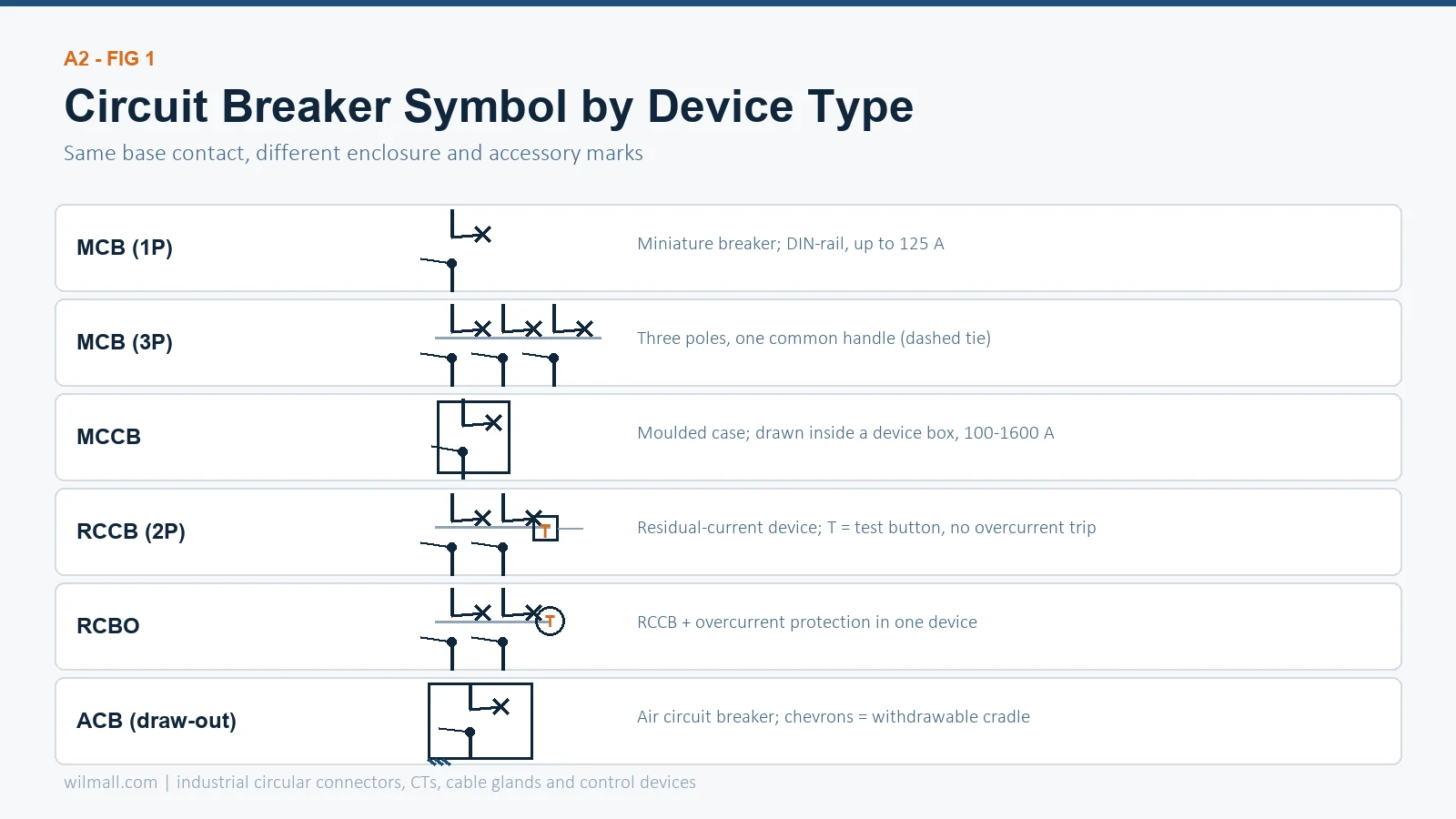
Circuit Breaker Symbol Chart by Device Type
One base contact, five devices. The table and the chart below give you the one-to-one match between the mark on the drawing and the hardware in the panel – useful when a customer drawing from another region uses a symbol style you have not seen before.
| Device | Symbol marks | Poles seen | Typical duty |
|---|---|---|---|
| MCB | Bare contact + X, hook handle | 1P / 3P | Final circuits, DIN rail, up to 125 A |
| MCCB | Contact inside a rectangular case | 3P / 4P | Distribution, 100-1600 A, adjustable trip |
| RCCB | Case + T test button, no overcurrent mark | 2P / 4P | Shock protection only, pairs with MCBs |
| RCBO | Case + T button + overcurrent contact | 1P+N / 2P+… | One device does both jobs |
| ACB | Large case, withdrawable cradle chevrons | 3P / 4P | Incomers and couplers, 630-6300 A |
For selection behind the symbol, our MPCB selection guide covers motor circuits and the overload relay vs MPCB comparison explains when a breaker alone is not enough. Hardware example: our WW10-63 RCCB matches the RCCB symbol exactly – two poles, T button, no thermal-magnetic trip.
Poles on the Symbol: 1P, 2P, 3P, 3P+N and 4P
Count contacts, not terminal screws. A dashed line through the tops of several contacts means one common handle – that is what makes three separate marks read as one 3P breaker.
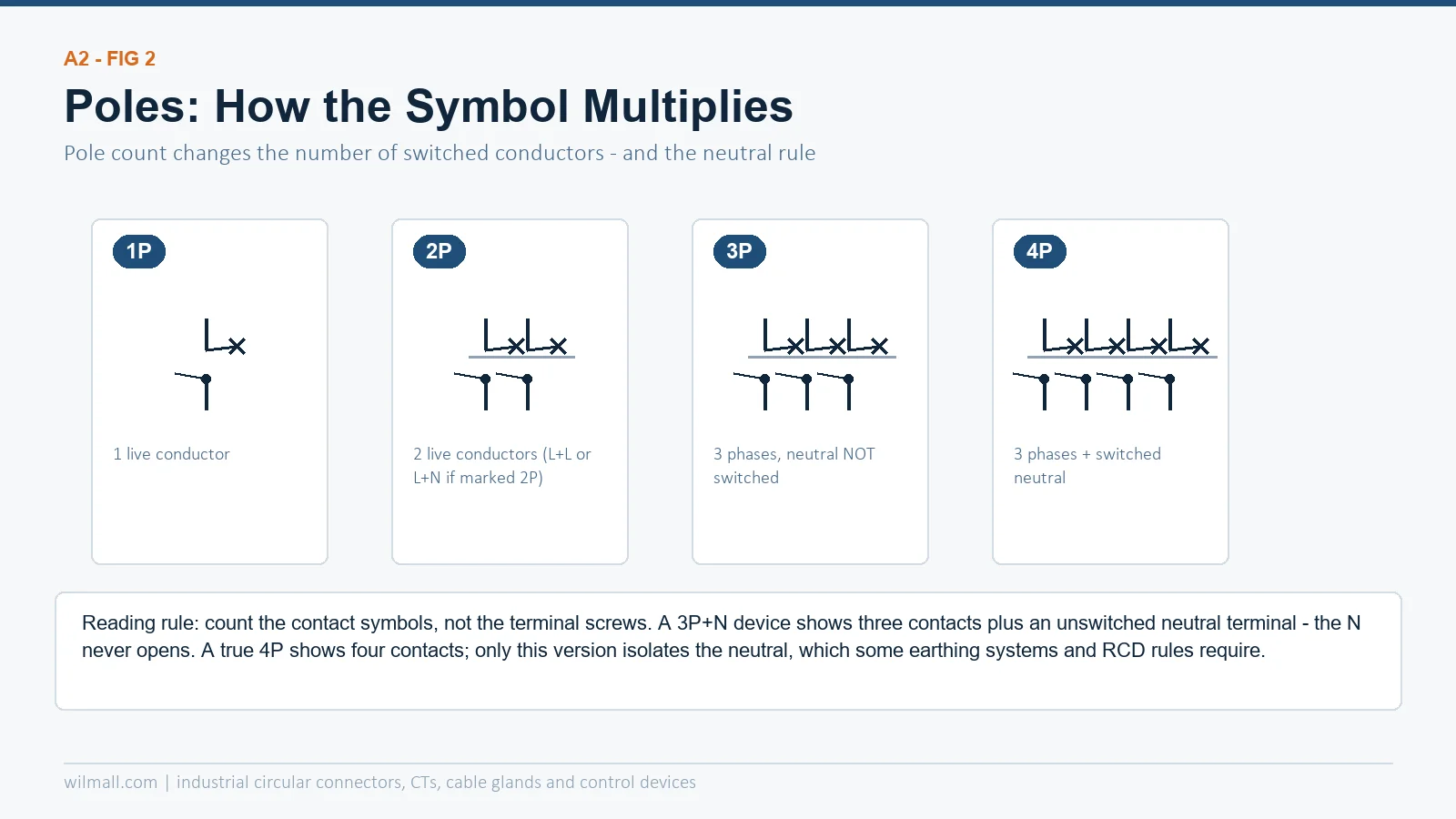
Two confusions cause most procurement errors. First, 3P+N is not 4P: the N terminal never opens, so the supply is not fully isolated – some earthing systems and RCD rules require a true 4P. Second, a 2P symbol on a 230 V L-N circuit means the breaker switches live and neutral; using a 1P device there breaches the drawing and, in many countries, the wiring rules. The circuit protection range lists each frame by pole count so the ordering code matches the symbol.
When the Symbol and the breaker behind it disagree
The most expensive mistake we see in RFQs is a symbol that says RCBO while the bill of materials lists an RCCB plus separate MCBs – functionally similar, physically different, different DIN width. Reverse cases are worse: a breaker symbol that omits the residual-current T mark, so shock protection disappears from the panel. If a drawing inherits symbols from several contractors, re-verify the three things the symbol cannot lie about: poles, test button, and whether the contact sits inside a case. Breaker coordination with contactors is a separate question – see our contactor vs circuit breaker guide and the IEC 60947-4-1 walkthrough.
Common Issues and Selection Tips for Circuit Breaker Symbols
Even seasoned professionals can trip up on symbols. Here’s how to avoid common pitfalls and make the best choices.
1. Avoiding Symbol Confusion
- Common Mistake: Mixing up symbols for different breaker types.
- Solution: Reference up-to-date standards and use checklists when reviewing drawings and specs.
2. Tailoring Symbols to Your Application
- Home Use: Prioritize RCCB symbols for wet or high-risk areas.
- Industrial Settings: Match symbols to the specific protection or isolation needs of your machinery and processes.
3. What Buyers Really Need to Know
- Rated Voltage/Current: Ensure the breaker can safely handle your system’s demands.
- Protection Features: Look for symbols indicating residual current or overcurrent protection, especially for sensitive or critical environments.
Mastering circuit breaker symbols is a practical skill that pays off in efficiency, safety, and peace of mind. Whether you’re designing, installing, or buying, a clear understanding of these symbols empowers you to make better decisions, reduce risk, and keep your electrical systems running smoothly.
We invite you to explore our extensive range of circuit breaker and experience firsthand the difference that quality and expertise can make. Whether you need assistance selecting the right model or want a custom solution, our knowledgeable team is ready to provide personalized support.
Please don’t hesitate to contact us today. Let’s work together to ensure your electrical projects are safe, efficient, and successful. Reach out via phone, email, or our website—your ideal circuit breaker solution is just a conversation away.