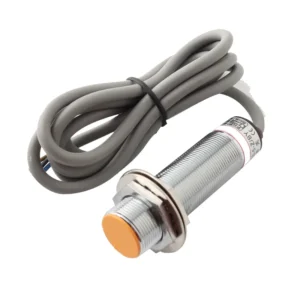
Ever wondered how elevators know when to open their doors or how your phone screen turns off when you hold it to your ear? The unsung hero behind these smart interactions is the capteur de proximité. These tiny yet powerful devices detect the presence or absence of objects without physical contact, making them indispensable in automation, manufacturing, and consumer electronics.
How Do Proximity Sensors Work?
Proximity sensors operate like a sixth sense for machines. Depending on the type, they use electromagnetic fields, sound waves, or light to detect nearby objects. Think of them as a bat’s echolocation—emitting signals and interpreting the feedback to “see” what’s around them.
Key Advantages of Using Proximity Sensors
No physical contact
Haute fiabilité
Fast response times
Durabilité
Détecteurs de proximité inductifs
How Inductive Sensors Function : These sensors detect metallic objects using electromagnetic induction. When a metal object enters the sensor’s field, it disrupts the current, triggering a switch.
Common Applications : Industrial automation; Machine safety systems
Capteurs de proximité capacitifs
Working Principle : Unlike inductive sensors, capacitive ones detect **both metallic and non-metallic objects** (like liquids or plastics) by measuring changes in capacitance.
Common Applications : Liquid level detection; Touchscreens
Capteurs de proximité à ultrasons
How Sound Waves Enable Detection : These sensors emit ultrasonic waves and measure their echo return time—like a submarine’s sonar. Great for distance measurement and object detection in varying conditions.
Comparison of Proximity Sensor Types
Type
Detection Range
Meilleur pour
Inductif
Short (mm-cm)
Metals only
Capacitif
Short to medium
Tous les matériaux
Magnétique
Short
Security, position sensing
Ultrasons
Long (up to meters)
Distance measurement
Optical
Medium to long
Precision applications
Choosing the Right Proximity Sensor
When choosing a proximity sensor, there are several key factors to consider. First, you need to determine the material type of the object being detected, as different materials may have an impact on the choice of sensor. Second, determine the required detection range, as the effective distance of the sensor will affect its effectiveness in practical applications. Finally, consider environmental conditions such as temperature, humidity, and interference factors, as these conditions may affect the stability and accuracy of the sensor. By carefully evaluating these factors, you can choose the most suitable proximity sensor to meet your needs.
—
Proximity sensors are the silent workhorses of modern tech, enabling seamless automation and smart interactions. Whether you’re designing a factory line or a consumer gadget, picking the right type ensures efficiency and reliability.
FAQ
1. What’s the main difference between inductive and capacitive sensors?
Inductive sensors detect only metals, while capacitive sensors work with almost any material.
2. Can ultrasonic sensors work in dusty environments?
Yes! Unlike optical sensors, ultrasonic ones aren’t affected by dust or fog.
3. Why are magnetic sensors used in security systems?
They’re reliable for detecting door/window positions without physical contact.
4. Are proximity sensors expensive?
Cost varies—inductive sensors are affordable, while laser-based ones are pricier.
5. Can I use an optical sensor outdoors?
It depends. Sunlight can interfere with IR sensors, but laser sensors may perform better.
—
This guide arms you with the knowledge to pick the perfect proximity sensor—like choosing the right tool for a job! Got more questions? Drop them below! 🚀
Les détecteurs de proximité inductifs peuvent sembler sortis d'un film de science-fiction, mais ils constituent en fait une pierre angulaire de l'automatisation moderne. Vous êtes-vous déjà demandé comment les machines "sentent" les objets sans les toucher ? C'est là que ces petites merveilles entrent en jeu. Dans cet article, nous allons nous plonger dans le monde des détecteurs de proximité inductifs, en expliquant ce qu'ils sont, [...]
Imaginez un dispositif capable de détecter des objets sans même les toucher - on se croirait dans un film de science-fiction, non ? Eh bien, les capteurs de proximité capacitifs rendent cela possible dans le monde réel ! Ces petits gadgets intelligents sont partout, de l'écran de votre smartphone aux systèmes d'automatisation industrielle. Mais comment fonctionnent-ils et pourquoi s'en préoccuper ? [...]
Vous êtes-vous déjà demandé comment les machines "voient" les objets sans les toucher ? Entrez dans le monde des commutateurs photoélectriques à réflexion diffuse, une technologie fascinante qui révolutionne discrètement l'automatisation. Que vous soyez un passionné de technologie ou un professionnel de l'industrie, ce guide vous expliquera tout ce que vous devez savoir sur ces incroyables dispositifs. Plongeons dans le vif du sujet ! - Qu'est-ce que [...]
Nous répondrons à votre demande dans les 24 heures
Nous accordons de l'importance à votre vie privée
Nous utilisons des cookies pour améliorer votre expérience de navigation, vous proposer des publicités ou des contenus personnalisés et analyser notre trafic. En cliquant sur "Tout accepter", vous consentez à notre utilisation des cookies.