A pendant station is the one piece of electrical equipment in a hazardous area that an operator holds in their hand, presses with a gloved thumb, and drags across a cable trolley eight hours a day. That combination — arcing contacts, a flexing cable entry and a person standing inside the classified zone — is why hazardous-area pendant control stations are certified as an assembly rather than specified as a box with buttons in it. It is also why the ATEX versus IECEx versus Class I Division 2 question comes up on almost every crane or hoist project that crosses a border.
The three systems are often treated as competing brands of the same certificate. They are not. Two of them — ATEX and IECEx — test to the same IEC 60079 standards and differ mainly in whose law gives the certificate force. The third, the North American Class and Division system, grew from a different code tradition and does not accept either of the other two as evidence. This guide decodes the marking on a pendant station, maps zones to divisions and back, explains why operator controls are the hardest part of the design, and sets out how to check a certificate before you release a purchase order.
Quick Answer: ATEX, IECEx or Division 2?
ATEX is mandatory to place equipment on the EU market and is not accepted as a substitute for a North American listing. IECEx is an international certification scheme built on the same IEC 60079 test standards as ATEX, and it is what most EPC contractors outside Europe specify. Class I, Division 2 is a classification under NEC Article 500, and a pendant station sold for it needs a UL or CSA listing — an ATEX certificate, even a Zone 2 one, does not make the station legal in a Division 2 area. The protection detail line — Ex db eb IIC T6 Gb — is identical in ATEX and IECEx; only the wrapper around it changes.
What a Hazardous-Area Pendant Station Has to Prove
Three separate things have to line up before a pendant can be installed in a classified area, and a purchase order usually only gets one of them right.
The first is the area classification, which is the plant’s document, not the supplier’s. It states the zone or division, the gas group or dust group, the temperature class and the ambient temperature range. Nobody selling pendant stations can tell a buyer what zone their crane runway is in. The second is the protection concept — how the equipment prevents ignition — which for a pendant is almost always a combination of flameproof pushbutton chambers inside an increased-safety enclosure. The third is the certificate, whose scope has to cover the exact model, gas group, temperature class and ambient range being installed.
What makes a pendant harder than a junction box is that its arcing parts are operated constantly. A terminal box contains no contacts that open under load. A pendant contains four, six or eight of them, each pressed thousands of times a shift, plus an emergency stop that must break the control circuit mechanically even if the contacts weld. The cable entry sees continuous bending at the gland. And the whole assembly is carried into the zone by the operator rather than bolted to a wall, so there is no argument that the hazardous area stops at the enclosure door.
| Document | Who issues it | What it settles | What it cannot settle |
|---|---|---|---|
| Area classification drawing | The plant or its process safety engineer | Zone or division, gas or dust group, temperature class, ambient range | Whether any particular product is suitable |
| Ex certificate (ATEX or IECEx) | Notified Body or IECEx Certification Body | Protection concept, EPL, gas group, ambient range, conditions of use | Whether the site classification accepts that scheme |
| Nameplate marking | Manufacturer | What the specific unit actually is | That the unit matches the certificate it claims |
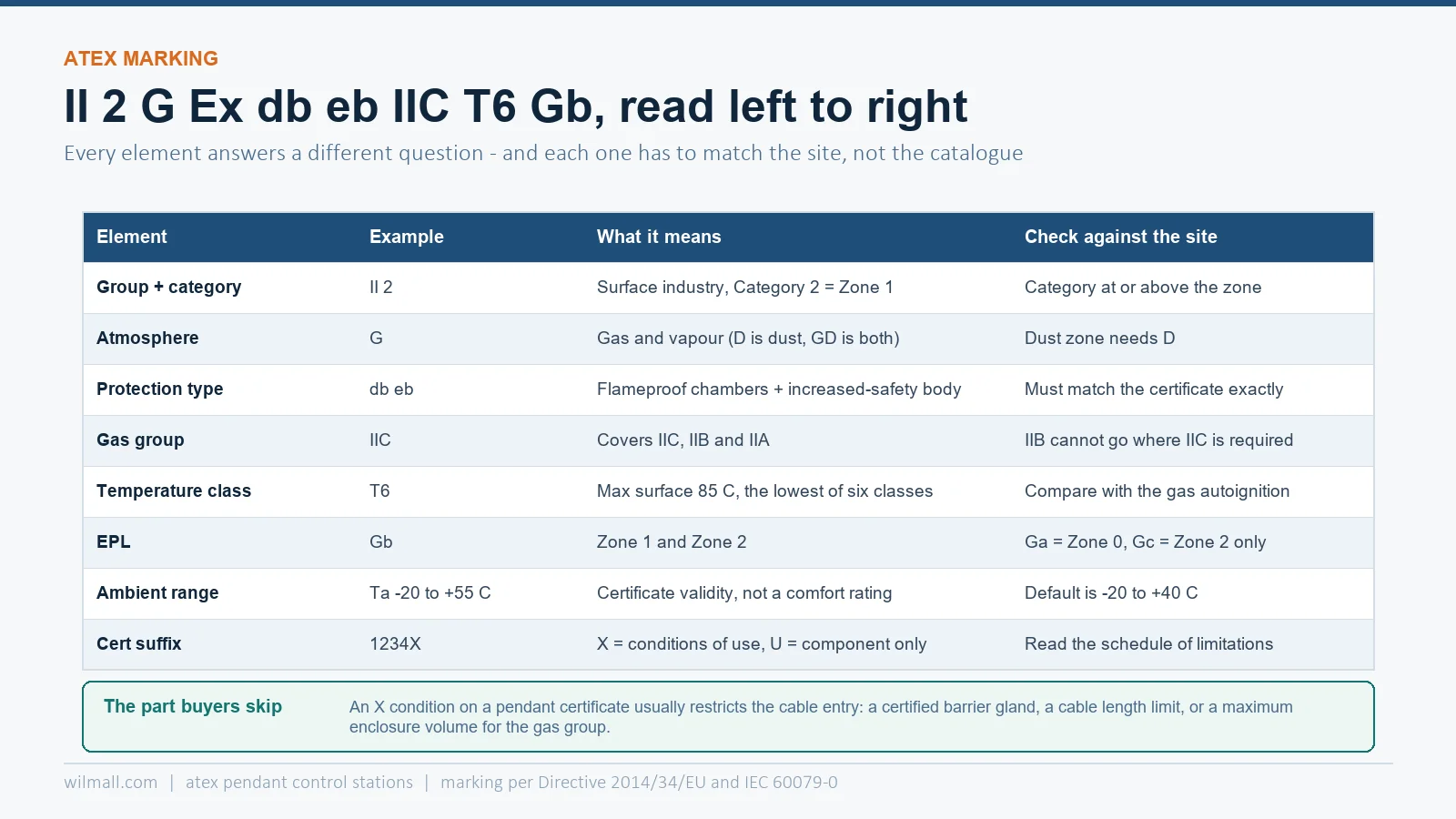
ATEX Marking Decoded: II 2 G Ex db eb IIC T6 Gb
A typical ATEX marking string on an industrial pendant station reads CE 0158 <Ex hexagon> II 2 G Ex db eb IIC T6 Gb, followed by the certificate number and an ambient range. Every element answers a different question, and buyers routinely read only the “Ex d” part.
| Element | Example | What it means | What to check against the site |
|---|---|---|---|
| CE mark + four-digit number | CE 0158 | EU conformity; the number identifies the Notified Body that handled quality assurance | The same Notified Body must appear on the certificate or its quality assurance notification |
| Ex hexagon | ⬣ (Ex in a hexagon) | Declares the product as explosion-protected equipment under the ATEX Directive | Present on the nameplate, not only in the catalogue |
| Equipment group | II | Group I is underground mining; Group II is all other surface industry | Group I equipment is a different product, not a cheaper Group II |
| Category | 2 | Category 1 covers Zone 0, Category 2 covers Zone 1, Category 3 covers Zone 2 | Category must be equal to or better than the zone |
| Atmosphere | G | G for gas and vapour, D for dust, GD for both | A gas-only pendant in a dust zone is non-compliant even if the enclosure is sealed |
| Protection type | db eb | Two concepts combined: flameproof enclosure (d) plus increased safety (e), at EPL level b | The combination must be the one on the certificate, not a mix of two certificates |
| Gas group | IIC | Highest gas group; covers IIC, IIB and IIA applications | IIB equipment cannot be used where IIC is required, but IIC is valid for IIB and IIA |
| Temperature class | T6 | Maximum surface temperature 85 °C, the lowest of the six classes | Compare with the autoignition temperature of the actual gas, not with a generic rule of thumb |
| EPL | Gb | Equipment protection level b for gas — suitable for Zone 1 and Zone 2 | Ga for Zone 0, Gb for Zone 1, Gc for Zone 2 |
| Ambient range | Ta -20 °C to +55 °C | The range over which the certificate is valid; if nothing is marked, assume the standard -20 °C to +40 °C | A crane cab roof in the Gulf or a freezer store will fall outside the default range |
| Certificate suffix | Sira 15ATEX1234X | X means specific conditions of use apply; U means an Ex component, not complete equipment | Read the schedule of limitations before designing the installation |
The two suffixes matter more than they look. An X condition on a pendant certificate commonly restricts the cable entry — for example requiring a certified barrier gland, or limiting the supply cable length, or stating a maximum enclosure volume for the gas group. An U certificate means the item is a component intended to be built into equipment that will be assessed separately. A supplier offering a “U”-certified pushbutton assembly as a finished pendant station has handed you a component, not a product.
Category, Zone and EPL: Three Labels for One Idea
ATEX equipment carries two parallel declarations of the same risk level: the Directive’s category (1, 2 or 3) and the IEC-derived Equipment Protection Level (Ga, Gb, Gc, Da, Db, Dc). They are not identical terminology, and datasheets mix them, so it is worth having them side by side.
| ATEX category | Gas zone | Dust zone | EPL | Where it may be installed |
|---|---|---|---|---|
| 1 G | Zone 0 | — | Ga | Zone 0, 1 and 2 |
| 2 G | Zone 1 | — | Gb | Zone 1 and 2 |
| 3 G | Zone 2 | — | Gc | Zone 2 only |
| 1 D | — | Zone 20 | Da | Zone 20, 21 and 22 |
| 2 D | — | Zone 21 | Db | Zone 21 and 22 |
| 3 D | — | Zone 22 | Dc | Zone 22 only |
The zones themselves describe how much of the time an explosive atmosphere is present. Many classification practices attach rough annual duration bands to them — above roughly 1,000 hours a year for Zone 0, between about 10 and 1,000 hours for Zone 1, and under about 10 hours for Zone 2. Those bands are engineering guidance from recommended practice, not numbers written into IEC 60079 or into the ATEX Directive, so they should never be used to argue a boundary. They are useful only for understanding why a Zone 2 pendant is a lighter, cheaper object than a Zone 1 one.
For a pendant station the practical consequence is that the upgrade direction is one-way. A Zone 1 (Gb) pendant can be installed in a Zone 2 location without argument. A Zone 2 (Gc) pendant cannot be moved into Zone 1, however robust the enclosure looks, because its internal components were never assessed for a one-fault condition. Crane users who buy on price for a Zone 2 runway and later extend the runway into a Zone 1 area end up replacing the stations.
IECEx: Same Tests, Different Paperwork
IECEx is a certification scheme run under the International Electrotechnical Commission, built on the same IEC 60079 series that ATEX harmonised. The technical content of the two certificates is therefore almost always identical, and many Notified Bodies are simultaneously IECEx Certification Bodies, so a manufacturer typically obtains both from one test campaign.
What differs is the paper trail. IECEx issues a Certificate of Conformity against an ExTR (explosive atmosphere test report), and the manufacturer’s factory is covered by a QAR (quality assessment report) that has to remain valid for the certificate to stay meaningful. The certificate number follows a fixed pattern — an ExCB code, a year, a sequence number and an optional suffix, for example IECEx DEK 21.0012X — and the number on the nameplate can be looked up in the scheme’s public certificate register.
| ATEX | IECEx | NEC Class I, Division | |
|---|---|---|---|
| Legal basis | Directive 2014/34/EU, enforced by EU member states | Voluntary international scheme, adopted contractually | NFPA 70 (NEC) Article 500, enforced by the AHJ |
| Marking on the pendant | CE + Notified Body number, hexagon, group, category, atmosphere, full Ex string | Full Ex string plus IECEx certificate number | Class, Division, Group letter, temperature class, listing mark |
| Protection detail | Ex db eb IIC T6 Gb | Ex db eb IIC T6 Gb | Listed to UL 1203, UL 698 or UL 913 depending on concept |
| Certificate check | Notified Body records and the certificate schedule | Public IECEx certificate register online | Listing body’s product database by file number |
| Accepted in the EU | Required | Not a legal substitute | No |
| Accepted in the US and Canada | No | No, unless the AHJ accepts supporting documentation under Article 505 | Required |
The point that gets lost in quotation comparisons is that IECEx is not an alternative to ATEX inside the EU, and neither is an alternative to a North American listing. A Zone 1 IECEx pendant shipped to a plant in Texas is a well-made object with no standing in the installation until it carries a UL or CSA mark. Conversely, an ATEX certificate is what a European insurer and a European inspector will ask for, and an IECEx certificate alone will not satisfy them.
Class I, Division 2 Under NEC Article 500
North America classifies by the probability that a hazardous atmosphere is present, in two steps rather than three. Class I, Division 1 covers locations where ignitable concentrations exist under normal operating conditions, or exist frequently through repair and maintenance, or where a failure of process equipment could release gas while electrical equipment also fails. Class I, Division 2 covers locations where ignitable concentrations are not expected in normal operation and, if they occur, exist only for a short period — typically because the material is in closed containers or the area is mechanically ventilated.
That one-step gap carries real cost. In Division 2 the Code relaxes the enclosure requirement for apparatus that does not produce arcs, sparks or hot surfaces in normal operation, and permits general-purpose enclosures with the appropriate wiring method. In Division 1, the pendant has to be listed explosion-proof, purged, or intrinsically safe. The practical result is that a Division 2 pendant is a much lighter, cheaper and easier-to-service object than a Division 1 pendant — and that a supplier quoting a Division 2 station against a Division 1 drawing will be caught at inspection.
Two vocabulary traps deserve to be called out. In North American usage “explosion proof” is a specific listing category tied to flameproof-style enclosures, not a general word for hazardous-area equipment, so a Division 2 non-incendive pendant is legitimately not explosion proof. And the gas groups run the other way round from IEC: NEC Group A is acetylene, B is hydrogen, C is ethylene and D is propane, so the IEC IIC band corresponds to Groups A and B with IIB mapping to Group C and IIA to Group D. Equipment marked for IIC covers every NEC gas group; equipment marked Group D covers almost none of them.
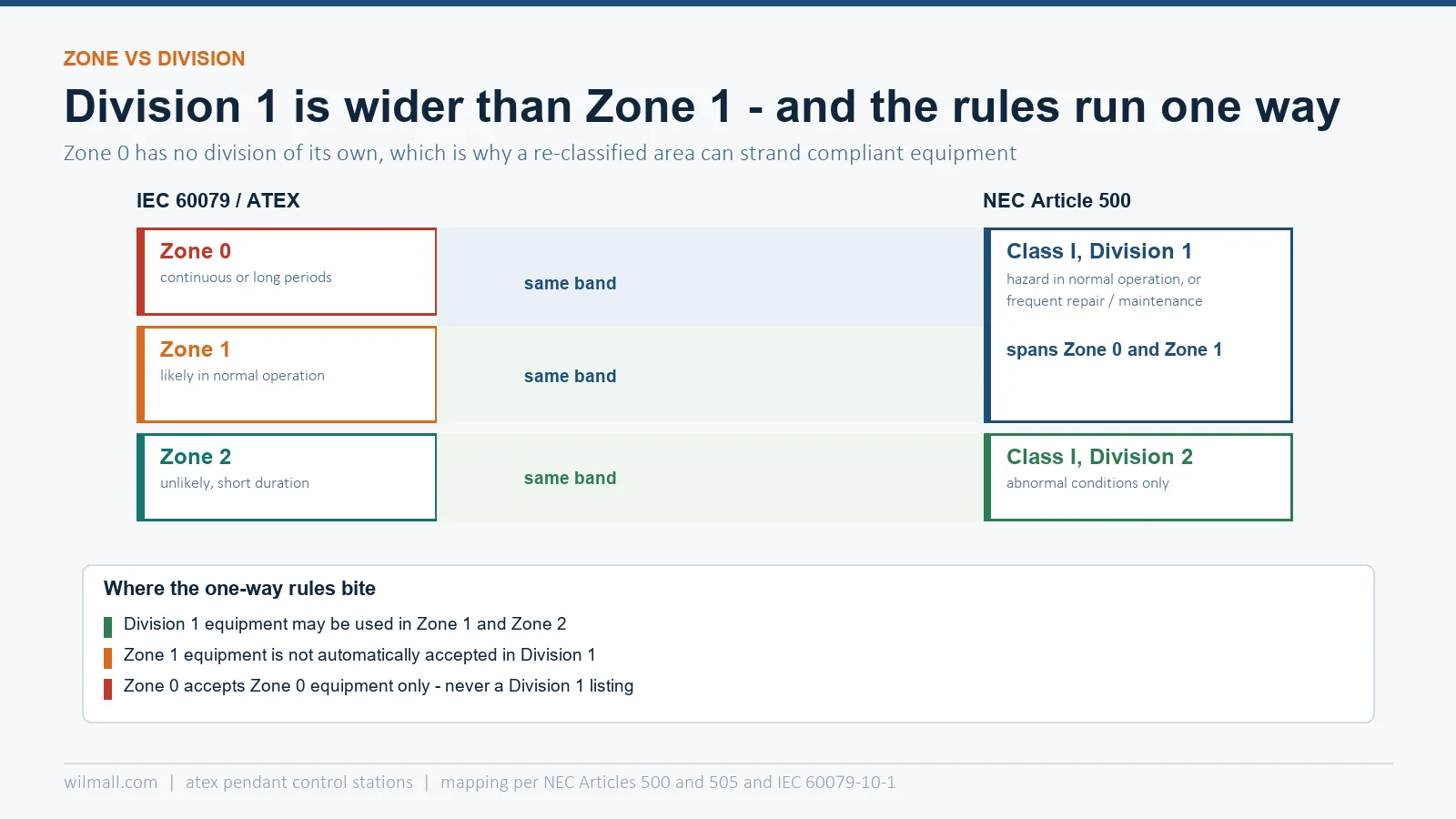
Division to Zone: The Conversion That Is Not a Conversion
The NEC also contains a zone system, in Article 505 for gas and Article 506 for dust, which mirrors IEC 60079. Designers therefore meet both languages on the same project, and the mapping between them is where most retrofit errors start.
| IEC zone | Approximate NEC division | Why the mapping is not exact |
|---|---|---|
| Zone 0 | Inside Class I, Division 1 | Division 1 does not separate continuous hazard from likely hazard, so Zone 0 has no division of its own |
| Zone 1 | Class I, Division 1 | Close correspondence, but equipment interchange rules still apply in one direction only |
| Zone 2 | Class I, Division 2 | Close correspondence in probability terms, not a certification equivalence |
| Zone 20 to 22 | Class II, Division 1 and 2 | Dust grouping differs between the systems (NEC Groups E, F, G against IEC IIIA, IIIB, IIIC) |
The interchange rules in Article 505 are deliberately asymmetric, and this is the single most common conversion mistake. Equipment listed for Division 1 may be used in Zone 1 or Zone 2 applications, and equipment listed for Division 2 may be used in Zone 2. In the other direction, Zone 1 equipment is not automatically acceptable in a Division 1 location, and Division 1 equipment is never acceptable in Zone 0. Zone 0 requires equipment listed for Zone 0 — in practice intrinsic safety at EPL Ga. A Division 1 flameproof pendant that was compliant inside a tank vapour space under a division drawing can become non-compliant the moment that space is re-drawn as Zone 0.
Article 505 also does not allow an area to be classified under both systems at once. A facility picks one and applies it, and the classification drawing has to state which. Re-classifying an area from divisions to zones is a re-classification with design consequences, not a relabelling exercise.
Why Operator Controls Are the Hard Part: Ex d, Ex e and Ex de
Increased safety, Ex e, works by making sure that arcs, sparks and hot surfaces cannot arise in normal operation — increased creepage and clearance distances, terminals that cannot work loose, temperature limits, and an enclosure of at least IP54. It achieves that by not allowing arcing components inside. A pushbutton is an arcing component by definition, which is why a plain Ex e box cannot simply be drilled and fitted with a standard button.
The answer for pendant stations is the combination marked Ex de: flameproof (Ex d) chambers or a flameproof enclosure for the switching elements, combined with increased safety (Ex e) construction for the terminal compartment and enclosure. The flameproof part contains the arc and cools the escaping gases through the flame path; the increased-safety part keeps the wiring side free of ignition risk and easy to terminate.
| Concept | Standard | Principle | Zones | Can it hold arcing contacts? |
|---|---|---|---|---|
| Ex d, flameproof | IEC 60079-1 | Contains an internal explosion and cools the escaping gas through machined flame paths | Zone 1, Zone 2 | Yes |
| Ex e, increased safety | IEC 60079-7 | Prevents arcs, sparks and hot surfaces from arising at all; IP54 minimum | Zone 1, Zone 2 | No |
| Ex de, combination | 60079-1 + 60079-7 | Flameproof switching chambers inside an increased-safety enclosure | Zone 1, Zone 2 | Yes, in the d chamber |
| Ex i, intrinsic safety | IEC 60079-11 | Limits circuit energy below the ignition threshold | Zone 0 with ia | Only at very low energy |
| Ex ec, increased safety for Zone 2 | IEC 60079-7 | Non-sparking construction for normal operation only | Zone 2 | No |
Two design details follow from this. The emergency stop has to be a mechanically latching, push-to-lock, twist-to-release type, and its contact block has to be the certified one named in the assembly certificate — not an equivalent from a different series. And because Ex d flame paths depend on machined joint faces, every opening of the enclosure for wiring is a maintenance event: the faces must be cleaned, not painted, and the cover bolts torqued as specified.
Zone 1 crane and hoist projects normally end up with Ex de stations at EPL Gb, in IIB or IIC depending on the gas study, at T4 to T6. Zone 2 projects can use Gc equipment and often use Ex ec, which is materially cheaper, but the same pendants then cannot be redeployed into Zone 1. On the North American side the equivalent decision is between a Division 1 explosion-proof station and a Division 2 station, and the cost difference is of the same order.
Cable Entries and the Certificate Boundary
Installation rules live in IEC 60079-14, and the cable entry is where a correctly certified pendant most often stops being compliant.
The rule set is short and unforgiving. A flameproof Ex d enclosure takes only Ex d certified cable glands, adaptors and blanking plugs, because the gland forms part of the flame path. An increased-safety Ex e enclosure accepts Ex e or Ex d glands, so an Ex d gland is universal while an Ex e gland on an Ex d box is a defect. Every unused entry needs a certified blanking plug, not a plastic cap. The sixth edition of IEC 60079-14, published in August 2024, added a selection flowchart for Ex d entries that turns on the gas group (hydrogen and IIC being the strict cases), the length of the connected cable and whether the enclosure volume exceeds 2,000 cm³ — factors that push the choice toward a compound-filled barrier gland.
On a pendant there is an extra mechanical problem: the cable is in continuous motion at the gland. That argues for a gland matched to the cable jacket and its flex rating, correct strain relief inside the enclosure, and cable chosen for festoon or trolley duty rather than fixed installation. It also argues for reading the X conditions on the certificate, because a restriction such as “cable entry to be made with a certified Ex d barrier gland” is exactly the kind of line that gets skipped between the panel shop and the site.
The wider point is that certification has a boundary. A station assembled from individually certified components is not automatically a certified station unless the assembly follows the component certificates’ conditions. Where the assembly matters, buy a pendant certified as complete equipment and keep the assembly drawing — that is the document the inspector will ask for. Stations built with ATEX certified armoured cable glands are only as good as the gland-to-enclosure interface on site, and a mismatched gland can void the enclosure’s protection concept regardless of what the label says.
How to Verify an ATEX or IECEx Certificate Before You Order
Certificate checks are quick when done in a fixed order. For an IECEx certificate, the number on the nameplate resolves in the scheme’s public register, and the register shows the certificate status, the issuing body, the product description and the ambient range. For ATEX, the number follows the pattern <Notified Body> <year>ATEX<sequence><suffix>, and the four-digit Notified Body number in the CE marking must match the body that handled quality assurance.
- Match the number format. A certificate number that does not follow the scheme’s pattern is the fastest possible rejection.
- Match the CE marking. The four-digit number next to the CE mark must be the Notified Body on the certificate or its quality assurance notification.
- Look the certificate up. Use the IECEx register or the Notified Body’s own record, never a PDF supplied by the seller without a number to check.
- Check the scope. The product description, model list, gas group, temperature class and ambient range must cover the exact item and the site conditions.
- Check the nameplate against the certificate. The full marking string, including EPL and Ta, has to match what the certificate authorises.
- Check the quality system status. For IECEx, the QAR has to be current; for ATEX, the quality assurance notification behind the CE number has to be in force. An expired QAR means the certificate no longer guarantees what it says.
| Red flag | What it usually means | What to do |
|---|---|---|
| A “U” certificate presented for a finished pendant | The item is a component, not certified equipment | Ask for the assembly certificate or the assessment that covers the finished station |
| Marked ambient range narrower than the site | The certificate is valid, but not for this installation | Request an extended-range certificate or change the product |
| EPL one step below the zone (Gc offered for Zone 1) | Zone 2 equipment being sold into a Zone 1 area | Reject; the internal components were never assessed for one fault |
| Certificate number not found in the register | Withdrawn, superseded, or never issued | Stop the order until a verifiable number is provided |
What to Put on the RFQ for a Hazardous-Area Pendant
Most quotation mismatches on hazardous-area pendants are not technical disagreements; they are missing inputs. An RFQ that states the following gets comparable, orderable offers.
| Input | Why the supplier cannot guess it |
|---|---|
| Area classification, zone or division, gas or dust group, temperature class | Decides category, EPL and protection concept, and therefore the price band |
| Ambient temperature range at the crane runway | Determines whether the standard certificate range is valid at all |
| Certificate scheme required (ATEX, IECEx, UL or CSA) | The same product may exist in three versions with three different labels |
| Button count and function, single or dual speed, selector switches | Sets the enclosure size and the number of flameproof chambers |
| Emergency stop type and whether it must be latching | The contact block must be part of the certified assembly |
| Cable length, cable type and whether it is festoon or trolley supported | Drives gland selection, strain relief and any X condition on the certificate |
| Gland and entry requirements, including unused-entry blanking | Gland certification must match the enclosure concept |
| Ingress protection and enclosure material | IP and Ex are separate ratings; both need to be stated |
| Required nameplate marking | Lets you verify the delivered units against the certificate on receipt |
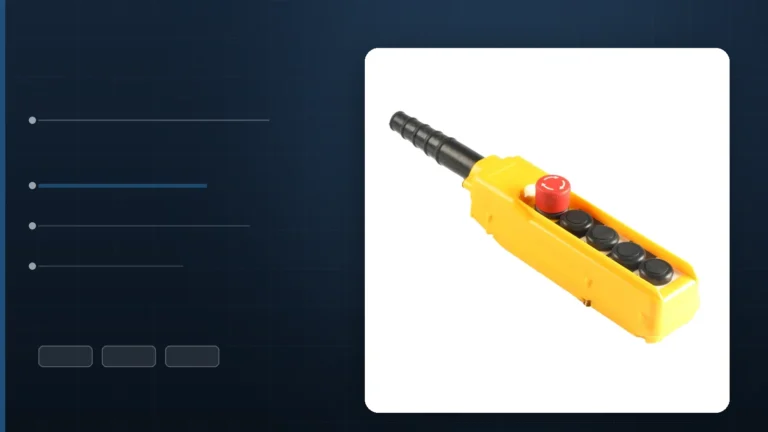
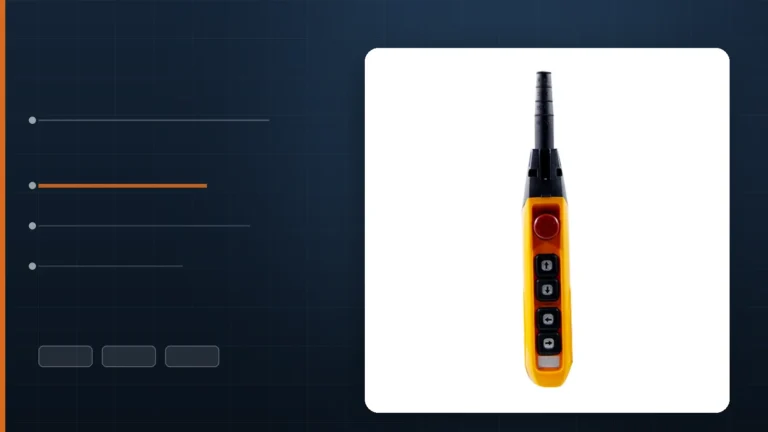
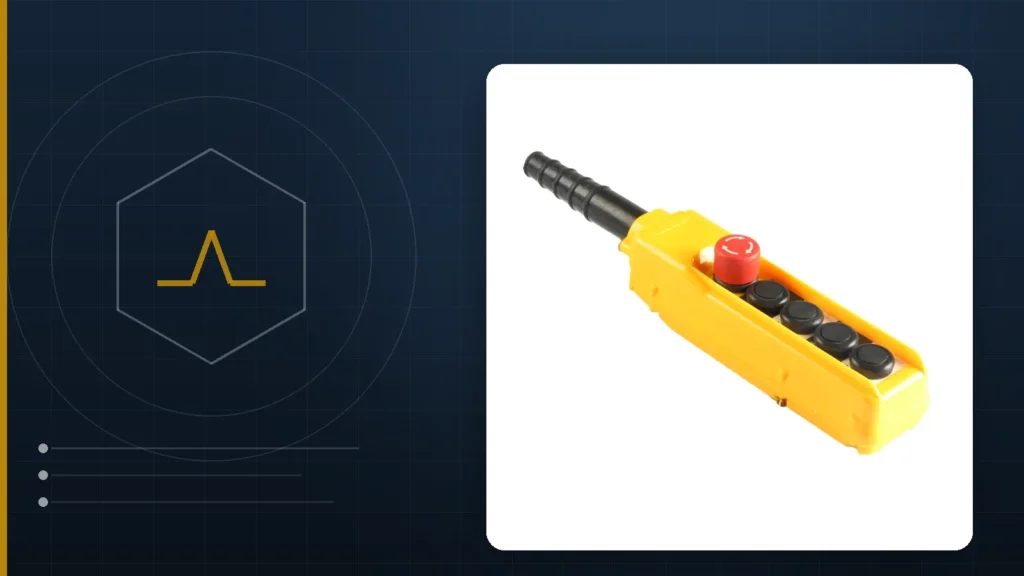
For a first look at what a certified station looks like in hardware, the explosion proof pendant control station range covers push-lock emergency stop versions such as the COP-3MSD three-button station and the COP-5MSS-DD five-button station; the pendant control station category lists the full button range. Button numbering, cable cores and control-circuit layout are covered in pendant control station wiring for 2, 4, 6 and 8 button layouts, and the switching side of the circuit — because the contactor that a pendant commands also has to survive the classified area — is set out in explosion-proof contactors and Ex d selection. If the installation is a two-button hoist control, the specifications side is in choosing a two-button pendant control for hoists.
FAQ
Is an ATEX certificate accepted in the United States?
No. The United States enforces the National Electrical Code through the authority having jurisdiction, and equipment in classified locations must be listed to the relevant UL or CSA standards. Article 505 allows zone-classified installations and lets the AHJ accept IECEx documentation as supporting evidence, but that is a case-by-case judgement, not a legal equivalence. Projects that need both markets normally buy dual-certified pendants.
Can a Zone 1 ATEX pendant be installed in a Class I, Division 2 area?
Not on the strength of the ATEX certificate alone. The zone-to-division interchange rules in Article 505 permit equipment listed for Zone 1 to be used in Zone 2 applications, but the equipment still has to carry a North American listing accepted by the AHJ. In practice the correct route is a pendant listed for Class I, Division 2 — or for Division 1, which covers Division 2.
What does the X at the end of a certificate number mean?
It means the certificate carries specific conditions of use that must be applied. For a pendant station the condition is usually about cable entry, enclosure volume or supply cable length. The conditions are printed in the certificate schedule, and an installation that ignores them is outside the certification even though the label looks correct.
Does an IP65 pendant station count as explosion protected?
No. Ingress protection and explosion protection are separate ratings answering separate questions. IP65 describes resistance to dust and water jets; it says nothing about whether an internal arc can ignite the surrounding atmosphere. An IP65 enclosure with uncertified pushbuttons is suitable for washdown areas and unsuitable for a Zone 1 area.
Which gas group should I specify for a crane pendant?
Take it from the area classification drawing, not from habit. IIC is the widest band and covers hydrogen and acetylene, so IIC equipment can be used in IIA and IIB areas; IIB equipment cannot be used where IIC is required. Specifying IIC where the study only requires IIA costs more than it needs to, but it buys flexibility if the process changes.