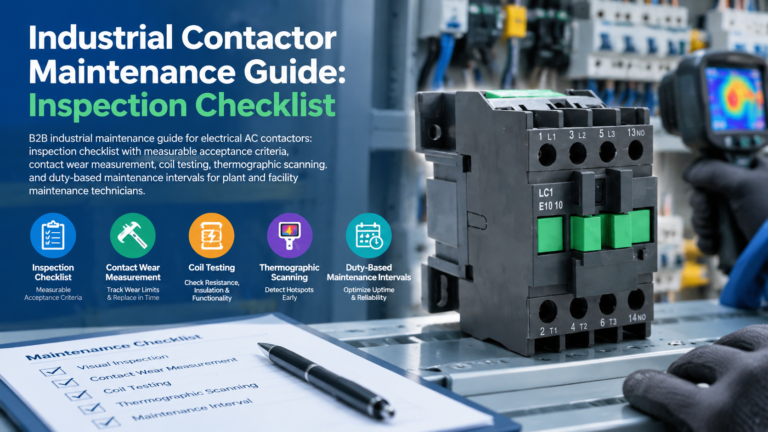







Industrial Contactor Maintenance Guide: Inspection Checklist
A 16-point contactor maintenance checklist with measurable acceptance criteria — contact wear, coil testing, terminal torque, thermography, and duty-based inspection intervals.
Read More
The contactor is one of the cheapest switching devices in a control panel — and one of the few that fails on a predictable schedule. So the question most buyers actually ask is not whether to replace it, but what the replacement will really cost once the part, the electrician, and the stopped machine are all counted. This guide breaks down AC contactor replacement cost for 2026 across residential HVAC, light commercial, and industrial three-phase applications, and shows where the money actually goes.
For a residential air conditioner, published US service pricing puts the replacement part at roughly $15–$80 and the complete job — part plus a licensed technician’s labor — at $150–$450. For an industrial three-phase contactor, the part alone can run from about $25 for a 9 A frame to well over $1,500 for a 630 A frame, and the total installed cost typically lands between $500 and $5,000 once labor and downtime are included.
The spread is enormous because “contactor replacement” covers three different jobs. The table below shows typical 2026 figures for each.
| 애플리케이션 | Part Cost | Labor | Downtime | Typical Total |
|---|---|---|---|---|
| Residential HVAC (single-phase, 20–40 A definite-purpose) | $15–$80 | $130–$350 | Not billed | $150–$450 |
| Light commercial (rooftop units, small panels, up to 95 A) | $30–$180 | $150–$400 | $0–$500 | $200–$900 |
| Industrial three-phase (IEC frames 9 A–630 A) | $25–$1,500+ | $150–$900 | $0–$10,000+ | $500–$5,000+ |
Figures reflect US service-market pricing in 2026; parts sourced directly from manufacturers, particularly from Chinese IEC-contactors suppliers, sit at the low end of each band. The rest of this article explains what drives each column — and which of them you can actually control.
A replacement invoice almost never shows the full cost. In a plant environment the total divides into four parts, and the part itself is usually the smallest of them.
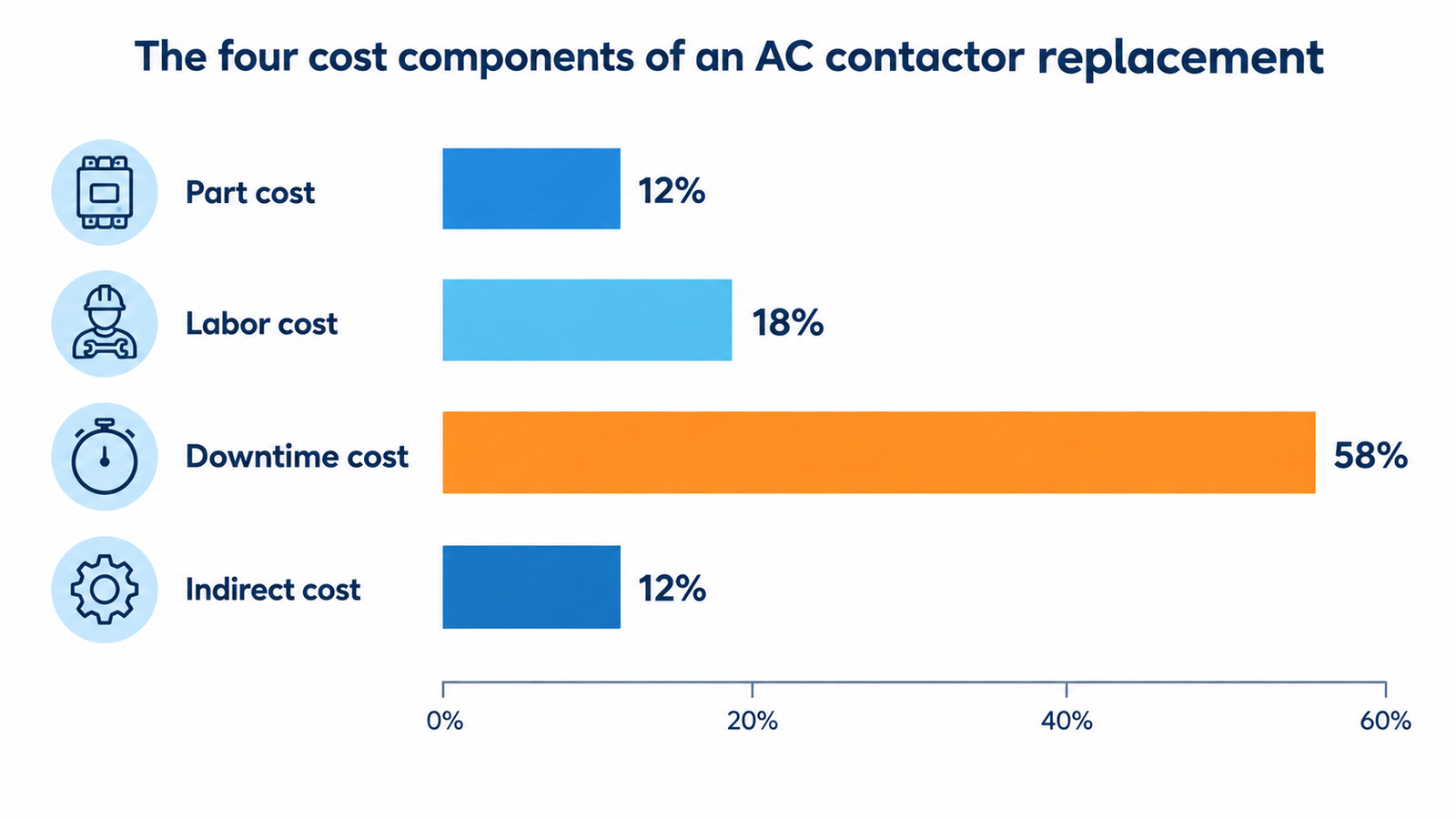
The new contactor itself. This is the only line item that is quoted up front, and the only one buyers tend to compare — which is why it gets disproportionate attention in procurement.
Diagnosis, lockout/tagout, the physical swap, torque checks, and a functional test. A straightforward swap in an accessible panel takes a licensed electrician 30–90 minutes; industrial jobs with arc-flash PPE requirements, permit-to-work procedures, or difficult access can take half a shift or more.
The production or service lost while the machine is off. This is the component that dominates industrial totals and the one that never appears on any quote. If a packaging line produces $2,000 of margin per hour, a four-hour unscheduled stop costs more than the contactor ever will.
Emergency freight, overtime premiums, re-commissioning, disposal of the failed unit, and — if the failure damaged anything downstream — collateral repairs. These are individually small but collectively real, and they scale with how unplanned the replacement was.
The single biggest driver of part cost is frame size, because larger frames mean more silver contact material, a bigger magnet system, and a heavier arc chute. The bands below are indicative 2026 ex-works prices for volume IEC-rated contactors from Chinese manufacturers; European brand equivalents in the same frames typically run three to five times higher.
| Frame (AC-3 Current) | Motor Capacity @ 400 V | Typical Part Price Band | Common Duty |
|---|---|---|---|
| 9–18 A | 2.2–7.5 kW | $15–$40 | Small pumps, fans, compressors |
| 25–40 A | 11–18.5 kW | $25–$60 | Conveyors, HVAC rooftops, machine tools |
| 50–65 A | 22–30 kW | $40–$90 | Larger pumps, packaged equipment |
| 80–95 A | 37–45 kW | $60–$140 | Process motors, compressors |
| 115–185 A | 55–90 kW | $120–$350 | Main drives, hoists, large fans |
| 225–400 A | 110–200 kW | $300–$900 | Heavy machinery, main distribution switching |
| 500–630 A | 250–315 kW | $800–$2,000+ | Large drives, generator and bus transfer |
If you are not sure which frame your motor actually needs, work it out before you buy — an oversized contactor wastes money twice, at purchase and in panel space. The AC-3 sizing chart walks through the selection step by step.
Labor is where residential and industrial replacements diverge sharply. A homeowner pays for one technician visit; a plant pays for the same visit plus the procedures around it.
| Setting | Typical Hourly Rate (US, 2026) | Typical Job Time |
|---|---|---|
| Residential HVAC service call | $75–$150 | 30–60 min |
| Commercial / light industrial electrician | $100–$180 | 1–2 h |
| Industrial plant (arc-flash PPE, permits, LOTO) | $120–$250 | 2–6 h |
| Emergency callout (nights, weekends, holidays) | 1.5–3× standard rate | Same job, premium hours |
Two details often surprise buyers on the residential side: many service companies charge a $75–$200 diagnostic fee that is sometimes (not always) credited against the repair, and the quoted “replacement cost” usually assumes the contactor is the confirmed fault. If the real problem is upstream, you pay for the diagnosis and then for the actual repair on top.
Here is the arithmetic that reframes the whole purchase. A 45 kW process fan driven by a 95 A contactor: the part costs about $90 from a direct manufacturer. An unplanned failure on a Tuesday afternoon costs the swap at emergency rates (call it $450), a four-hour production stop on a line worth $1,500 per hour ($6,000), and expedited freight because nobody stocked the spare ($120). Total: roughly $6,700 — of which the contactor was 1.3%.
This is why serious maintenance budgets treat the question differently. The same contactor, swapped during a planned shutdown by an in-house electrician, costs about $90 in parts and one labor hour. The decision that saves five figures is not which contactor to buy — it is whether the replacement happens on your schedule or the equipment’s.
Before you pay for any replacement, though, make sure the contactor is actually the failed component. A burned coil, welded contacts, and a chattering armature each point to different root causes, and replacing the contactor without finding the cause just schedules a second purchase. The failure symptoms guide covers the diagnosis, and the troubleshooting guide maps each symptom to its underlying cause.
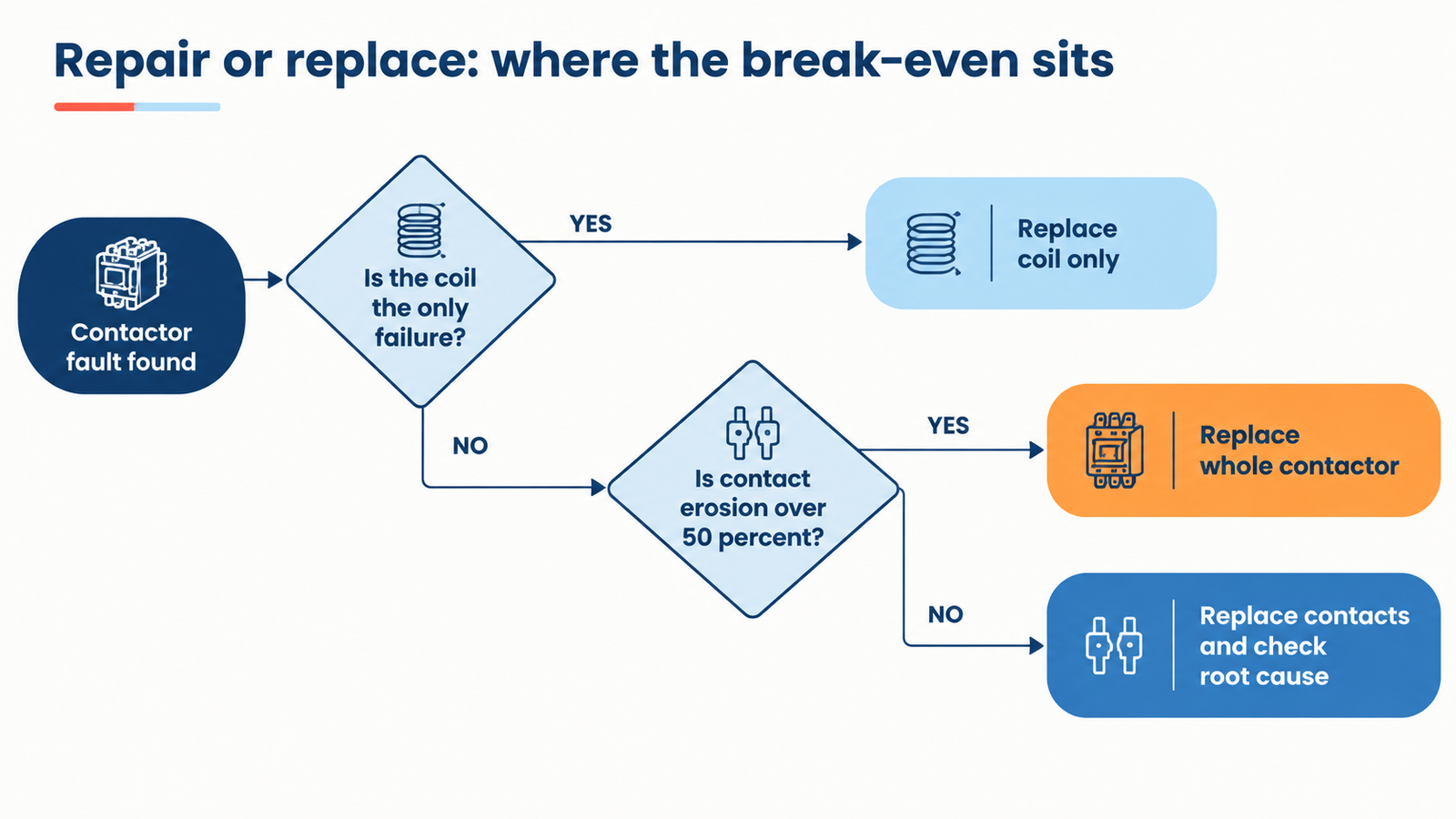
Not every failed contactor needs a full replacement, and on larger frames the arithmetic can favor partial repair. The decision tree is simple:
| Repair Option | Typical Cost | Makes Sense When |
|---|---|---|
| Coil only | $10–$80 | Coil is open or shorted; contacts, springs and arc chute are sound |
| Contact kit | $20–$150 | Contact erosion is visible but under roughly half the material thickness; single failure, no history of repeats |
| Full contactor | Part price by frame | Erosion past half the material, welded contacts, cracked housing, arc-chute damage, or more than one repair in the unit’s recent history |
Use a break-even rule rather than hope: if the repair parts plus the labor to fit them exceed about 40% of a new unit’s price, replace the whole contactor. A rebuilt contactor with worn springs and a degraded arc chute fails again — and the second failure arrives without warning, which is exactly the cost pattern the table above punishes.
Whether the job is repair or replacement, several items routinely escape the budget:
Once the required frame and utilization category are fixed, the remaining cost levers are all procurement-side:
A $90 contactor and a $400 contactor in the same frame are not the same purchase if one of them lasts twice as long, because the expensive part of a contactor is never its price — it is the visit required to change it. On critical equipment, contact material quality, mechanical endurance, and consistent coil manufacturing show up as fewer unplanned interventions, and a single avoided emergency swap pays the price premium several times over.
For plant buyers, the practical version is a two-tier spares policy: certified, well-made units for critical drives, and standard-volume frames for everything else. If you want to see where those price tiers land on real hardware, the CJX2-F400 interlocking contactor page and the CJX2 series overview list current frames and configurations, and the factory will quote directly for project quantities.
Replacing an AC contactor costs $150–$450 in a residential HVAC system and $500–$5,000 or more in an industrial plant — but in both cases the part is the smallest line item. Frame size drives the part price, labor rates and access drive the service cost, and downtime drives everything in a production environment. Get the diagnosis right, decide repair versus replace with the 40% break-even rule, buy the correct frame from the right tier of supplier, and schedule the swap on your calendar rather than the equipment’s. That is the whole cost playbook.
A residential HVAC swap takes a technician 30–60 minutes including diagnosis. An industrial three-phase replacement takes one to two hours in an accessible panel, and up to half a shift when arc-flash PPE, lockout/tagout, and commissioning tests are required.
If you are a qualified person, the mechanical swap is straightforward: isolate the supply, verify zero voltage, photograph the wiring, swap the unit, and restore. In most jurisdictions, work on fixed three-phase industrial equipment must still be done by or under a licensed electrician, and the functional test afterward is not optional.
Residential HVAC contactors commonly last 10–15 years with seasonal cycling. Industrial contactors are rated in electrical switching cycles rather than years — a correctly sized AC-3 unit typically serves well over one million operations, but chronic overload, dust, vibration, or undervoltage can cut that life dramatically.
Repeat failures within months almost always indicate a root cause that was never fixed: the contactor is undersized for the load, the coil voltage does not match the control circuit, terminal torque was never verified, or chronic voltage dips are causing the armature to chatter. Replace the cause, not just the contactor.
On small frames (up to about 40 A), no — the full unit costs so little that labor dominates either way. On larger frames, a coil-only or contact-kit repair can be worthwhile when the mechanism, springs, and arc chute are verifiably sound. Apply the 40% rule: if repair parts plus fitting labor exceed 40% of a new unit’s price, replace the whole thing.
Expect a 1.5–3× labor premium for after-hours callouts, plus diagnostic fees, expedited freight, and — in a production setting — the downtime itself, which is typically 10–50× the part price. Planned replacement during scheduled maintenance usually eliminates all three premiums.