1-Pole vs 2-Pole AC Contactors (HVAC): How to Choose
Pole count is decided by the wiring system, not the frame size. Compare 1-pole and 2-pole HVAC contactors, the bypass-bar construction and the safe replacement rules.
Read More
Every load-current path in a contactor ends at a contact tip, and the alloy that tip is made from decides how the device behaves for its entire service life: how much voltage it drops, how fast its surface erodes, whether it welds shut on a compressor inrush, and whether it can legally be sold into your market. Yet contact material is the specification line most buyers never check, because the datasheet heading says “silver contact” and the price difference between a good tip and a cheap one is hidden inside the frame rating.
This guide explains the three silver-based materials you will actually encounter in IEC contactors — AgNi (silver-nickel), AgCdO (silver-cadmium oxide) and AgSnO2 (silver-tin oxide) — what each one is genuinely good at, why AgCdO is disappearing from new equipment, and how to specify the right material for the load instead of accepting whatever is in the cheapest frame. It is written for procurement and engineering teams buying IEC 60947-4-1 contactors, not for metallurgists.
| Material | Best at | Weak at | Typical home |
|---|---|---|---|
| AgNi (typically AgNi 90/10) | Low contact resistance, low cost, easy to fabricate | Anti-welding at high inrush; DC transfer | Small contactors, control relays, AC-1 and light AC-3 duty |
| AgCdO (typically AgCdO 88/12) | Balanced anti-welding + low resistance — the former universal material | Regulatory status; restricted for new EU-market equipment | Legacy medium/high-power contactors; shrinking supply |
| AgSnO2 (often doped with In2O3 or Bi2O3) | Anti-welding on high inrush, lowest arc erosion at high current, RoHS-compliant | Higher contact resistance, harder to attach, higher cost | AC-3/AC-4 motor duty, capacitive and lamp loads, DC, EV and solar |
The one-paragraph version: AgNi is the economy material for light duty, AgCdO was the all-rounder until cadmium regulation pushed it out of new designs, and AgSnO2 is the modern default for anything that switches hard. The rest of this article is about making that choice correctly at the margins, where the wrong pick costs real money.
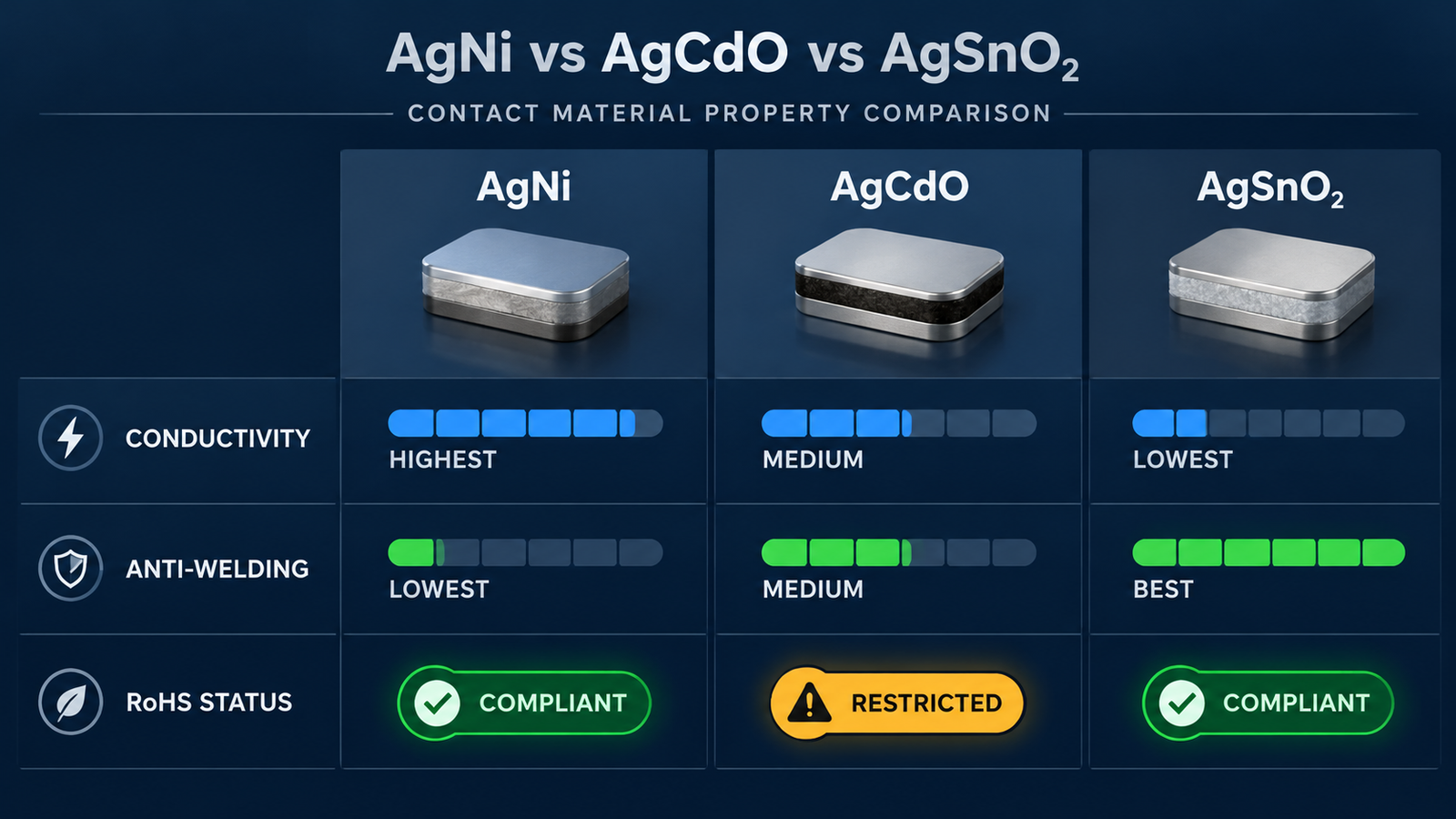
Contact materials are not melted alloys. They are composites made by powder metallurgy: silver powder mixed with the second-phase powder (nickel, cadmium oxide or tin oxide), pressed, sintered, and then either extruded or internally oxidised. The second phase does not carry current — it is there to interrupt the weld and control the arc. Silver carries the current; the oxide or nickel particles give the surface its resistance to fusion and erosion.
The finished tip is then attached to a copper contact bridge, either by riveting (small frames), resistance welding or brazing (larger frames). This construction detail matters later in the cost section, because the thickness of that silver layer — not the rating printed on the front plate — is what determines switching life.
For the context of where these tips sit inside the device, see the components inside an AC contactor.
AgNi is typically 88–92% silver with 8–12% nickel. Its defining advantages are a low, stable contact resistance (roughly 80–90% IACS conductivity) and a simple, cheap manufacturing process that extrudes into fibre-reinforced tips with good mechanical strength.
Its limitation is anti-welding. Under a high inrush current — a compressor start, a lamp bank, a transformer energisation — an AgNi surface can fuse across the contact interface, and the welding force needed to break it apart is higher than the contactor’s opening force can reliably overcome. AgNi also suffers noticeable material transfer in DC circuits, where the arc always burns in the same direction and pip-and-crater formation is pronounced.
AgNi is the correct choice when the load is benign: resistive heating (AC-1), control circuits, small motor loads at the low end of the frame’s rating, and general-purpose relays. It is the wrong choice when the datasheet’s inrush column matters more than the running-current column.
For roughly five decades, AgCdO — around 85–90% silver with 10–15% cadmium oxide — was the default contact material for medium and high-power contactors. Cadmium oxide disperses through the silver matrix and does three useful things at once: it resists welding under high inrush, it erodes slowly under an arc, and — uniquely among the common second phases — it actively quenches the arc, because CdO decomposes and evaporates at arc temperature, cooling the arc root. Its contact resistance is low and stays low, because switching action self-cleans the surface.
The problem is cadmium itself: a toxic, bioaccumulative heavy metal. The EU RoHS Directive (2011/65/EU) restricts cadmium to 0.01% by weight in homogeneous materials, and the exemption that historically allowed cadmium in electrical contacts has been progressively narrowed, with the remaining scope widely reported to end in 2025. The effect on the supply chain is already visible: by the mid-2020s most large contact manufacturers had switched their medium and high-power lines to AgSnO2-based tips, and AgCdO is now mainly found in legacy stock, spare parts and markets outside RoHS scope.
The practical consequence for buyers: if your equipment must carry a current RoHS declaration, treat any quotation that specifies AgCdO contacts as non-compliant until proven otherwise. If you maintain older equipment that used AgCdO, match like-for-like from remaining stock rather than swapping to AgSnO2 blindly — the swap is generally upward-compatible on performance, but the higher contact resistance of AgSnO2 can change thermal behaviour in tightly rated designs.
AgSnO2 is typically 85–92% silver with the balance tin oxide, and it is now the standard tip on motor-duty contactors — including the medium and large frames in the CJX2-F225 class — as well as on DC contactors, EV relays and solar switching devices. Against AgCdO it holds its own everywhere that matters in modern duty: anti-welding on lamp, capacitor and high-inrush loads is measurably better, and at high currents (roughly 500 A and above at the contact) its arc-erosion rate is lower.
Tin oxide is more chemically stable than cadmium oxide, and that stability has a cost: the surface film on AgSnO2 builds a slightly higher contact resistance, and on very low loads — dry circuits, PLC inputs, signal switching at millivolts — that film may not break down, giving unstable or rising resistance over time. On a 100 A motor load this is irrelevant; on a low-level sensing circuit it is a real failure mechanism. If the contactor or relay in question also switches low-level signals, AgNi — or gold-flashed contacts on the auxiliary side — is the safer answer.
“AgSnO2” is a family, not a single material. Plain AgSnO2 made by powder metallurgy behaves differently from AgSnO2In2O3 (silver-tin-indium oxide, made by internal oxidation), and both differ from AgSnO2 doped with small amounts of Bi2O3 or other additives that improve erosion behaviour. Internal-oxidation material has a finer, more uniform oxide dispersion and better erosion performance, and it is what reputable manufacturers specify for high-end frames. Cheaper powder-metallurgy AgSnO2 with coarse oxide particles erodes faster and can show rising contact resistance earlier in life. The material designation on the datasheet — not just “silver contacts” — is what tells you which one you are buying.
| Property | AgNi 90/10 | AgCdO 88/12 | AgSnO2 / AgSnO2In2O3 |
|---|---|---|---|
| Conductivity (% IACS) | 80–90 | 80–85 | 70–80 |
| Contact resistance | Low, very stable | Low, very stable (self-cleaning) | Moderate; can rise on light/dry loads |
| Hardness (HV) | 70–90 | 90–110 | 100–130 |
| Anti-welding, high inrush | Average | Good | Best |
| Arc erosion at high current | Average | Good | Best |
| DC material transfer | Significant (pairs with AgC) | Moderate | Lowest of the three |
| RoHS status | Compliant | Restricted; exemption ending | Compliant |
| Relative tip cost | Lowest | Low–moderate (legacy stock) | Highest (material + attachment) |
| Load | 카테고리 | Recommended tip | Why |
|---|---|---|---|
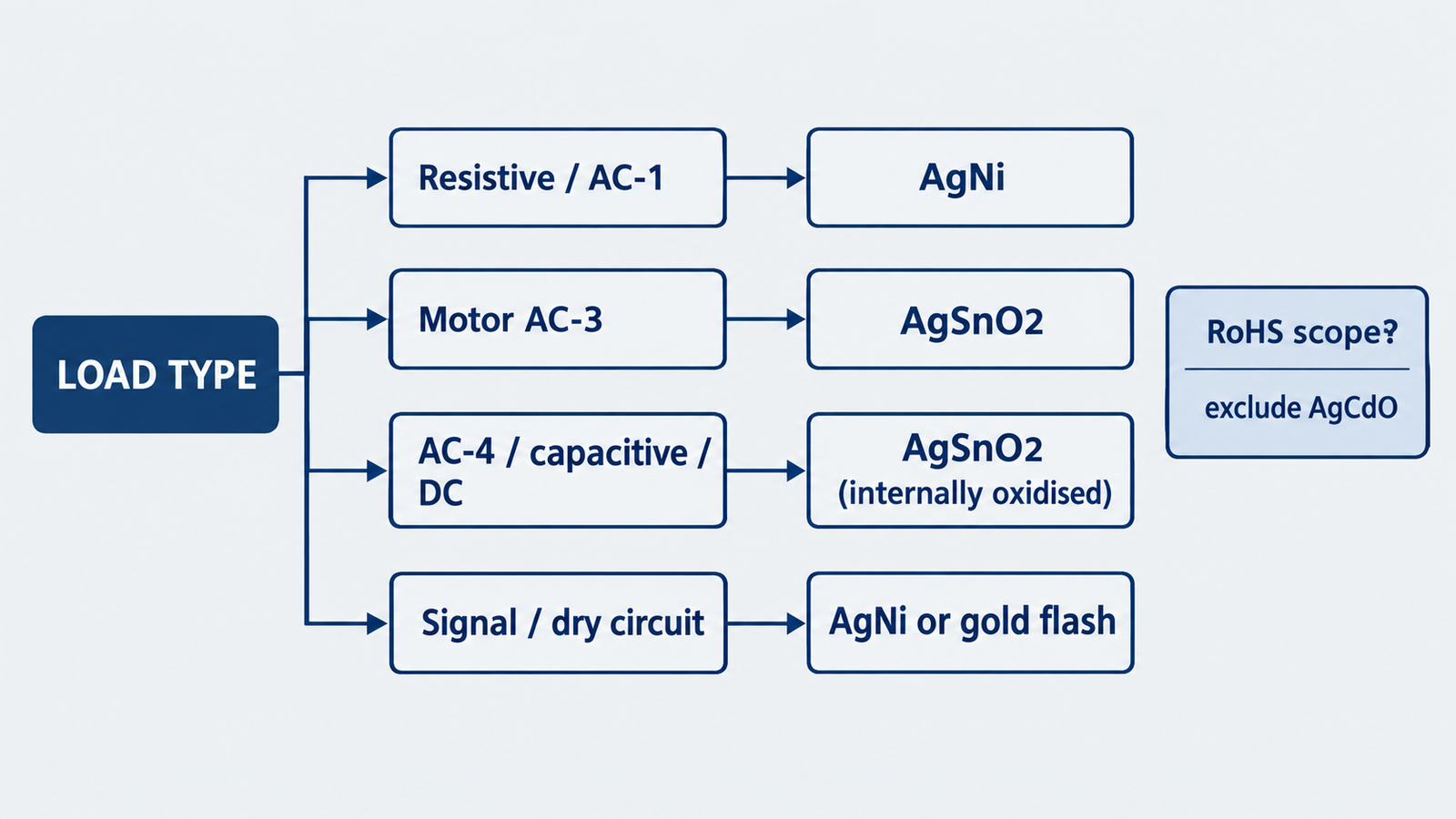
| Heaters, resistive furnaces | AC-1 | AgNi | No inrush stress; resistance and cost dominate |
| Squirrel-cage motor, DOL start | AC-3 | AgSnO2 (or AgCdO legacy) | 6–8× FLA inrush demands anti-welding |
| Plugging, jogging, reversing under load | AC-4 | AgSnO2, internally oxidised | Highest arc energy per operation; erosion life is the limit |
| Lamp banks, capacitors, transformers | AC-6a/6b | AgSnO2 | Extreme inrush peaks; best anti-welding required |
| DC loads, EV, solar strings | DC-1 to DC-6 | AgSnO2 (or AgSnO2 + AgC pairing) | Directional transfer must be minimised |
| Control relays, dry circuits, signals | — | AgNi (gold flash on aux contacts) | Stable low-level resistance matters more than weld resistance |
Where these categories come from and what each one demands of the contactor, see AC-1 to AC-4 explained. Note that the auxiliary contacts discussed in auxiliary versus main contacts are a separate material decision: small AgNi tips, sometimes gold-plated, because they switch control signals rather than load current.
Contact tips are 85–92% silver by mass, and on a 100 A-plus frame the total silver across the moving and fixed contacts runs into tens of grams. Silver is therefore one of the largest variable costs in the device — often comparable to or larger than the plastics and copper in the frame — which is why tip material and thickness are the first place a cost-down programme looks.
Run an illustrative check on a 225 A three-pole contactor: if each pole carries roughly 10–15 g of silver across its tips, the device holds 30–45 g of silver. At silver prices in the range seen through 2024–2026, that metal alone is worth several US dollars per unit before fabrication. A competitor quoting the same 225 A frame noticeably cheaper is very often quoting a thinner tip, a lower-silver composition, or a bonded rather than solid tip.
Three field checks reveal the difference without a metallurgical lab:
For how contact erosion shows up in service and when the tips — or the whole device — should be replaced, see the contactor maintenance and inspection checklist.
| Mistake | Consequence | Fix |
|---|---|---|
| Specifying AgNi for a compressor or lamp load | Welded contacts, failed opening, possible downstream damage | Match material to inrush, not running current |
| Accepting “silver contacts” as a material spec | Unknown composition; life and compliance both unverifiable | Require the alloy designation on the datasheet |
| Using AgSnO2 contacts on dry/low-level signal circuits | Unstable or rising resistance, intermittent faults | Use AgNi or gold-flashed contacts for signal duty |
| Buying on price without checking tip thickness | Short electrical life; silver mass is where cheap frames cut cost | Audit thickness, attachment and resistance at incoming inspection |
It is restricted rather than simply banned. RoHS limits cadmium to 0.01% by weight, and the electrical-contact exemption that kept AgCdO usable has been narrowed, with expiry dates reported through 2025. New RoHS-scope equipment should not specify AgCdO; legacy equipment and markets outside RoHS scope still see it.
Usually yes, and in hard-duty applications the swap improves anti-welding and erosion life. Check two things first: the higher contact resistance of AgSnO2 raises temperature rise slightly, which matters in tightly rated frames, and the tip attachment process differs (AgSnO2 is harder to braze), so use tips made for replacement rather than improvising.
That is expected. AgSnO2 carries a higher, more stable surface film resistance; on a load circuit it is insignificant relative to the total circuit impedance. If the reading grows over successive checks, or the circuit is a low-level signal one, reconsider the material choice for that duty.
Internally oxidised AgSnO2In2O3 gives the best erosion life at high contact energy. On AC-4, erosion life — not welding — is the limiting mechanism, so the material with the lowest mg-per-operation loss wins.
Only indirectly. The contact resistance contributes to the pole circuit’s heat, but on load circuits the load current path’s dominant heat is in the copper and terminations. Material choice matters for the contacts’ own temperature and weld behaviour, not for coil consumption.
It is silver-tin oxide with indium oxide added, produced by internal oxidation, with a finer and more uniform oxide dispersion. It erodes more slowly and keeps contact resistance more stable than plain powder-metallurgy AgSnO2. For high-duty frames it is worth the premium; for light duty it is unnecessary.
Specify contact material the way you specify any other load-bearing component: match it to the duty, demand the exact designation, and verify it at incoming inspection. AgNi for benign loads, AgSnO2 for anything with inrush or arc energy, AgCdO only where legacy and regulation allow. And when two quotes for the same frame rating differ by more than the silver market can explain, audit the tips — thickness, attachment and composition — because that is where the difference, and the failure risk, actually lives.