
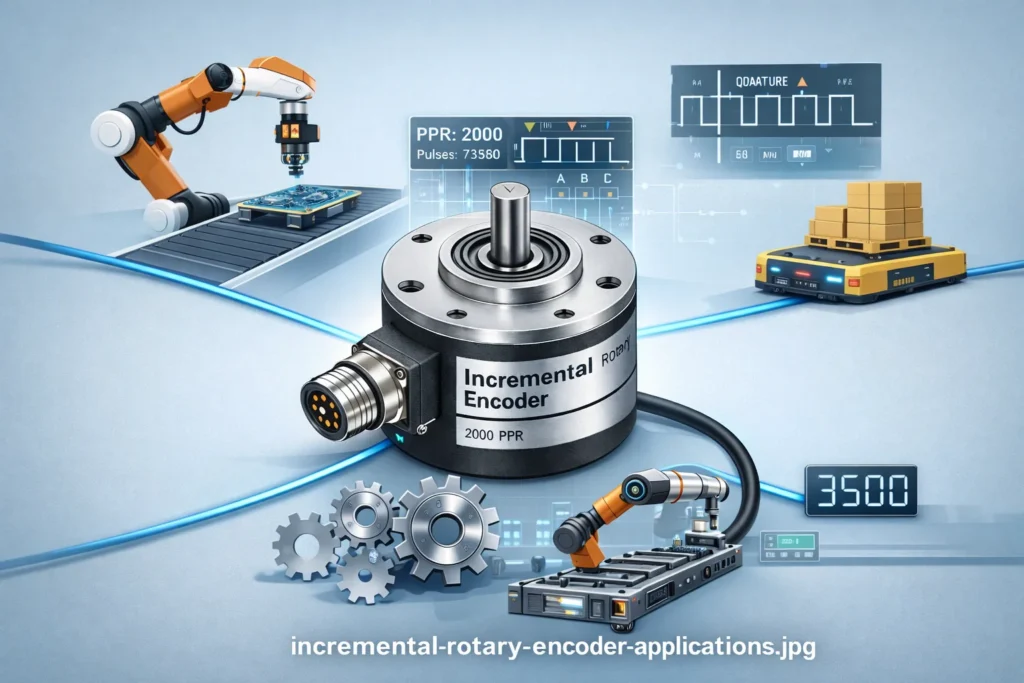
Incremental Rotary Encoder High Precision A B Z Signals
목차
Incremental rotary encoders are cost-effective sensors designed to measure relative position, speed, and direction in various industrial applications. They provide quadrature A/B signals and optional index/Z pulses, enabling precise motion feedback and control.
Wilmall incremental rotary encoders stand out for their:
- Robust construction: Durable aluminum or stainless steel housing ensures long-term reliability even in harsh environments.
- Wide resolution range: From 100 up to 10,000+ pulses per revolution (PPR) for versatile application needs.
- Optical and magnetic options: Choose based on accuracy and environmental resistance requirements.
- Compatible outputs: Quadrature signals compatible with PLCs, servos, Arduino, and other microcontrollers.
- Flexible shaft designs: Solid shaft, hollow shaft, and blind hollow bore options for easy integration.
| 기능 | 세부 정보 |
|---|---|
| Resolution Range | 100 to 10,000+ PPR/CPR |
| Output Signals | Quadrature A/B, optional Index/Z pulse |
| Output Types | TTL, HTL, RS-422, Open Collector, Push-Pull |
| Shaft Options | Ø6mm, Ø8mm, Ø10mm solid; hollow shaft types |
| 공급 전압 | 5V, 5-24V, 10-30V DC |
| Protection Ratings | IP50 to IP67 for dust and water resistance |
Wilmall’s incremental rotary encoders provide reliable, accurate speed feedback and relative position sensing, meeting the demands of automation, robotics, and motor control systems worldwide.
How Incremental Rotary Encoders Work
Incremental rotary encoders use quadrature encoding to track position and direction. This means they generate two signals, A and B, which output square waves shifted by 90°. The phase difference between these quadrature A/B signals lets you detect whether the shaft is rotating clockwise or counterclockwise.
Key Signal Features:
- A/B signals: Two channels with a 90° phase difference for direction detection.
- Index/Z pulse: A single pulse per revolution used as a reference mark for exact positioning.
Pulses per Revolution (PPR) and Counts per Revolution (CPR)
- PPR counts how many pulses the encoder emits in one full shaft turn.
- CPR is the total count including quadrature multiplication:
- x1 = count each pulse on channel A only
- x2 = count on both A and B channels
- x4 = count every rising and falling edge on A and B signals (highest resolution)
| Encoding Mode | Counts per Revolution (CPR) | Notes |
|---|---|---|
| x1 | PPR | Basic pulse count |
| x2 | 2 × PPR | Higher resolution |
| x4 | 4 × PPR | Maximum position detail |
Incremental vs. Absolute Encoders
| 측면 | 인크리멘탈 인코더 | 앱솔루트 인코더 |
|---|---|---|
| 출력 | Quadrature A/B pulses + Z pulse | Unique binary/Gray code for each angle |
| 위치 참조 | Relative position, zero set on startup | Absolute position at power-on |
| Complexity/Cost | Simpler and more cost-effective | More complex, higher cost |
| Typical Use | Speed feedback, relative positioning | Precise reference, absolute positioning |
Incremental shaft encoders provide fast, reliable feedback of shaft rotation and direction, with an optional index/Z pulse helping with homing or zero-reference setups. This makes them ideal for applications needing relative movement tracking and speed measurement.
For wiring and integration tips on A/B/Z signals, our cable gland solutions can help ensure secure connections in industrial setups.
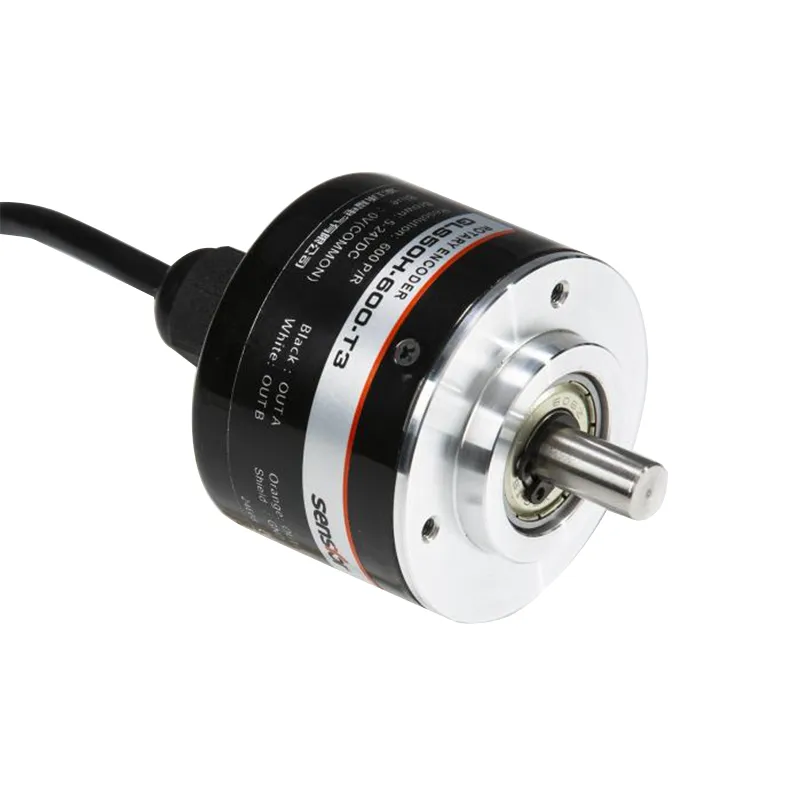
Technical Specifications of Wilmall Incremental Rotary Encoders
Here’s a quick overview of the key specs for Wilmall’s incremental rotary encoders, designed to cover a wide range of industrial needs:
| 기능 | 설명 |
|---|---|
| 해상도 | 100 to 10,000+ PPR/CPR (Pulses/Counts per Revolution) |
| Output Signals | Quadrature A/B signals, optional Index/Z pulse for precise reference |
| Output Types | TTL, HTL, Line Driver (RS-422), Open Collector, Push-Pull |
| Shaft Options | Solid shaft (Ø6mm, Ø8mm, Ø10mm), Hollow shaft, Blind hollow bore |
| 공급 전압 | 5VDC, 5-24VDC, or 10-30VDC |
| 최대 속도 | Up to 6000 RPM (depends on model and application) |
| 보호 등급 | IP50 to IP67, offering robust dust and water resistance |
| Operating Temp. | -20°C to +85°C standard, with extended temperature versions available |
| Housing Material | Durable aluminum or stainless steel for long-lasting use |
| Connections | Cable, M12 connector, or terminal block for flexible installation |
Wilmall encoders combine optical and magnetic sensing technologies to deliver accurate speed feedback 그리고 relative position detection. Their quadrature output encoders ensure reliable direction detection using A/B phase signals, while the Index or Z pulse helps with exact reference positioning.
For industrial environments requiring sturdy, high-performance encoders compatible with PLCs, servos, and microcontrollers like Arduino, these specs ensure top-notch reliability and functionality.
Explore detailed models and mounting options, including solid vs. hollow shafts, for your specific application needs like robotics or CNC systems. For wiring and integration, check out our range of GLS50H rotary encoders for a deep dive into a popular Wilmall option.
Product Variants & Selection Guide
Wilmall offers a broad range of incremental rotary encoder models designed to fit various industrial needs. Whether you need a solid shaft or a hollow shaft incremental encoder, our lineup covers multiple shaft diameters such as Ø6mm, Ø8mm, and Ø10mm to match your machinery precisely.
Key Selection Factors:
- Shaft Type: Choose between solid shaft, hollow shaft, or blind hollow bore options.
- Resolution: From 100 up to 10,000+ pulses per revolution (PPR) or counts per revolution (CPR), including high resolution incremental rotary encoders for precise measurement.
- Output Types: Select from TTL, HTL, line driver (RS-422), open collector, or push-pull outputs based on your control system.
- 운영 환경: Models are available for dusty, vibratory, or harsh conditions—IP ratings range from IP50 to IP67.
- Mounting Style: Flexible mounting options ensure easy installation in tight or challenging spaces.
To make choosing easier, use our quick selector tool considering your shaft diameter, required resolution, and working environment. This ensures you get the right quadrature encoder tailored to your application.
For example, if you’re integrating with PLCs or servo systems, an optical incremental encoder with a high PPR and line driver output may be ideal. For rugged environments, consider our magnetic rotary encoder variants designed for reliability under vibration and contamination.
Explore the detailed table of Wilmall models, which highlights shaft vs. hollow designs, various output types, and resolution ranges. Our comprehensive guide helps you pick the perfect incremental rotary encoder for your project with confidence.
For additional support on sensor compatibility and installation, you might find our guide on practical knowledge points of proximity switches useful as it complements sensor selection strategies.
증분 로터리 엔코더의 애플리케이션
Incremental rotary encoders are widely used across various industries thanks to their precision and reliability in measuring relative position, speed, and direction. They play a crucial role in industrial automation, enabling accurate motor feedback and process control in assembly lines and manufacturing equipment. In robotics, these encoders provide precise movement control for joints and wheels, enhancing repeatability and performance.
CNC machines rely on incremental shaft encoders to deliver exact positioning for cutting tools and spindles, ensuring high-quality machining outcomes. Conveyor systems also use these encoders for speed feedback and position tracking to maintain smooth material handling.
In packaging equipment, incremental rotary encoders help synchronize operations such as filling, sealing, and labeling by monitoring shaft rotations and speeds. Elevator controls utilize them for safe and smooth cabin movements by accurately detecting shaft position and speed.
Additional applications include radar and antenna systems, where rotary encoders manage rotational positioning for tracking signals, and various custom machinery setups that demand reliable feedback for motor control.
For more encoder options and integration accessories, check out our comprehensive encoder category to find models best suited for your application.
Benefits & Advantages of Wilmall Incremental Rotary Encoders
WilmaII incremental rotary encoders offer high accuracy and repeatability, making them reliable for precise position and speed feedback in various applications. They provide a cost-effective alternative to absolute encoders, especially when only relative position data is needed.
Key Benefits at a Glance
| 혜택 | 설명 |
|---|---|
| High Accuracy & Repeatability | Precise quadrature A/B signals ensure consistent output for exact motion control. |
| Cost-Effective Alternative | Lower cost than absolute encoders without sacrificing key functions. |
| Fast Real-Time Response | Instantaneous pulses per revolution (PPR) for quick speed and direction updates. |
| Durable in Harsh Environments | Robust construction handles vibration, dust, and contamination efficiently. |
| Easy Integration | Compatible with counters, PLCs, servos, and microcontrollers like Arduino. |
Built to perform under tough conditions, Wilmall’s incremental rotary encoders maintain reliable feedback even in industrial settings with vibration or dust. Their flexible output options and wide resolution range simplify integration with motion controllers and drives, ensuring smooth real-time speed and position control.
For those seeking a balance of accuracy, speed, and durability, Wilmall incremental shaft encoders deliver consistent value without the complexity or cost of absolute position feedback. This makes them ideal for automation, robotics, CNC machines, and motor feedback systems.
Explore our robust models, including optical incremental encoders 그리고 magnetic rotary encoders, designed to fit diverse industrial needs and environments. For wiring and connectors, you can also check out Wilmall’s SD16 series connectors to ensure seamless installation and reliable signal transmission.
Installation & Mounting Guide
Proper installation is key for your incremental rotary encoder to deliver accurate and reliable feedback. Here are some simple guidelines to ensure smooth setup:
Shaft Coupling Recommendations
- Use flexible couplings to connect the encoder shaft to your motor or equipment shaft; this helps absorb misalignment and reduces wear.
- Avoid using rigid couplings unless shafts are perfectly aligned to prevent damage.
- Check that the shaft diameter matches your incremental shaft encoder (commonly Ø6mm, Ø8mm, or Ø10mm).
- For hollow shaft incremental encoders, secure the shaft properly with the supplied key or set screw.
Wiring Diagrams for A/B/Z Outputs
- The quadrature A/B signals provide direction and speed information, while the index (Z) pulse signals one pulse per revolution for reference.
- Connect the encoder outputs to your controller (PLC, servo drive, or microcontroller) following the specific wiring color codes in the datasheet.
- Choose output type compatible with your system: TTL, HTL, Line Driver (RS-422), or open collector.
- Ensure proper power supply voltage (5VDC, 12V, or 24V depending on model) and observe proper grounding to minimize electrical noise.
Alignment and Calibration Tips
- Align the encoder shaft carefully for smooth rotation without wobble.
- Use the index/Z pulse to establish a home or zero position—this is critical for repeatable positioning in automation and CNC applications.
- After installation, run several revolutions to verify the encoder outputs correctly count pulses and detect direction.
- Calibrate your controller to match the encoder’s Pulses per Revolution (PPR) or Counts per Revolution (CPR).
Following these steps ensures your incremental rotary encoder works perfectly from day one, providing precise relative position, speed feedback, and direction signals for your system.
For detailed wiring examples and mounting advice, check out our helpful guide on 5 key tips to choose the best incremental rotary encoder.
Accessories & Related Products
To get the best performance from your incremental rotary encoder, Wilmall offers a full range of accessories tailored to fit various installation needs. Our line includes sturdy mounting brackets designed for secure and precise encoder placement, as well as reliable shaft couplings that maintain alignment and reduce wear.
Complement your setup with high-quality cables and connectors, including options like the durable aviation connector plug for robust signal transmission in industrial environments. We also provide signal converters that can adapt quadrature A/B signals and index/Z pulse outputs for different control systems.
For seamless integration, choose from compatible controllers specifically optimized for incremental shaft encoders. These accessories ensure your system maintains accurate feedback for relative position, speed, and motor control, whether you’re working with optical or magnetic rotary encoders.
Explore our accessories to customize your application with ease and ensure the reliable operation of your high-resolution incremental rotary encoder.
Frequently Asked Questions (FAQ)
What is the difference between PPR and CPR?
PPR stands for Pulses Per Revolution, which counts the number of pulses generated by the incremental rotary encoder for each full turn of the shaft. CPR, or Counts Per Revolution, refers to the total counts after considering quadrature multiplication (x1, x2, or x4), effectively giving a higher resolution for position tracking.
How do A/B signals detect direction?
Incremental rotary encoders use quadrature A/B signals with a 90° phase difference. By checking which signal leads or lags, the system can determine the rotation direction—forward or reverse.
What happens on power loss?
Since incremental shaft encoders track relative position, they lose their exact position reference on power loss. That’s why the Z pulse (index pulse) is used for homing or reference resetting when the power is restored.
적합한 해상도를 선택하려면 어떻게 해야 하나요?
Choosing resolution depends on your application’s precision needs and speed. Higher Pulses Per Revolution (PPR) values offer better accuracy but may require more processing power. For typical speed feedback or motor control, 100 to 1000 PPR works well; precision tasks might need 5000 PPR or more.
Explore our detailed FAQ section for more answers on how to pick and use incremental rotary encoders effectively.
Downloads & Resources
Get all the essential documents and tools you need for Wilmall incremental rotary encoders right here. Access detailed datasheets to review the full technical specifications, CAD models for easy design integration, and clear wiring diagrams to help with the correct connection of quadrature A/B signals, index/Z pulse outputs, and power supply lines. For developers and integrators, practical programming examples are also available to simplify working with popular controllers like PLCs, Arduino, and microcontrollers.
These resources ensure seamless installation, setup, and operation of your incremental shaft encoder or hollow shaft incremental encoder, whether you’re working on motor feedback, speed control, or relative position sensing projects.
For compatible accessories that improve your wiring and connection reliability, you can also explore options like our SD20 series connectors and durable M-series M18 nickel-plated brass cable gland that support robust signal transmission in demanding industrial environments.
Why Choose Wilmall Incremental Rotary Encoders?
Choosing Wilmall means opting for quality, reliability, and unbeatable value in incremental rotary encoders. Here’s why Wilmall stands out as your go-to supplier for incremental shaft encoders, including optical and magnetic rotary encoder options:
| 기능 | Wilmall Advantage |
|---|---|
| 품질 보증 | Rigorous testing ensures durable, accurate encoders ready for tough environments. |
| Competitive Pricing | Affordable prices without sacrificing performance or precision. |
| Fast Delivery | Efficient global shipping to keep your projects on schedule. |
| 사용자 지정 | Tailor encoder resolutions, shaft types, and output interfaces to your exact needs. |
| 기술 지원 | Expert advice for smooth integration with PLCs, controllers, and drives. |
Wilmall’s high-resolution incremental rotary encoders deliver precise quadrature A/B signals, along with optional index (Z) pulse outputs, making them ideal for applications needing fast, reliable position and speed feedback.
When you choose Wilmall, you get a partner committed to helping you find the right solution whether you work with motors, CNC machinery, or automation systems. For specialized needs, we also offer easy integration options with popular platforms like Arduino and industrial controllers.
Explore how Wilmall’s combination of performance, service, and value makes us the smart choice for your next incremental rotary encoder project.
Ready to Get Started with Wilmall Incremental Rotary Encoders?
Experience the precision and reliability of Wilmall’s incremental rotary encoders for your next project. Whether you need high-resolution quadrature output encoders for motor feedback or cost-effective relative position encoders, we’re here to help.
- Request a quote tailored to your specific shaft, resolution, and output needs.
- Contact our sales team for expert advice on selecting the perfect incremental shaft encoder or hollow shaft incremental encoder.
- If you’re ready to buy, simply add to cart and enjoy fast shipping worldwide.
- Need help choosing? Use our live chat for real-time support and recommendations based on your application — from industrial automation to robotics.
Take the next step now and ensure your system gets the best in speed feedback and position sensing with Wilmall incremental rotary encoders.