Motor Thermal Damage Curve vs Relay Trip Curve
Six points, two lines, three conditions. Plot the thermal damage curve against the relay trip curve and know exactly what the overlaps mean.
Read More
Almost every contactor maintenance plan in the field is built on a calendar: inspect annually, change contacts every three years. That approach fails in both directions. It over-maintains a contactor that switches a pump twice a day and under-maintains a hoist contactor that switches two hundred times a day — and the hoist is the one that welds shut during a shift, not during the annual shutdown.
This guide builds a maintenance schedule from the two variables that actually predict wear: the utilisation category the contactor works in, and the number of operations it performs. It produces an interval table by duty class, a four-tier inspection ladder, and the trigger-based interventions that replace calendar guessing. It assumes you already know how to inspect a contactor — for the checklist itself, use the industrial contactor inspection checklist. This article is about when to run it.
A contactor’s life is consumed by operations, and how much life each operation consumes depends on the duty class. The schedule therefore has two inputs and one output:
The cap matters: even at very low operation counts, elastomer ageing, dust accumulation and terminal creep happen on a timescale of years, so no contactor should go more than 24 months without an electrical check regardless of how few times it has switched.
The utilisation category describes what the contacts are doing at the moment of switching, and the electrical life figures differ by an order of magnitude between categories. The definitions are set out in AC-1 to AC-4 utilisation categories, but for maintenance planning only two matter:
| Duty | What happens at the contact | Typical electrical life relative to AC-3 | Binding limit |
|---|---|---|---|
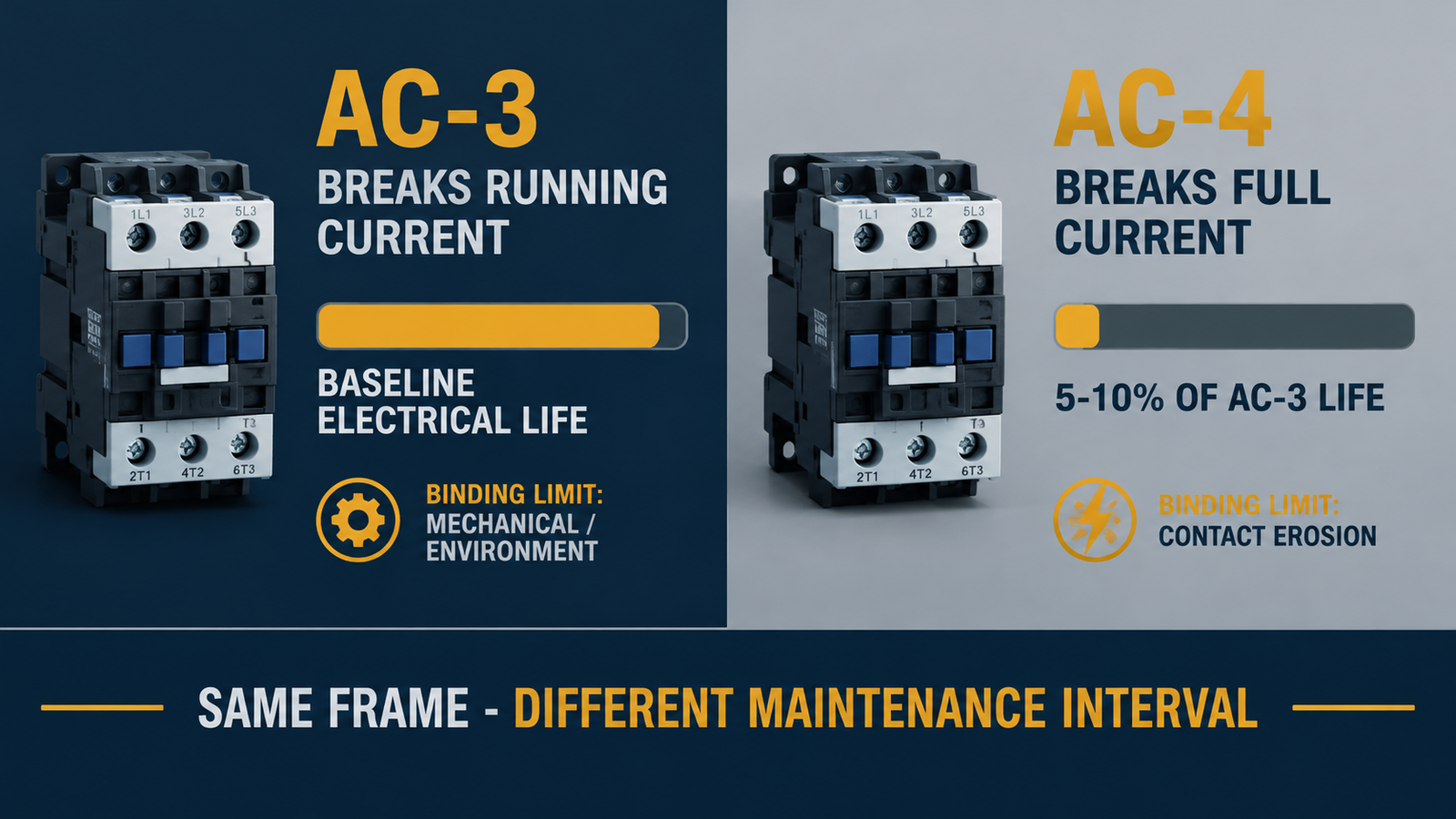
| AC-3 (motor starting, breaking running current) | High inrush current on make, rated current on break | 1× (baseline — often 10⁶ operations or more) | Mechanical life or environment, not contact erosion |
| AC-4 (plugging, jogging, reversing under load) | High current on both make and break | Roughly 5–10% of the AC-3 figure | Contact erosion — the contacts are the wear item |
That single ratio is the reason a calendar schedule cannot work. Two identical contactors, one on a conveyor motor and one on a hoist, have the same purchase date and completely different wear trajectories. Confirm the actual figures from the specific frame’s datasheet rather than from a family table — the ratio holds broadly, but the absolute numbers do not.
Example A — AC-3 pump motor. A 30 kW pump starts 40 times a day, 300 days a year: 12,000 operations per year. If the frame’s AC-3 electrical life is 1,000,000 operations, the electrical budget alone would stretch to decades. The binding constraint is therefore not the contacts at all — it is the environment and the mechanism, and the schedule should be the calendar cap: annual electrical check, terminal re-torque, and a visual at mid-year. Replacing contacts on this motor on an operations basis would be wasteful.
Example B — AC-4 hoist contactor. A hoist contactor performs 200 operations a day, 250 days a year: 50,000 operations per year. At AC-4 the same frame might be rated only 100,000 operations, so the entire electrical life is consumed in two years — and at 80% of budget, the inspection point arrives at about 1.6 years. Here the contacts are the wear item, an operations counter is essential, and replacement should be planned from the counter rather than discovered from a failure.
The contrast is the whole point of a duty-based schedule: identical hardware, maintenance intervals differing by a factor of five or more, both correct for their application.
| Окружающая среда | AC-3 (low cycle) | AC-3 (high cycle, >100 ops/day) | AC-4 | Notes |
|---|---|---|---|---|
| Clean, climate-controlled panel | 12–24 months | 12 months | Per operations counter, cap 6 months | Lowest wear; contact inspection may be visual only |
| Dusty (wood, cement, grain) | 12 months | 6–12 months | 3–6 months | Dust in the arc chute accelerates erosion and tracking |
| Humid or condensing | 12 months | 6–12 months | 3–6 months | Check coil insulation and terminal corrosion |
| Corrosive / coastal / chemical | 6 months | 3–6 months | 3 months | Silver sulphide film on contacts raises resistance |
| High ambient (>40 °C in panel) | 6–12 months | 6 months | 3 months | Derate the current rating as well, not just the interval |
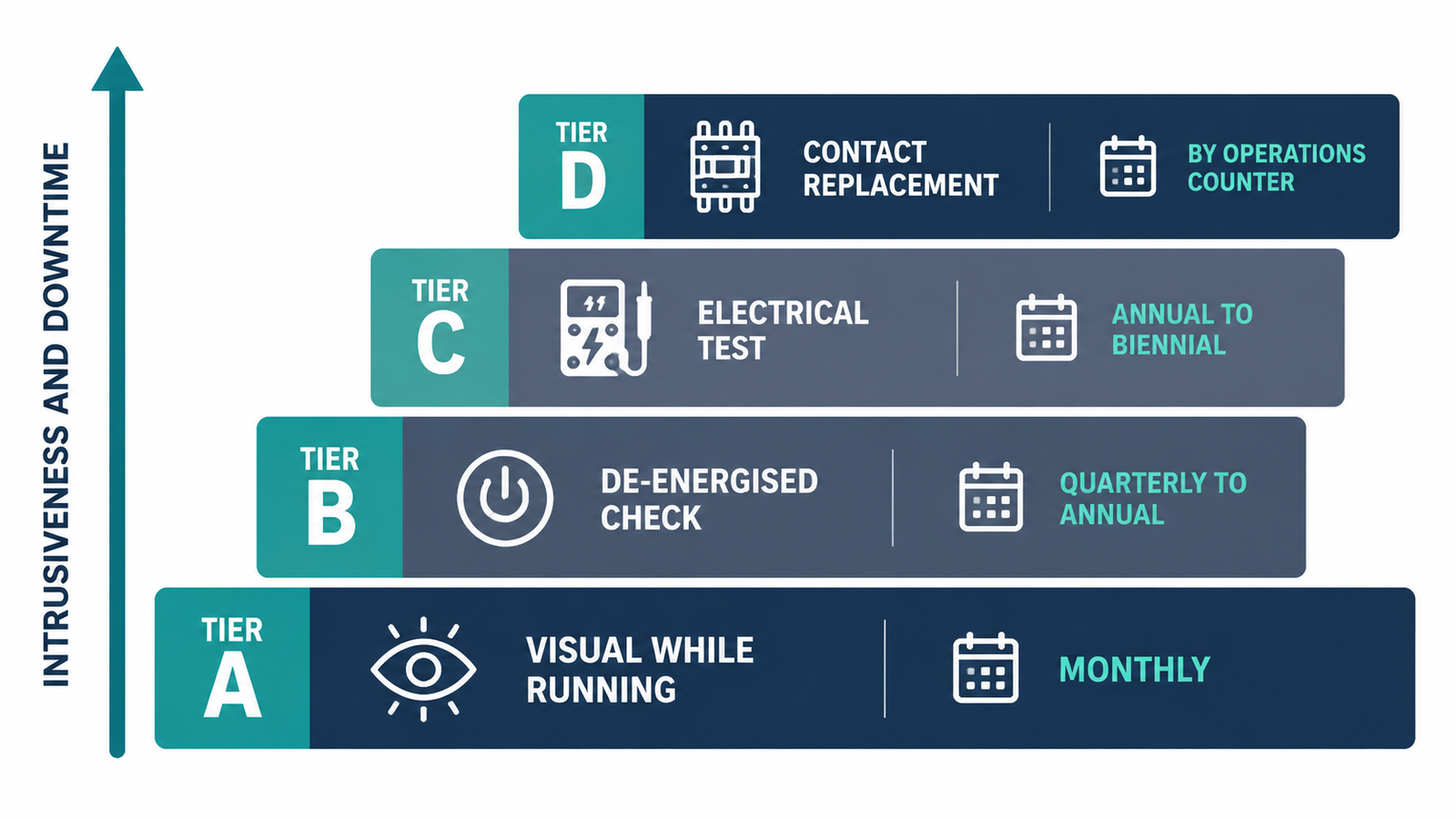
Rather than one annual event, split the work into tiers so that the intrusive tasks happen only as often as they need to.
| Tier | Frequency | Tasks | Skill / downtime |
|---|---|---|---|
| A — Visual while running | Monthly | Listen for hum, look for discoloured terminals, check panel temperature and any smell of hot insulation | Operator or technician; no downtime |
| B — De-energised check | Quarterly to annual | Terminal torque, contact appearance, arc chute dust, coil and auxiliary connections, manual operation | Technician; circuit isolated |
| C — Electrical test | Annual to biennial | Millivolt drop across closed poles, insulation resistance, pickup and drop-out voltage | Technician with meter; circuit isolated |
| D — Contact replacement | By operations counter | Replace eroded contacts or the contactor, reset counter, record baseline | Planned outage |
Tier C is the one most often skipped, and it is the one that catches wear before failure. A millivolt-drop trend across the closed pole shows contact erosion and terminal degradation months before a thermal event; a single spot reading tells you very little. Record it in millivolts at a known current, and watch the direction of travel rather than comparing against an absolute limit.
| Trigger | What it indicates | Action |
|---|---|---|
| Contact that stays closed after the coil is de-energised | Welded contacts | Remove from service immediately; replace contacts or device |
| Millivolt drop rising across successive checks | Contact erosion or terminal degradation | Bring forward tier C/D; inspect the specific pole |
| Asymmetric drop between poles | Uneven erosion, possible single-phasing risk | Check all poles; replace as a set |
| Coil current or pickup voltage drifting | Shading ring, coil insulation or supply voltage problem | Investigate the cause, not just the coil |
| Buzz or chatter that was not there before | Pole face contamination, shading ring, or low control voltage | Diagnose before it becomes a welded contact |
| Operations counter reaching 60–80% of life | Planned wear point | Schedule tier D at the next planned outage |
These triggers are what turn a schedule into a maintenance strategy. A calendar plan tells you when someone last looked; a trigger tells you when to act. The symptom-to-cause mapping for the electrical faults behind several of these is covered in how to tell if a contactor is bad, and the contact erosion mechanism itself in contactor contact materials.
The schedule is only as good as the count, and counting is easier than most plants assume:
Record the figure at each intervention. An operations log with three or four entries over two years is enough to reveal a machine whose duty has quietly changed — a conveyor that used to run continuously and now jogs, for instance, converting an AC-3 application into an AC-4 one without anyone re-specifying the contactor.
| Mistake | Consequence | Correction |
|---|---|---|
| Using one annual interval for every contactor in the plant | AC-4 devices fail between visits; AC-3 devices are opened unnecessarily | Classify by duty, then set intervals per group |
| Counting running hours instead of operations | Arithmetic looks rigorous but measures the wrong thing | Count starts; hours do not consume contacts |
| Planning replacement at 100% of electrical life | No margin for duty drift or measurement error | Inspect at 60–80% of budget |
| Ignoring the calendar cap on lightly used devices | Elastomer ageing, dust and terminal creep go unchecked for years | 24-month maximum in clean conditions, shorter elsewhere |
| Skipping millivolt-drop trending | Wear is discovered as a thermal event rather than a trend | Record the reading at every tier C visit and watch the trend |
| Replacing one eroded pole and leaving the others | Uneven poles, asymmetric current, single-phasing risk | Replace contacts as a set |
Where the duty has already drifted into AC-4 territory — a machine that now jogs where it used to run — the correct fix is sometimes a larger frame rather than a shorter interval, because a bigger contactor with more silver in the tips buys life directly. The comparison between AC-3 and AC-4 life budgets is set out in AC-3 versus AC-4 duty.
By operations, not by years. Divide the frame’s electrical life at the actual duty class by the annual operation count, apply a 0.6–0.8 maintenance factor, and cap the result at 24 months for inspection. Contacts — or the device — are then replaced when the counter reaches the planned point.
On frames with replaceable contacts and intact mechanics, replacing the contact set is usually enough. Replace the device when the mechanism is worn, the coil former is degraded, the arc chutes are damaged, or the frame no longer holds torque on its terminals.
AC-4 electrical life is roughly 5–10% of the AC-3 figure, so the interval is correspondingly shorter — often in the range of 3 to 6 months for high-cycle hoist and reversing duty, driven by an operations counter rather than a fixed date.
Annual inspection is a reasonable cap, but the electrical test tier can stretch to two years on a clean, lightly used AC-3 device. What should not stretch is the visual check, because a contactor can fail from a loose terminal or a degraded coil without accumulating any operations at all.
Ask what the contactor breaks. If it breaks normal running current — a motor at speed — it is AC-3. If it breaks a current above running current, as in plugging, jogging, reversing under load, or starting against a high-inertia load, treat it as AC-4.
Yes, above roughly 40 °C ambient the current rating must be reduced, which in practice means selecting a larger frame for the same motor. A shorter maintenance interval does not compensate for an undersized device; it only finds the wear sooner.
Replace the calendar with an operations budget. Classify each contactor’s duty, count its starts, divide the datasheet electrical life by the annual count, and inspect at 60–80% of that budget — then impose a 24-month cap for cleanliness and a shorter cap for harsh environments. Split the work into four tiers so intrusive tasks happen only when needed, trend millivolt drop instead of trusting a single reading, and let trigger conditions override the schedule whenever they appear. For frames that carry the duty classes discussed here, the 3TF series contactors page lists the ratings available, and the AC contactor category covers the full range.