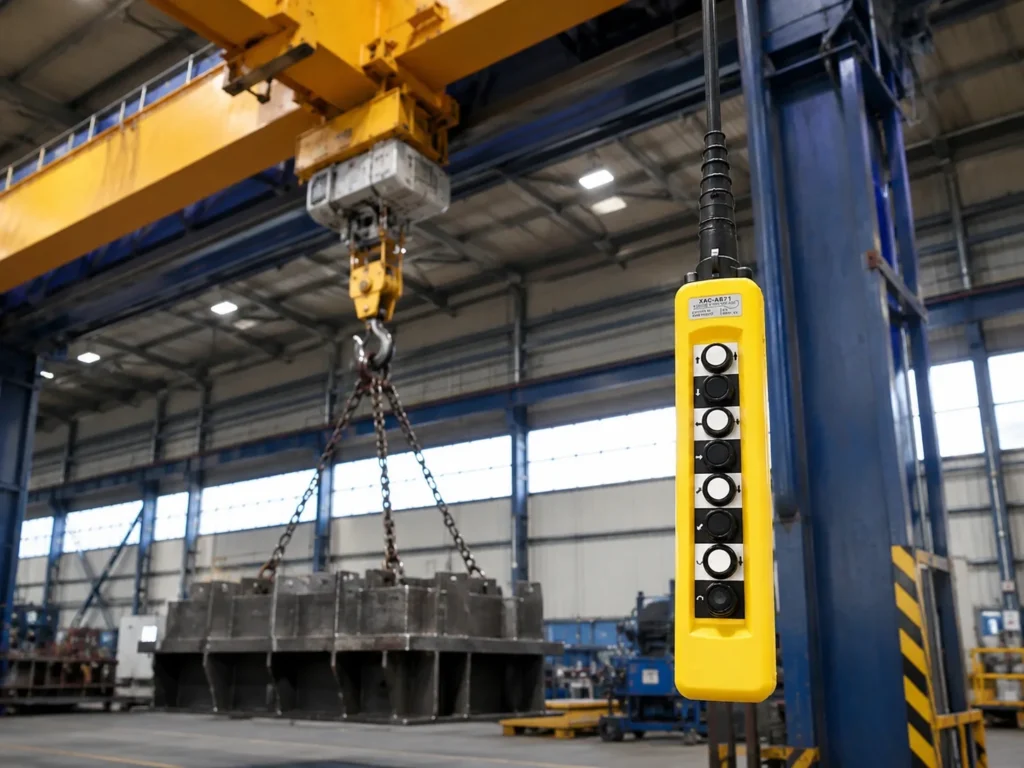
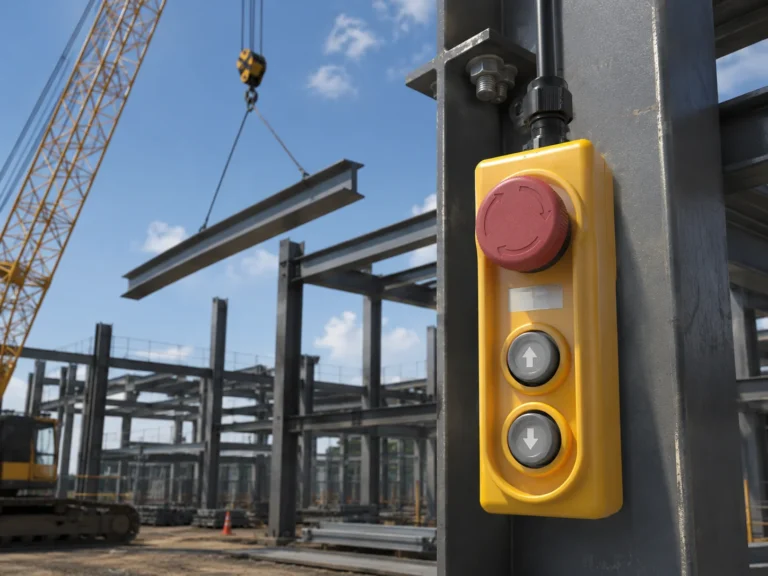
When I talk with procurement teams, maintenance managers, and crane builders, one pattern shows up again and again: everyone wants a control device that is simple, durable, and easy to standardize across projects. That is exactly why the 8 button crane pendant remains such a practical choice for overhead cranes, hoists, beam handling systems, and workshop lifting stations. In real factories, nobody gets excited about a control station until the day production stops because of a broken switch, a sloppy enclosure, or a badly chosen model. Then suddenly, the humble pendant becomes the star of the meeting.
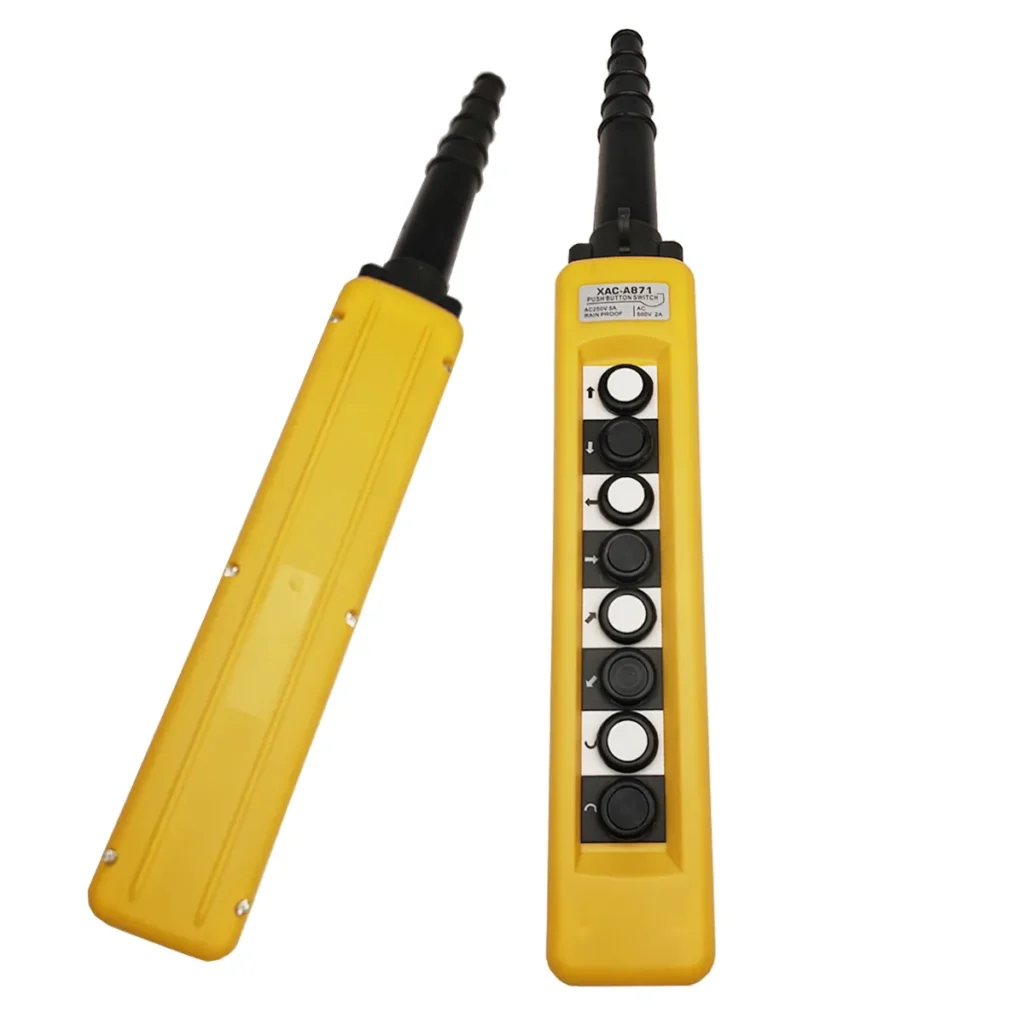
For buyers looking at the Crane Pendant Control XAC-A871 Manufacturer category, the conversation should go beyond “eight buttons equals more functions.” A better question is this: does the unit actually fit your application, wiring logic, environmental conditions, and purchasing model? The XAC-A871 configuration is described by Schneider Electric as a pendant control station with 8 pushbuttons, an impact-resistant yellow enclosure, a solid rubber grommet junction for water tightness, and an ergonomic pistol grip for single-handed operation. It is also presented for hoist and crane control in harsh environments, with IP65 protection.
What is the 8 button crane pendant XAC-A871?
A crane pendant control is not just a handheld box with buttons. In hoisting applications, it is the operator’s direct interface with motion, load positioning, and stop/start behavior, so the quality of the pendant affects both productivity and risk control. IEC 60204-32:2023 applies to electrical and electronic equipment for hoisting machines and includes control feeders outside the machine, such as flexible cables or conductor systems, which is highly relevant when evaluating pendant-based control assemblies.
That practical role explains why so many B2B buyers still prefer a wired push button pendant over a remote in specific environments. Schneider notes that pendant controls are wired to the hoist or festoon system, so there is no transmitter-receiver interference, while the tradeoff is that the operator must stay relatively close to the load path. In other words, a wired crane pendant control can be very dependable, but it still has to be selected with site layout and operator position in mind.
I like to put it this way: if the crane is the muscle, the pendant is the handshake. If that handshake is weak, sticky, or confusing, the whole job feels awkward. For B2B buyers, that means the right crane pendant station should be evaluated as part of the machine system, not as an afterthought tossed into the RFQ at the last minute.
The XACA871 is commonly identified as an 8-way or 8 pushbutton pendant control station for single-speed hoisting applications. Product listings and technical references describe it as suitable for overhead cranes, tower cranes, fixed hoists, and beam hoists, with a yellow polypropylene enclosure and double-insulated construction.
The button arrangement matters more than many people expect. One technical listing describes the contact logic as the first pushbutton for raise, the second for lower, the third for right, the fourth for left, the fifth for forward, the sixth for reverse, the seventh with 1 NO marked “I,” and the eighth with 1 NC marked “O,” while mechanical interlocking is provided between paired directions. That structure makes the model especially relevant for applications where operators need motion control in more than one axis rather than only basic up/down lifting.
Here is a compact technical view that many procurement teams find easier to scan during supplier comparison:
Artículo
XAC-A871 details
Product type
Pendant control station with 8 pushbuttons
Uso típico
Control of single-speed hoist motor and crane motions
Recinto
Yellow polypropylene, double insulated
Protection
IP65 for dust and water resistance in harsh environments
Ergonomics
Pistol-grip style for single-handed control
Safety logic
Mechanical interlocking between paired directions
Contact notes
1st to 7th buttons commonly 1 NO, 8th commonly 1 NC in listed configurations
Terminal style
Screw clamp terminals are listed in one technical source
For manufacturer, factory, supplier, exporter, wholesaler, and wholesale buyers in China-focused sourcing channels, this matters because the XAC-A871 format is not a vague commodity. It is a known form factor with known expectations: enclosure strength, sealing, button mapping, interlocking, and operator handling. Chinese exporter and wholesale listings also show XAC-A871 and XAC-A8713 style products in active market circulation, with MOQ and trade terms such as FOB, CFR, CIF, DAT, and FAS appearing in catalog-style listings.
What is the actual logic behind selecting the 8 button crane pendant
Motion Architecture
In practice, choosing an 8 button crane pendant is less about “more buttons is better” and more about motion architecture. If your crane or hoist only needs up/down functions, an 8-button body may be overbuilt for the task. If the equipment includes hoisting plus trolley travel plus bridge travel, however, the extra buttons become useful for organizing directional commands cleanly and reducing operator confusion. Technical descriptions of the XACA871 specifically reference raise, lower, right, left, forward, and reverse functions, which aligns with multi-motion control needs.
Natural Environment
The next question is environment. Konecranes advises buyers to consider whether the pendant must keep out moisture and dust and whether it must withstand impacts, while Schneider and other listings describe the XACA871 as impact resistant, dust resistant, water resistant, and vibration resistant, with IP65 protection. If a crane works in fabrication shops, metal handling bays, maintenance zones, or outdoor-adjacent loading areas, those details are not nice extras; they are the difference between stable service life and frequent replacement.
Security Protection
Then comes safety logic. One industry document on hoist push-button switches explains that mechanical interlock is included so opposite directions such as up/down or east/west cannot be pressed at the same time, and XACA871 technical listings also mention mechanical interlocking between pairs. For me, that is one of the easiest ways to separate a proper crane pendant push button switch from a cheap lookalike that only imitates the exterior shape.
Procurement Structure
Finally, there is purchasing structure. A B2B buyer usually wants more than unit price. They want continuity of supply, labeling support, batch consistency, factory inspection response, export packing, and after-sales service. That is why search terms such as crane pendant manufacturer, pendant switch supplier, crane control station factory, hoist pendant exporter, and wholesale push button pendant are not just SEO fluff; they reflect real commercial decision points in industrial procurement.
How it connects in actual use
Let’s make this practical, because buyers do not run factories on theory. In a typical single-speed hoist setup, the pendant sends discrete control commands through normally open and normally closed contacts to the control circuit. One wiring reference notes that hoist up and hoist down signals pass through switch contacts and that testing should confirm stop-circuit continuity and verify that each NO switch closes only when pressed. A wilmall related technical listing also identifies screw clamp terminal connections for the XAC-A871.
What does that mean on the shop floor? Usually, the buyer or panel builder is checking four things:
Whether the pendant contact arrangement matches the control diagram. Technical listings for the XACA871 show a defined command structure rather than a blank universal enclosure, so the contact logic should be checked against the hoist control circuit before purchase.
Whether the motion pairs are logically grouped. Because the XACA871 is described with directional pairs and mechanical interlocking, it suits applications where preventing simultaneous opposite commands is important.
Whether the cable entry and sealing fit the site conditions. Schneider highlights the solid rubber grommet junction with cable for maximum water tightness, which directly supports use in harsher industrial settings.
Whether the operator can use it with gloves. Schneider and reseller descriptions emphasize the ergonomic pistol grip and suitability for heavy-work-glove operation in mechanical handling applications.
I always tell buyers this gently, with a smile: the fastest way to overspend is to buy the wrong “cheap” pendant twice. A slightly higher-quality pendant switches push button assembly that fits the wiring and environment often costs less over a year than repeated downtime, rushed replacements, and one irritated maintenance supervisor with a flashlight and no patience.
Safety, compliance, and operating reality
Safety is where buyers should stay serious, even if the rest of the sourcing conversation is full of price bargaining and heroic spreadsheet battles. IEC 60204-32:2023 covers electrical equipment and systems for hoisting machines, and Konecranes notes that electrical requirements for overhead cranes regulate voltage, cabling, and the design and construction of pendant controls to protect operators and other personnel from electrical shock.
Beyond standards, operating behavior matters. An overhead crane safety source states that operators should not lift, lower, or transport a load until people are clear of the load path, should not transport persons by crane or hoist, and should not hang loads over people. Another source notes that pendant control keeps the operator near the load path, which improves direct observation but can also expose the operator to hazards if site discipline is poor.
One industry article claims that at any given moment, over 250,000 people are at risk of accidents related to crane and hoist system operation. Even if a buyer treats that figure as a broad industry estimate rather than a formal regulatory statistic, it still captures the point: control devices belong in the safety conversation, not only the purchasing conversation.
This is also why emergency-stop logic needs project-level review. Konecranes notes that if a crane is equipped with E-stop, buyers should select a pendant with an emergency stop button, while one XACA871 listing states the model is “suitable for emergency stop: No.” For projects that require an emergency-stop function on the pendant body, buyers should verify whether an alternate variant such as XAC-A8713 or another station layout is more appropriate.
What procurement teams should ask suppliers
When a sourcing manager asks me how to compare one supplier against another, I do not start with price. I start with clarity. If a manufacturer or supplier cannot answer basic questions about contact arrangement, IP rating, enclosure material, terminal style, interlocking, and application fit, the quotation is already weaker than it looks.
A serious supplier, factory, or exporter should be able to confirm:
Whether the offered unit follows the XAC-A871 8-button structure or only a visually similar housing.
Whether the enclosure is polypropylene and double insulated, as listed in technical references for this model family.
Whether the unit provides IP65 protection and suitable water-tight cable entry for the intended site.
Whether the button contact arrangement matches your control logic, especially if the project uses hoist, trolley, and bridge motions.
Whether the supplier offers labeling, OEM marking, batch traceability, export packaging, and after-sales service.
That last line matters a lot for B-end conversion. A buyer searching for a crane pendant station supplier or 8 button crane pendant manufacturer in China is usually not hunting for one sample piece; they are looking for stable replenishment, quotation speed, documentation support, and commercial responsiveness. In other words, procurement is buying reliability twice: once in the product, and once in the company behind it.
Here is how many B2B buyers mentally compare offers:
Buyer concern
What a stronger offer looks like
Technical fit
Clear confirmation of 8-button layout, contact logic, and intended hoist/crane use
Supplier understands hoisting-machine electrical requirements under IEC 60204-32 scope
Safety logic
Mechanical interlocking and proper motion pairing are documented
Commercial support
Factory response, exporter capability, wholesale terms, and service consistency
And yes, this is the part where I politely suggest that buyers send an inquiry with their control diagram, voltage, motion requirement, cable requirement, and annual demand estimate. It saves everyone time, and it is much better than emailing “Need best price urgently” and hoping engineering will read your mind.
A realistic buying example
Imagine a workshop building line with a single-speed hoist, motorized trolley travel, and bridge travel, where operators wear gloves and the equipment runs in a dusty fabrication environment. In that scenario, an 8-button crane pendant control with directional interlocking, glove-friendly grip, and IP65 protection is a reasonable fit based on the published characteristics of the XACA871 family.
Now imagine a different case: a compact hoist with only up/down movement and a mandatory emergency-stop button on the pendant. In that application, the buyer should not assume the standard XACA871 is ideal, because one technical source explicitly lists it as not suitable for emergency stop, while another market listing separately identifies XAC-A8713 as an 8-way version with emergency stop. That is the kind of small detail that prevents big purchasing mistakes.
This is why I do not treat the push button pendant as a generic accessory. In real procurement, the right model is the one that matches motion count, safety requirement, enclosure need, and sourcing method at the same time. If only one of those four fits, the quotation may look neat but the project will not.
For B2B buyers, the Crane Pendant Control XAC-A871 Manufacturer category works best when it is treated as a serious control component rather than a generic spare part. The published data around the XACA871 points to a practical package: 8 pushbuttons, ergonomic handling, IP65 protection, water-tight cable entry, and application fit for single-speed hoist and crane control in demanding environments.
And honestly, that is what smart procurement looks like in the electrical industry. Not flashy. Not mysterious. Just the right crane pendant station from the right manufacturer, supplier, or factory, with the right service behind it, delivered before your maintenance team starts using creative language in the workshop.
PREGUNTAS FRECUENTES
What makes an 8 button crane pendant different from a basic pendant station?
The main difference is functional capacity. Technical references for the XACA871 show a defined 8-pushbutton layout supporting multiple motion commands such as raise, lower, left, right, forward, and reverse, rather than only simple hoist up/down control.
Is the XAC-A871 suitable for harsh industrial environments?
Published product descriptions state that this model family is impact resistant, dust resistant, water resistant, and vibration resistant, with IP65 protection and a solid rubber grommet junction for water tightness. Those features make it more suitable for harsher environments than light-duty open-style control devices.
Is this crane pendant push button switch good for single-speed hoists?
Yes, multiple technical listings describe the XACA871 as intended for control of single-speed hoist motor applications. Buyers should still verify the contact arrangement and command logic against the actual control schematic before placing a bulk order.
Can it be used as a crane pendant station for multi-direction travel control?
Technical descriptions show directional functions including right, left, forward, and reverse in addition to raise and lower, so it is relevant for crane systems that require more than vertical motion control. That is one reason the model appears often in overhead crane and beam hoist discussions.
What should I ask a manufacturer or supplier before buying wholesale?
Ask for confirmation of the exact button layout, contact configuration, enclosure material, IP grade, terminal type, interlocking method, and whether the offered product includes the same functional structure as the published XACA871 references. If you are buying from a China factory, exporter, wholesaler, or OEM supplier, also ask about batch consistency, marking, packaging, and service response time.
Does every crane pendant control need an emergency stop?
Not necessarily on the pendant body itself, but the project safety design must be evaluated carefully. Konecranes advises that if the crane is equipped with E-stop, buyers should choose a pendant with an emergency stop button, and one listing for XACA871 notes that it is not suitable for emergency stop, so model selection must follow the machine requirement.
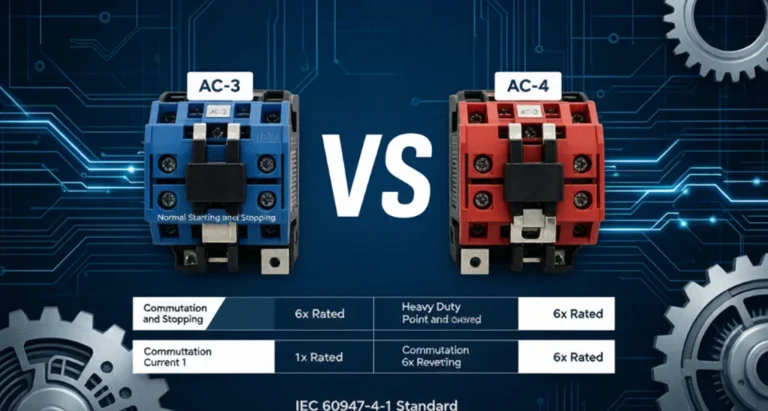
Why Utilization Categories Matter for Contactor Selection Specifying a contactor by rated current alone is one of the fastest ways to end up with welded contacts, short electrical life, and unplanned downtime. The contactor utilization category—defined in IEC 60947-4-1—tells you what kind of load the contactor can switch and how severe that switching duty is. Two […]
Choosing the right electric hoist push button switch is not just about finding a handheld control with a few buttons. In real lifting applications, the wrong choice can create wiring mismatch, poor operator control, replacement delays, or unnecessary safety risks during hoist and crane operation.
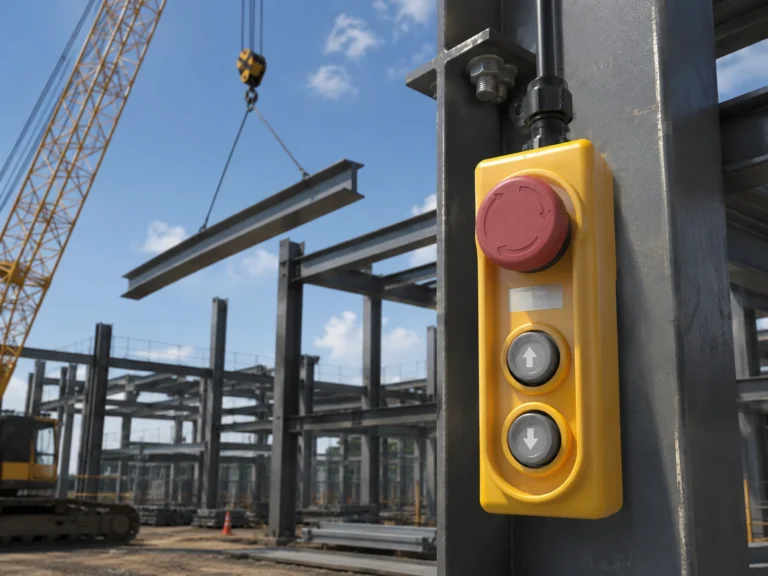
A 2 button pendant control is a hand-held control station designed for simple machine motion, looks simple, but choosing the wrong one can create real problems in hoist and lift applications.