AC-15 vs DC-13: Auxiliary Contact Ratings Explained
AC-15 gives a contact 4 A at 240 V; DC-13 gives the same contact 0.3 A at 250 V. The categories, the test duties behind them, and the PLC dry-circuit floor.
Read More
A standard contactor inside a flameproof enclosure is not an explosion-proof contactor — it is a hazard. Ex d certification covers the joints, the heat budget, the cable entries and the interlock of the whole assembly, and every element of the marking string is a purchase constraint. This page explains what “Ex d” actually protects against, how to decode Ex d IIB T4 Gb, why certified assemblies derate the contactor inside, and the practical route most buyers should take.
“Explosion-proof” in IEC language means protection concepts from the IEC 60079 series. For contactors, the relevant concept is Ex d — flameproof enclosure (IEC 60079-1): the enclosure is built to contain an internal explosion and cool the escaping flame through precisely machined joints until it cannot ignite the outside atmosphere. It does not prevent the ignition; it confines it.
| Concept | Standard | Role in a contactor installation |
|---|---|---|
| Ex d (flameproof) | IEC 60079-1 | Encloses the arc-producing contactor; contains internal explosion |
| Ex e (increased safety) | IEC 60079-7 | Used for the terminal compartment — no arcing parts, extra creepage |
| Ex t (dust enclosure) | IEC 60079-31 | Dust-only zones (21/22); different certification layer |
| Marking & EPL | IEC 60079-0 | The “Gb/Gc” suffix maps the unit to Zone 1 or Zone 2 |
The dual marking “Ex de” is common: arcing parts live in the Ex d chamber, field wiring terminals in an Ex e compartment — cheaper than making the whole box flameproof.
A typical contactor assembly arrives marked like Ex d IIB T4 Gb. Read it as five separate constraints:
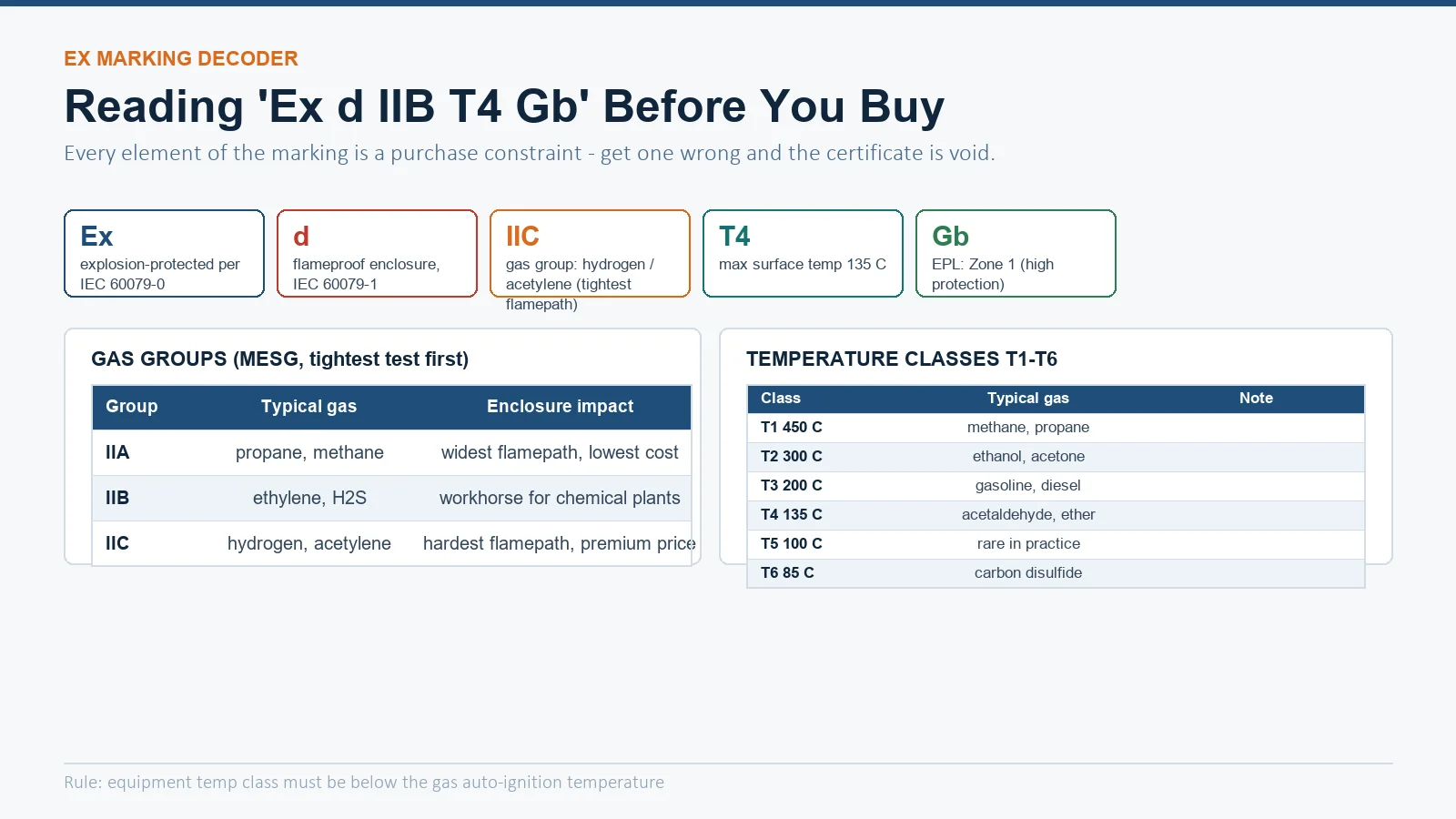
Missing any element voids the certificate. Get the marking right in both directions: the temperature class number must be at or below the gas’s class (a T4 unit is acceptable where T3 is required, because its surface runs cooler), while the gas group letter must be equal or more severe than the plant’s group (a IIC unit covers IIA and IIB service; the reverse is not true). Zone level (Gb vs Gc) must match or exceed the zone the unit will stand in.
Inside an open-air panel, a contactor’s coil and contact losses convect away. Inside an Ex d enclosure they have nowhere to go: flameproof enclosures are heavy, sealed-labyrinth boxes with poor internal circulation. Three consequences follow:
This stacks on top of ordinary thermal derating — our contactor derating guide for temperature, altitude and dust covers the open-air side; inside Ex d, assume the assembly manufacturer has already done it and verify the final rated current against your motor’s nameplate.
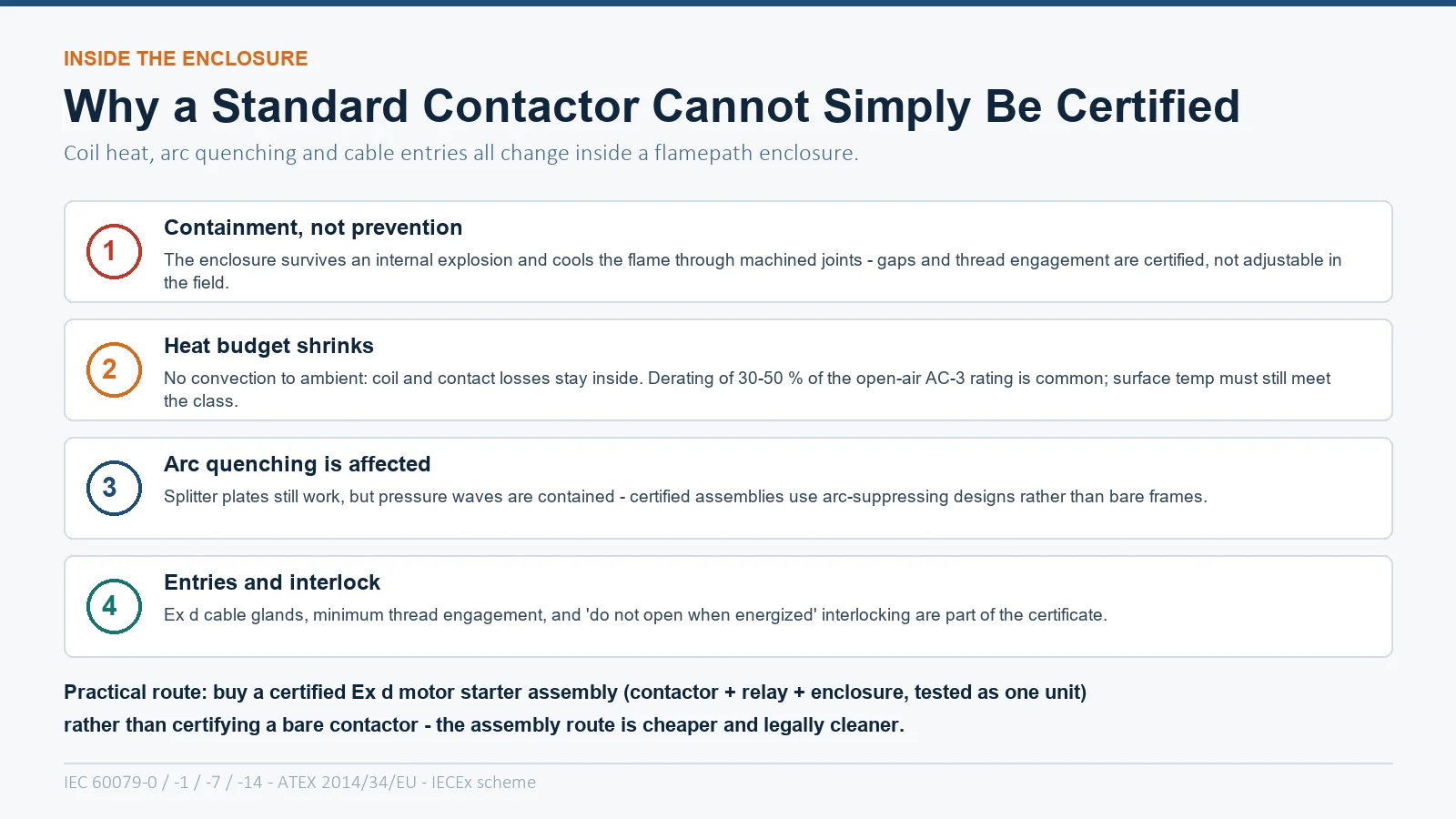
The legally clean and usually cheaper route is a certified Ex d motor starter assembly: contactor, overload relay, disconnect and enclosure supplied as one unit with a single certificate. Trying to source a “bare” Ex d contactor runs into reality quickly:
Vetting the assembly supplier matters as much as the electronics — the same discipline from our manufacturer-vs-trader vetting guide applies, plus one more demand: the IECEx or ATEX certificate number, and the EU Declaration of Conformity matching the marking string.
| Artículo | Requirement | Common field mistake |
|---|---|---|
| Cable entries | Certified Ex d glands; minimum thread engagement per the certificate (often 5 full threads) | Using an increased-safety (Ex e) gland on a flameproof entry, or one thread short |
| Opening the box | “Do not open when energized” — disconnect first, allow cooldown | Opening under load after an arc event; scorch marks then need factory review |
| Flamepath maintenance | Clean, un-painted, light oil film only; no gasket on flamepath faces | Applying paint or sealant to a machined joint |
| Enclosure damage | Dents or corroded flamepaths = remove from service pending recertification | “It still works” reasoning — geometry is the protection |
| IP rating | Typically IP66-class enclosures; dust zones need IP6X for conductive dust (IIIC) | Assuming the IP and Ex ratings are the same thing — see our NEMA vs IP guide |
For the switching component inside the assembly, our CJX2-F series contactors are the standard frame family used by many Ex d assembly builders — request the certified-assembly variant from the AC contactor category rather than sourcing the frame separately.
Not every classified area needs flameproof construction, and the most expensive specification error is buying Ex d where a cheaper concept is legal. For Zone 2 (gas present only under abnormal conditions), the Ex nA / Ex nC “non-sparking” concept (IEC 60079-15) and Ex ec increased-safety variants cover many contactor duties at a fraction of Ex d cost. For Zone 1, the realistic menu is Ex d, Ex p (pressurized enclosure, attractive for larger panels but needs clean instrument air), and encapsulation for small modules.
Two practical notes on this decision. First, the choice belongs to the area classification document, not the buyer’s preference — a Zone 1 area is not negotiable down to Zone 2 to save money. Second, equipment marked for the stricter zone is always acceptable in the milder one (a Gb unit may live in Zone 2), so over-specification is a cost decision, not a compliance failure. Where contactors switch infrequently and the enclosure is small, buyers often find that a certified combination starter in Ex d is still the cheapest fully-certified package — get quotes for both routes before committing.
Cost structure, roughly: an Ex d assembly runs 3–10× the equivalent standard panel, with the premium driven by enclosure size and gas group (IIC flamepaths are the expensive step), not by the contactor inside. That is one more reason to derate honestly and keep the box small: the flamepath geometry scales with volume.
In North American usage “explosion-proof” maps to flameproof construction, functionally equivalent to Ex d (tested to 4× the maximum experimental pressure per IEC 60079-1). But certificates do not cross automatically: an NEC/UL-listed explosionproof enclosure is not valid in an ATEX Zone 1 without IEC 60079 certification, and vice versa. Buy the certificate your jurisdiction requires.
Only if the contactor produces no arcs, sparks or hot surfaces in normal service. Electromechanical contactors arc on every switching operation, so the contactor itself must be in the Ex d (or pressurized) part of the installation; Ex e covers terminals and non-arcing components. Choosing Ex d where Ex e would legally suffice is also the most common cost overrun — the savings usually come from the non-arcing parts of the design.
“X” flags special conditions of use listed in the certificate — for example a restricted ambient range, a mandatory external earth bond, or a torque value on the cover screws. Read them before installation; they are part of the certificate’s validity.