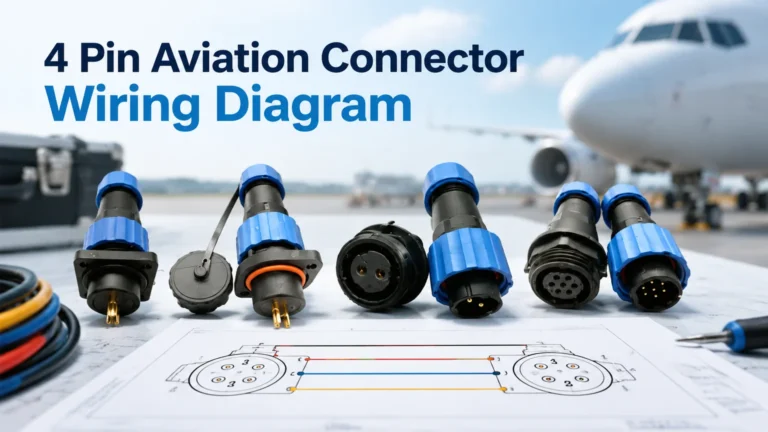
4 Pin Aviation Connector Wiring Diagram: Pinout, Shield and Grounding
Which conductor goes on which pin of a 4-pin aviation connector, how to terminate the shield, and the grounding rules that prevent intermittent faults.
Read More
A buyer searching “aircraft connectors”, one searching “aerospace connectors” and one searching “aviation connectors” are often looking for three different products — yet supplier catalogues use the words interchangeably, which is how inquiries end up mismatched. A maintenance buyer who needs a certified MIL-spec bayonet receptacle gets quoted a moulded GX16 plug. An OEM panel builder who wanted an IP67 industrial circular connector gets asked for airworthiness paperwork they never needed.
This article separates the three terms the way procurement actually uses them, explains where each product family is specified, and states plainly where our supply fits — so that neither side wastes a quotation cycle. If you already know which family you need, you can go straight to the aviation connector category or the size-comparison guide for the industrial series.
| Term | What buyers usually mean | Governing standards | Typical environment | Lead time reality |
|---|---|---|---|---|
| Aircraft connectors | Repair and maintenance parts for civil aircraft: bayonet or threaded rectangular/circular connectors on airframe, avionics and engine looms | MIL-DTL-38999, MIL-DTL-26482, EN 3645/3646, AS6036 | Certified airworthy hardware, traceability required | Long; certified distributors, batch documentation |
| Aerospace connectors | Military/space-grade hardware: high-density, EMI-shielded, hermetic or high-temperature series for defence programmes and satellites | MIL-DTL-55302, MIL-DTL-38999 Series III, ESCC specs | Extreme altitude, vibration, radiation; full qualification | Very long; programme-bound sourcing |
| Aviation connectors | In industrial trade usage (especially from Chinese suppliers): threaded circular connectors for industrial equipment — the GX/LD/SD families | IEC 61076 / DIN-style M-thread practice; IP ratings per IEC 60529 | Factory floors, outdoor cabinets, machinery, vehicles | Days to weeks; stocked or short-run production |
The confusion is historical. “Aviation connector” entered industrial trade English as the literal translation of 航空插头 — the generic Chinese trade name for small threaded circular connectors, named for their aviation origins decades ago. The industrial versions kept the name long after their actual jobs moved to factory automation, LED signage, energy storage and communications cabinets. So when a supplier catalogue says “aviation connector”, it usually means the industrial circular families — not a part with an airworthiness certificate.
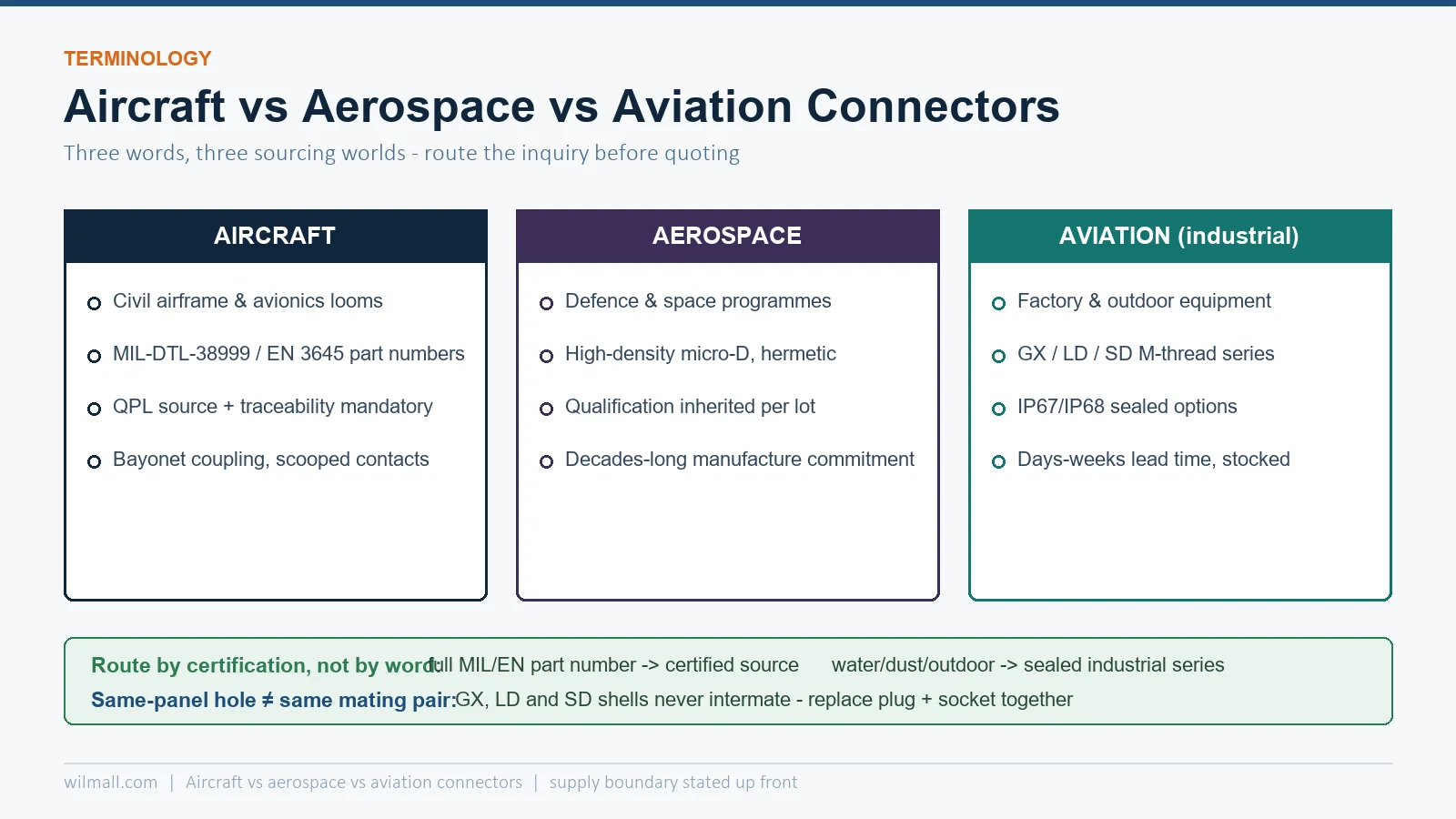 ” />
Genuine aircraft connectors exist inside a certification system. A connector on a civil aircraft loom is specified by a MIL-DTL-38999 or EN 3645 part number that encodes shell material, class, insert arrangement, contact style and keying. The certificate trail — material lots, test reports, QPL (qualified products list) membership — is part of the product. A physically identical unqualified part is not “the same connector cheaper”; it is an unairworthy part, and no maintenance organisation can install it.
If a request shows these markers and you are a buyer, source only from qualified distributors or manufacturers with QPL listing. If you are a supplier without that qualification, say so explicitly — a declined inquiry preserves the relationship; a wrongly shipped “equivalent” ends it.
Aerospace, in sourcing language, sits above aircraft: defence programmes, launch vehicles, satellites, and high-reliability industrial-adjacent systems. Beyond the MIL-DTL families it includes high-density micro-D, hermetic feedthroughs, and radiation-tolerant constructions. Two features distinguish this tier from everything else:
For a general industrial buyer, aerospace-grade parts are the wrong answer in both directions: they cost ten to fifty times an industrial equivalent, and their long lead times do not fit factory maintenance schedules. The only sensible crossover is where an industrial application genuinely needs the extreme-environment features — high vibration combined with wide temperature — in which case a hybrid approach (industrial connectors with specified derating, or purpose-built industrial high-reliability series) is usually more economical.
The industrial families sold under the aviation-connector name are threaded circular connectors optimised for a different brief: thousands of mating cycles at moderate cost, IP sealing for outdoor cabinets, and pin counts from 2 to 12 at currents from signal level to roughly 20 A. Three construction tiers cover the range:
| Tier | La construction | Sealing | Service | Typical duty |
|---|---|---|---|---|
| Metal screw shell (GX style) | Nickel-plated brass, solder or screw contacts | Thread joint only; unmated socket exposed | Indoor, benign | Machine internal wiring, control panels |
| Moulded hybrid (LD style) | Engineering plastic body, metal contacts | Sealing cap, improved strain relief | Dust, splash, outdoor cabinets | Solar, signage, telecom enclosures |
| Sealed waterproof (SD style) | Moulded shell with gasketed interfaces | IP67/IP68 mated and capped unmated | Wet, washdown-adjacent, marine-adjacent | Agricultural equipment, outdoor lighting, pumps |
Our SD20 waterproof aviation connectors are the reference part in the top tier, with the LD28 series covering the larger 28 mm footprint for higher pin counts. The whole range — SD13, SD16, LD16, LD20, LD28 — shares the same contact system philosophy: accessible screw or solder terminations, sealed unmated state, and no reliance on the thread alone for environmental protection.
When a “connectors” inquiry arrives without context, three questions separate the families in under a minute:
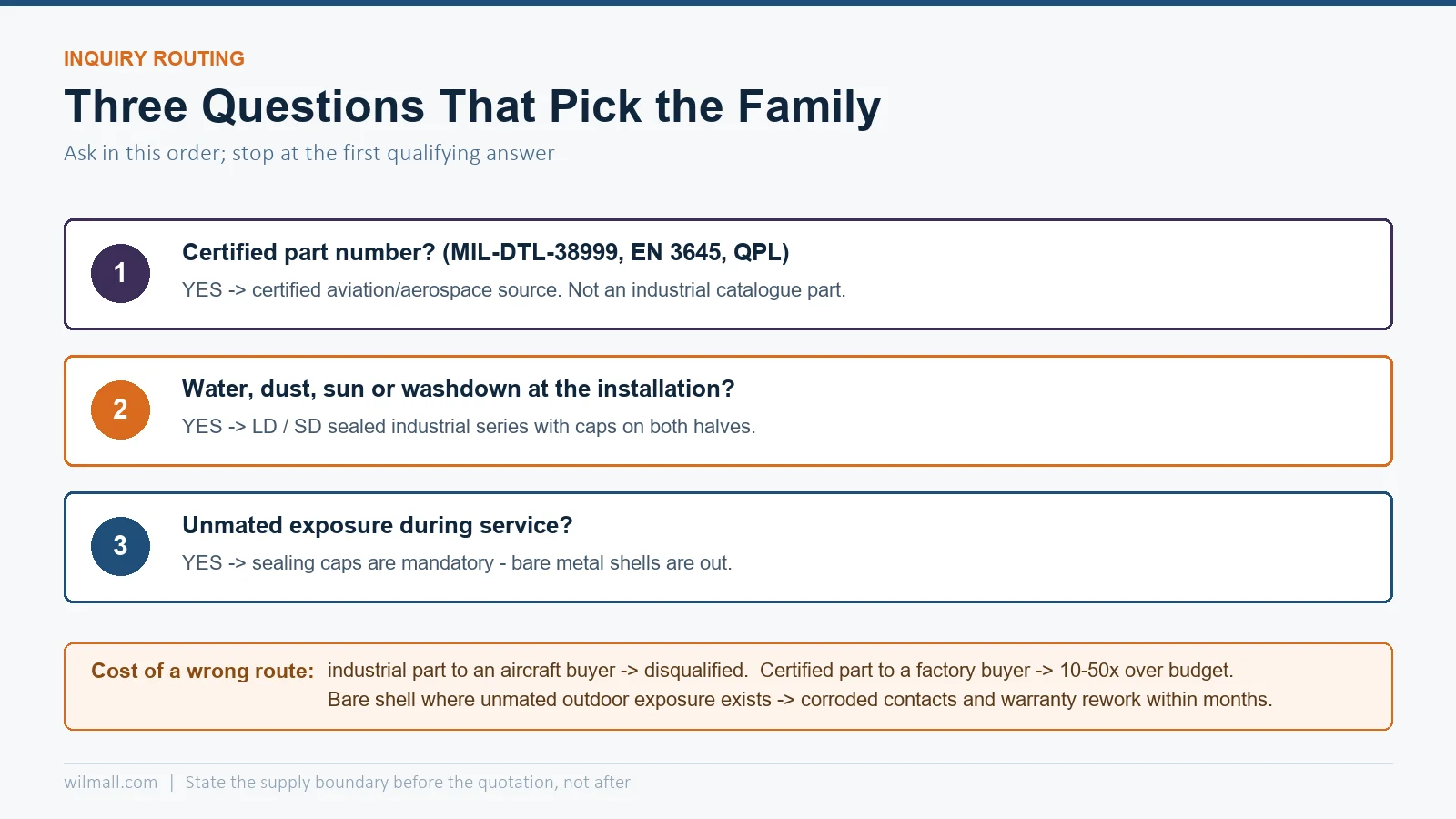 ” />
Getting the terminology wrong costs money in both directions, and the failure pattern is asymmetric:
| Mismatch | What happens | Coût |
|---|---|---|
| Industrial part quoted to an aircraft buyer | Disqualified instantly; risk of being flagged as an unqualified supplier | Lost credibility, often permanently |
| Certified part quoted to an industrial buyer | Quotation is 10–50× the acceptable price; buyer walks away confused | Lost order, wasted engineering time |
| IP-rated part specified where only indoor duty exists | Small over-specification, usually absorbed | Minor cost premium |
| Bare metal shell specified where unmated outdoor exposure exists | Corroded contacts, intermittent faults within months | Warranty and site rework — the expensive one |
That last row is the one we most often see in after-sales conversations: the connector was not “bad”, it was simply the wrong family for the environment. The fix costs nothing at specification time — a sealed series instead of a bare shell — and a fortune later.
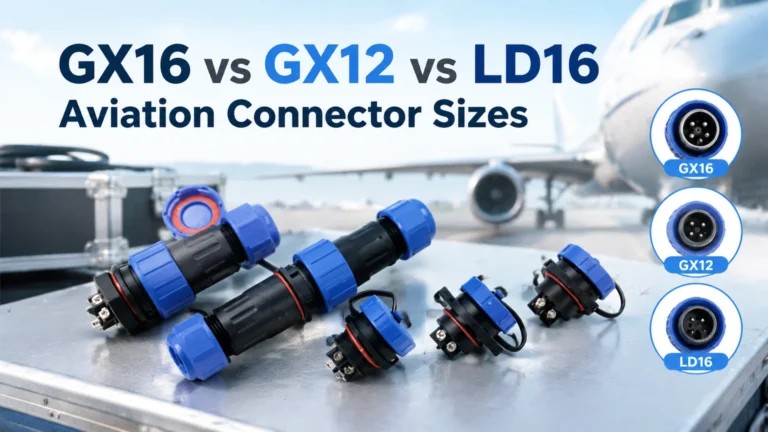
GX12/GX16 are one family within the industrial aviation-connector group. “Aviation connector” is the trade-category name; GX, LD and SD are the series within it, differing in shell construction and sealing.
No. Airworthiness requires parts qualified to the applicable MIL/EN specification with full traceability, installed by an approved organisation. Industrial connectors have no such qualification.
It is the dominant US military specification family for circular connectors: threaded or bayonet coupling, EMI shielding, environmental sealing, with qualified manufacturers listed on a QPL. If an inquiry quotes it, the buyer needs certified supply.
A sealed moulded series in the same 16 mm footprint — SD16 or LD16 with caps — keeps the panel hole unchanged and adds IP-sealed unmated protection. See the size and pin chart for the substitution table.
Historical naming: 航空插头 (aviation plug) described the earliest small threaded circular connectors in Chinese industry, and the trade name survived the migration into factory equipment. It signals the connector family, not airworthiness.