






Why Is My MCB Tripping? Causes & Fixes
Your MCB trips for four main reasons: overload, short circuit, earth leakage, or a faulty breaker. This guide explains each cause, how to find it, and how to fix it safely.
Read More
When I talk with procurement teams about crane controls, one pattern shows up again and again: everyone remembers the motor, the inverter, and the hoist, but the Hoist Control Pendant Station gets treated like the quiet extra in the movie. Then one day the quiet extra becomes the whole plot. A hoist control pendant station is not just a button box; it is the operator’s direct interface with motion, safety, speed, and daily productivity. In many industrial plants, that tiny handheld unit decides whether the workday feels smooth, controlled, and profitable—or whether it feels like a meeting that should have been an email.
The numbers make the point very clearly. A Konecranes analysis of 319 OSHA-investigated overhead crane incidents from 2000 to 2020 found 1,013 OSHA violations, 180 injuries, 161 fatalities, more than $2.9 million in OSHA fines, and an estimated economic impact above $500 million. The same analysis also found that 72% of incidents happened during routine job activities and that 63% may have been prevented by proper training. That is exactly why a control pendant, a pendant control station, or a crane pendant control assembly should never be selected only on price. For B2B buyers, the right pendant station protects operators, reduces downtime, supports compliance, and makes sourcing from a reliable manufacturer or supplier far more valuable than chasing the cheapest unit on a spreadsheet.
A buyer may see a control pendant as a small accessory, but the field data says otherwise. In the same overhead crane incident analysis, 38% of cases involved workers being crushed by the load, 27% involved load drops, 11% involved falls, 11% involved people being crushed or run over by the overhead or gantry crane, and 10% involved improper or absent lockout/tagout. Even more sobering, 91% of the incidents in which a person was crushed or run over by the crane resulted in a fatality. In plain English: when motion control is poor, the consequences are brutally expensive.
That is where a well-built push button pendant earns its keep. Good crane pendant control should support quick, clear, deliberate operator action, especially in lifting, lowering, and stopping conditions. Safety standards also back this up: IEC guidance states that an emergency stop shall operate as either a stop category 0 or stop category 1, shall override other functions, shall stop dangerous movement as quickly as possible, and shall not allow restart simply by releasing the emergency stop. I always tell buyers the same thing: if the button feel is vague, the enclosure is flimsy, or the stop circuit is poorly defined, you are not buying a bargain—you are buying future paperwork.
For procurement teams in steel service centers, fabrication shops, warehouses, automotive lines, and equipment plants, this means the hoist control pendant station is not a “consumable” purchase. It is a control interface with direct influence on safety culture, operating rhythm, and maintenance calls. A good pendant station should feel boring in the best possible way: no surprises, no hesitation, no mystery, and no operator arguing with the machine before lunch.
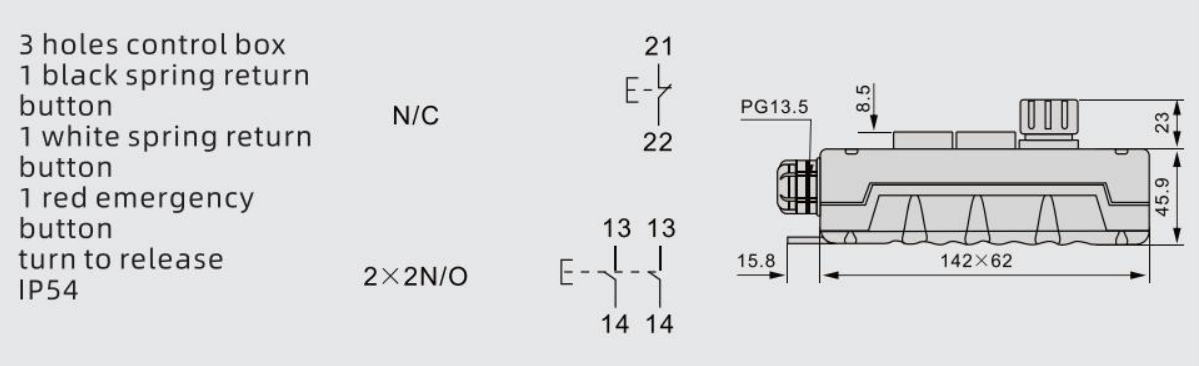
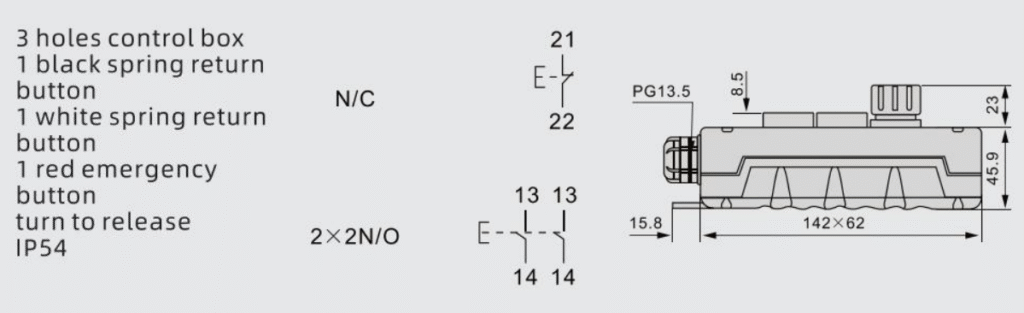
Now let’s talk about the COP-A2B, Public supplier listings for COP-A2B variants describe an IP65 waterproof and dustproof control box intended for crane or lift applications, with a 610 mm cable, a black 4-wire cable, and an M8 4-pin A-code female circular connector rated IP65. One listing describes black and white momentary buttons with a separate red emergency stop, while another COP-2B style listing describes a 1NO1NC combination push button arrangement for waterproof crane hoist use. That combination tells me the model is positioned as a compact industrial pendant station for practical motion control where dust, splash, and frequent handling are part of the job.
There is also an important purchasing lesson hidden in those listings: the exact contact configuration can vary across supplier descriptions. One page highlights NO momentary buttons plus a red stop device, while another emphasizes 1NO1NC combinations and CE/CQC positioning. As a result, no serious buyer should approve a sample based on catalog photos alone. A real purchasing decision should be based on the electrical schematic, contact block logic, connector definition, cable spec, ingress rating evidence, and reset behavior of the emergency stop. That is how a professional buyer works with a factory, supplier, exporter, or wholesaler in China without turning a control pendant purchase into a guessing game.
From a sales and engineering perspective, the COP-A2B works best when it is presented honestly: as a compact, application-oriented control pendant, not as a magic box that fits every crane ever built since humanity discovered steel. If your customer needs a small pendant control station with emergency stop, limited command points, waterproofing, and simple wiring logic, this model is commercially attractive. If the project requires multi-speed travel, more operators, or complex signaling, you may need a larger push button pendant family instead of forcing a small unit to pretend it has a bigger job title.

In the market for pendant controls, size and button count matter more than many buyers expect. ASI’s published range for crane pendant products shows how broad the category can be, with single-row models available in 5, 7, 8, 10, and 12 operators, and double-row versions available in 4, 6, 8, 10, 12, and 14 buttons, with emergency stop included depending on model. That tells us something useful for procurement: not every pendant station is meant for the same crane duty, operator preference, or machine logic.
So how should a buyer think about a hoist control pendant station without turning the conversation into a textbook? I use three filters. First, match the command set to the motion required in the real application. If the job is basic hoist up/down with stop, a compact COP-A2B style control pendant may be enough; if the crane also needs cross travel, long travel, horn, selector, or multi-speed functions, the buyer should consider a higher-button pendant station class. Second, treat emergency stop behavior as a control-circuit decision, not a cosmetic feature. IEC guidance for machinery says emergency stop must override other functions and must not trigger an automatic restart on release. Third, verify environmental fit. An IP65-rated pendant control station is attractive, but the cable entry, connector match, strain relief, and daily handling conditions still determine actual field performance.
From a wiring perspective, the most practical commercial discussion is not “How many buttons does it have?” but “What exactly does each contact do in the control circuit?” Public COP-A2B listings show that contact descriptions can vary, which means the buyer should request the terminal assignment drawing before final approval. In a typical crane pendant control application, buyers usually want motion buttons as momentary command inputs and the emergency stop wired into the safety or control stop chain so it interrupts dangerous movement reliably. I know that sounds less romantic than a glossy catalog, but terminals are honest in a way marketing copy rarely is.
This is also where high-conversion long-tail terms matter commercially. A buyer searching “waterproof pendant control station,” “emergency stop push button pendant,” “hoist pendant station manufacturer,” or “crane control pendant supplier China” is usually not browsing for fun. They are close to an RFQ, sample request, vendor comparison, or replacement order. If your product page and blog content speak clearly about wiring logic, emergency stop behavior, ingress protection, connector definition, and OEM documentation, you are talking to a real B2B customer, not just feeding the search engine.
For B2B procurement, the commercial story is bigger than the part number. Many overseas buyers are not only looking for a product; they are looking for a stable manufacturer, responsive factory support, consistent wholesale supply, and export-ready documentation from China. That is why terms like supplier, exporter, wholesaler, wholesale, and service are not fluff in this market. They are buying signals. When a crane builder or distributor searches for a pendant station from a China manufacturer, they usually want one or more of these outcomes: OEM branding, stable lead time, lot consistency, lower total cost, or technical service after the first order.
The good news is that the market structure supports this kind of sourcing. Public COP-A2B and related crane pendant listings in China emphasize industrial use, waterproof protection, compact command layouts, and compatibility with hoist or lift applications. At the same time, broader pendant station catalogs show that the category scales from simple emergency stop units to higher-button crane pendant control products for more complex machine functions. In other words, a professional supplier can support both replacement demand and platform-level sourcing for OEMs. That matters if you are a distributor building a product line, a contractor standardizing spare parts, or a wholesaler trying to reduce the number of oddball SKUs hiding in the warehouse like shy cats.
What separates a credible supplier from a risky one is not only price. It is response quality. A real factory or exporter should answer practical questions about contact arrangement, ingress rating evidence, cable configuration, connector type, emergency stop reset behavior, sample lead time, and packaging for export. Public standards references also matter here: IEC 60204-32:2023 for hoisting machines includes emergency stop, control circuit protection, cableless control system requirements, symbols for actuators, EMC, and technical documentation requirements. If a supplier cannot discuss documentation clearly, the service level behind the quotation may be thinner than the cardboard in the shipping box.
| Supplier type | What B2B buyers should request | What it signals |
|---|---|---|
| Manufacturer | Drawings, BOM outline, test records, production consistency evidence | Direct control over build quality and revision management |
| Factory | Sample lead time, process photos, QC flow, packaging standard | Whether the supplier can support repeat orders smoothly |
| Supplier | Commercial quotation, MOQ, lead time, spare parts availability | Baseline purchasing practicality |
| Exporter | HS description, carton spec, labeling, shipment support | Readiness for cross-border orders |
| Wholesaler | Stock depth, mixed-SKU support, replacement availability | Speed and flexibility for distributors or service firms |
| Service partner | Technical confirmation on wiring, application match, and after-sales response | Whether the purchase will stay problem-free after delivery |
If you are writing for buyers, this is the sentence that often moves the conversation forward: a compact control pendant can be inexpensive, but poor communication around drawings, contacts, and compliance can make it costly very fast. And yes, that is my polite sales-engineer way of saying that the cheapest quotation is sometimes just an expensive complaint waiting to happen. For RFQ-driven markets, it is perfectly reasonable to invite the customer to send an inquiry for the exact contact logic, cable requirement, and quantity plan before placing a wholesale order.
In the end, a hoist control pendant station is one of those products that looks simple until you are the person responsible for uptime, safety, and repeat purchasing. Then it becomes very clear why experienced buyers focus on emergency stop behavior, contact logic, ingress protection, and supplier response quality.
The COP-A2B is commercially interesting because it sits in a useful space: compact, industrial, and relevant to customers searching for a pendant control station, push button pendant, or crane pendant control product from a China manufacturer, supplier, exporter, or wholesaler. But smart procurement still comes down to one rule I trust more every year: buy the pendant station that matches the job, the circuit, and the service expectation—because a crane operator should be lifting loads, not testing your optimism.
Often used interchangeably in sales language, but the real decision depends on function, contacts, and environment.
Public listings position it at IP65, which is useful for many industrial settings.
Contact logic, emergency stop behavior, connector type, cable spec, and compliance documents.
No. Published pendant families vary widely in button count and application scope.
Consistent quality, documentation, response speed, and technical service—not just a low quote.