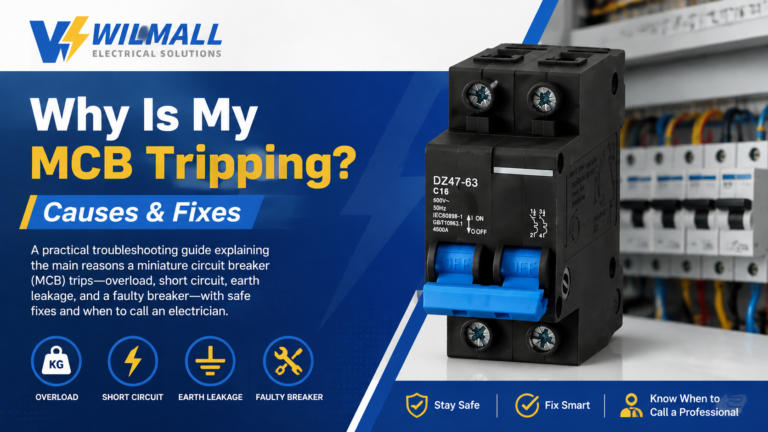





Why Is My MCB Tripping? Causes & Fixes
Your MCB trips for four main reasons: overload, short circuit, earth leakage, or a faulty breaker. This guide explains each cause, how to find it, and how to fix it safely.
Read More
Choosing the right electrical enclosure means navigating two major rating systems: NEMA and IP. Both describe how well an enclosure protects internal components, but they measure different things and are not interchangeable. Specifying the wrong rating can lead to equipment failures, code violations, and costly field corrections. This guide breaks down the key differences, provides a practical cross-reference chart, and helps you select the right enclosure for your environment.
NEMA ratings and IP ratings both classify the level of environmental protection an enclosure provides. However, they originate from different standards organizations, use different formats, and evaluate different types of protection.
NEMA ratings are defined by the National Electrical Manufacturers Association under NEMA 250. They are primarily used in North America and evaluate a broad set of environmental conditions including solid and liquid ingress, corrosion resistance, external ice formation, oil and coolant exposure, and even hazardous location performance. A NEMA type number, such as NEMA 4X, describes the overall environmental capability of the enclosure.
IP ratings follow IEC 60529, an international standard published by the International Electrotechnical Commission. An IP code uses two digits: the first indicates protection against solid objects and dust (0 to 6), and the second indicates protection against water (0 to 9K). IP ratings focus exclusively on ingress protection from solids and liquids. They do not test corrosion resistance, ice formation, or mechanical durability.
The table below summarizes the most important structural differences between the two systems.
| Fonctionnalité | IP Rating (IEC 60529) | NEMA Rating (NEMA 250) |
|---|---|---|
| Standard | IEC 60529 | ANSI/NEMA 250 |
| Primary Region | International | Amérique du Nord |
| Dust Protection | Yes | Yes |
| Water Protection | Yes | Yes |
| Corrosion Resistance | No | Yes |
| Ice Formation | No | Yes |
| Oil and Coolant Exposure | No | Yes |
| Hazardous Locations | No | Yes (Types 7–10) |
| Rating Format | Two-digit code (e.g., IP66) | Type numbers (e.g., Type 4X) |
Because NEMA evaluates everything IP does plus additional environmental factors, the cross-reference runs in one direction only. A NEMA type can be mapped to a minimum IP equivalent, but an IP rating alone cannot satisfy a NEMA requirement.
Use this chart as a starting point. It shows the minimum IP equivalent that each NEMA type meets or exceeds. It cannot be used in reverse, because an IP rating does not guarantee NEMA compliance.
| NEMA Type | Approximate IP Equivalent | Key Protection | Application typique |
|---|---|---|---|
| NEMA 1 | IP10 | Personnel contact, falling dirt | Indoor electrical rooms |
| NEMA 3R | IP14 | Rain, sleet, ice (no dust) | Outdoor metering, pad-mounted gear |
| NEMA 4 | IP66 | Hose-directed water, dust, ice | Industrial washdown areas |
| NEMA 4X | IP66 | NEMA 4 + corrosion resistance | Coastal, chemical, food processing |
| NEMA 12 | IP52 | Circulating dust, dripping liquids | Manufacturing control panels |
| NEMA 6 | IP67 | Temporary submersion | Submersible applications |
For example, a NEMA 4X enclosure meets or exceeds IP66 requirements for dust and water protection, but an IP66 enclosure does not automatically meet NEMA 4X because NEMA 4X also requires corrosion resistance testing that IP66 does not evaluate.
An IP rating consists of the letters IP followed by two digits. Each digit represents a specific level of protection.
| First Digit | Protection Against Solids | Second Digit | Protection Against Water |
|---|---|---|---|
| 0 | No protection | 0 | No protection |
| 1 | Objects larger than 50 mm | 1 | Vertically falling water drops |
| 4 | Objects larger than 1 mm | 4 | Splashing water from all directions |
| 5 | Dust-protected | 5 | Low-pressure water jets |
| 6 | Dust-tight | 6 | Powerful water jets |
| — | — | 7 | Temporary immersion up to 1 m |
| — | — | 8 | Continuous immersion |
One important detail: IP ratings are not cumulative above IPX6. An enclosure rated IP67 for temporary immersion might fail an IP66 jet test because the two tests measure different things. If your application requires both jet and immersion protection, look for enclosures tested and rated for both.
Selecting the correct enclosure rating starts with understanding the installation environment. Consider the following factors before specifying an enclosure.
Indoor enclosures in clean, climate-controlled environments typically need only basic protection. NEMA 1 or an IP10 to IP20 rating is sufficient for office electrical rooms. For indoor industrial areas with circulating dust and occasional dripping liquids, NEMA 12 (approximately IP52) is the standard choice.
Coastal facilities, chemical plants, food processing operations, and marine applications require corrosion resistance. In these environments, NEMA 4X is the appropriate choice because it includes corrosion testing that no IP rating evaluates. If your project follows IEC standards, specify an IP66 or IP67 rating plus a separate corrosion resistance requirement.
Factories and food processing plants that use regular hose-directed washdown cleaning need enclosures rated for powerful water jets. NEMA 4 or NEMA 4X and IP66 are the common specifications. NEMA 4X adds the corrosion resistance needed for environments where washdown chemicals may be present.
North American projects typically specify NEMA ratings. International projects commonly use IP ratings. For global projects spanning multiple regions, look for enclosures that carry dual certifications to simplify procurement and compliance.
Avoiding these common specification errors can save significant time and cost:
Yes. Many enclosure manufacturers design products that comply with both standards. A dual-rated enclosure, such as one marked NEMA 4X / IP66, is common for international industrial projects where equipment may be installed in North America but sourced globally. Dual-rated enclosures simplify global compliance, engineering approvals, and international procurement. When only one rating is available, add the missing environmental requirements as separate line items rather than assuming the single rating covers everything.
If you need enclosures that meet specific protection requirements for industrial applications, you can explore options like double door metal enclosures with IP65 protection designed for power distribution and equipment housing.
No. IP66 protects against dust and powerful water jets, while NEMA 4X includes the same water and dust protection plus corrosion resistance, ice formation testing, and broader environmental evaluation. An IP66 enclosure does not automatically meet NEMA 4X.
No. The conversion runs one direction only. A NEMA type meets or exceeds a minimum IP equivalent, but an IP rating alone cannot be mapped to a NEMA type because NEMA evaluates factors that IP does not test, such as corrosion and ice formation.
For outdoor installations in North America, NEMA 3R, NEMA 4, or NEMA 4X are common depending on whether you need dust, water, or corrosion protection. For international projects, IP66 or IP67 are typical. In coastal or chemical environments, NEMA 4X is strongly recommended.
No. IP ratings under IEC 60529 test only solid particle and liquid ingress. Corrosion resistance is evaluated under NEMA standards, specifically for types like NEMA 4X, which undergo extended salt spray and chemical exposure testing.
Food processing environments typically require washdown capability and corrosion resistance. NEMA 4X is the standard choice because it handles hose-directed water and resists corrosion from cleaning chemicals. IP66 alone may not be sufficient unless paired with a material rated for corrosion, such as stainless steel.
NEMA and IP ratings serve the same fundamental purpose, protecting electrical equipment from environmental exposure, but they are not interchangeable. NEMA covers a broader scope including corrosion, ice, and hazardous locations, while IP focuses on dust and water ingress. The safest approach is to specify in the system your project standard uses, treat cross-reference charts as minimums, and verify that the enclosure material and construction match the actual installation environment.
For industrial electrical enclosures and distribution equipment, Wilmall offers factory-direct solutions with CE, UL, and RoHS compliance, supporting OEM customization and bulk supply for distributors and project contractors. To learn more about their product range, visit the technical blog or contact the team for project-specific guidance.