






HVAC Contactor Guide: Types, Sizing & Replacement
How to specify and replace HVAC contactors: definite purpose vs IEC vs NEMA types, nameplate sizing from RLA and FLA, pole count, derating, and a replacement checklist.
Read More
Choosing between contactor brands is rarely about finding the “best” name on a list. It is about matching a brand tier to the risk level of the panel you are building. A premium European contactor on a general-purpose fan circuit is money you will never recover. A budget contactor on a 24/7 compressor duty cycle is a warranty claim waiting to happen. This guide compares the contactor brands that actually matter for industrial buyers in 2026, maps them into five practical tiers, and gives you the cross-reference table and landed-cost math that most “top 10” lists leave out. Browse the full AC contactor range if you want to see how the families described here line up in practice.
There is no single winner. If you want the short version, match your application to the tier below and then verify the certification matches your destination market.
| Application risk level | Recommended tier | Representative brands | Why this tier |
|---|---|---|---|
| Safety-critical, high switching frequency, OEM machine under warranty | Tier 1 — European premium | Schneider Electric, ABB, Siemens | Documented electrical life curves, global spare availability, accessory ecosystem |
| Precision machinery, compact panels, automotive and electronics lines | Tier 2 — Japanese precision | Mitsubishi Electric, Fuji Electric | Small footprint, high mechanical life, tight PLC integration |
| Export panels needing a premium name at a lower unit cost | Tier 3 — Value-premium | LS Electric, Hyundai Electric | Korean build quality with a shorter brand premium |
| Standard industrial control, building services, general motor starting | Tier 4 — Volume value | Chint, Delixi, People Electric | IEC-certified performance at a fraction of premium pricing |
| OEM/ODM programmes, private label, cost-driven volume builds | Tier 5 — Export OEM | Chinese OEM factories (including the LC1-D, 3TF and CJX2 families) | Full control over coil voltage, labelling, packaging and MOQ |
The rest of this article explains what separates those tiers, how the model families cross-reference, and what the brand premium actually buys you in money and downtime.
Most brand comparisons rank companies. That is less useful than it sounds, because a Tier 1 brand and a Tier 4 brand can both be the correct purchase on the same project — just for different circuits. What matters is the structural difference between tiers.
Schneider Electric’s TeSys range is the de facto reference point: TeSys D (roughly 9–150 A) for general motor control, TeSys F (up to 800 A) for heavy switching, and TeSys K for compact duties. ABB’s AF series is built around an electronically controlled coil that accepts a wide AC/DC voltage band in a single unit, which cuts the number of coil variants you need to stock. Siemens SIRIUS 3RT contactors are the natural default when the rest of the control architecture is already Siemens, because the engineering data drops straight into the same automation toolchain. Eaton’s DILM range (a continuation of the Moeller design) is unusual in covering both IEC and North American practice, and Legrand and Hager fill the building-services end.
What you are buying at this tier is documentation and predictability. Published electrical life curves at specific AC-3 loads, declared short-circuit coordination tables with matching breakers and overload relays, and a global distribution network that will have a replacement coil on a shelf in most capital cities. For a panel that carries a warranty, a service contract, or a customer specification naming the brand, that documentation is worth the price. For a stand-alone pump starter in your own workshop, it usually is not.
Mitsubishi Electric’s S-T and S-N series and Fuji Electric’s SC series compete on mechanical life and footprint rather than on ecosystem breadth. Their contactors are typically smaller for the same rating, which matters when you are packing a dense control cabinet and every millimetre of DIN rail is contested. Mitsubishi units also pair cleanly with Mitsubishi PLC and drive platforms, which is why they dominate Japanese-origin machinery and semiconductor equipment. Fuji has a strong position in continuous-duty applications such as HVAC compressors. If your machine was designed in Japan, substituting a Tier 4 contactor usually creates a mechanical and documentation problem rather than a cost saving.
LS Electric’s MC series and Hyundai Electric’s HGC range occupy the useful middle ground. The build quality is a genuine step up from volume Chinese product, the certification packages are complete, and the brand premium is materially lower than the European or Japanese names. For exporters who need a recognisable badge on a panel without paying Tier 1 pricing, this is often the pragmatic answer.
Chint’s NXC and NC1 series and Delixi’s CJX2s are the two names you will meet most often in this tier, with People Electric’s RDC range and CNC Electric’s YCC1 covering the budget-export end. The quality gap that existed twenty years ago has largely closed at the standard ratings. Modern Tier 4 contactors carry IEC 60947-4-1 test data, and many hold UL or cUL recognition for specific ratings. What has not closed is the ecosystem: accessory depth, published coordination tables, and the willingness of a distributor on the other side of the world to hold your exact variant in stock.
The final tier is not really a brand at all. It is the group of Chinese factories — the source of the LC1-D, CJX2-D, 3TF and CJX2-F families you will see sold under dozens of different labels — that manufacture to a specification and put your name, or nobody’s name, on the front. This tier is where an experienced buyer has the most leverage: coil voltage, auxiliary contact configuration, terminal labelling, packaging and documentation are all negotiable, and MOQs are typically far below what a Tier 1 distributor will discuss.
Two clarifications matter here. First, a legitimate OEM-branded equivalent is not a counterfeit. A CJX2-D contactor is an independent design in the LC1-D form factor; a counterfeit is a unit sold as genuine Schneider with Schneider markings. Second, Tier 5 quality varies enormously between factories, which is why third-party test reports and a factory audit are non-negotiable at this tier — more on that below.
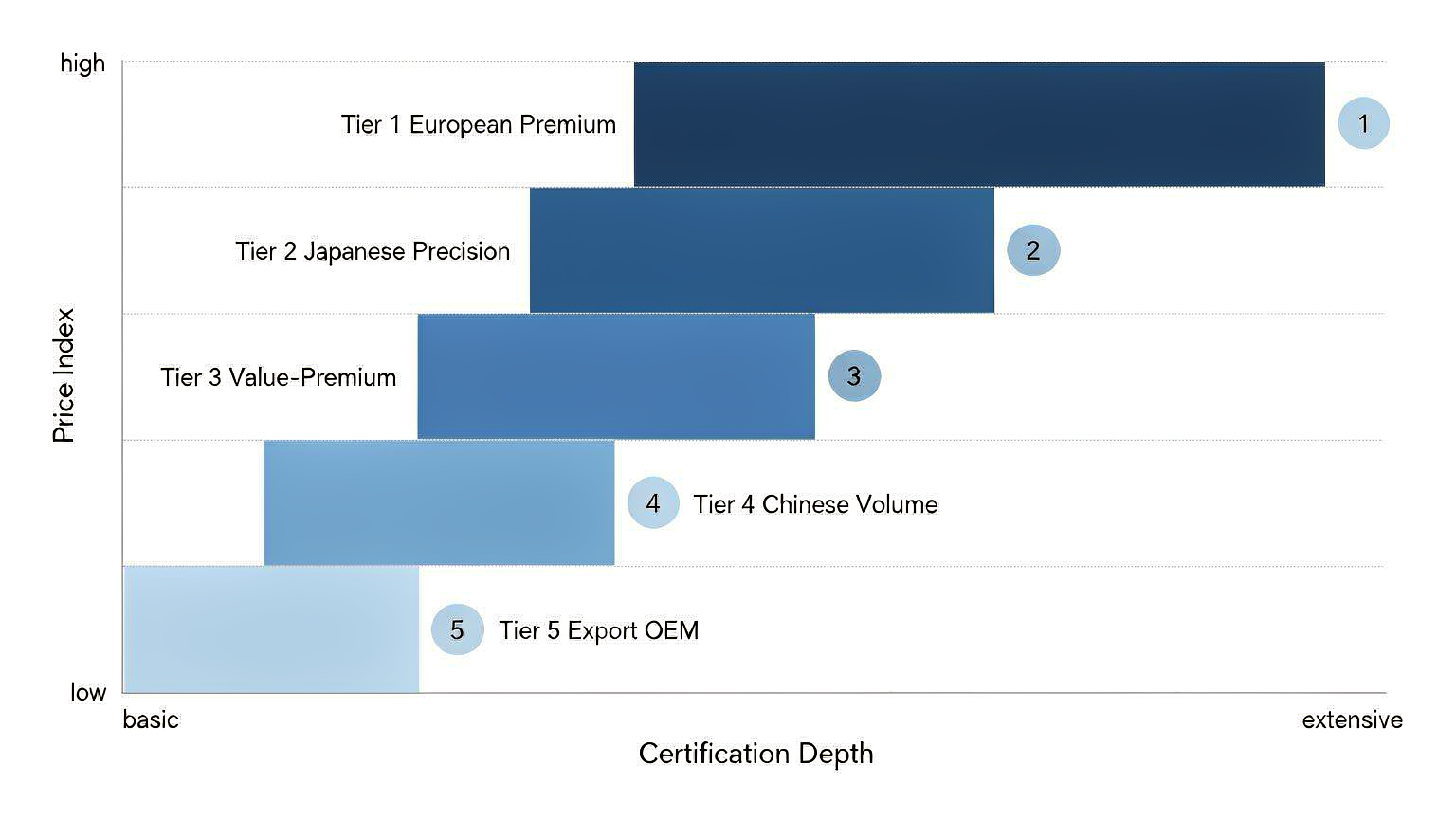
The table below summarises the brands you are most likely to be quoting against, with the flagship series and the honest trade-off for each.
| Brand | Origin | Flagship series | Typical frame range | Main strength | Main trade-off |
|---|---|---|---|---|---|
| Schneider Electric | France | TeSys D (LC1D), TeSys F (LC1F) | 9–800 A | Broadest portfolio, deepest accessory and coordination data | Highest unit price; premium for documentation you may not need |
| ABB | Switzerland / Sweden | AF, A, AX | 9–750 A | Electronic coil handles wide AC/DC voltage band; low coil consumption | Coil electronics are a service item in harsh or high-temperature panels |
| Siemens | Germany | SIRIUS 3RT2, 3RT1 | 9–500 A | Seamless fit with Siemens automation and switchgear | Best value only inside a Siemens ecosystem |
| Eaton | Ireland / USA | DILM, XTCE, Freedom (NEMA) | 9–500 A | Covers IEC and NEMA practice in one family | Availability outside Europe and the Americas can be thinner |
| Rockwell Automation | USA | Allen-Bradley 100-C, 500 (NEMA) | 9–97 A (IEC) | Native fit with Logix control platforms | Priced for the North American installed base |
| Mitsubishi Electric | Japan | S-T, S-N | 10–150 A | Compact footprint, high mechanical life | Narrower high-current range than European brands |
| Fuji Electric | Japan | SC, SW | 9–150 A | Continuous-duty reliability, HVAC and compressor duty | Accessory ecosystem smaller than Tier 1 |
| LS Electric | South Korea | MC, GMC | 9–150 A | Strong price-to-quality ratio, growing distribution | Less recognised than Tier 1 on premium tender lists |
| Chint | China | NXC, NC1 | 9–95 A | Global value leader, wide stock availability | Accessory depth below Tier 1; verify the exact variant rating |
| Delixi | China | CJX2s | 9–95 A | Very competitive pricing, complete model coverage | Documentation quality varies by distributor |
| Export OEM factories | China | LC1-D, CJX2-D, 3TF, CJX2-F families | 9–800 A | Custom coil, labelling and packaging; low MOQ | Quality varies sharply between factories — audit required |
Note that the frame ranges are indicative of the mainstream catalogue, not the absolute limit of each brand. If you need to confirm whether a specific rating suits your motor, the sizing method in our guide to how to size and select a contactor walks through the AC-3 calculation step by step.
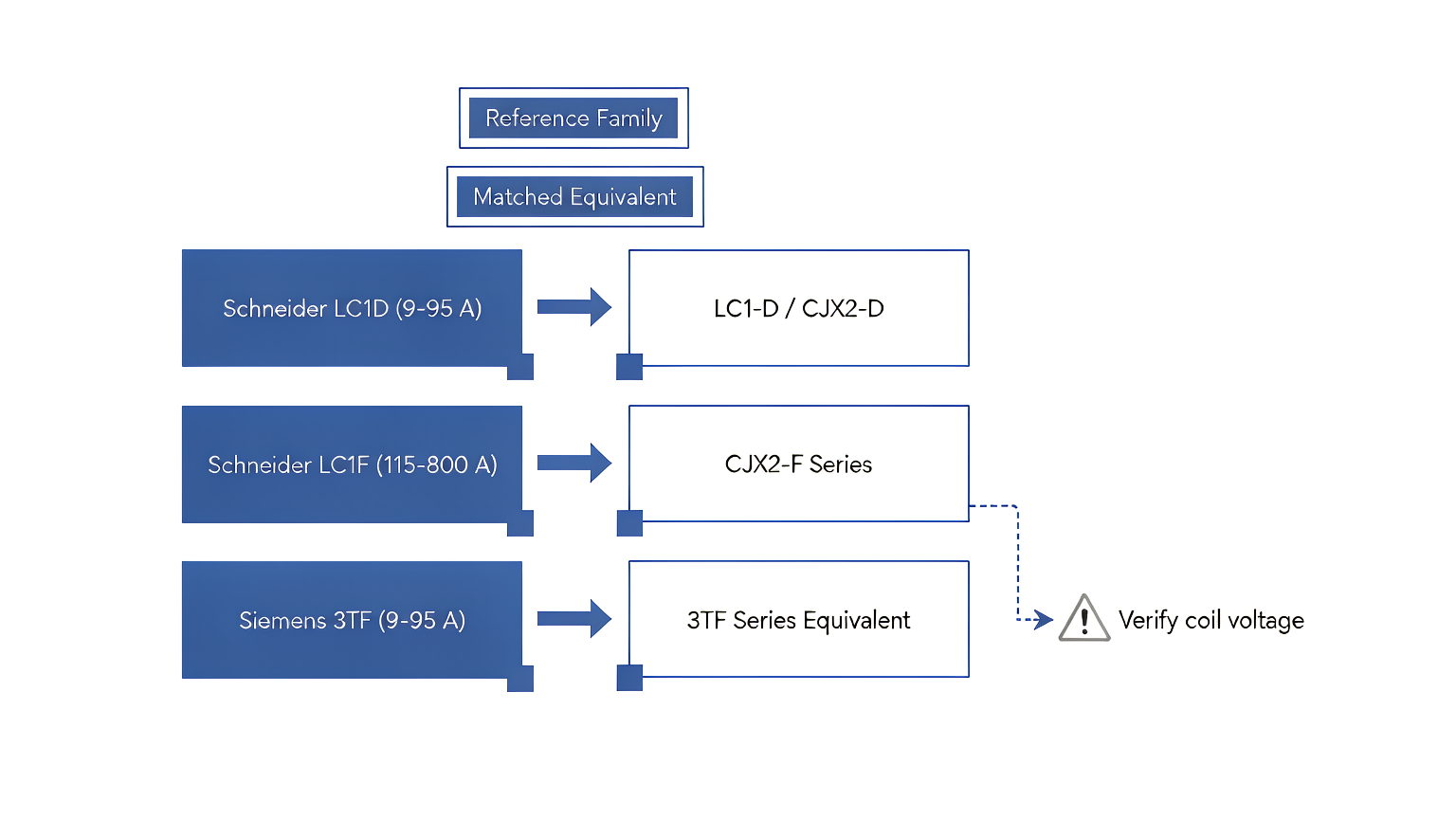
This is the part of brand selection that buyers actually lose time on. When a machine arrives with a burnt-out LC1D contactor and the lead time on a genuine replacement is six weeks, you need to know which alternative families physically fit and functionally match. The table below maps the common reference families.
| Reference family | Brand | Commonly matched family | Typical current range | What matches |
|---|---|---|---|---|
| TeSys D (LC1D) | Schneider Electric | LC1-D / CJX2-D compact frames | 9–95 A | Frame footprint, terminal layout, coil terminal position, auxiliary block interface |
| TeSys F (LC1F) | Schneider Electric | CJX2-F series | 115–800 A | Heavy-frame mounting, double-break contact structure, interlock provision |
| 3TF | Siemens (legacy) | 3TF series equivalents | 9–95 A | Mounting pattern, AC-3 rating ladder, thermal relay coupling |
| SIRIUS 3RT2 | Siemens | No direct compact equivalent | 9–95 A | Function only — check dimensions and auxiliary interface before substituting |
| AF / A series | ABB | No direct equivalent | 9–750 A | Function only — the electronic coil has no mechanical analogue |
| DILM | Eaton | Partial overlap with CJX2-D | 9–150 A | Function and rating; verify footprint per frame size |
| S-T / S-N | Mitsubishi Electric | No direct equivalent | 10–150 A | Function only — Japanese frame sizes are usually smaller |
Three cautions apply whenever you cross-reference a contactor brand. First, “equivalent” means the mounting and function match, not that the unit is certified as a drop-in replacement for the original — a substituted contactor can invalidate a panel’s existing certification. Second, coil voltage and frequency must be confirmed independently; the frame may match while the coil is 220 V AC 50 Hz against a required 24 V AC. Third, auxiliary contact configurations (1NO+1NC versus 2NO+2NC, and whether they are side-mounted or front-mounted) differ between families even when the main frame is identical. Our guide to the terminal markings on a contactor is a useful checklist before you commit to a substitution.
Brand reputation is soft. Certification is hard, and it is where the tiers separate in a way that a price list will never show you.
IEC 60947-4-1 is the international benchmark for contactors and motor-starters, and it is what defines the AC-1 through AC-4 utilisation categories. For North America, UL 508 is the legacy industrial control equipment standard, while UL 60947-4-1 is the harmonised adoption of the IEC document — increasingly the one to specify for new designs. Canada follows CSA C22.2 No. 60947-4-1. China requires CCC for products in scope, and the Eurasian Customs Union requires EAC.
If you want to understand how the utilisation categories change the rating you need, our explainer on AC-1 to AC-4 utilisation categories covers the derating in detail — it is the single most common reason a correctly branded contactor still fails early.
These two distinctions catch out more buyers than any other certification question.
That last point is why, at Tiers 4 and 5, you should ask for third-party test reports from a recognised laboratory rather than accepting a CE certificate as the end of the conversation.
| Destination market | Approval to specify | What to request from a value-tier supplier |
|---|---|---|
| European Union | CE (LVD 2014/35/EU), IEC 60947-4-1 test data | Declaration of Conformity plus the underlying type-test report |
| United States | UL 60947-4-1 or UL 508; Listed versus Recognized as applicable | UL file number and the exact rating covered by it |
| Canada | cUL or CSA C22.2 No. 60947-4-1 | cUL file number for the specific frame size |
| China | CCC (where in scope) | CCC certificate number |
| Russia / Customs Union | EAC | EAC certificate covering the model range |
| Middle East, Africa, South and Southeast Asia | Varies by project; IEC test data usually accepted | Third-party laboratory report (for example TÜV or SGS) plus a factory audit |
Brand decisions get made on unit price and then paid for in downtime. Here is the arithmetic on a realistic build: 100 contactors in the 9–18 A AC-3 class, installed in a single panel batch, operating at roughly 600 operations per day on a three-shift site.
| Cost line | Tier 1 premium | Tier 4 value | Comment |
|---|---|---|---|
| Unit purchase (×100) | Baseline | Roughly 40–60% lower | The only number most buyers compare |
| Documentation and coordination engineering | Included in published tables | Often needs your own verification | Real engineering hours if you are certifying a panel |
| Spare-parts holding | Distributor holds stock locally | You hold the stock | 100 units at 600 ops/day will consume contact tips |
| Unplanned downtime exposure | Replacement available in hours | Depends entirely on your spares strategy | One shift of lost output usually exceeds the entire brand premium |
| Electrical life at AC-3 | Published curves at defined loads | Varies by factory — demand test data | The number that decides your total cost of ownership |
The conclusion is not “buy cheap” or “buy premium”. It is that the brand premium is worth paying when a failure costs more than the contactor, and worth avoiding when it does not. A Tier 4 contactor in a standby circuit with a spare on the shelf is a sound engineering decision. The same contactor in an unmanned pumping station four hours from the nearest town is not.
If your application is a reversing or star-delta starter, the modular and block form factors behave differently under these conditions — our comparison of modular versus traditional contactors covers where each format wins.
| Mistake | What it costs you | How to avoid it |
|---|---|---|
| Buying on unit price alone | Short electrical life, repeat failures, unplanned downtime | Compare landed cost including spares and downtime exposure |
| Assuming a recognised brand guarantees the exact rating you need | A certificate that does not cover your frame size or coil variant | Read the certificate scope, not just the logo on it |
| Treating “compatible” as “certified replacement” | Invalidated panel certification and inspection failures | Confirm with the panel certifier before substituting a family |
| Ignoring ambient and grouping derating | Contact welding and nuisance tripping within months | Size on the temperature inside the closed enclosure |
| Buying a whole panel’s worth of contactors from an unverified factory | Batch-level quality variation and no recourse | Sample test first, then scale; require a third-party report per batch |
The best contactor brand is the one whose tier matches the consequence of failure on that specific circuit — no more and no less. Build your shortlist around the five tiers, verify the certification actually covers the rating you are buying, and check the cross-reference table before you assume two families are interchangeable. Where a premium name is required by specification, buy it and get the documentation value. Where it is not, a properly certified value-tier or OEM contactor with a sound spares strategy will do the same job for materially less money.
If you are working through a bill of materials and want to compare the LC1-D, 3TF, CJX2-D and CJX2-F families against your existing specification, you can review the LC1-D series contactors, the 3TF series contactors, the heavy-duty CJX2-F series, or the LC1-E series directly, or send us your motor schedule and we will match coil voltage, frame and auxiliary configuration to your application.
Schneider Electric’s TeSys range is the most widely specified globally because of its portfolio breadth and documentation depth, and ABB and Siemens are comparable at the top end. “Best overall” is still the wrong question — the right one is which tier matches the risk of the circuit you are building. A Tier 4 contactor is often the better purchase for standard motor starting.
Yes, provided it holds valid certification for your destination market and the exact rating you are buying, and provided you have verified the electrical life data rather than assumed it. The realistic risks at lower tiers are shorter contact life, thinner documentation and longer spare-part lead times — not immediate failure.
In the compact 9–95 A frames, the LC1-D and CJX2-D families share the mounting footprint, terminal layout and auxiliary block interface, which is why they are commonly used as substitutes. Function and fit usually match, but coil voltage, auxiliary contact configuration and any existing panel certification must all be confirmed before you install one.
A UL Listed contactor is certified as a complete stand-alone product. A UL Recognized contactor is certified as a component intended for use inside a Listed end product. If you are building a field-installed panel that is not part of a Listed assembly, Recognized status may not satisfy the local authority, so confirm which one your project requires.
No. CE marking is a manufacturer’s self-declaration of conformity supported by a technical file. It is not third-party certification. For value-tier suppliers, ask for an independent laboratory test report in addition to the CE Declaration of Conformity.
Two is usually the practical minimum — one primary and one approved alternative, both cross-referenced at the frame level and both holding the certification your market requires. A single qualified brand leaves you exposed to lead-time shocks, which is the most common cause of emergency substitution and the certification problems that follow.