IEC 60947-4-1 Explained: What the Standard Requires
Every number on a contactor nameplate comes from IEC 60947-4-1. Here is the clause-by-clause map - and the test report you should demand.
Read More
You drop the control power and the contactor stays closed. The motor keeps running with zero command — or worse, it will restart the moment supply returns with nobody expecting it. A contactor that fails to open is a safety incident, not a nuisance, and it has exactly three mechanisms: welded contacts, residual magnetism, or a mechanical failure of the return system. Each leaves a different fingerprint, and the discrimination takes ten minutes. This page walks through identifying the mechanism, making the machine safe, and designing the fault out.
Before any diagnosis, remove stored energy and isolate: open the upstream disconnect or breaker under load if it is rated for it, apply lockout-tagout, verify zero voltage at the load side, and stop or block any machine motion the stuck contactor is driving. A contactor stuck closed means the load can re-energize the instant supply returns — treat the load terminals as live until the isolation is proven with a meter.
| Mechanism | Fingerprint | Immediate action |
|---|---|---|
| Welded main contacts | Auxiliary feedback (NO 13–14) still closed while coil is de-energized; armature physically stuck | Replace contacts or contactor; find the cause of the weld |
| Residual magnetism (remanence) | Armature releases slowly, after seconds or on tapping; only after long energized periods | Replace contactor; check for DC component or wrong coil supply |
| Return spring failure / mechanical jam | Armature moves sluggishly or not at all; mechanism stiff by hand; debris in the mechanism | Replace contactor; review environment and maintenance interval |
The most common cause by far. The contact faces weld together during a closing (making) event or a severe breaking event — typically a start against a stalled motor, plugging, a short-circuit above the contactor’s making capacity, or simply a worn contact pair near the end of its electrical life. The weld bridges the contact gap, so even with the coil de-energized and the return spring pushing, the circuit stays closed through the weld itself.
Confirm it in 60 seconds: with control power off and the coil verified dead, check the auxiliary NO contact 13–14 with a meter (if fitted) — it reads closed because the armature never moved. Then gently attempt to move the armature by hand: a welded set of contacts holds the pole pieces together with surprising force. Open the contactor and inspect the poles: a welded pair shows a bright metallic bridge between contact faces, often on one pole only — which also explains the single-phasing the motor experienced beforehand.
The underlying causes and how to catch them early are covered in contactor troubleshooting 그리고 measuring contact wear. Frequent starters and reversing drives are the highest-risk applications — see reversing contactor wiring and interlocks for why welded contacts are especially dangerous there.
The magnet core is soft iron, but no soft iron is perfect: after long continuous energization, the core retains a small magnetic field. If that remanent field exceeds the return spring force at drop-out, the armature sticks closed for a few seconds — or until a tap on the housing breaks it free. The fingerprint that distinguishes remanence from welding: the contactor does release, but late, and the delay grows with how long the coil was held in.
Remanence is characteristic of magnet systems designed for DC coils or operated with a rectified/economized coil supply, and it can also appear when a coil rated for one voltage is fed with the wrong one after a panel change. A unit showing remanence is replaced, not adjusted — the magnet material and gap design are fixed at manufacture, and the fault worsens with every long duty cycle.
The third path is simply mechanical: the return spring fatigues or breaks, the armature guides gum up with dust and grease, or contamination (metal swarf, powder, moisture with corrosion) physically blocks the small travel of the armature. The fingerprint: the armature does not move even though nothing is welded, the mechanism feels gritty or dead by hand, and the fault may correlate with the environment — foundries, cement, woodworking and textile plants see this far more often.
This is the mechanism that a routine inspection catches: mechanism operation should be checked at every scheduled service per the inspection checklist, and harsh-environment panels need shorter intervals and appropriate enclosure protection per contactor derating for temperature, altitude and dust.
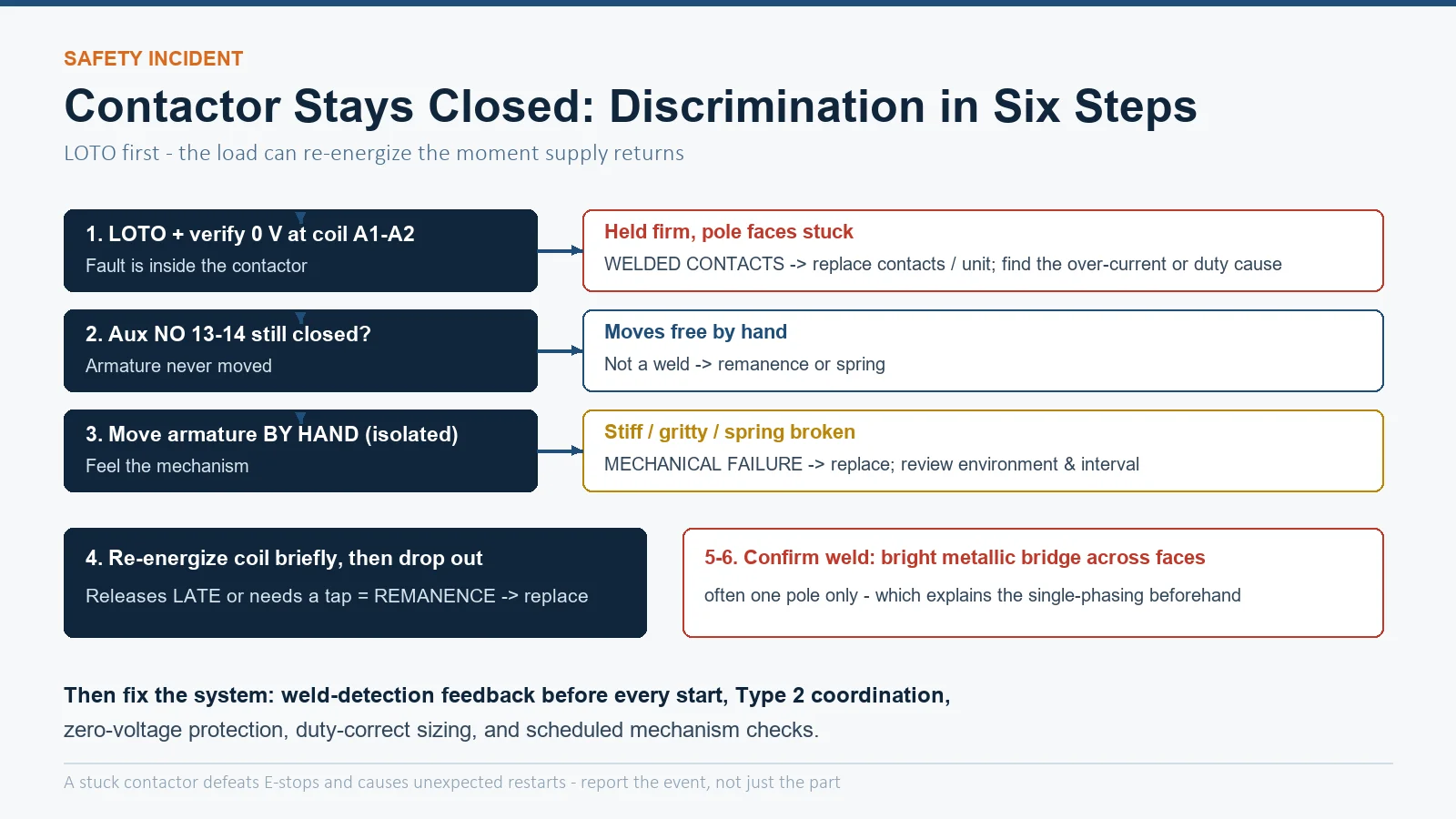
| 단계 | Observation | 결론 |
|---|---|---|
| 1. Verify coil is dead at A1–A2 | 0 V confirmed | Fault is inside the contactor, not the control circuit |
| 2. Check auxiliary NO 13–14 | Closed while coil dead | Armature did not move — continue |
| 3. Try armature by hand (isolated) | Held firmly, pole faces stuck | Welded contacts → replace contacts/unit |
| 4. Armature moves free by hand | Releases when pushed | Weld unlikely → check remanence/spring |
| 5. Reclose coil briefly, then drop | Releases late or needs a tap | Remanence → replace unit |
| 6. Inspect spring and mechanism | Broken spring, debris, stiffness | Mechanical failure → replace unit, review environment |
Three consequences follow from a contactor that will not open, and each has injured people:
Report the event, not just the part. A welded contactor is a symptom: something (current, frequency, coordination, environment) exceeded the design envelope, and the same envelope will produce the same weld on the replacement if nothing changes.
| Prevention layer | How it works |
|---|---|
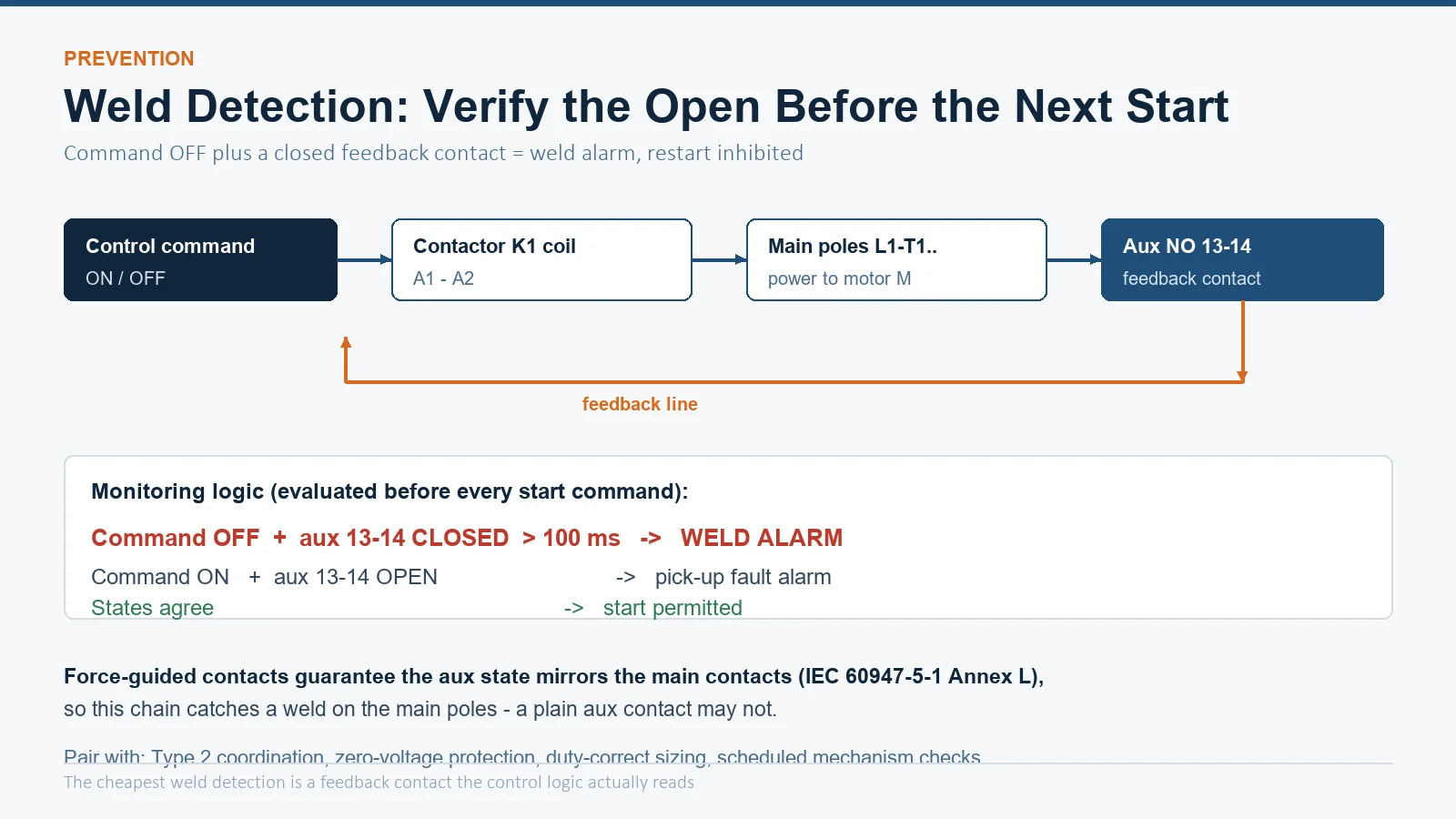
| Weld detection feedback | Monitor an auxiliary contact or use force-guided contacts: command off + feedback closed = weld alarm before the next start is permitted |
| Correct coordination | Type 1/Type 2 coordination and proper SCPD sizing so short-circuit making/breaking never exceeds the contactor’s rating |
| Duty-appropriate sizing | Frequent starts, plugging and jogging sized on AC-4 data, not AC-3 — see the AC-3 rating chart for the baseline |
| Zero-voltage protection | Control circuit wired so supply restoration never re-energizes a coil by itself |
| Scheduled mechanism checks | Operation, spring condition and cleanliness verified at planned intervals |
A welded contact set on a large frame can sometimes be renewed with the manufacturer’s contact kit — but only after the mechanism, spring and pole faces are inspected, and only if the weld was a single event (a rare fault current) rather than chronic wear. If the weld came from duty beyond the rating, or the unit shows remanence, spring failure or any mechanical damage, replace the whole contactor. A repair that leaves the root cause in place simply schedules the next incident. The broader decision framework between component renewal and full replacement is laid out in how to tell if your AC contactor is bad, and symptom routing for related faults in the troubleshooting index.
Three possible mechanisms: the main contacts are welded together, the magnet core holds the armature by residual magnetism, or the return spring/mechanism has failed. The auxiliary feedback state and armature movement tell you which within minutes.
Physically yes — with the system isolated, the armature can usually be pried free — but the welded faces are damaged and will weld again. Replace the contacts or the contactor; never re-energize a welded contactor.
Starting against a stalled or plugged motor, short-circuit currents above the making capacity, worn contacts near end of life, insufficient contact pressure from chatter, or single-phasing before the fault. Chronic welding means the sizing or coordination is wrong.
Yes. The hazard appears when supply returns or when someone assumes the load is dead because it was “switched off”. Isolate and lock out until the fault is cleared.
Layer it: weld-detection feedback before every start, correct short-circuit coordination, duty-correct sizing, zero-voltage protection in the control circuit, and scheduled mechanism inspection. For safety functions, use monitored contactors or a safety-rated architecture rather than a standard contactor alone.
Typically 10–40 ms for an AC contactor. Release noticeably later than that — a second or more — indicates remanence or a degrading mechanism, and the unit should be replaced during the next planned stop.
Sourcing a replacement you can trust after a stuck-contactor incident? 그리고 CJX2-D170 170 A AC contactor and the rest of the CJX2 range are built with high-reliability return springs, precision pole faces and full coordination data. Tell us the motor rating and duty — we will confirm the right frame and its coordination tables within one working day.