AC Contactor Market: Standards, Segments and Sourcing Regions
A structural map of the AC contactor market: the IEC, UL and NEMA standards worlds, four demand segments, and what each sourcing region is actually good at.
Read More
This index routes a field symptom to its most likely cause and to the page with the full measurement procedure. It deliberately stays shallow: each row names the cause and the first check, then hands off to a dedicated guide. Troubleshooting pages that try to explain everything in one scroll bury the answer you came for.
Start with the five-minute triage below if you are standing in front of a panel right now. Use the symptom table if you already know what you are seeing and want the next step.
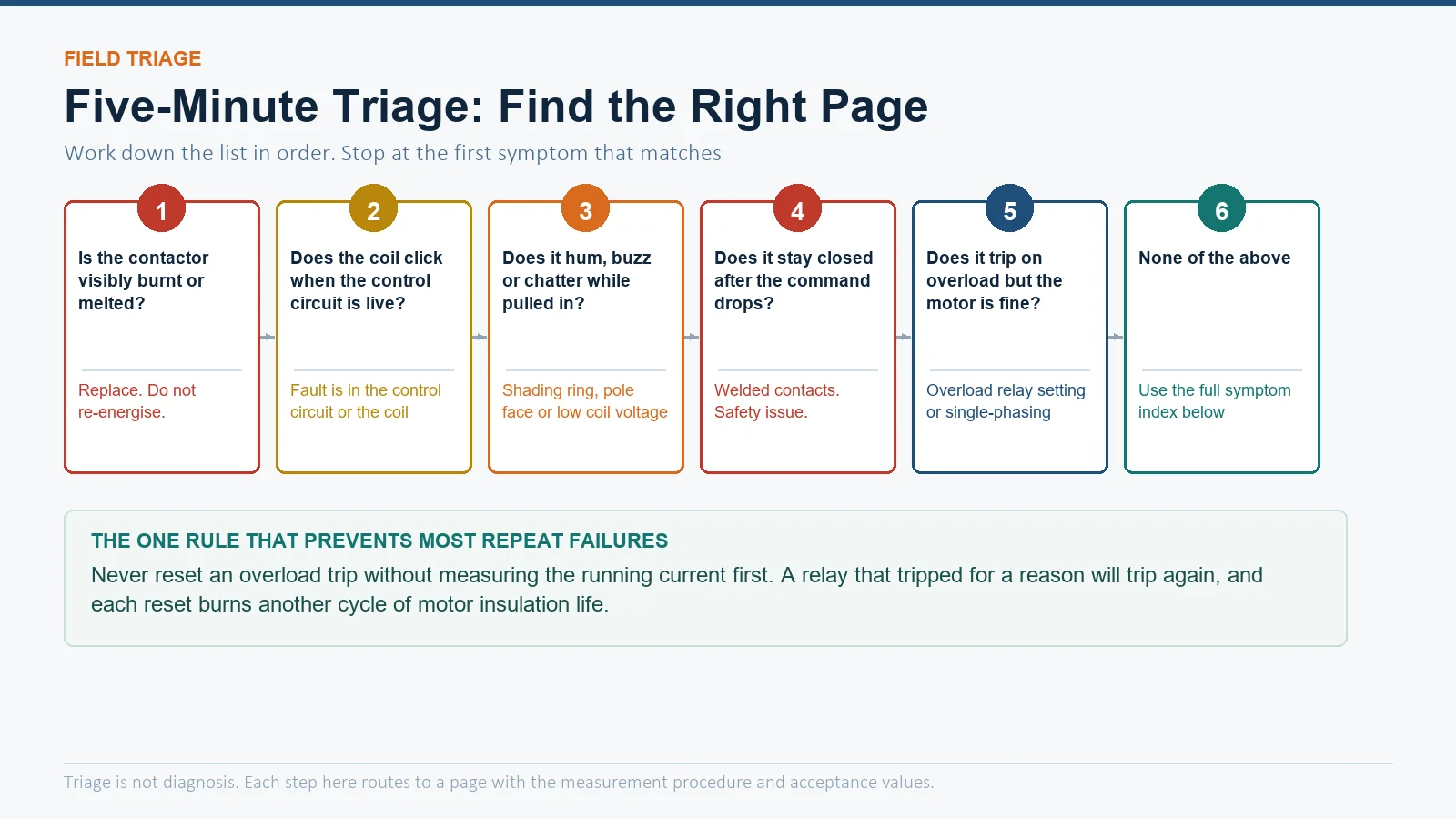
Work down the list in order and stop at the first match:
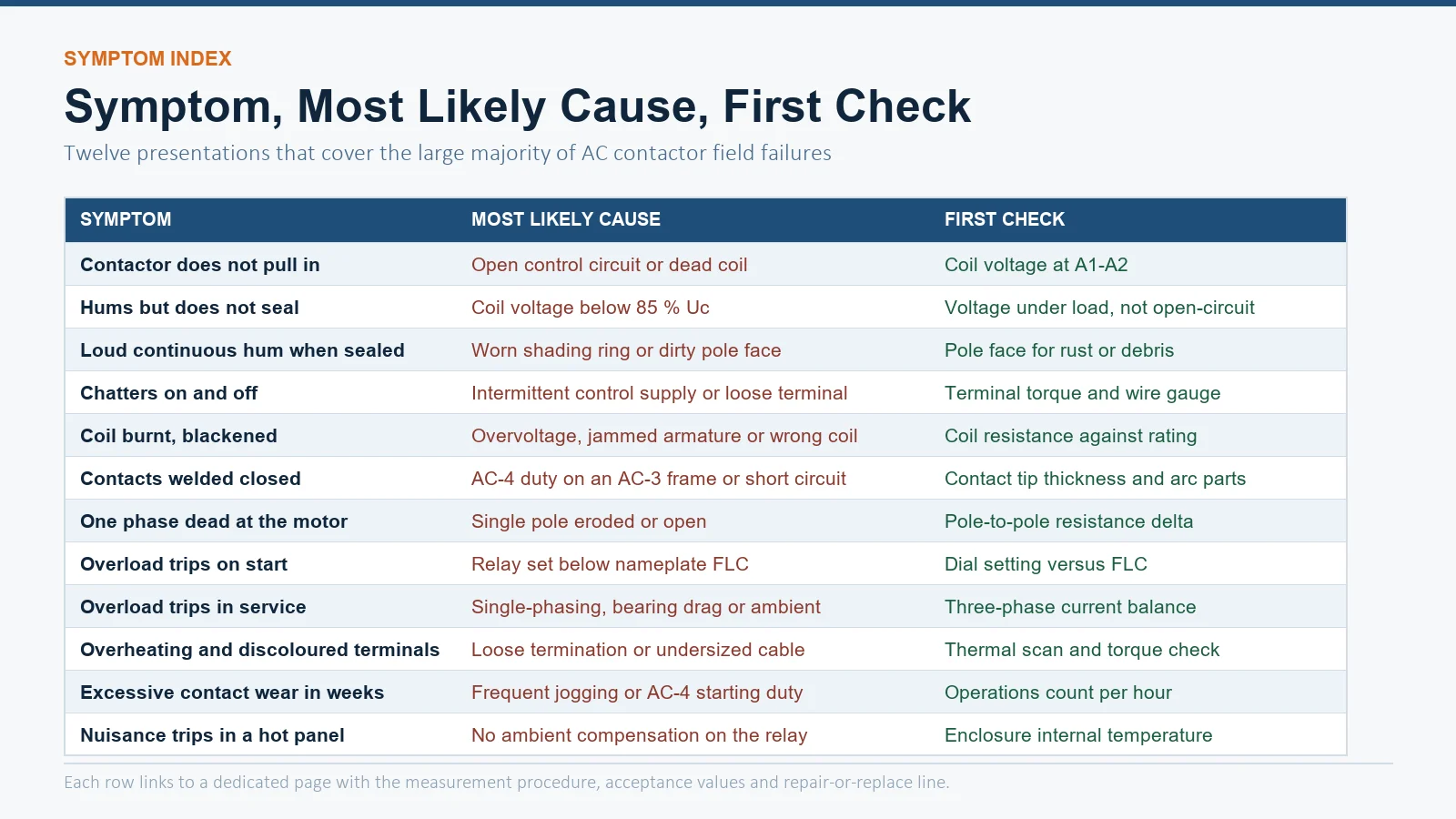
| Symptom | Most likely cause | First check | Detail page |
|---|---|---|---|
| Contactor does not pull in | Open control circuit or dead coil | Coil voltage at A1–A2 under command | Coil test |
| Hums but does not seal | Coil voltage below 85 % of Uc | Voltage under load, not open-circuit | Coil voltage |
| Loud continuous hum when sealed | Worn shading ring or dirty pole face | Pole faces for rust, dust or debris | Buzzing fix |
| Chatters on and off | Intermittent control supply or loose terminal | Terminal torque and control wiring | Buzzing fix |
| Coil burnt or blackened | Overvoltage, jammed armature, wrong coil | Coil resistance against the rated band | Coil test |
| Contacts welded closed | AC-4 duty on an AC-3 frame, or a short circuit | Contact tip thickness; check downstream | Contact wear |
| One phase dead at the motor | Single pole eroded open | Pole-to-pole resistance delta | Contact wear |
| Overload trips on start | Relay dial set below nameplate FLC | Dial setting versus FLC | Overload setting |
| Overload trips in service | Single-phasing, bearing drag, ambient heat | Three-phase current balance | Overload setting |
| Overheating, discolored terminals | Loose termination or undersized cable | Thermal scan and torque check | Maintenance checklist |
| Contact wear in weeks | Frequent jogging or AC-4 duty | Operations count per hour | AC-3 vs AC-4 |
| Nuisance trips in a hot panel | No ambient compensation on the relay | Enclosure internal temperature | Derating guide |
Two fallbacks cover the rest. First, test the contactor as a component — the multimeter test procedure checks coil resistance, contact continuity and insulation step by step, and the no-instrument version in three diagnostic hacks works when the panel is dead. Second, confirm the symptom is not upstream: a VFD-driven motor that never starts may be the drive’s interlock logic, not the contactor — see contactor on VFD input vs output.
Most contactor symptoms end in replacement, but the line is worth drawing precisely because parts and labor differ by frame size:
| 조건 | Action | Why |
|---|---|---|
| Welded contacts | Replace | Welding hardens the contact surface; the next weld comes sooner |
| Contact erosion past ~1/3 tip thickness | Replace contact set (large frames) or unit | Bounce and arcing increase once overtravel is gone |
| Burnt coil | Replace coil (if a genuine coil fits and the armature moves freely) | But first find why it burnt — see the coil test page |
| Broken or missing shading ring | Replace unit on small frames; ring on large ones | The hum returns and the armature runs hot until fixed |
| Discolored but sound housing and terminals | Clean, re-torque, re-test | Heat discoloration alone does not condemn the unit |
Whatever the repair, reset discipline applies: never reset an overload trip without measuring the running current first. The reset guide explains the three-strike rule and when a reset becomes the fault.
Two conditions routinely get blamed on the contactor and aren’t:
For the preventive side — the inspections that catch most of these symptoms before they stop a line — the maintenance schedule lays out intervals by duty class, and the component anatomy guide explains what each part does when it fails.
Field troubleshooting generates the data that makes the next failure cheaper. Three fields are worth writing down every time, in the work order or on the panel card:
After three or four recorded events, patterns emerge that no single visit can show: the panel that runs hot every summer, the crusher that jogs too often, the pump that single-phases when the supply dips. Troubleshooting pages fix today’s fault; records fix the plant.
Measure coil voltage at A1–A2 while commanding the contactor. Zero volts means the problem is upstream; correct voltage with no pull-in means the coil or mechanism. That single measurement splits the search space in half — the coil test page continues from there.
You can, and it often works — but a contactor that failed for a reason will fail the replacement too. Two minutes with the symptom index usually names the cause before the spare is out of the box.
They fail differently: relays trip (a circuit decision), contactors fail to conduct or to release (a physical state). If the load runs and then trips, look at the relay; if it never starts or never stops, look at the contactor.
Usually a pole face that never seated during commissioning, or a coil voltage marginally below nominal. A brief hum at pickup is normal; continuous hum is a shading ring or voltage problem and shortens coil life.
No. Chatter multiplies make-break arcs, erodes contacts fast and heats the coil. Isolate the cause the same shift — the buzzing page lists the three causes in the order to check them.
The frame that feeds the most critical motor, with its matching coil, plus one overload relay of the same setting range. The maintenance schedule page prioritizes spares by criticality if you need a fuller list.