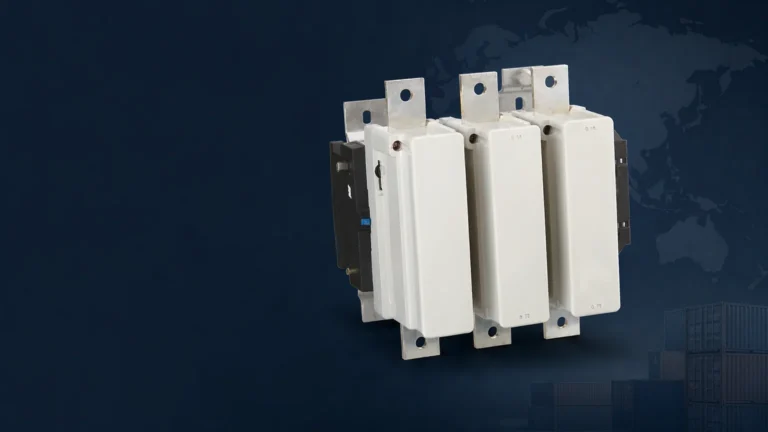
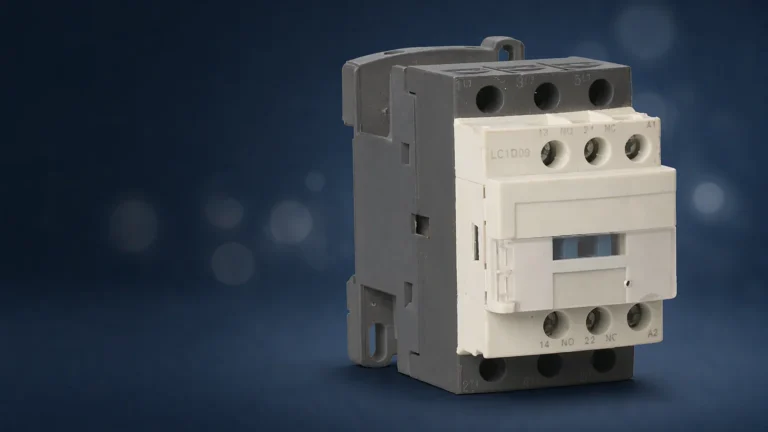
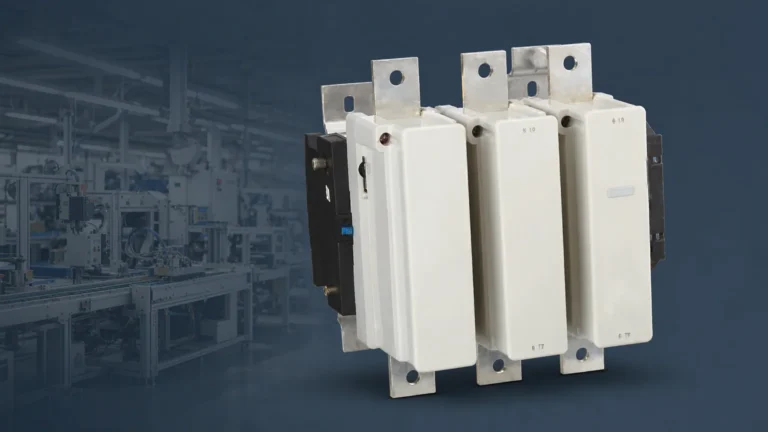
AC Contactor Market: Standards, Segments and Sourcing Regions
A structural map of the AC contactor market: the IEC, UL and NEMA standards worlds, four demand segments, and what each sourcing region is actually good at.
Read More
For a standard 3-pole AC contactor with an AC coil, the indicative FOB China price band in 2026 runs from about $3 at 9 A to roughly $700 at 630 A — a two-hundred-fold spread that scales with the mass of silver and copper inside the frame, not with the ampere number. The bands below give you a sanity check for quotations; they are not an offer, and the bottom of this page lists exactly which variables move a real quote by 10–40 %.
If your question is what a failed contactor costs to swap in service, that is a different calculation — parts, labor and downtime — covered in the replacement cost guide. This page is about buying new units: what the market charges, why, and how to keep three quotes comparable.
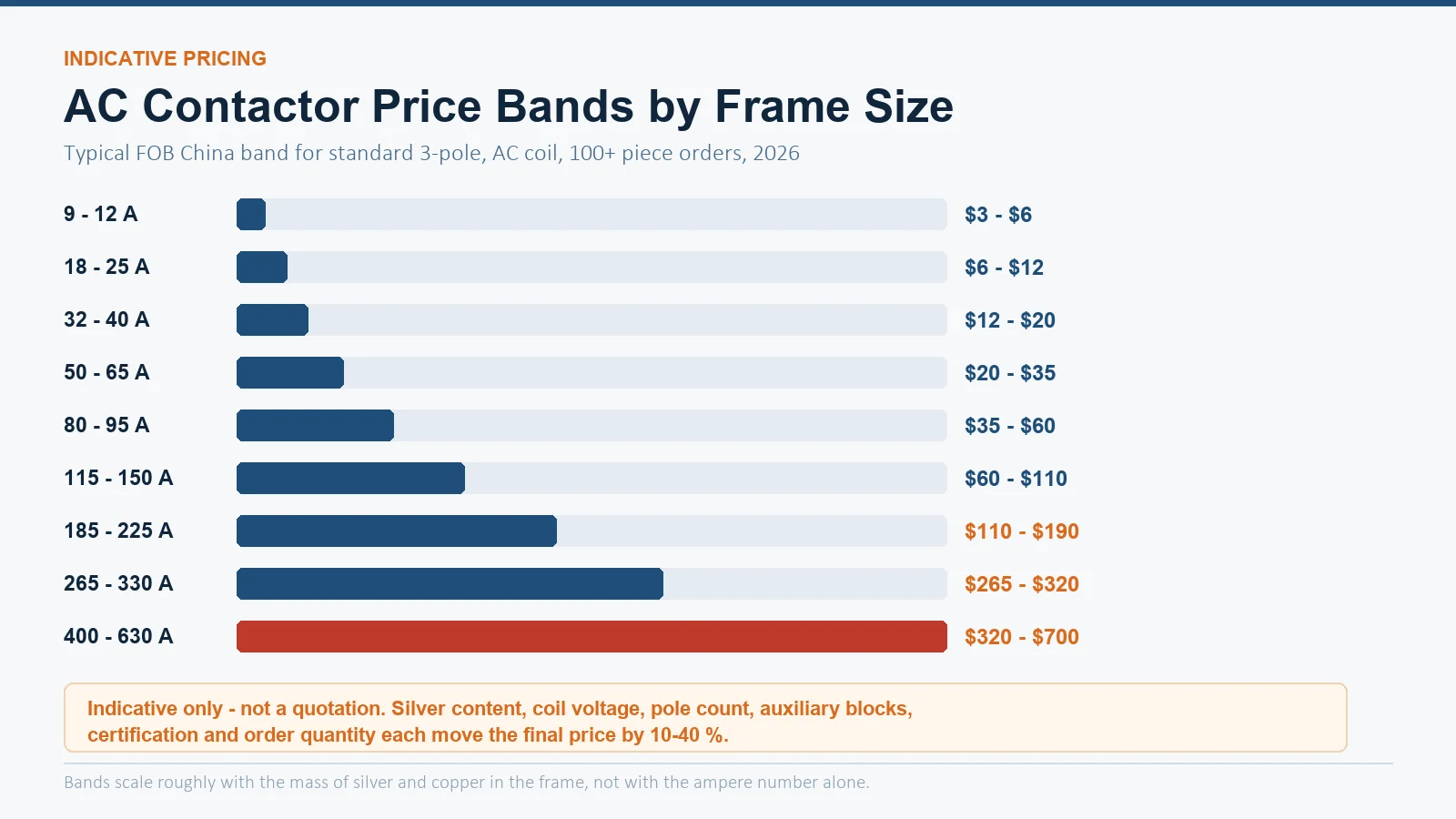
| Frame range | Indicative FOB band (USD) | Typical motor duty @ 380 V |
|---|---|---|
| 9 – 12 A | $3 – $6 | 4 – 5.5 kW |
| 18 – 25 A | $6 – $12 | 7.5 – 11 kW |
| 32 – 40 A | $12 – $20 | 15 – 18.5 kW |
| 50 – 65 A | $20 – $35 | 22 – 30 kW |
| 80 – 95 A | $35 – $60 | 37 – 45 kW |
| 115 – 150 A | $60 – $110 | 55 – 75 kW |
| 185 – 225 A | $110 – $190 | 90 – 110 kW |
| 265 – 330 A | $190 – $320 | 132 – 160 kW |
| 400 – 630 A | $320 – $700 | 200 – 315 kW |
Assumptions behind every band: standard 3-pole frame, AC coil at a common voltage (220/230 V or 380/400 V), no auxiliary blocks fitted, 100+ piece order quantity, FOB a Chinese port, 2026 silver and copper prices. Break any of these assumptions and the band moves — sometimes out of it.
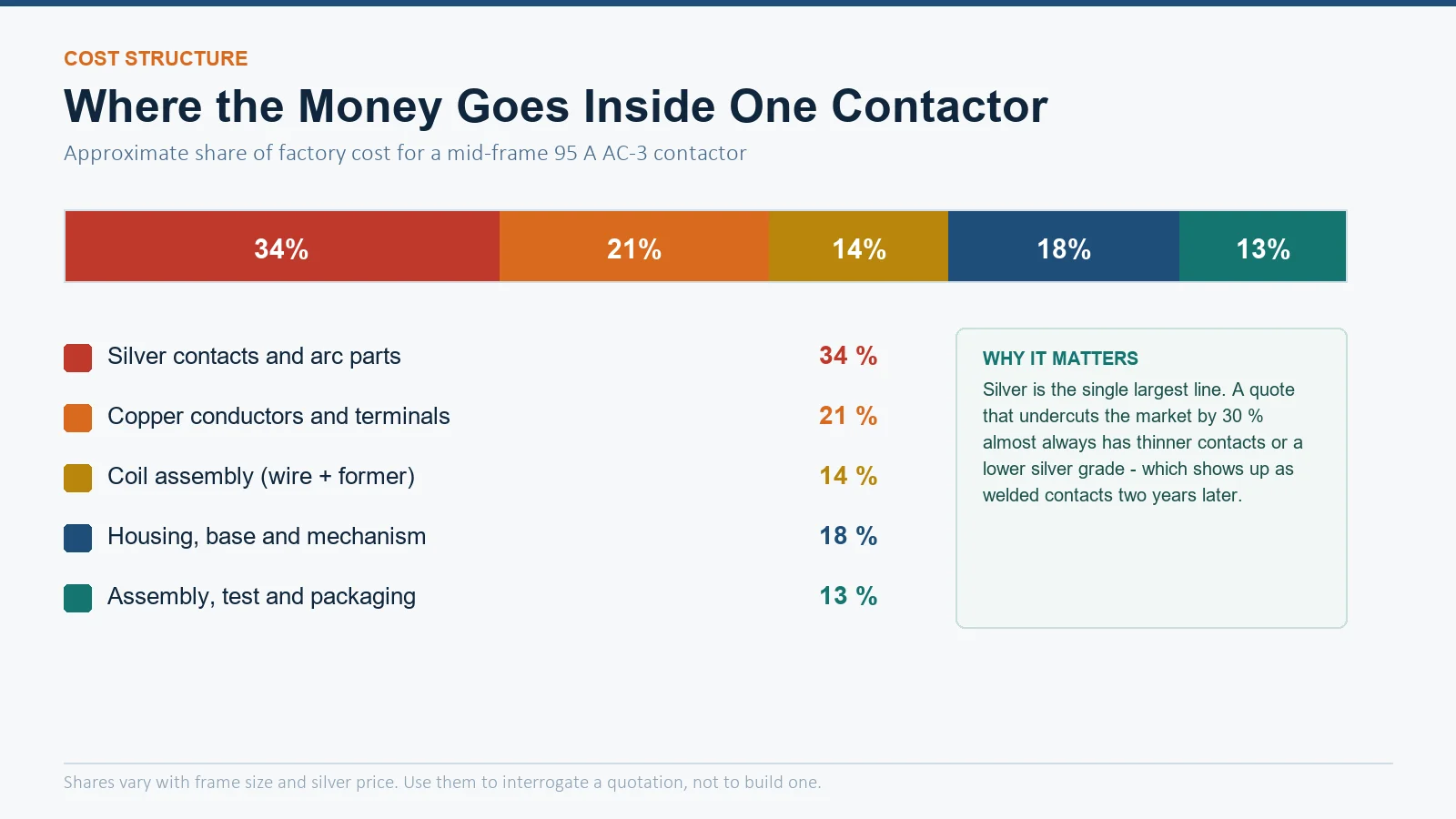
Contact prices are material-driven, which is why they track commodity markets more than electronics pricing. For a mid-frame 95 A unit, the factory cost stack falls out roughly like this:
| Variable | Effect on price | Buyer guidance |
|---|---|---|
| Pole count (3P vs 4P) | +25–35 % for 4-pole | Only order 4P where neutral switching is required |
| Coil voltage | Common voltages at band; exotic ones +10–20 % | Check stock coils before specifying 110 V at 60 Hz |
| Auxiliary contact blocks | Front-mounted F+1 block adds $1–4 small frames | Count NO/NC needs before quoting — see the auxiliary contact guide |
| Order quantity | 100 pcs vs 1,000 pcs often spans 15–25 % | Consolidate frames; split deliveries cost more than storage |
| Certification scope | CE-only vs CB + UL adds double digits on those frames | Match certificates to destination market, not ambition |
| Silver price at order time | ±5–10 % on large frames | Quote validity of 30 days is standard for a reason |
MOQ structure matters as much as unit price. Factories quote per production batch — commonly 200 to 500 pieces per frame — while stockists sell any quantity but at the top of the band. A buyer needing 40 pieces of one frame usually does better with a stockist; a buyer consuming 600 pieces a year does better at the factory door, as the manufacturer vs trader guide explains in detail.
Price lists diverge because each supplier assumes a different product. Force comparability with a one-page specification sheet attached to every RFQ:
Two further checks catch most games. First, ask for the routine test sheet that ships with the units — a factory with a test bench produces it instantly. Second, verify the frame ladder against the model number decoder: a quote for “CJX2-3211” tells you poles and aux layout; a quote for “32A contactor, good quality” tells you nothing.
The bands describe market pricing for compliant product. Prices far below the band exist, and they are consistent offers — but they monetize somewhere else:
For frames above 115 A the arithmetic gets brutal: a $40 saving on a 225 A contactor against a day of unplanned line stoppage is not a saving. Buy the frame band with evidence, not the cheapest offer on it.
Unit price is only the visible part of what an order costs. Three line items routinely change the effective price by more than any negotiation does:
A practical pattern for plants standardizing on a ladder: quote the whole family at once, take the volume tier on the frames you actually consume, and hold the savings against a one-year spare-parts kit priced in the same order. The maintenance schedule guide sizes that kit from duty data rather than guesswork.
Neither exactly — they are trade bands for volume B2B orders. Distributor retail for single pieces runs higher, especially above 95 A where handling and stock cost dominate.
Because cost follows the silver and copper mass, the arc chamber engineering and the testing burden — all of which scale faster than current. The mechanism and contact systems of a 630 A frame are a different class of component.
Within the compliant band, spread is typically 10–20 %. Spread beyond that signals a difference in material grade or test scope — which is why the specification sheet matters more than the negotiation.
Silver and copper drive short-term movement; annual movement in a normal year is single-digit percent. A quote older than 60 days deserves re-validation, whatever the frame.
Sometimes — one frame up adds 20–40 % to the unit price but buys cooler running and longer contact life in hot panels or at altitude. The derating guide tells you when environment, not price, should pick the frame.
UL and CSA certified product sits above these bands — certification, testing and limited production runs all add cost. Budget 20–50 % over the IEC band for the same current rating, and confirm the certification holder as described in the supplier vetting checklist.