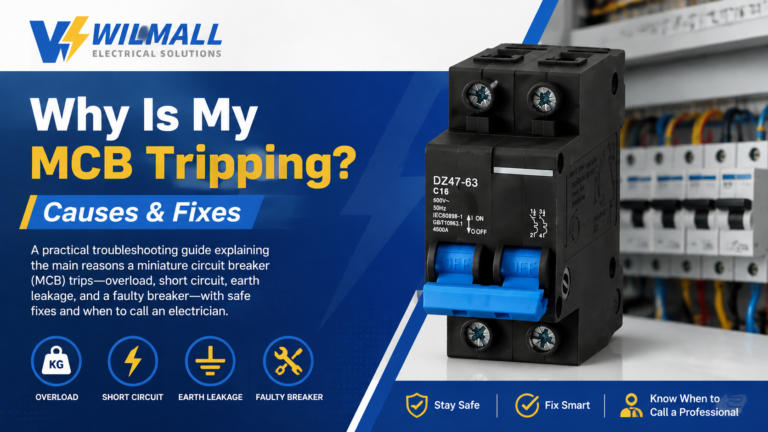







Why Is My MCB Tripping? Causes & Fixes
Your MCB trips for four main reasons: overload, short circuit, earth leakage, or a faulty breaker. This guide explains each cause, how to find it, and how to fix it safely.
Read More
Specifying a contactor by rated current alone is one of the fastest ways to end up with welded contacts, short electrical life, and unplanned downtime.
Сайт contactor utilization category—defined in IEC 60947-4-1—tells you what kind of load the contactor can switch and how severe that switching duty is.
Two contactors with the same ampere rating can have completely different real-world performance depending on whether they are rated for AC-3 or AC-4 duty.
If you are selecting an AC contactor for a motor application, understanding the difference between AC-3 and AC-4 categories is not optional—it is the single most important factor that determines whether your installation will run reliably for years or fail within weeks.
This article breaks down the technical differences, helps you identify which category your application falls under, and provides clear selection logic so you can avoid the most common sizing mistakes.

Utilization categories are an IEC 60947-4-1 classification system that rates contactors based on the type of load they switch and the severity of the switching conditions.
Instead of assigning a single generic current rating, the standard defines specific making and breaking current values, power factor (cos φ), and test conditions for each category.
The key insight is that the same physical contactor can carry different rated operational currents depending on the utilization category.
A contactor rated 32 A under AC-3 duty might only be rated 25 A—or less—under AC-4 duty for the same voltage.
This happens because AC-4 switching conditions impose far greater stress on the contacts, forcing manufacturers to derate the device to maintain acceptable electrical life.
For motor control applications, the two categories you will encounter most often are AC-3 и AC-4. A third category, AC-1, applies to non-inductive or lightly inductive loads such as resistance heaters and is not suitable for motor switching.
For more background on contactor fundamentals, visit our electrical knowledge section.
The AC-3 usage category covers squirrel-cage motor applications where the contactor starts the motor directly (across-the-line) and disconnects it after the motor has reached nominal speed.
The defining characteristic is that the contactor breaks the circuit while the motor is running normally—meaning the breaking current equals the rated operational current (Ie), not the starting current.
Per IEC 60947-4-1, the AC-3 test conditions are:
Because the breaking current is relatively low, the arc energy during contact separation is moderate.
This allows the contacts to last significantly longer—typically 500,000 to 2,000,000 operations depending on frame size and manufacturer.
The common thread: the motor accelerates to full speed, runs for a meaningful period, and then stops. Starting frequency is moderate—typically fewer than 30 operations per hour.

The AC-4 usage category covers squirrel-cage motor applications involving inching (jogging), plugging, and frequent reversing.
The critical difference from AC-3 is that the contactor breaks the circuit while the motor is still accelerating or rotating—meaning the breaking current can be as high as 6 × Ie, the same level as the making current.
Per IEC 60947-4-1, the AC-4 test conditions are:
Breaking at 6 × Ie generates arc energy that is dramatically higher than in AC-3 duty.
The arc concentrates intense heat on the contact surface, causing accelerated material erosion. Under AC-4 conditions, electrical life typically drops to 100,000–500,000 operations—often only 10% to 30% of the AC-3 life for the same contactor frame.
Two operating modes define AC-4 duty:
Plugging is a rapid stop or reverse method where the motor phase sequence is reversed while the rotor is still turning.
This creates a counter-torque that brakes the motor aggressively.
The contactor must break a current close to locked-rotor value during this transition.
Inching (jogging) is energizing the motor for short bursts—typically fractions of a second—to move a mechanism in small increments.
The motor never reaches full speed, so each jog cycle involves making and breaking near-locked-rotor current.

| Параметр | AC-3 | AC-4 |
|---|---|---|
| Making current | 6 × Ie | 6 × Ie |
| Breaking current | 1 × Ie | 6 × Ie |
| Power factor (cos φ) | 0.35 | 0.35 |
| Motor state at break | Running at full speed | Accelerating or rotating (not at full speed) |
| Typical electrical life | 500,000–2,000,000 operations | 100,000–500,000 operations |
| Relative contact wear per operation | Low (diffuse arc, even erosion) | High (constricted arc, localized erosion) |
| Usable current rating (same frame) | Full rated Ie | Reduced (typically 50–70% of AC-3 rating) |
| Typical applications | Pumps, fans, compressors, conveyors | Cranes, hoists, mills, indexing drives |
The breaking current row tells the entire story.
Under AC-3, the contactor opens at running current.
Under AC-4, it opens at six times running current.
That sixfold difference in breaking current is what drives the massive gap in arc energy, contact wear, and electrical life.
Use these four questions to determine whether your application requires AC-3 or AC-4 rated contactors:
Many real-world applications do not fall cleanly into AC-3 or AC-4.
A conveyor might run in AC-3 mode for 95% of the time but require occasional jogging for maintenance positioning.
In these mixed-duty cases, you need to calculate equivalent contact wear to estimate realistic electrical life.
The standard approach uses a wear-weighting factor:
Equivalent AC-3 operations = AC-3 operations + (k × AC-4 operations)
Where k is the wear ratio—typically 3 to 10 depending on the contactor design and manufacturer test data.
For example, if a hoist performs 50 normal start-stop cycles and 5 inching operations per day with a wear factor of k = 8:
Equivalent wear = 50 + (8 × 5) = 90 equivalent AC-3 operations per day
In this example, the 5 inching operations contribute nearly as much wear as the 50 normal cycles combined.
Ignoring them would cause you to overestimate contactor life by more than 40%.
Always request the manufacturer’s wear factor data for mixed-duty calculations.
| Mistake | What Happens | How to Avoid |
|---|---|---|
| Sizing from AC-3 current rating for an AC-4 application | Rapid contact erosion, welded contacts, failure within weeks | Use the AC-4 rated current for the same frame size, which is typically 50–70% lower |
| Treating AC-3 and AC-4 as interchangeable | Electrical life drops to 10–30% of expected, causing premature replacement | Confirm the actual duty cycle before selecting the category |
| Ignoring switching frequency | Contactor life is far shorter than catalog estimates because operations per hour drive cumulative wear | Calculate equivalent operations using the wear factor method |
| Using AC-1 ampere rating for motor loads | Severe undersizing for inrush and breaking duty | Never use AC-1 ratings for motor control; always reference AC-3 or AC-4 |
| Skipping electrical life verification for frequent-duty applications | Unplanned downtime when the contactor fails before the scheduled maintenance window | Cross-reference manufacturer endurance curves at your actual switching frequency |
Once you have identified your utilization category, selection becomes straightforward. For AC-3 applications, choose a contactor whose AC-3 rated current at your operational voltage meets or exceeds the motor full-load amperes (FLA).
For AC-4 applications, use the contactor’s AC-4 rated current—not the AC-3 rating—and verify that the expected electrical life at your switching frequency meets your maintenance interval requirements.
If your application involves mixed duty, calculate the equivalent wear as described above, then select a frame size that delivers adequate life under the combined load.
When in doubt, upsizing the contactor frame is a practical strategy—larger contacts tolerate more arc energy per operation, extending life proportionally.
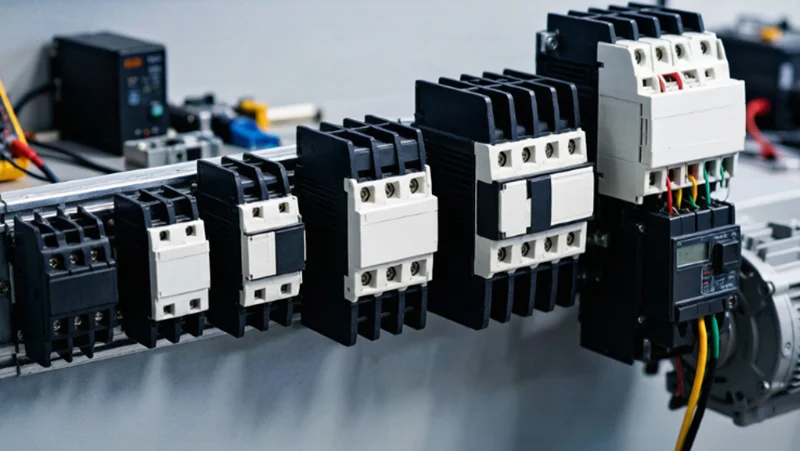
Wilmall offers a range of AC contactors with documented AC-3 and AC-4 ratings, supported by technical datasheets that list making/breaking capacities and electrical endurance curves.
You can also browse the full product catalog for compatible overload relays, motor starters, and complementary control components.
For additional technical guidance, our AC contactor resources и industry insights cover selection, wiring, and maintenance topics in depth.
AC-3 is the IEC 60947-4-1 utilization category for squirrel-cage motors with normal start-stop duty. The contactor makes at 6 × rated current (motor inrush) and breaks at 1 × rated current (normal running current). It is the most common category for standard motor control applications such as pumps, fans, and conveyors.
Under AC-4 duty, the contactor breaks at 6 × rated current—the same level as the making current. This happens because the motor has not reached full speed when the contactor opens, as occurs during inching, plugging, or frequent reversing. The resulting arc energy is far higher, causing accelerated contact wear and significantly shorter electrical life.
Occasional inching during commissioning or maintenance is generally acceptable. However, if inching or jogging occurs as part of normal production, the application should be treated as AC-4 duty. The frequency of inching operations—not their existence—determines whether AC-4 selection is required. Use the equivalent wear calculation method to assess mixed-duty impact on contactor life.
For the same contactor frame, AC-4 electrical life is typically 10% to 30% of the AC-4 life—meaning a contactor rated for 1,000,000 operations under AC-3 may deliver only 100,000 to 300,000 operations under AC-4. The exact ratio depends on the contactor design, contact material, and switching frequency. Always consult the manufacturer’s endurance curves for specific numbers.
Calculate equivalent contact wear using the formula: equivalent AC-3 operations = AC-3 operations + (k × AC-4 operations), where k is the wear factor (typically 3–10). Compare the result against the manufacturer’s endurance curve to verify that the selected contactor will meet your target maintenance interval.
Yes. The same contactor frame typically has a lower rated operational current under AC-4 than under AC-3. For example, a contactor rated 40 A under AC-3 at 400 V might be rated only 25–28 A under AC-4 at the same voltage. Always select using the rating that matches your actual duty category.
The difference between AC-3 and AC-4 comes down to one variable: the motor’s state when the contactor opens.
If the motor is at full speed, the breaking current is low and AC-3 duty applies.
If the motor is still accelerating—or being reversed—the breaking current is six times higher and AC-4 duty governs selection.
That single distinction drives a 3- to 10-fold difference in electrical life and determines whether your contactor will last for years or fail prematurely.
Before specifying any contactor, confirm the utilization category, quantify your switching frequency, and verify electrical life against your maintenance schedule.
For AC-4 or mixed-duty applications, always use the AC-4 rated current and manufacturer endurance data—not the AC-3 amperage alone.
If you need help matching a contactor to your specific duty cycle, explore our AC contactor selection or contact our technical team for application-specific guidance.