How to Select the Right Surge Suppressor for Contactors
The right coil surge suppressor protects the contact without slowing drop-out. Compare flyback diode, MOV, RC snubber and TVS, with selection rules for AC and DC coils.
Read More
Pole count is the first line on an HVAC contactor datasheet and the fastest way to order the wrong part. A 30 A frame with the right current rating but the wrong number of poles either leaves a live leg energised at the compressor, breaks a neutral it should not break, or single-phases a three-phase unit. None of those are subtle failures.
This guide explains what the pole count actually switches in each wiring system, why one-pole contactors contain a solid copper bypass bar that most people never notice, how the ratings differ between the two constructions, and the replacement rules that keep an HVAC service call from turning into a callback. It applies to residential and light-commercial single-phase equipment; for the wider sizing picture across all contactor types, see contactor sizing and selection.
| Aspect | 1-Pole contactor | 2-Pole contactor |
|---|---|---|
| Switched conductors | One leg; the other leg has a solid bypass bar | Both legs switch mechanically together |
| Load de-energised when open | No — one terminal stays live at the load | Yes — full isolation at the load |
| Contact wear pattern | All arc work on one pole; bypass never wipes | Both poles wear evenly |
| Correct wiring system | Line–neutral (230 V L–N regions, 120 V loads) | Split-phase 240 V (two hot legs, no neutral) |
| Modern residential AC standard | Legacy (mostly pre-1990s installs) | Standard on new 240 V split-phase systems |
| Substitution direction | Cannot replace a 2-pole safely | Can replace a 1-pole (wiring permitting) |
A pole is one set of moving and fixed contacts: one line terminal, one load terminal, one arc gap. In a two-pole HVAC contactor, the two contact sets sit on a common armature bridge and open and close within milliseconds of each other. In a one-pole contactor, there is only one real switching set — and here is the construction detail that matters: the second leg is carried by a solid copper or brass bypass bar moulded into the housing between the second line and load terminals. It never opens. It has no arc chute, no contact pressure, no wiping action, and no erosion because it never interrupts anything.
That bypass bar is why a one-pole contactor has four screw terminals like a two-pole unit, and why the difference is invisible until you look at the label or trace the bar with a meter. It is also why the two devices are not interchangeable: one of them interrupts one conductor, the other interrupts two.
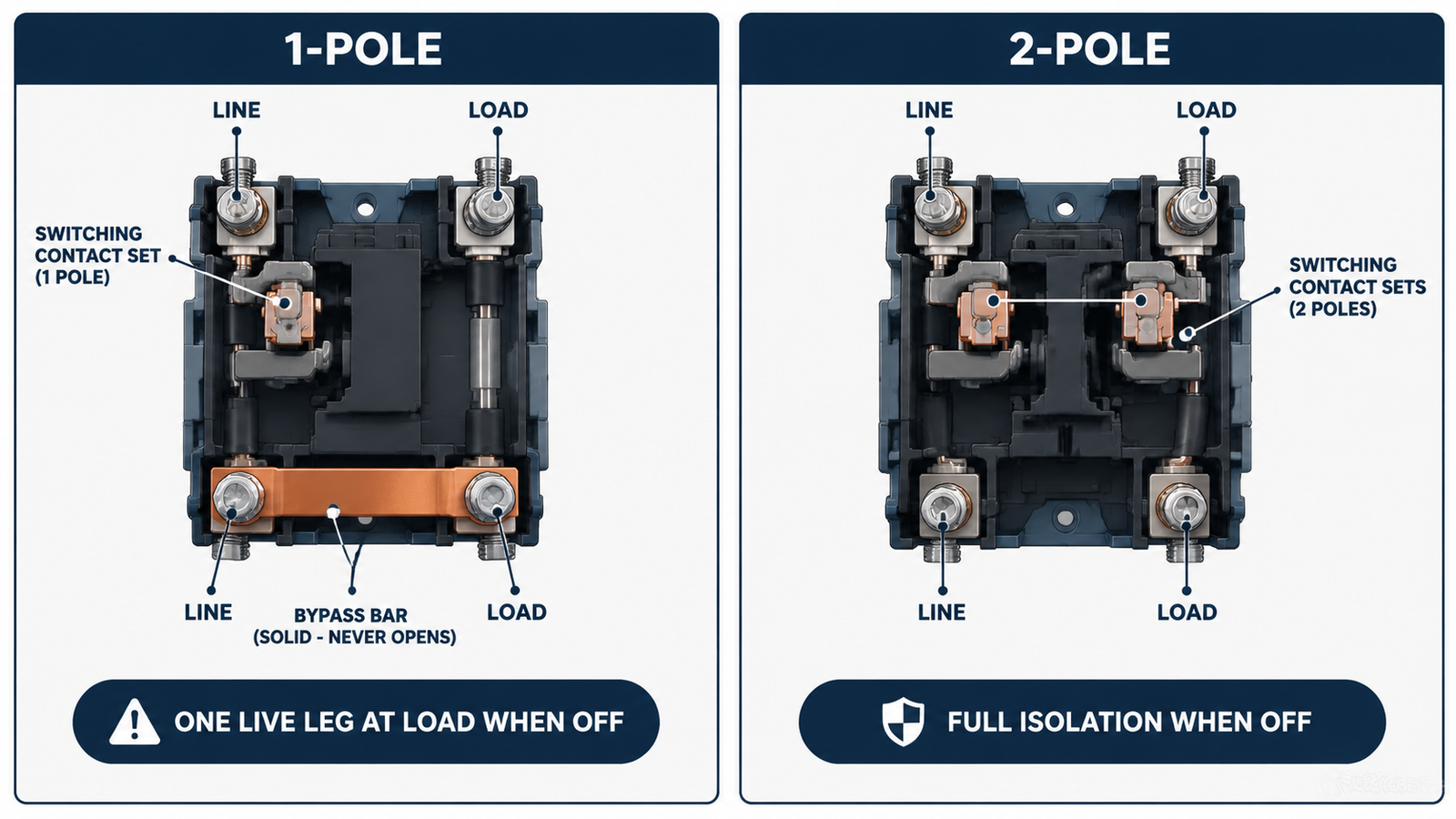
Terminal identification works the same way on both — line side L1/L2, load side T1/T2 — as covered in what L1, L2, T1, T2 mean on a contactor.
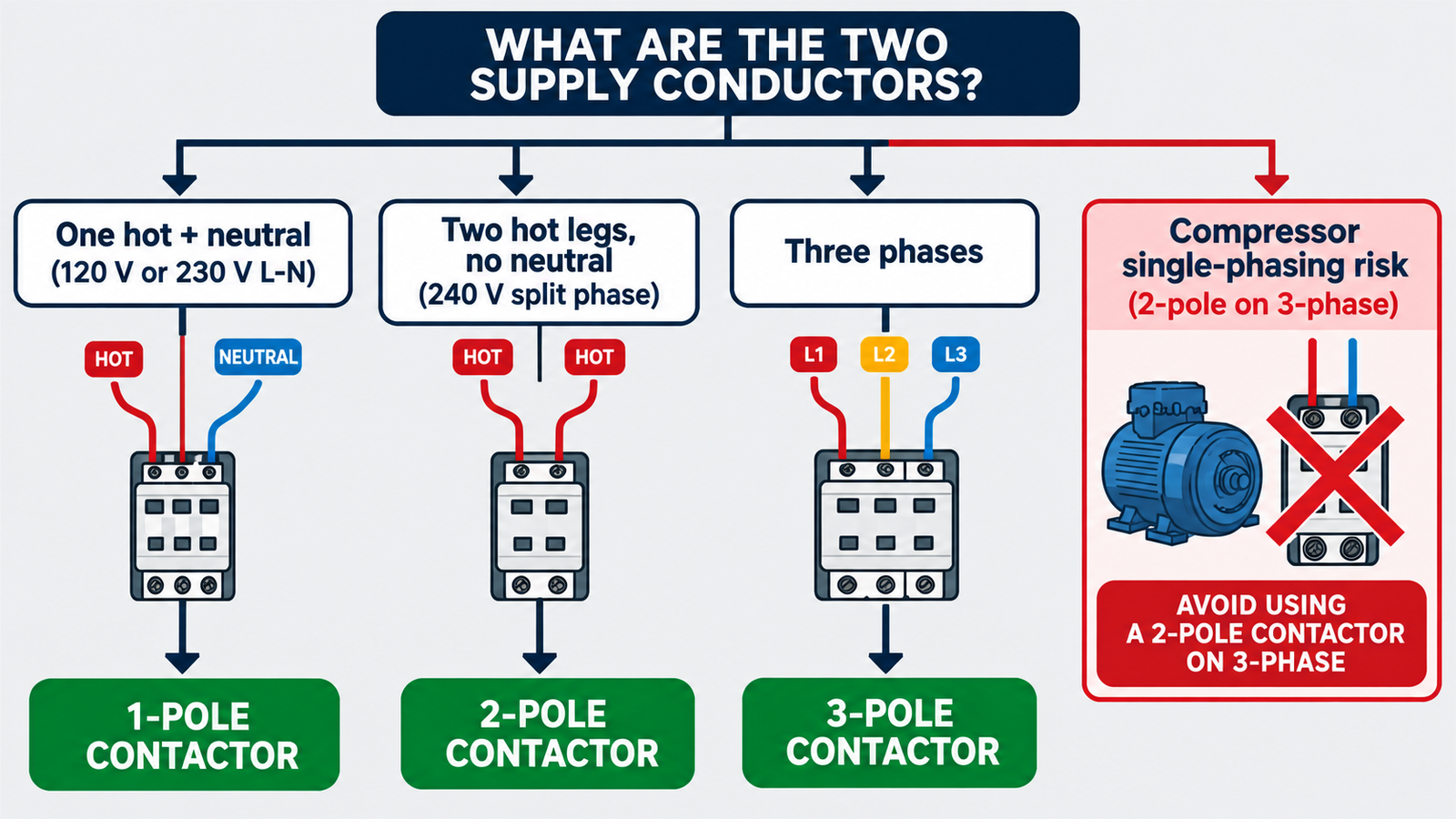
The choice is not really about the contactor; it is about what the two supply conductors are.
A North American residential condenser runs on two 120 V hot legs — L1 and L2, 240 V between them, no neutral at the unit. Both legs are live with respect to ground at all times. Switching only one leaves the other hot at the compressor and fan terminals even when the thermostat is satisfied, which is why the bypass-bar construction is a legacy arrangement there: it predates modern service-safety expectations. The disconnecting means for the equipment is required to open all ungrounded conductors, and on a modern installation the contactor itself is expected to do the same. This is why most residential AC units today ship with two-pole contactors, and why replacing a two-pole with a one-pole is both a shock hazard during service and a code problem in most jurisdictions.
Here the picture reverses. One conductor is a grounded neutral and only one is hot. A one-pole contactor switching the line is the correct and normal arrangement, and there is a code reason not to “upgrade” to two poles: switches and breakers generally must not disconnect the grounded conductor unless they simultaneously open all ungrounded conductors of the circuit. A two-pole device breaking the neutral in one of these systems can leave the load at line potential through its own wiring while appearing isolated — the opposite of the intention.
Small condensers, fans and pumps on 120 V line–neutral circuits take a one-pole contactor for the same reason: one hot, one neutral, and only the hot should be switched.
Three-phase equipment needs all three phases switched — a three-pole contactor. Using a two-pole device leaves one phase permanently connected and the motor single-phases, which destroys three-phase compressors quickly and expensively.
HVAC contactors are mostly definite-purpose devices, and their rating structure differs from general-purpose IEC frames — the distinction is covered in definite-purpose versus general-purpose contactors. For pole selection specifically, three numbers matter:
Match the replacement’s FLA and LRA ratings to the old part’s label, not to the tonnage estimate — and match the pole count to the wiring system, not to what is on the truck.
On a one-pole contactor, every start and stop puts the full arc duty on a single contact set. That pole erodes, pits and eventually welds — the normal life progression. The bypass bar, meanwhile, never interrupts, but it also never wipes, and over years its screw terminals can develop oxide and looseness that show up as millivolt drop and local heating. Because the bar looks like a perfectly good pole, technicians rarely inspect it.
The service habit that catches this: with the unit running, measure voltage drop across each line-to-load pair (L1–T1 and L2–T2). The switched pole will show a few tens of millivolts; the bypass leg should show less. If the bypass leg’s drop approaches or exceeds the switched pole’s, the bar terminals are degraded — clean and re-torque, or replace the contactor. On two-pole units the same measurement simply confirms even wear between the two poles. Either way, if the switched pole is heavily pitted, the guidance in how to tell if an AC contactor is bad applies.
| Installed device | Safe replacement | Notes |
|---|---|---|
| 2-pole on a 240 V split-phase unit | 2-pole only | A 1-pole substitution leaves one leg live at the load — never acceptable |
| 1-pole on a 240 V split-phase unit | 2-pole (preferred) or 1-pole like-for-like | Upgrading to 2-pole gives full isolation; confirm enclosure space and wiring |
| 1-pole on a 230 V line–neutral system | 1-pole | Do not fit a 2-pole that breaks the neutral |
| 2-pole, 3-phase unit (incorrect install) | 3-pole | Two poles on a three-phase compressor single-phases it |
| 2-pole, emergency substitution | 3-pole with one pole unused | Acceptable temporarily; the reverse (2-pole for 3-phase) never is |
| Mistake | Consequence | Correct practice |
|---|---|---|
| Ordering by current rating alone | Wrong pole count; unsafe or non-compliant installation | Confirm the wiring system before ordering |
| Replacing a 2-pole with a 1-pole “because one side still works” | One leg permanently live at the compressor terminals | Replace like-for-like on pole count; a failed pole means a new contactor |
| Fitting a 2-pole on a 230 V line–neutral system | Neutral disconnected under load; load can sit at line potential | Switch the line conductor only; keep the neutral continuous |
| Using a 2-pole contactor on a three-phase unit | Single-phasing; compressor failure | Three-phase loads take a 3-pole contactor |
| Sizing from tonnage instead of the nameplate | Underrated FLA or LRA; welded contacts at compressor start | Match FLA and LRA from the equipment or old part label |
Only where both conductors are meant to be switched — a 240 V split-phase system, where upgrading a legacy 1-pole to a 2-pole is generally an improvement in service safety. In a line–neutral system (230/120 V), no: the second pole would break the grounded neutral, which switching devices are not supposed to do on its own.
They date from service practice that accepted one live leg at the load, with the second leg carried by a solid bypass bar. Modern expectation is full de-energisation at the equipment when it is off, which is why two-pole contactors became standard on North American residential condensers.
A solid copper or brass conductor linking the second line terminal to the second load terminal. It carries continuous current and compressor inrush but never opens — no arc interruption, no contact pressure, no wiping action. It is the reason a 1-pole unit has four terminals.
Per-pole ratings are similar across the frame, but check the datasheet: some 1-pole definite-purpose frames carry slightly different FLA and LRA figures than their 2-pole equivalents, because the switching duty and thermal layout differ. Always match the label values, not the frame size alone.
Yes, in a pinch — wire two poles and leave the third unused. This is a recognised temporary substitution on residential units. The reverse is impossible: a 2-pole contactor on a three-phase compressor leaves one phase unswitched and single-phases the motor.
Almost never. Chatter is a coil-side problem: low control voltage from the transformer or long 24 V wiring, a weak coil, or dirty/loose control connections. Pole count only changes how many load legs are interrupted.
Match the pole count to the wiring system first and the amperage second: two hot legs means two poles, line–neutral means one, three phases means three. Know that a 1-pole HVAC contactor carries its second leg on a solid bypass bar that never interrupts and rarely gets inspected, and check its terminal drop during service. Then match FLA and LRA to the nameplate. For frames that cover the single-phase and three-phase HVAC ratings discussed here, the CJX2 series contactors page lists the available pole configurations and current ranges, and the AC contactor category collects the full range.