Export paperwork is where cable gland orders get stuck. The gland itself is rarely the problem — the invoice is, because an Indian buyer’s accounts team needs an eight-digit HSN code that matches the product description, and “cable gland” is not a heading of its own anywhere in the tariff. Two otherwise identical orders can legitimately carry different codes depending on what the body is made of and whether the item is a complete gland or a spare seal.
This guide sets out the codes that Indian customs and GST practice apply to the cable glands we ship, why brass, nylon and stainless steel variants can end up under different headings, what the eight-digit rule means for export invoicing, and the classification mistakes that most often hold up a shipment. It is written for exporters shipping into India, and for Indian buyers who need to check a supplier’s paperwork before releasing payment. If you are still settling the mechanical side of the order, start with what a cable gland actually does, then come back to the paperwork.
Quick Answer: What HSN Code Do Cable Glands Use?
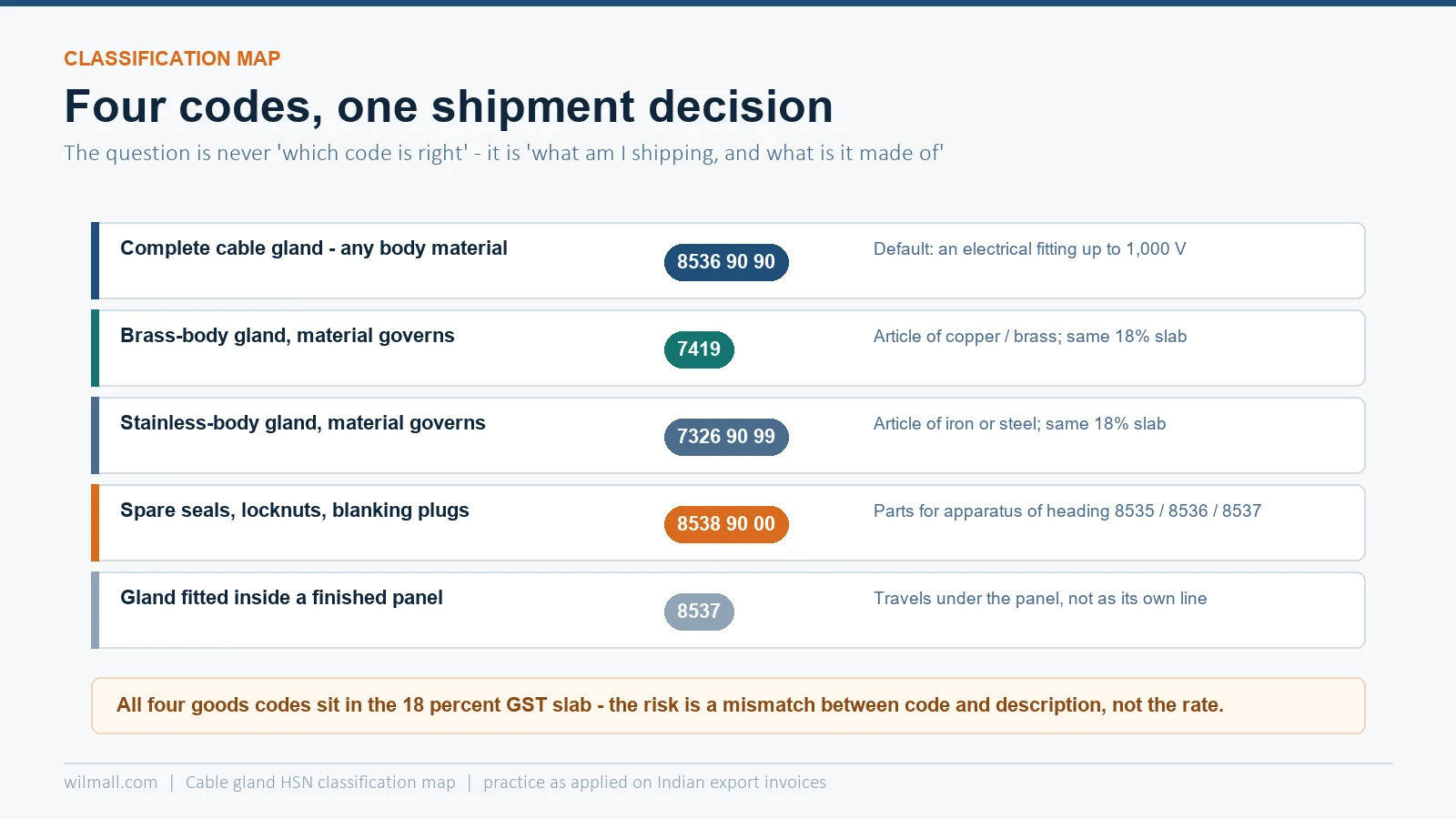
The code most Indian suppliers and customs brokers apply to a complete industrial cable gland is HSN 8536 90 90, at a GST rate of 18 percent. Heading 8536 covers electrical apparatus for switching, protecting or making connections in electrical circuits up to 1,000 V, and the 90 90 tail is the “other” basket that fittings such as cable glands fall into. Brass-body glands are sometimes classified instead under heading 7419 (other articles of copper), and individual spare parts — seals, locknuts, blanking plugs — often go under 8538 90 00 as parts suitable for use with apparatus of headings 8535, 8536 and 8537. All of these carry 18 percent GST.
The important point is not which single code is “correct” in the abstract. It is that the code has to be consistent with the invoice description, the material, and whether you are shipping a complete gland or a component for one. That consistency is what a customs officer or an accounts department actually checks.
The Four Codes That Cover Cable Glands
Four headings cover almost every cable gland shipment. They all sit in the 18 percent GST slab, which simplifies pricing — but they are not interchangeable, and using the wrong one creates a mismatch between the invoice narrative and the tariff code.
| HSN code | Heading description | Typically used for | GST rate |
|---|---|---|---|
| 8536 90 90 | Electrical apparatus for switching, protecting or making connections, up to 1,000 V — other | Complete industrial cable glands (metal and plastic), the default classification | 18% |
| 7419 | Other articles of copper | Brass-body glands classified by material rather than function; brass accessories | 18% |
| 8538 90 00 | Parts suitable for use solely or principally with apparatus of heading 8535, 8536 or 8537 | Spare seals, O-rings, locknuts, blanking plugs sold separately | 18% |
| 7326 90 99 | Other articles of iron or steel | Stainless steel glands classified by material in some practices | 18% |
Because every one of these lands on 18 percent, the financial consequence of picking the wrong one is usually zero. The practical consequence is not: an invoice whose code contradicts its own description is the kind of detail that triggers a query at customs, and a query at customs is a delay measured in days.
Why Brass, Nylon and Stainless Glands Can End Up Under Different Headings
The tension in classifying a cable gland is between what it does and what it is made of. Functionally, a gland is an electrical accessory: it terminates a cable into an enclosure, provides strain relief, seals against ingress, and in armoured types bonds the armour to earth. That is the argument for heading 8536. Materially, a brass gland is a machined copper-alloy article, and that is the argument for heading 7419.
Indian practice is not uniform on this. Many suppliers classify all complete glands under 8536 90 90 regardless of body material, because the gland’s commercial identity is as an electrical fitting. Others classify brass-bodied glands under 7419 and stainless ones under 7326, treating the material as the deciding characteristic. Both approaches appear in live invoices, and the choice is normally settled by the buyer’s accounts team and the customs broker, not by the exporter. The material split is also visible on the product side: the plastic cable gland range and the metal ranges are not just different products, they are different paperwork.
What matters for an exporter is to pick one convention and apply it consistently. If your Indian customer books your brass glands under 7419 this quarter and 8536 90 90 next quarter, their input tax credit reconciliation gets harder than it needs to be, and the inconsistency is visible in their GSTR-2B. Ask which code the buyer’s system expects, then use it on every invoice.
Why a Gland and Its Spare Seal May Not Share a Code
The most common surprise in gland paperwork is that the parts do not travel under the same code as the assembly. Heading 8538 exists specifically for parts that are suitable for use solely or principally with apparatus of headings 8535, 8536 and 8537. A sealing ring, an O-ring, a locknut or a blanking plug sold on its own is a part, not a gland — and it books under 8538 90 00.
This matters in two situations. The first is a spare parts order: a box of twenty seals and ten locknuts should not be invoiced as 8536 90 90 even though they are destined for glands. The second is a mixed shipment: if a consignment contains both complete glands and spare parts, the two lines carry different codes, and a single line item described as “cable glands and accessories” is exactly what creates the mismatch.
The same logic applies at the other end of the scale. A gland supplied as part of a finished enclosure or a control panel is generally not classified on its own at all — it travels under the classification of the panel, which is heading 8537 territory. If you ship gland-equipped enclosures, do not add a gland line to the invoice; describe the enclosure.
The Eight-Digit Rule on Export Invoices
Indian GST law requires an HSN code on tax invoices, and the number of digits required scales with turnover. For exports the practical standard is four digits at minimum, but customs documentation and most large buyers expect the full eight-digit tariff item. For a code like 8536 90 90, all four pairs matter: 85 is the chapter (electrical machinery and equipment), 36 is the heading (apparatus for switching, protecting or making connections), the first 90 is the subheading, and the second 90 is the tariff item. Writing “8536” on an invoice is not the same as writing “8536 90 90”.
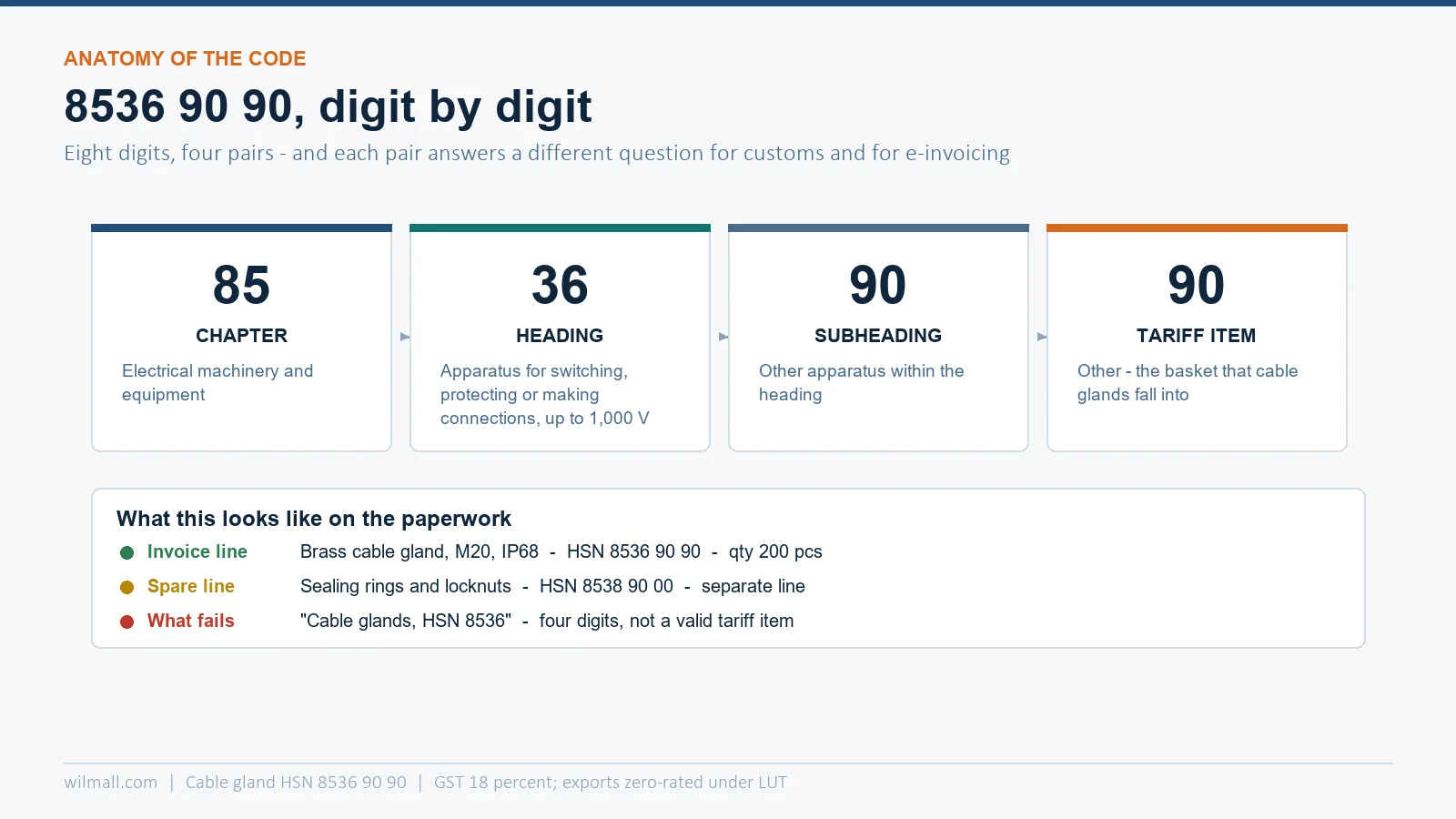
The eight-digit format also feeds India’s e-invoicing system, which validates the code against the NIC master list. A six-digit code that is not a valid tariff item will be rejected at the portal rather than at the border, which means the correction happens on your side, under time pressure, after the invoice has already been issued.
One more distinction worth knowing: HSN codes classify goods, while services use SAC codes. If you also sell cable glanding and termination as an on-site service, that service line needs a SAC code, not the gland’s HSN. Mixing the two on one invoice line is a common and avoidable error.
GST Rate and the LUT Route for Exports
All four headings in the table above attract 18 percent GST on domestic supply. For exports the rate that matters is effectively zero, because export supplies are zero-rated — but only if the paperwork supports it. Exporters shipping under a Letter of Undertaking (LUT) supply without charging IGST and recover input credit separately; exporters without a LUT charge IGST and claim a refund. Either route is legitimate, but they produce very different invoices, and an Indian buyer will notice immediately if the exporter’s invoice assumes the wrong one.
GST rates in India move by notification, and the slab structure was reorganised in September 2025. Heading 8536 remained at 18 percent through that change, but the correct discipline for any exporter is to confirm the current rate against the latest CBIC notification before quoting a landed price — or to let the buyer’s customs broker confirm it. The figures in this article describe practice at the time of writing and are not tax advice.
Five Classification Mistakes That Slow Down a Shipment
These are the errors that show up repeatedly in gland shipments into India, and every one of them is cheap to prevent at the invoice stage.
| Mistake | What it causes | Fix |
|---|---|---|
| Code 8536 90 90 on a line described only as “spare parts” | Description and tariff item contradict each other; query at customs | Parts under 8538 90 00 with a description naming the part |
| Four-digit code on an export invoice | Buyer’s e-invoice or bill of entry needs the full tariff item | Always write eight digits: 8536 90 90, not 8536 |
| Mixed consignment on one invoice line | Glands and seals forced under one code; buyer’s ITC reconciliation breaks | Separate lines per code, each with its own description and quantity |
| Switching between 7419 and 8536 90 90 between shipments | Inconsistent import history for the buyer; visible in GSTR-2B | Agree one convention with the buyer and apply it on every invoice |
| Glands inside a panel invoiced as a separate gland line | Panel classified as 8537 carries its own code; duplicate line confuses valuation | Classify the enclosure; drop the gland line |
What to Put on the Invoice: A Checklist
A gland export invoice that clears without queries tends to have the same six things in place:
- Eight-digit HSN per line, matching the description on that line.
- A description that names the product and the material — “brass cable gland, M20, IP68” rather than “gland”.
- Separate lines for complete glands and for spare parts.
- The GST treatment stated explicitly — zero-rated under LUT, or IGST charged.
- The buyer’s GSTIN on a B2B invoice, so their input credit lands in GSTR-2B.
- The same code the buyer’s system expects — confirmed once, reused every time.
If you are building an order around a specific gland type and want the mechanical specification settled at the same time as the paperwork, the practical next step is the cable gland size chart — the thread and cable-diameter decision drives the part number, and the part number is what the invoice description has to match. For the environmental side of that decision, the IP68 gland thread guide covers the PG, metric and NPT options.
The same eight-digit discipline applies across the rest of the catalogue. We have written up the codes for AC contactors under 8536 and for pendant control stations under 8536 50; the pendant page also covers the codes for crane radio remotes and emergency stop buttons, which often travel in the same consignment as control gear.
Conclusion
Cable glands do not have a heading of their own in the Indian tariff, so classification is a judgement between function and material — usually resolved in favour of 8536 90 90 for complete glands, 7419 for brass bodies where material governs, and 8538 90 00 for the parts. All of them sit at 18 percent GST, and exports are zero-rated under a LUT. The difference between paperwork that clears and paperwork that gets queried is rarely the code itself; it is whether the code, the description, the material and the line structure agree with each other. Decide the convention once with your buyer, write all eight digits, and keep glands and their spare parts on separate lines.
Frequently Asked Questions
What is the HSN code for a cable gland in India?
Complete industrial cable glands are generally classified under HSN 8536 90 90, which sits in heading 8536 for electrical apparatus up to 1,000 V. Brass-bodied glands are sometimes classified under heading 7419 as articles of copper, and stainless steel variants under 7326. All of these attract 18 percent GST, so the choice rarely changes the tax — but it should be agreed with the buyer and applied consistently.
What is the GST rate on cable glands?
18 percent on domestic supply under all of the commonly used headings. Exports are zero-rated: supplied under a Letter of Undertaking, no IGST is charged on the invoice and input credit is recovered separately; without a LUT, IGST is charged and refunded. Confirm the current rate against the latest CBIC notification before quoting, because slab structures change by notification.
Do brass and nylon cable glands use different HSN codes?
They can. Nylon and other plastic-bodied glands are almost always booked under 8536 90 90 as electrical fittings. Brass-bodied glands are booked either under the same code or under 7419 depending on the practice of the buyer’s broker. Since both carry 18 percent GST, the practical requirement is consistency between shipments rather than a single universally correct answer.
Which HSN code applies to cable gland spare parts?
Seals, O-rings, locknuts and blanking plugs sold separately normally fall under 8538 90 00 — parts suitable for use solely or principally with apparatus of headings 8535, 8536 and 8537 — also at 18 percent. A mixed consignment of glands and spare parts should carry separate invoice lines with their own codes.
How many HSN digits do I need on an export invoice?
Eight. The requirement scales with turnover for domestic invoices, but customs documentation, e-invoicing validation and most large Indian buyers expect the full eight-digit tariff item. Writing 8536 instead of 8536 90 90 is the single most common paperwork correction on gland shipments.
Does a cable gland inside a control panel need its own HSN code?
Generally no. A gland supplied as part of a finished enclosure or panel travels under the classification of the panel, which is heading 8537 territory. Adding a separate gland line to the invoice creates a duplicate that complicates valuation rather than clarifying it.