IEC 60947-4-1 Explained: What the Standard Requires
Every number on a contactor nameplate comes from IEC 60947-4-1. Here is the clause-by-clause map - and the test report you should demand.
Read More
A contactor that switches a 45 kW pump twice an hour can be sized from the nameplate. The same contactor driving a hoist 150 times an hour will overheat, weld its contacts and fail within months — at exactly the same load current. Duty cycle and operating frequency are separate sizing inputs, and they are the inputs most often skipped. This page explains what the IEC duty types actually mean, where the operations-per-hour limit comes from, and how to derate a selection for frequent switching.
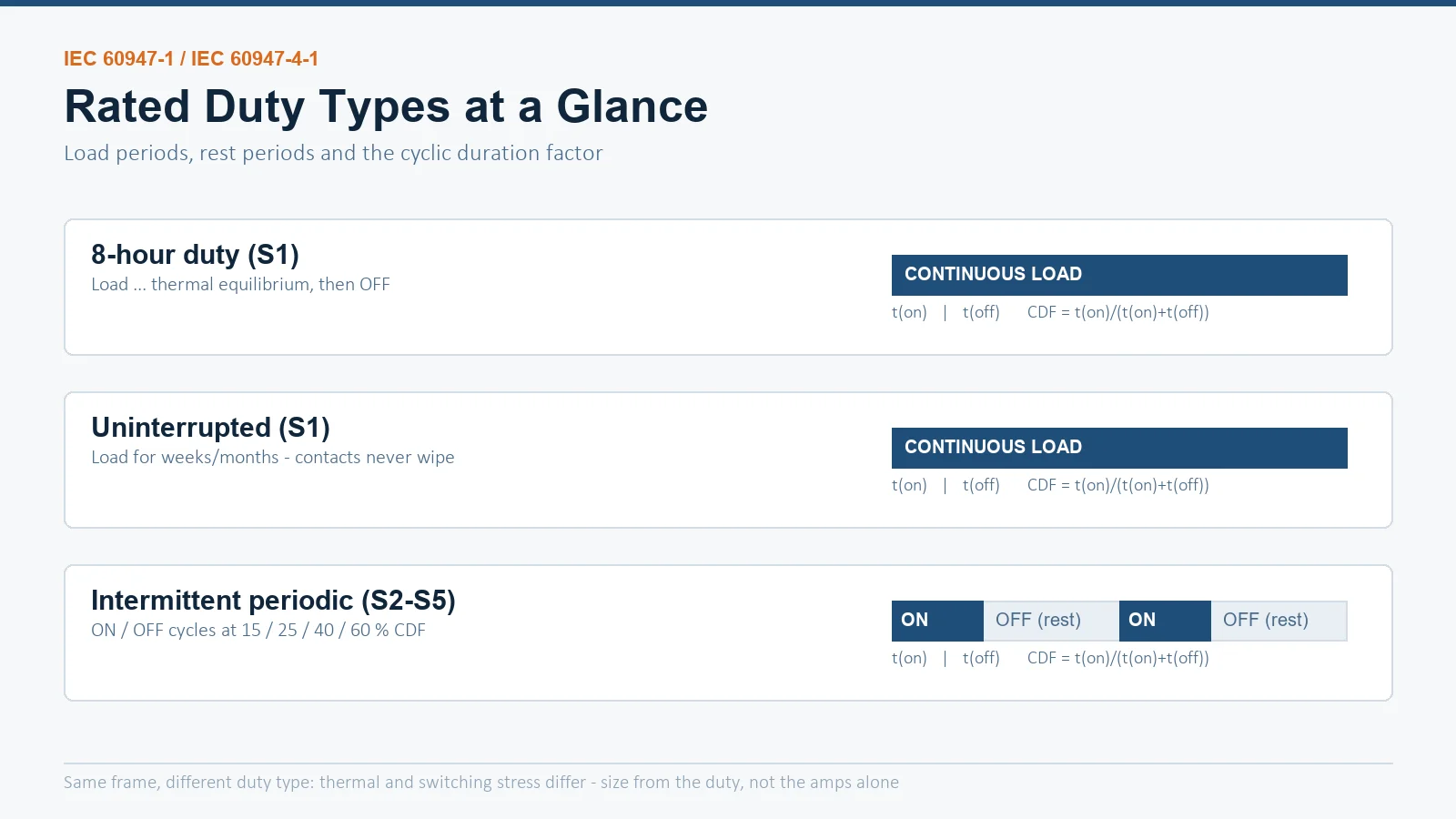
IEC 60947-1 and IEC 60947-4-1 define four rated duty types. The duty type appears in the tender or on the machine specification, and it decides how much thermal and switching stress the contactor absorbs per hour.
| Duty type | Symbol | What it means | Typical application |
|---|---|---|---|
| 8-hour duty | S1 (8 h) | Constant load long enough to reach thermal equilibrium, then switched off | General machinery run in shifts |
| Uninterrupted duty | S1 | Constant load for weeks or months without switching off | Pumps, fans, compressors |
| Intermittent periodic duty | S2–S5 (with CDF) | Identical on/load–off/rest cycles; contacts never fully cool | Cranes, hoists, presses, doors |
| Continuous duty | S1 (unlimited) | Constant load, indefinite duration, coil energized permanently | Building services, process plant |
The trap is the second row. Uninterrupted duty sounds easier than 8-hour duty, but it is harder on the contacts. A contactor that never switches never gets the contact wipe action that cleans oxide off the silver faces, so contact resistance creeps up over months. That is why some manufacturers publish a slightly lower permissible current for uninterrupted duty than for 8-hour duty — and why a contactor sized exactly to the running current for a fan that runs all summer is living closer to the limit than it looks.
Three things heat up, and they heat at different speeds:
The published rated operational current Ie assumes the duty type it is quoted against. Change the duty, change the effective rating — this is the same family of derating decisions covered in contactor derating for temperature, altitude and dust, and the two deratings stack.
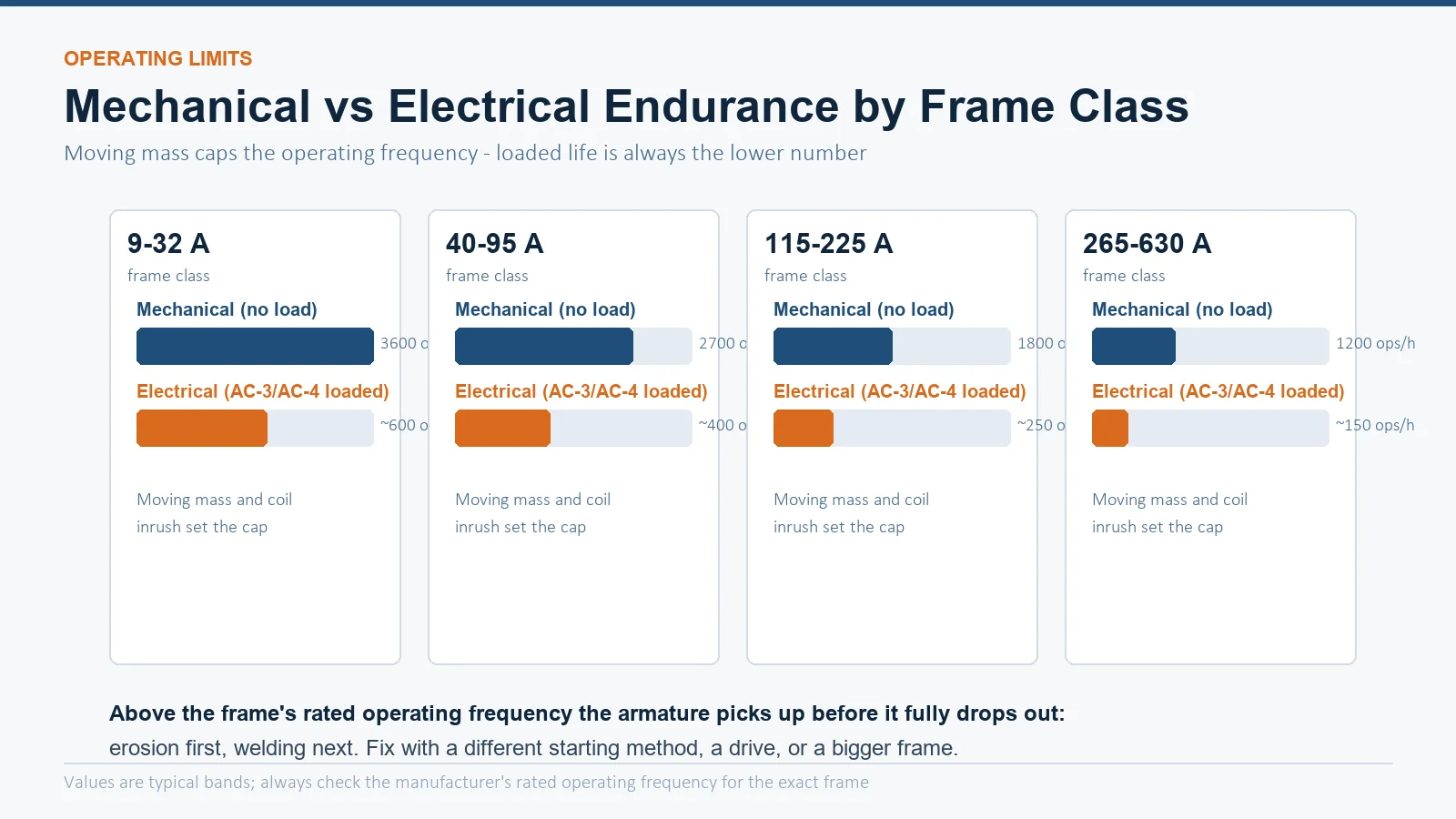
Manufacturers publish two very different endurance figures and both matter:
| Endurance type | Typical range (small to large frames) | What wears out |
|---|---|---|
| Mechanical endurance | 1–30 million operations | Spring, mechanism, pole faces — no load connected |
| Electrical endurance (AC-3) | 0.1–2 million operations | Contact erosion per making/breaking event |
| Electrical endurance (AC-4) | 0.02–0.3 million operations | Severe erosion and welding risk during plugging/jogging |
A 9–32 A frame may be rated 3 600 mechanical operations per hour and a 400–630 A frame only 600–1 200, simply because the larger moving mass cannot be accelerated and braked faster. Exceed the rated operating frequency and the mechanism cannot complete its travel between operations — the armature starts picking up before it has fully dropped out, which first erodes and then welds the contacts. If your application needs more operations per hour than the frame allows, the fix is a smaller contactor pair, a soft starter, or a VFD — see contactor on VFD input vs output for the drive-side arrangement.
For S2–S5 duty the specification carries a cyclic duration factor (CDF):
CDF = ton / (ton + toff) × 100%
Standard values are 15 %, 25 %, 40 % and 60 %. A travel-door drive that runs 30 s and rests 45 s has a CDF of 40 % and a cycle time of 75 s — but at 48 cycles per hour, the contactor sees 48 making and breaking events per hour regardless of how cool it stays. Thermal sizing and switching endurance must both be checked.
| Application | Typical ops/hour | Typical CDF | Duty consequence |
|---|---|---|---|
| HVAC fan | 2–6 | ~100 % | Nameplate AC-3 selection is sufficient |
| Water pump, auto-start | 10–30 | 20–40 % | Standard AC-3, check endurance life |
| Overhead crane traverse | 150–600 | 25–40 % | Derate frame or move to AC-4 component |
| Hoist / plugging duty | 150–300 | 40–60 % | AC-4 sizing, enlarged frame mandatory |
| Punch press, jogging | 300–1 200 | 10–25 % | AC-4 and high mechanical endurance class |
A 7.5 kW / 380 V hoist motor needs 150 starts per hour with a 40 % CDF, including plugging on reverse. Step through it:
| Situation | Rule |
|---|---|
| Duty stated as S2–S5 with CDF | Size on the duty-specific curve or the AC-4 table, never the AC-3 table alone |
| More than ~30 loaded starts/hour | One frame size up from the AC-3 selection |
| Plugging, jogging or inching present | Treat as AC-4; size on AC-4 rating or a mixed-duty factor from the manufacturer’s table |
| Ops/hour above frame rating | Reduce ops/hour, use a smaller frame for the same motor via a different starting method, or switch to a drive |
| Coil inrush dominates | Consider a wider operating-range coil or electronic coil module to cut inrush stress |
| Mistake | What happens | Correct approach |
|---|---|---|
| Sizing a crane drive from the AC-3 chart | Contact welding within weeks of commissioning | Size on AC-4 or mixed-duty data |
| Ignoring duty type because “the current is the same” | Overheating at high frequency; nuisance trips | Check ops/hour and CDF against frame limits |
| Counting only thermal load on an S1 continuous fan | Contact resistance creep over months | Include contact wipe/oxide behavior in inspection intervals |
| Assuming mechanical endurance = electrical life | Mechanism fine, contacts eroded long before | Track electrical operations separately |
It is the pattern of on and off periods the contactor is specified to handle. The duty type (S1 to S5) plus the cyclic duration factor tells you how much thermal and switching stress the device absorbs, and therefore which rating column you size from.
Small frames up to 32 A typically allow 1 200–3 600 mechanical operations per hour, mid frames several hundred to 1 200, and large frames 600–1 200. Loaded (electrical) endurance is far lower and depends on the utilization category — always check the manufacturer’s operating frequency rating for the exact frame.
Both. The contactor absorbs erosion and heat at every start, while the motor absorbs rotor heating. The contactor usually shows the damage first, which is why frequent-start applications are sized one or more frames up.
Because contacts that never operate never get wiped clean. Contact film builds up slowly, raising contact resistance and temperature over time. Some frames carry a lower uninterrupted-duty current for exactly this reason.
Measure the actual run and rest times over a representative hour and compute CDF = on/(on+off). Door and gate drives typically land at 25–40 %, and their switching counts place them in intermittent periodic duty even though the current is small.
Category (AC-1 to AC-4) describes how hard each switching event is; duty cycle describes how many events happen per hour. A hard category at low frequency and an easy category at high frequency can produce the same total stress, which is why both must be checked together — see AC-1 to AC-4 utilization categories.
Need a contactor for a frequent-switching application? The CJX2 series AC contactor covers 9 A to 630 A with published AC-3 and AC-4 data, high mechanical endurance ratings and international certifications. Send us your motor rating and duty cycle — our engineers will confirm the frame size within one working day.