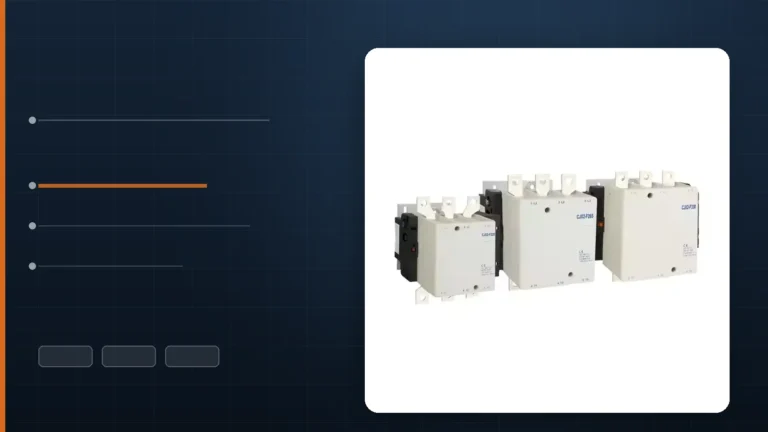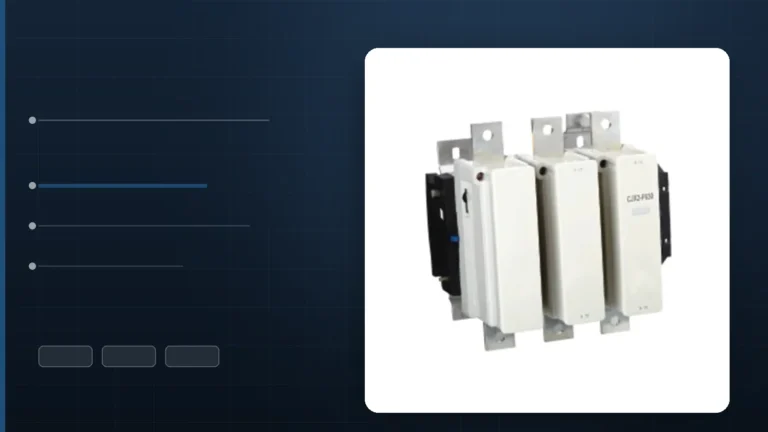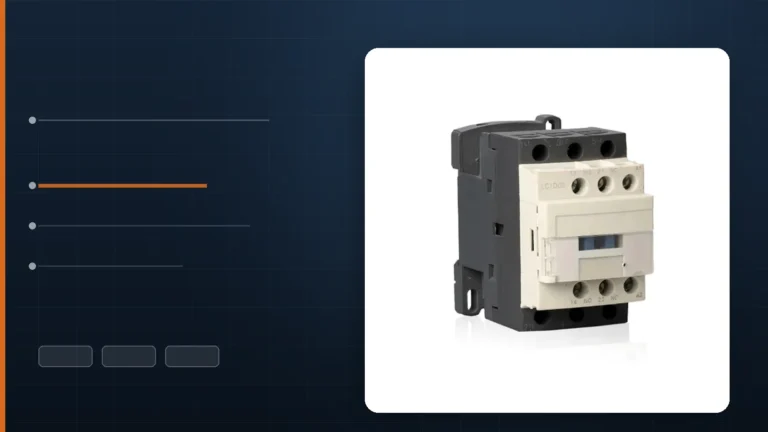
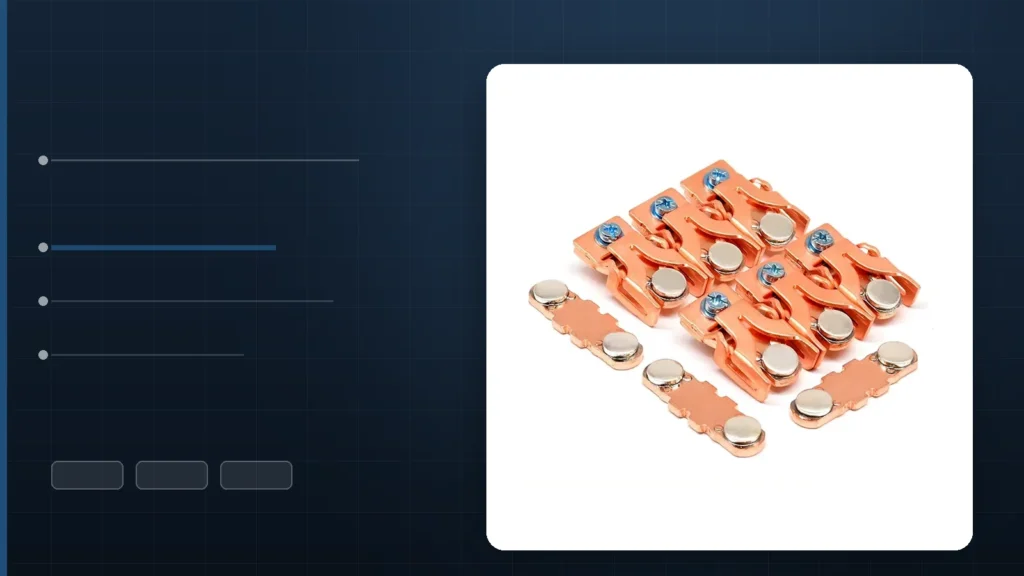
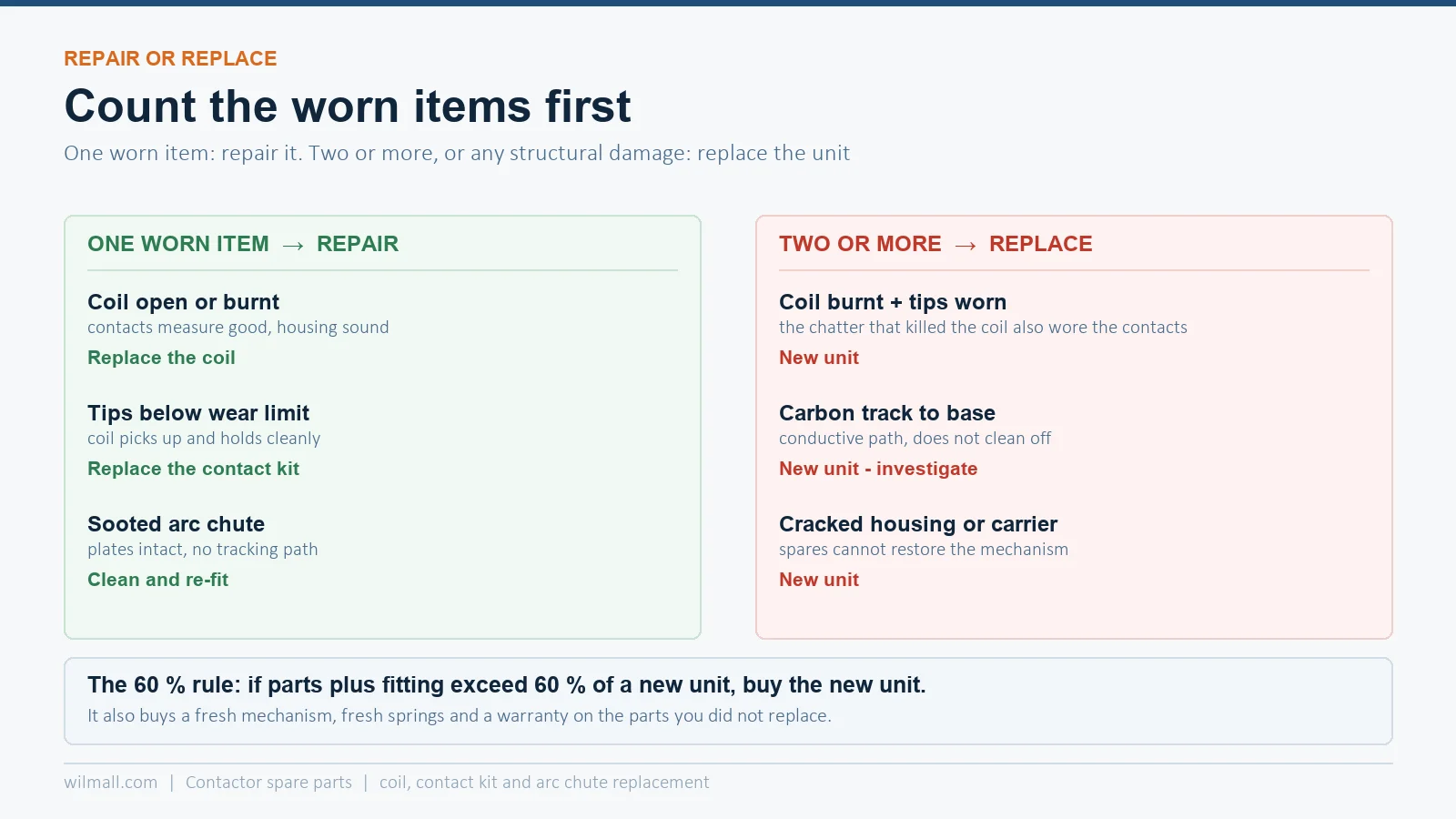
A contactor has four serviceable parts — coil, contact kit, arc chute and the shading ring — and they wear at completely different rates. Replace the coil alone when the winding is open or burnt and the contacts still measure good. Replace the contact kit alone when tip thickness is below the limit and the coil still picks up cleanly. Replace the whole contactor when two or more of those items are worn, when the housing is cracked or carbon-tracked, or when the contact carrier or return spring is damaged. The decisive detail is the part number: a coil is identified by frame letter plus voltage — FF220 is a 220 V coil for a CJX2-115/150, and it will not fit a CJX2-185.
Spare-part enquiries are where a good contactor relationship is won or lost. The buyer has a machine down, a contactor in hand, and a photo of a label. If the answer is “here is the coil, part number FG220, and by the way your arc chute is the reason the coil burnt” — you have a customer for the next ten years. If the answer is “buy a new contactor”, you have a transaction.
This guide covers the four wear items, the decision line between repairing and replacing, the coil code system we publish on our coil range, and the compatibility traps that turn a ten-minute repair into a second breakdown.
Four Parts, Four Wear Rates
The mistake in most spares conversations is treating “the contactor failed” as one event. It is four independent ageing processes that happen to share a housing, and the one that failed first tells you what to check next.
| Part | What it does | How it fails | Typical share of a new unit’s price |
|---|---|---|---|
| Coil | Generates the holding force | Open winding, shorted turns, burnt insulation from chatter or overvoltage | 15 – 25 % |
| Contact kit | Carries and interrupts the load current | Tip erosion, pitting, welding, silver loss at the arc root | 20 – 35 % |
| Arc chute | Splits and cools the arc on break | Eroded splitter plates, soot bridging, carbon tracking to earth | 10 – 20 % |
| Shading ring | Keeps an AC magnet from chattering at current zero | Cracked or detached ring — loud buzz, coil overheats, contacts chatter | Not sold separately; part of the magnet assembly |
Two consequences follow. First, a burnt coil is usually a symptom: a cracked shading ring, a low control voltage or a worn contact carrier all make the magnet chatter, and a chattering coil draws inrush current continuously. Replace the coil without finding the cause and the new one burns in the same number of weeks. Our guide to contactor buzzing walks through the diagnosis.
Second, the electrical life of the contacts and the mechanical life of the mechanism are counted separately. A contactor on a 30-operation-per-hour duty can consume its contact budget in two years while its mechanism is barely broken in. That is why contact kits outsell complete units in plants with pulsed or jogging duty.
The Two-Part Rule: Repair or Replace
We use a simple line with customers, and it holds up across frames from 9 A to 630 A.
Count the worn items. One → repair. Two or more → replace the unit. Any structural damage → replace the unit, regardless.
“Structural” means: cracked or carbon-tracked housing, a melted or discoloured terminal block, a bent contact carrier, a stretched or heat-set return spring, or a magnet face with visible step wear. Those are not spare-part problems — they are the frame telling you the device has been through a fault.
| Condition found | Coil | Contacts | Arc chute | Verdict |
|---|---|---|---|---|
| No pickup, coil open, contacts measure good | Replace | Keep | Clean | Coil only |
| Picks up fine, tips at or below the wear limit | Keep | Replace | Clean | Contact kit only |
| Buzzes, coil discoloured, tips worn | Replace | Replace | Replace | New unit |
| Contacts welded, housing scorched | — | — | — | New unit — and investigate the load |
| Carbon track from arc chute to base | — | — | — | New unit — tracking is not cleanable |
The economic argument runs the same way. If the parts and the labour to fit them come to more than roughly 60 % of a new unit, the new unit also buys you a fresh mechanism, fresh springs, a new warranty and no uncertainty about the parts you did not replace. On the small frames the labour usually decides it on its own: a coil for a 9 A contactor is a small fraction of the price, but the electrician’s hour is not.
The Coil: Match the Code, Not Just the Voltage
This is where most wrong-part orders originate. Two coils can both be “220 V AC” and still be completely different devices — different frame, different magnet, different starting VA. On the large frames we publish the code as a frame letter plus the voltage, and the letter is the part that people get wrong.
| Contactor frame | 110 V | 127 V | 220 V | 380 V | Starting VA | Holding VA |
|---|---|---|---|---|---|---|
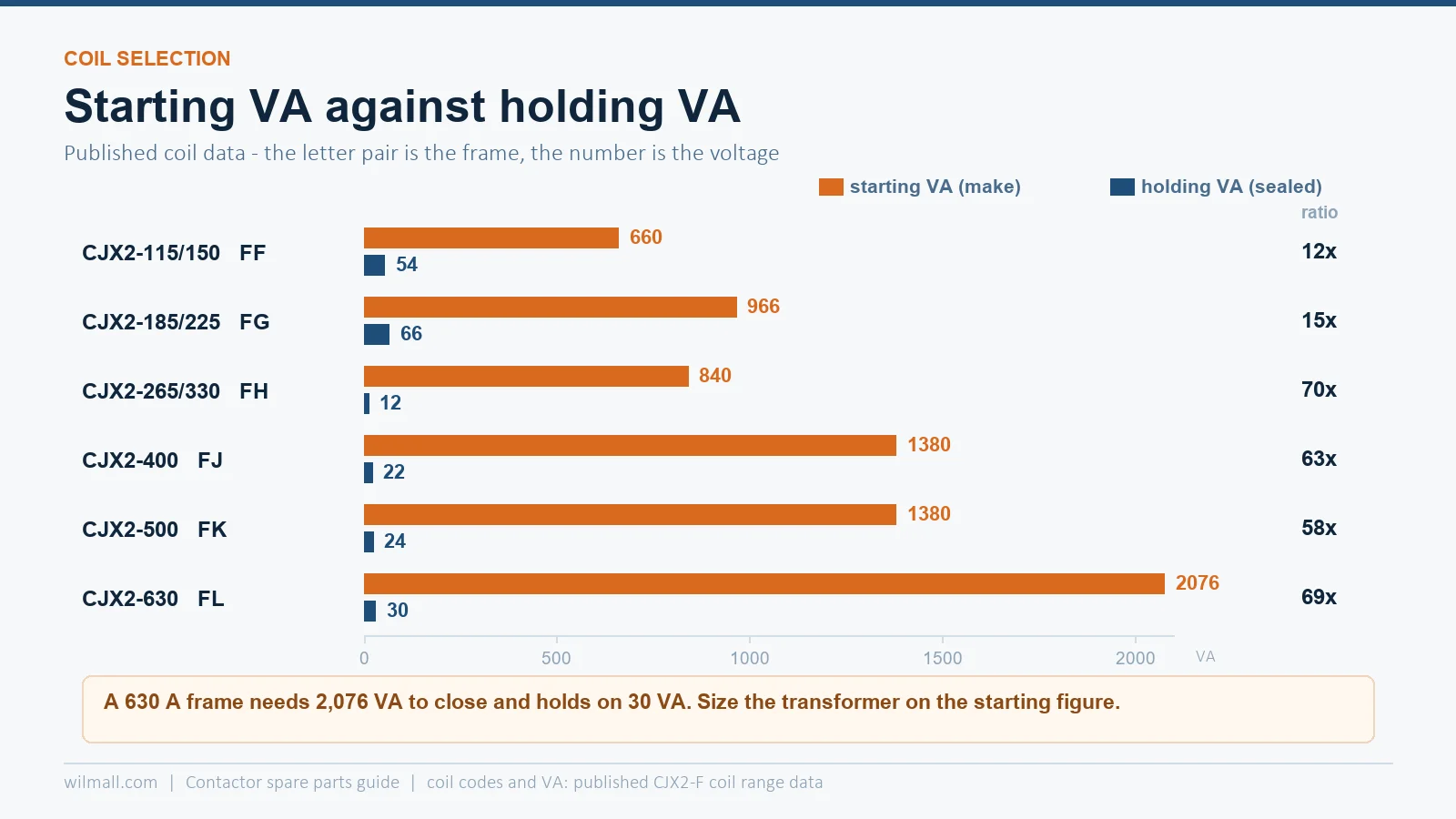
| CJX2-115 / 150 | FF110 | FF127 | FF220 | FF380 | 660 | 54 |
| CJX2-185 / 225 | FG110 | FG127 | FG220 | FG380 | 966 | 66 |
| CJX2-265 / 330 | FH110 | FH127 | FH220 | FH380 | 840 | 12 |
| CJX2-400 | FJ110 | FJ127 | FJ220 | FJ380 | 1380 | 22 |
| CJX2-500 | FK110 | FK127 | FK220 | FK380 | 1380 | 24 |
| CJX2-630 | FL110 | FL127 | FL220 | FL380 | 2076 | 30 |
Three things to read out of that table before ordering:
- Starting VA is 20 to 70 times holding VA. A 630 A frame pulls 2,076 VA to close and holds on 30 VA. That ratio is why a marginal control transformer closes the contactor once and then drops it out — the transformer sags on inrush, the magnet weakens, the coil draws inrush continuously and burns. Our coil power consumption guide covers the sizing arithmetic.
- Holding VA is not monotonic across frames. The 265/330 frame holds on 12 VA, less than the smaller 185/225 at 66 VA. Do not extrapolate; read the row for your frame.
- The smaller frames use a different code system. On the LC1-D / CJX2-D range the suffix is a two-character code where the letter is the voltage and the digit is the frequency: B = 24 V, D = 42 V, E = 48 V, with 5 = 50 Hz, 6 = 60 Hz, 7 = 50/60 Hz, and a D suffix for DC coils (BD, ED, ND). A B5 coil is 24 V 50 Hz; a B7 is 24 V 50/60 Hz.
And a frequency warning that costs real money: a 50 Hz coil on a 60 Hz supply produces less flux and less holding force, so it buzzes and eventually welds. A 60 Hz coil on a 50 Hz supply draws more current and runs hot until the insulation fails. If the plant frequency is not what the label says, that is the whole fault.
Contact Kits: Measure Before You Order
Contacts are the only wear item you can evaluate quantitatively, and almost nobody does. Two measurements decide the order.
Tip thickness. Compare the moving contact tip against the new-part dimension. Our contact wear guide sets out the four indicators and the replacement limits; the practical version is that once you are through roughly half the original tip thickness, order the kit rather than wait for the next failure.
Resistance across the closed pole. A four-wire measurement on a good pole gives a stable micro-ohm figure; a pole that has lost silver reads noticeably higher and drifts. Compare the three poles against each other — a spread of more than about 20 % between poles means one of them is done, even if all three still “work”.
Two ordering notes. Contact material matters — AgSnO2, AgNi and AgCdO behave differently on welding and erosion, and a kit in the wrong material will fail early on the same duty; our material comparison explains the trade-offs. And do not reject tarnished contacts: a silver surface that has gone brown or black in storage has formed silver sulphide, which is soft, burns off on the first operation and has no effect on performance. Bright and shiny is not a quality criterion.
Arc Chutes: Clean or Replace
The arc chute is the cheapest part and the most often ignored. It has one job: split the arc into short segments, cool them, and let them extinguish before the current zero.
Clean it when the contamination is soot — a dry, powdery, uniformly grey-black film from normal arcing. Blow it out with dry compressed air at low pressure, wipe the plates, and check that the gaps between splitter plates are clear.
Replace it when you see any of these: splitter plates with eroded or chipped leading edges, plates welded together by a heavy arcing event, a chute body with a burnt-through section, or — the serious one — a brown or black tracking path running along the insulation from the chute to the base or between phases. Carbon tracking is conductive, it does not clean off, and it is a phase-to-phase fault waiting for a humid day. Our arc chute article covers the discrimination in detail, including the voltage budget that shows how few contaminated gaps it takes to break down.
Frame-to-Part Map
This is the table to keep on the desk. Contact kits are grouped by frame family, not by individual rating, and the families are wide — one kit covers the 330F and 400F frames, another covers 115F and 150F.
| Contactor family | Contact kit covers | Coil family | Notes |
|---|---|---|---|
| CJX2-D115 / D150 / D170 | D115 – D170 kit | FF (115/150), FG (185/225) | 115/150 shares the FF coil; the 170 frame steps up |
| CJX2-F / LC1-F 115 – 150 | 115F – 150F kit | FF110 / FF220 / FF380 | Most common large-frame spares line |
| CJX2-F / LC1-F 185 – 225 | 185F – 225F kit | FG110 / FG220 / FG380 | Holding VA jumps to 66 — check the control transformer |
| CJX2-F / LC1-F 265 – 330 | 265F kit, 330F – 400F kit | FH | Two kits cover the range; check which frame you have |
| CJX2-F / LC1-F 500 | 500F kit | FK | Coil starting VA 1,380 |
| CJX2-F / LC1-F 630 | 630F kit | FL | Coil starting VA 2,076 — the largest in the range |
| LC1-D / CJX2-D 9 – 95 A | Frame-specific kits | B7 / D7 / E7 / M7 / Q7 series | Voltage letter plus frequency digit |
Full product details are on the CJX2-F series page. When ordering, quote the contactor’s own label — model, coil code and voltage — rather than the machine’s drawing number, because machines get rebuilt and drawings do not always follow.
Compatibility Traps Between Brands
Almost every 9–95 A contactor on the market follows the same mounting and terminal layout, which creates a dangerous assumption: that the parts interchange. They do not, and three specific mismatches cause repeat failures.
- Coil VA does not match. A replacement coil that physically fits may draw 40 % more holding VA than the original. On a marginal control transformer that is the difference between holding and chattering.
- Contact material differs. A silver-nickel kit in a device that was originally AgSnO2 will weld earlier on an inductive or capacitor load. The device “works” until the first hard switching event.
- Auxiliary blocks key differently. The block may clip on and sit one position off, so the normally-closed contact that was meant to interlock is actually the normally-open one. This shows up as a control-circuit fault that nobody can find, and it is a genuine safety issue on reversing and changeover starters.
The rule we give customers is simple: parts from one brand, or a complete unit from one brand. Never a mixed unit. If a customer must use a locally available coil in an imported contactor, check the frame letter, the voltage, the frequency and the starting and holding VA against the table above before it goes in.
What to Stock, by Duty
Spares holding is a cost decision, and it should follow failure probability rather than sentiment. Rank your contactor population by duty, then stock accordingly.
| Duty | What fails first | Minimum stock |
|---|---|---|
| Continuous running, few operations (pumps, fans) | Coil, after years | One coil per frame in use |
| Frequent cycling (hoists, packaging, pulsed heaters) | Contacts, then arc chute | One contact kit per frame, plus one chute |
| Jogging / plugging (machine setup) | Contacts and carrier | One complete unit per frame — kits do not restore a worn carrier |
| Critical process, no bypass | Anything | Complete unit, plus coil and kit |
Whatever you stock, store it sealed and dry. Coils absorb moisture in an unheated store and fail on first energisation — a failure that has nothing to do with the supplier and everything to do with the shelf.
Five Mistakes in Spare-Part Orders
- Ordering a coil by voltage only. Frame letter, voltage, frequency, starting and holding VA. Four data points, or you will be re-shipping.
- Replacing a coil without finding the chatter. The new coil will fail identically. Check the shading ring, the control voltage and the carrier first.
- Fitting contacts into a worn carrier. New tips on a bent carrier run misaligned, wear unevenly and weld.
- Cleaning a carbon track. It does not come off, and the device still fails — usually phase to phase.
- Mixing brands inside one unit. It works on the bench and fails on the load.
Questions fréquemment posées
How do I know whether to replace the coil or the whole contactor?
If the coil is open or burnt and the contacts still measure within limits and the housing is sound, replace the coil. If the contacts are also worn, or the housing, carrier or spring shows damage, replace the complete unit — two worn items is the break-even point.
What does a coil code like FF220 mean?
The letter pair identifies the coil family, which is tied to the contactor frame, and the number is the coil voltage. FF220 is a 220 V coil for a CJX2-115/150 frame; FG220 is a 220 V coil for a CJX2-185/225 frame. They are not interchangeable even though both say 220 V.
Can I use a 50 Hz coil on a 60 Hz supply?
Physically yes, but not reliably. A 50 Hz coil on 60 Hz produces less flux and less holding force, so the magnet buzzes and the contacts chatter. The reverse — a 60 Hz coil on 50 Hz — draws excessive current and overheats. Order the dual-frequency (suffix 7) coil if the supply is uncertain.
Are contactor contacts from different brands interchangeable?
Often they fit and sometimes they work, but the contact material and the tip geometry differ between manufacturers, and both affect welding and erosion behaviour. Use the original manufacturer’s kit, or replace the complete unit.
Should I clean or replace the arc chute?
Clean it if the deposit is dry soot and the splitter plates are intact. Replace it if plates are eroded, chipped or welded together, if the chute body is burnt through, or if there is any brown or black tracking path on the insulation — carbon tracking is conductive and cannot be cleaned off.
Why does a new coil burn out within weeks?
Almost always because the original fault was not the coil. A cracked shading ring, a control voltage below the pickup threshold, or a worn contact carrier makes the magnet chatter, and a chattering coil draws its starting current continuously. It overheats and fails, exactly as the first one did.
How long do contactor contacts last?
It depends entirely on operations and breaking current, not on calendar time. A pump contactor at two operations per hour may run for a decade; a pulsed heater or a jogged machine tool can consume the same contact set in a year. Use the published electrical life figure divided by your actual operations per hour.
If you are rebuilding a spares list across a mixed contactor population, send us the labels — model, coil code and voltage — and we will return a matched kit list per frame so the stores bin matches the plant.