






Best Contactor Brands in 2026: Comparison & Buying Guide
Contactor brands split into five practical tiers. Compare Schneider, ABB, Siemens, Chint, Delixi and OEM equivalents by certification, cross-reference and total cost.
Read More
Searching for modular contactor manufacturers usually returns two kinds of results: pay-to-list supplier directories, and brand pages written by the brands themselves. Neither answers the question a buyer actually has, which is not “who is the biggest” but “which type of supplier should I place this order with, and how do I verify them before I commit tooling money.” This guide separates modular contactor makers into four supplier archetypes, maps where the manufacturing actually happens, and gives you the vetting framework, RFQ specification sheet and red-flag list that turn a supplier shortlist into a qualified manufacturing partner. If you want to see how the compact and DIN-rail frames described here are configured, start with the modular contactor range.
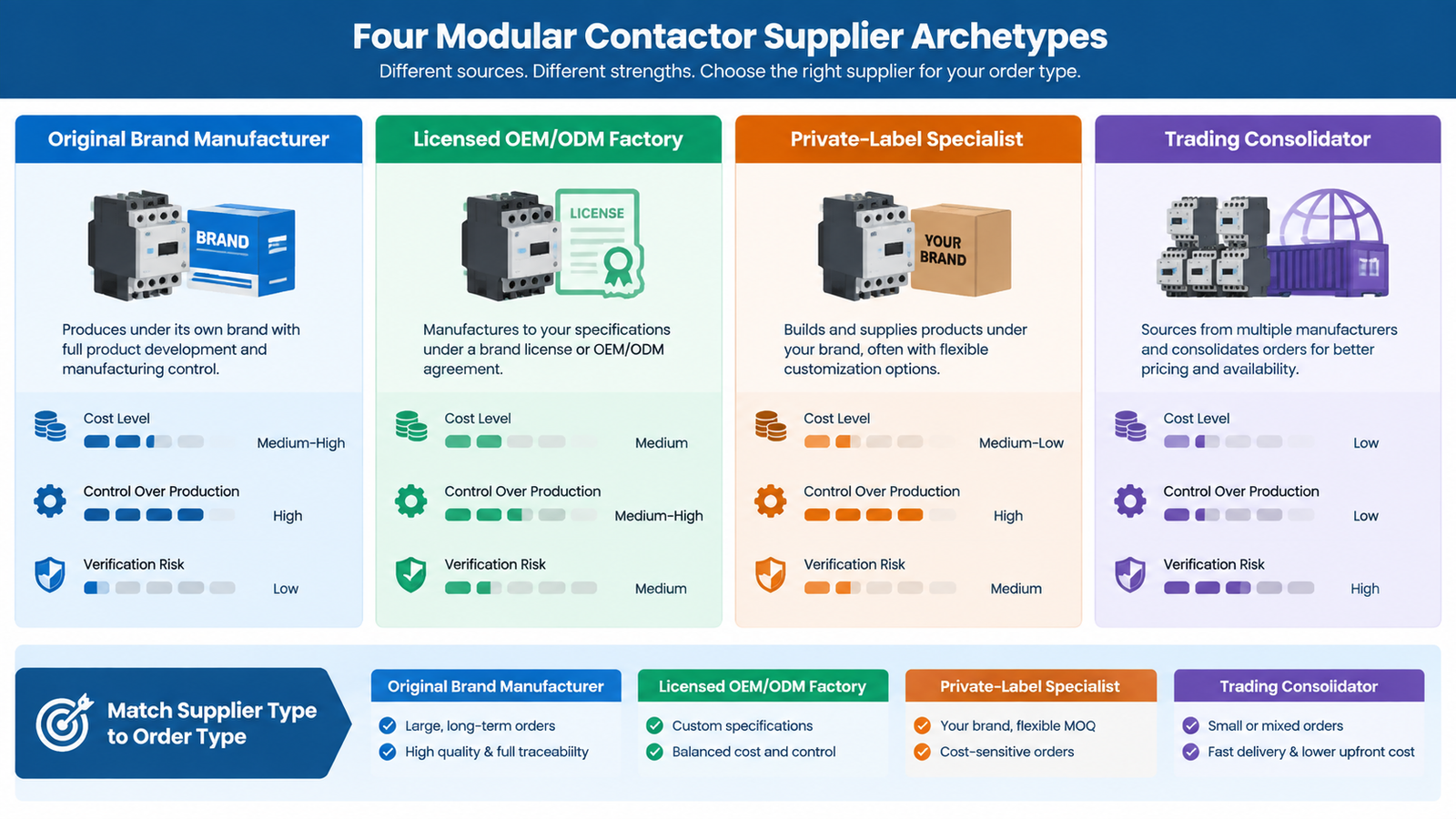
There is no single best manufacturer. There is a best type of manufacturer for the order in front of you, and choosing the wrong archetype is the most expensive mistake in low-voltage sourcing — more expensive than picking the wrong brand. Use this table as your first filter before you request a single quotation.
| Supplier archetype | Best suited to | Typical strengths | Main risk |
|---|---|---|---|
| Original brand manufacturer (Tier-1 global) | Warranty-critical machines, safety functions, panels requiring documented electrical life curves | Published endurance data, global spare availability, full accessory ecosystem, insurer and inspector acceptance | Highest unit cost; long lead times on non-stock coil voltages; low willingness to change nameplate or terminal layout |
| Licensed OEM / ODM factory | Private-label ranges, distributor own-brand programmes, repeat volume with a fixed specification | Brand-comparable construction at a fraction of Tier-1 cost; genuine engineering support; tooling and moulding in-house | Quality varies enormously between factories; certification is often held by the buyer, not the factory; needs real auditing |
| Private-label and white-label specialist | Fast market entry, catalogue fill, e-commerce and maintenance-market supply | Low minimum order quantity, artwork and packaging handled for you, short time to market | Cosmetic-only customisation; you inherit a generic electrical specification you did not define; weak technical support |
| Trading company / consolidator | Mixed-category orders, small trial quantities, single-invoice convenience | Widest catalogue, one contact for many product families, flexible on small volumes | Least control over production; the “factory” you audit may not be the factory that makes your goods; weakest traceability |
Most sourcing failures come from a mismatch, not a bad factory. A private-label specialist asked to hold a ±5% coil pick-up tolerance on a safety circuit will disappoint you. A Tier-1 brand asked to produce 300 units with your logo will simply decline.
Before you shortlist anyone, agree on the scope of the product, because the two standards involved are not interchangeable and manufacturers specialise in one or the other.
A modular contactor is a DIN-rail mounted device built to IEC 61095, intended for household and similar installations. It is defined by utilisation categories AC-7a (slightly inductive loads such as lighting and resistive heating) and AC-7b (household motor loads such as fans and small pumps), it occupies a fixed number of 17.5 mm module widths, and it is switched by a control signal from a timer, sensor, thermostat or building-management output.
An industrial contactor is built to IEC 60947-4-1, is rated by AC-1 through AC-4 duty, and is sized around motor starting current rather than lighting load. Frame sizes are larger, coils draw more holding power, and accessory blocks are added rather than integrated.
The boundary matters commercially because a factory tooled for IEC 61095 modular housings is usually not the same factory that moulds IEC 60947-4-1 industrial frames. When a supplier offers “both” from one line, ask which of the two is actually produced in-house. The distinction between the two families, and the derating traps that come with it, is covered in more detail in our guide to modular contactors in modern control systems.
These are the companies whose name ends up on the datasheet. They own the design, hold the type-test reports, and carry product liability. Their value to a buyer is documentation: published mechanical and electrical endurance curves, temperature-rise test data, declared short-circuit coordination with specific fuse and breaker models, and a global accessory catalogue that will still exist in ten years.
Buy from this archetype when the panel is under warranty, when an inspector or insurer will ask for a listing, or when the switching duty is severe enough that electrical life data decides the outcome. Do not buy from this archetype expecting nameplate changes, unusual coil voltages on short lead time, or willingness to run a 200-unit trial order.
This is where the majority of the world’s private-label contactors are actually born. An OEM factory builds to your drawing and your specification; an ODM factory offers an existing design that you rebrand. The engineering capability gap between a good ODM factory and a Tier-1 brand is far narrower than the price gap suggests — but the variance between a good one and a poor one is enormous.
What separates them is process control, not design. Ask whether coil winding is in-house or subcontracted, how contact riveting pressure is controlled and recorded, whether the housing material has a documented flame-retardant grade, and whether final test is 100% routine test or sampling. A factory that answers these precisely, with records, is worth paying more for than one that answers with adjectives.
These suppliers exist to get a branded product to market quickly. They will print your logo on the housing, design your carton, apply your EAN codes and ship in weeks. What they will not do, unless you push hard, is change the electrical specification underneath.
That is a perfectly reasonable trade for a distributor filling catalogue gaps or supplying the maintenance market. It is the wrong trade for an OEM building machines, because the contactor becomes the component you cannot control and cannot trace when a batch fails.
Trading companies are not inherently a problem. Many are excellent at logistics, documentation and multi-category consolidation, and they will accept order sizes no factory will touch. The problem is verification: when a trading company says “our factory,” you have no way of knowing which production line your goods came from, which is why traceability and corrective-action records are usually weakest in this archetype.
If you use a consolidator, treat the manufacturer behind them as a separate supplier you have not yet qualified, and say so in the contract.
Low-voltage electrical manufacturing is heavily clustered. Knowing the cluster tells you what a supplier is likely to be good at, and what to test hardest.
| Cluster | Typical strength | What to verify hardest |
|---|---|---|
| Liushi Town, Yueqing, Wenzhou, Zhejiang (China) | Widest concentration of contactor, MCB and relay manufacturing anywhere; component, tooling, moulding and test suppliers within short distance of the line; strong IEC-market export experience | Variance between factories is the widest here too. Insist on third-party inspection and batch testing, copper purity certificates for coil wire, and a tighter acceptance quality limit than the default |
| Guangdong (China) | North American compliance experience; mature UL-oriented documentation and factory-inspection practice | Verify UL factory inspection status, not just a product listing. Certified production typically carries a measurable cost premium |
| Jiangsu (China) | Higher-reliability and custom engineering work; larger automation and renewables-oriented programmes | Budget for engineering and non-recurring tooling charges, and validate reliability data through independent testing rather than accepting factory figures |
| Vietnam, Thailand, Malaysia (ASEAN) | Contract manufacturing for Japanese, Korean and European brands; strong plastic moulding and coil winding | Confirm whether your order runs on the same line and bill of materials as the brand work, or a separate lower tier |
One practical note: a supplier’s registered address is not evidence of a factory. Wilmall, for example, is based in Yueqing City, Wenzhou — inside the cluster — and works as a manufacturer and supplier with OEM/ODM, private-label and custom-branding capability. That is exactly why we publish a vetting framework below that applies equally to us and to anyone else you are considering. The framework is the point; nobody should be taken on trust.
We deliberately do not publish a ranked “top 10.” Published revenue rankings for this category conflict with each other, and supplier directories are pay-to-list. Instead, here is the honest landscape: the manufacturers a buyer will realistically meet in a tender or a search, grouped by the role they play. Treat it as a shortlist generator, not a league table.
| Group | Manufacturers | Role in your sourcing |
|---|---|---|
| European premium | Schneider Electric, ABB, Siemens, Eaton, Legrand, Hager | The specification benchmark and the reference for cross-compatibility. Use them to define what “good” means before you evaluate alternatives |
| Japanese, Korean and US automation brands | Mitsubishi Electric, Fuji Electric, Omron, LS Electric, Rockwell Automation (Allen-Bradley) | Strong where the panel is already built around a specific automation platform and spare-part continuity outweighs unit price |
| Chinese national brands | Chint, Delixi, People Electric | The mid-tier volume option with broad catalogue coverage, regional distribution and improving documentation |
| OEM / ODM and private-label factories | Concentrated in the Liushi / Yueqing cluster in Zhejiang, with additional capacity in Guangdong and Jiangsu | Your cost-effective route to an own-brand range. Quality is determined almost entirely by how well you specify and audit |
| Suppliers with modular contactor ranges | Wilmaull and other Yueqing-based manufacturers and suppliers offering OEM/ODM and private-label programmes | The factory-direct route, where you deal with the manufacturing specification directly rather than through distribution layers |
Two cautions on using this table. First, a manufacturer appearing in a group tells you nothing about whether their modular contactor line specifically is strong — brand strength and modular-range depth are different things, so always ask for the modular series datasheet rather than the company brochure. Second, a factory that produces for a well-known brand does not automatically quote you the same quality tier. Confirm the exact bill of materials and test regime for your order.
This is the core of the article. Each point has a piece of evidence you should demand, and a red flag that should stop the process.
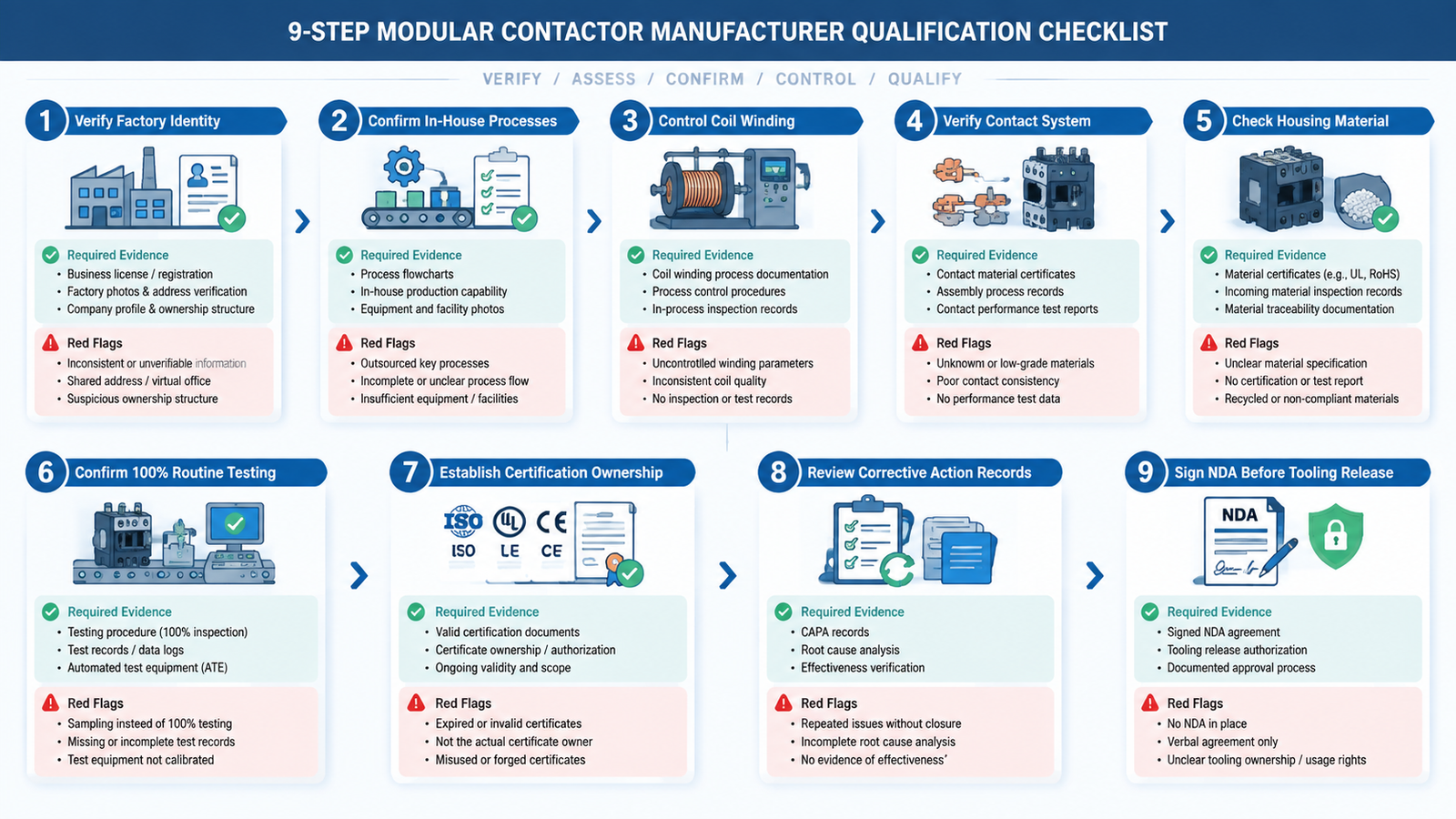
| # | Qualification point | Evidence to demand | Red flag |
|---|---|---|---|
| 1 | Legal and factory identity | Business licence, factory address, ownership, year established, number of production lines, monthly capacity, main export markets | Registered address is an office tower or a residential building with no production address disclosed |
| 2 | Process vertical integration | Which processes are in-house: coil winding, contact riveting or welding, moulding, assembly, routine test | Every process is “partnered” — you are buying from an assembler of bought-in subassemblies |
| 3 | Coil winding control | Wire class and insulation system, turns count control method, in-house or outsourced, sample test records for pick-up and drop-out voltage | No record of coil resistance or pick-up voltage per batch |
| 4 | Contact system | Silver alloy grade and supplier, riveting pressure or welding parameters, contact force measurement | Contact material described only as “silver” or “copper” with no alloy designation |
| 5 | Housing and insulation | Thermoplastic grade, flame-retardant classification, dimensional control method and tolerance | Flammability grade cannot be named, or the certificate covers a different moulding |
| 6 | Routine test regime | Whether final test is 100% or sampling; which parameters are recorded; whether records are retained and retrievable by batch | Sampling only, on a safety-switching product, with no retained records |
| 7 | Certification ownership | Certificates naming the exact model, frame size and coil voltage; who holds the certificate — factory or buyer | A certificate covering a different frame size, or a CE document with no declaration of conformity |
| 8 | Corrective action history | A real 8D or corrective-action report from a previous quality issue, with root cause and verification of effectiveness | No process exists for handling complaints, or the factory claims to have never had one |
| 9 | Commercial and legal protection | Non-disclosure agreement signed before drawings are exchanged; signed outline drawing before any mould is cut; IP assignment clause; warranty terms and liability | Tooling is cut before you approve a drawing, or IP ownership is left undefined |
Point 9 is where buyers lose the most money, and it is the easiest to get right. Do not release a drawing before an NDA is signed, and do not authorise a mould until you have signed the outline drawing. Those two rules alone prevent the majority of tooling disputes.
Vague enquiries get vague quotations, and comparing vague quotations is how buyers end up choosing on price alone. Send the same completed sheet to every candidate so the responses are actually comparable.
| Field | What to specify |
|---|---|
| Standard and utilisation category | IEC 61095 with AC-7a and/or AC-7b, or IEC 60947-4-1 with AC-1 / AC-3 |
| Poles and module width | Number of poles, plus the 17.5 mm module widths the device must occupy |
| Rated operational current | Per utilisation category, not a single headline number |
| Rated voltage and frequency | e.g. 230/400 V AC, 50 Hz — state the destination grid |
| Coil voltage and type | AC or DC, nominal voltage, and the operating band you require for pick-up and drop-out |
| Contact configuration | Main poles, plus auxiliary contacts including any normally-closed arrangement for status feedback |
| Control interface | Whether the coil is driven directly from mains, from a sensor or timer, or from a controller output — and whether leakage-current hold-in is a concern |
| Manual override and indication | Whether a manual override and a clear ON/OFF indicator are required |
| Endurance requirement | Mechanical operations and electrical operations at the stated duty |
| Ambient conditions | Maximum enclosure temperature, humidity, altitude, and any pollution degree |
| Coil wire copper purity | Set a minimum, and require a certificate — copper quality drives both cost and long-term coil reliability |
| Certification by destination market | Name the market, not the certificate. The market determines which certificate is valid |
| Quality acceptance | Acceptance quality limit, sampling standard, and whether third-party inspection is required |
| Branding and packaging | Nameplate layout, marking language, carton artwork, EAN codes, manual language, pallet configuration |
| Commercial terms | Incoterm, payment terms, warranty period, spare-parts availability, product liability insurance |
If you are still deciding which ratings to put in the sheet, the specification logic is set out in our guide to choosing a modular contactor, and the material choices behind points 3 to 5 are covered in our breakdown of contactor components and materials.
Unit price is mostly a materials story, which is why quotations move when copper and silver move. Understanding the split tells you which cost reductions are real engineering and which are silent downgrades.
| Cost element | Approximate share of unit cost | What to watch |
|---|---|---|
| Materials | Roughly 55–65% | Coil copper is the single largest input, followed by silver contact material, thermoplastics and springs. Copper and silver price movement passes straight through to your quotation |
| Labour and testing | Roughly 12–18% | Higher at low volumes and manual assembly lines; automation reduces the share meaningfully only above high four-figure annual volumes |
| Packaging | Roughly 5–8% | Custom-branded cartons and inserts can multiply packaging cost several times over compared with standard export packaging |
| Overhead, certification and margin | Roughly 19–25% | Tier-1 brand production carries the highest share here; verified OEM factories sit below it |
The figures above are an indicative industry split, not a quotation, and they vary with frame size, volume and destination market. Use them to interrogate a quotation, not to build one.
Two structural points matter more than the percentages. First, minimum order quantity is not a fixed number — it depends on how far your part deviates from the catalogue. A standard catalogue modular contactor can often start at a flexible trial quantity, while a new rating, a new housing or a custom terminal layout requires tooling and therefore a four-figure volume to be economic. Second, a cheaper quotation usually means one of four things: lower copper purity in the coil, a smaller silver contact, a lower-grade thermoplastic, or sampling instead of full routine test. Ask which, in writing.
These three terms are used interchangeably in sales conversations and mean very different things commercially.
| Model | Who designs | What you own | Time to market | Customisation depth |
|---|---|---|---|---|
| Private label / white label | The factory | The brand and the packaging artwork only | Fastest — weeks | Cosmetic: logo, nameplate, carton |
| OEM | You design, the factory builds | The design, subject to your IP clause; the factory owns the process | Medium | Full: electrical specification, materials, terminal layout, marking |
| ODM | The factory designs, you rebrand | The brand; the design generally remains the factory’s, and may be sold to others | Medium to long | Moderate: configuration and branding, limited design change |
The trap is ODM. If exclusivity is not written into the contract, the factory is free to sell the identical design to your competitor under a different name. If your commercial advantage depends on the design being yours, you need OEM with a clear IP assignment — or an ODM agreement with an explicit exclusivity term, a defined territory and a duration.
Certification is destination-specific. A CE mark is not a global passport, and asking for “all certificates” produces a folder you cannot use.
| Destination | What is normally required | Practical note |
|---|---|---|
| European Union | CE marking under the Low Voltage Directive, plus EMC where applicable, with a Declaration of Conformity; RoHS and REACH declarations expected | CE is a manufacturer’s self-declaration. It is a legal claim, not third-party proof — pair it with CB test reports if you want independent evidence |
| North America | UL 508 or UL 60947 listing, or CSA equivalent, for acceptance by inspectors and insurers | A CE certificate alone will not satisfy an inspector. Also establish whether the product is Listed or Recognized, since that changes how it may be installed |
| Great Britain | UKCA marking with the corresponding declaration | Separate from CE since 2021; confirm which the supplier actually holds |
| Middle East | Country-specific conformity schemes, such as SASO / SABER for Saudi Arabia | Requirements change; verify current rules at order time rather than relying on a supplier’s older certificate |
| ASEAN | National registration or standards-body approval in the destination country | Each country differs; a certificate valid in one market is not automatically valid in the next |
| China | CCC certification, which is compulsory for the listed product scope | Relevant if the product will also be sold domestically |
| Russia and EAEU | EAC conformity | Confirm the technical regulation cited applies to the specific frame |
| Brazil | INMETRO conformity assessment | Often requires a local representative; plan for it early |
One rule covers every row: a certificate is only valid for the exact model, frame size and coil voltage it names. A certificate issued for a different frame in the same family is not evidence for your shipment. The certification hierarchy and the Listed-versus-Recognized distinction are examined further in our contactor brand comparison.
These are the patterns that most often precede a quality or delivery failure. Any one of them is a reason to slow down; three or more is a reason to walk away.
| Red flag | What it usually means |
|---|---|
| Refuses a video or on-site factory audit for a first order | You are probably dealing with a trading intermediary, or with a production line that cannot withstand inspection |
| Quotes a price well below every other candidate without a stated trade-off | Something in the bill of materials is being reduced — copper purity, silver content, thermoplastic grade, or test coverage |
| Cannot name the contact alloy or the coil wire class | No engineering ownership of the two components that determine product life |
| Offers certificates covering a different frame size | Certification has not been obtained for the product you are buying |
| Has no corrective-action report from any past issue | Either no quality process exists, or no complaint has ever been recorded — both are implausible at scale |
| Will not sign an NDA before receiving drawings | Your design will not be protected |
| Wants to cut tooling before you approve the outline drawing | Change control will be weak for the whole programme |
| Promises a delivery date without checking raw material availability | Lead time will slip, usually after you have committed to your own customer |
Wilmall is a manufacturer and supplier of low-voltage electrical protection and connection products, based in Yueqing City, Wenzhou — inside the Liushi low-voltage manufacturing cluster. Alongside the industrial ranges, we supply DIN-rail switching devices for lighting, heating and small-load control with AC and DC coil options, manual override and clear ON/OFF indication, and we support OEM/ODM, private-label and custom-branding programmes with nameplate, carton artwork and marking language to your specification.
For industrial panels and larger switching duties, the relevant families are the CJX2-F series AC contactors rated 115 A to 800 A for motor control and up to 1600 A for distribution circuit control, the compact CJX2-D / LC1-D DIN-rail frames, and the LC1-D series used across a wide installed base.
Send your model list, coil voltages, required certifications and target quantity, and we will confirm the applicable minimum order quantity and return a quotation. If you are preparing a first order, the inspection checklist we use for field acceptance is a useful template for writing your own incoming-inspection plan.
The modular contactor manufacturers worth your time are not the ones with the loudest directory listing — they are the ones that match your order archetype and can evidence their process. Sort your shortlist into the four archetypes first, send one identical RFQ sheet to every candidate, and hold every one of them to the same nine-point qualification standard, including the factory that published this article. Nail down the NDA, the approved outline drawing and the per-batch test records, and the rest of the sourcing decision becomes a straightforward comparison rather than a gamble.
The largest manufacturers by revenue are the global brands — Schneider Electric, ABB, Siemens, Eaton, Legrand and Hager in Europe, and Mitsubishi Electric, Fuji Electric, Omron, LS Electric and Rockwell Automation across Japan, Korea and the United States — with Chint, Delixi and People Electric leading the Chinese mid-tier. However, published revenue rankings for this category conflict with one another, and the largest share of private-label modular contactors is produced by OEM and ODM factories in the Liushi / Yueqing cluster that are not household names at all. Size is a poor selection criterion; archetype fit and process evidence matter more.
With OEM, you own the design and the factory manufactures to your drawing and specification. With ODM, the factory owns an existing design and you rebrand it. OEM gives you control over the electrical specification and, with a proper IP clause, ownership of the design. ODM is faster and cheaper to launch but the design usually remains the factory’s unless you negotiate exclusivity, which means the same product can be sold to your competitors under a different name.
Send the standard and utilisation category, pole count and module width, rated current per category, rated voltage and frequency, coil voltage and operating band, main and auxiliary contact configuration, control interface, endurance requirement, ambient conditions, minimum copper purity, certification for the specific destination market, acceptance quality limit, branding and packaging requirements, and commercial terms. Sending the same completed sheet to every candidate is what makes their quotations genuinely comparable.
Minimum order quantity is not a fixed figure — it depends on how far the part deviates from the factory’s catalogue. A standard catalogue modular contactor can often start at a flexible trial quantity, while a new rating, a new housing mould or a custom terminal layout requires tooling and therefore a four-figure volume to be economic. Get the MOQ confirmed against your exact model list rather than against a generic range.
Ask for the business licence and factory address, then confirm which processes are in-house — coil winding, contact riveting, moulding, assembly and routine test. Demand per-batch coil test records, the silver alloy designation, the thermoplastic flame-retardant grade, and certificates that name your exact model and coil voltage. Require a video or third-party factory audit for the first order, and ask for a corrective-action report from a past quality issue. A factory that answers all of this with records is worth a premium over one that answers with assurances.
No. For North America, inspectors and insurers generally expect UL 508 or UL 60947 listing, or the CSA equivalent. CE is a manufacturer’s self-declaration under European directives and does not satisfy North American conformity requirements. Also establish whether the product is UL Listed or UL Recognized, because that determines how and where it may be installed in a panel.