IEC 60947-4-1 Explained: What the Standard Requires
Every number on a contactor nameplate comes from IEC 60947-4-1. Here is the clause-by-clause map - and the test report you should demand.
Read More
A contactor hums quietly in normal operation. When that hum turns into a loud buzz — or grows steadily over weeks — the contactor is telling you which of three things is failing: the coil voltage, the pole faces, or the shading ring. Each has a different sound, a different measurement, and a different fix. Diagnose by ear and meter in that order, because ignoring a buzz is expensive: chatter bounces the contacts, bounces erode them, and eroded contacts weld closed.
| Sound | When it happens | Likely cause |
|---|---|---|
| Loud buzz immediately on pickup, steady | Every closing | Coil voltage below the pickup window (under 85 % Uc) |
| Buzz that appears after months of quiet running | Gradually worsening | Pole faces contaminated, rusted or worn |
| Buzz at exactly twice mains frequency, rising over weeks | Gradual, mechanical | Cracked or detached shading ring |
| Single loud clack at pickup, then near-silence | Normal | Normal inrush transient — no fault |
An AC contactor’s armature only seals in fully when the coil sees at least 85 % of its rated control voltage (IEC 60947-4-1 operating limits: pickup between 85 % and 110 % Uc). Below that, the armature does not seat completely, the air gap stays open, and the magnetic circuit chatters at 100/120 Hz — the mechanical buzz you hear.
The classic mistake is measuring the supply at the panel and calling it good. Measure at the coil terminals A1–A2, with the contactor pulling in — voltage sags under the coil’s inrush load of 5–10× the sealed current, and a supply that reads 230 V open-circuit can sag below the pickup window the moment the coil energizes. Long control runs, thin control wiring, one supply feeding several contactors that close simultaneously, and transformers shared with inductive loads are the usual culprits. The full measurement procedure, including resistance bands by coil voltage, is covered in contactor coil test: resistance, pickup and drop-out voltage.
A second, sneakier version: the coil is rated 380 V but the control circuit actually feeds it 220 V after a recent panel modification. The contactor picks up (barely), hums loudly, runs hot, and fails six months later with a burnt coil — see contactor coil voltage markings explained for why that mismatch is so easy to miss.
The armature and the magnet core meet across two machined pole faces. When they seal metal-to-metal with the shading rings doing their work, the hum is a low murmur. When dust, oil film, rust (especially after a shutdown in humid storage) or impact deformation leaves even a 0.05 mm gap, the magnetic circuit can no longer hold the armature firmly and it vibrates against the core — a louder, harsher buzz that grows over time.
Inspect after isolating the panel: open the contactor or remove the armature and look at the pole faces. Clean with a lint-free cloth and isopropyl alcohol. Never file or sand them — the faces are machined flat and adding an artificial gap makes the problem permanently worse. Light staining that does not wipe off can be left; deep rust pits or visible impact craters mean the contactor is due for replacement. This check slots naturally into the annual routine described in the contactor inspection checklist.
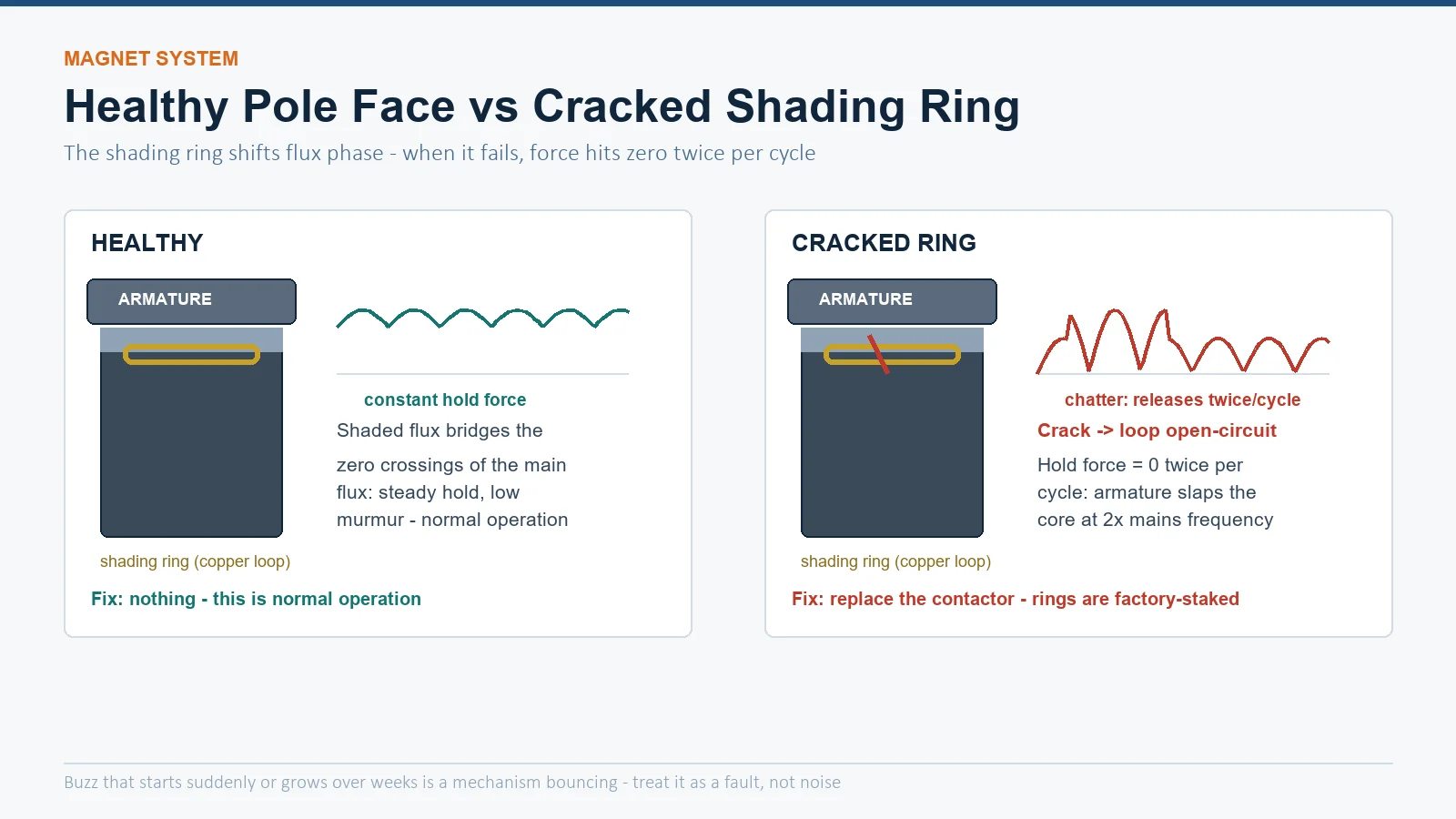
A shading ring is a shorted copper loop embedded in one half of each pole face. It splits the magnetic flux into two out-of-phase components so that, at the moment the main flux passes through zero (100/120 times per second on AC), the shaded flux still holds the armature — that is what keeps an AC contactor from chattering by design. When the ring cracks, or its embedding slot loosens so the loop goes open-circuit, the holding force collapses to zero twice every cycle and the armature slaps against the core at exactly twice mains frequency: a loud, metallic, rhythmic buzz that gets worse over weeks.
Confirm by inspection: pull the armature and look at each pole face. A cracked ring is usually visible as a hairline fracture across the copper loop; a loose ring rattles when the contactor is tilted. Shading rings are not field-repairable — the contactor is replaced, because the ring is cast or staked into the core at the factory.
| Check (in order) | Method | Result → conclusion |
|---|---|---|
| 1. Coil voltage under load | True-RMS meter across A1–A2 while pulling in | Below 85 % Uc → supply/wiring problem, fix the circuit |
| 2. Voltage OK but still buzzing | Isolate, inspect pole faces | Dirt/rust/oil film → clean, retest |
| 3. Faces clean but buzzing | Inspect shading rings | Crack or looseness → replace the contactor |
| 4. Coil open or swollen | Resistance test vs rated band | Burnt coil (often a symptom of long chatter) → replace, then fix the root cause |
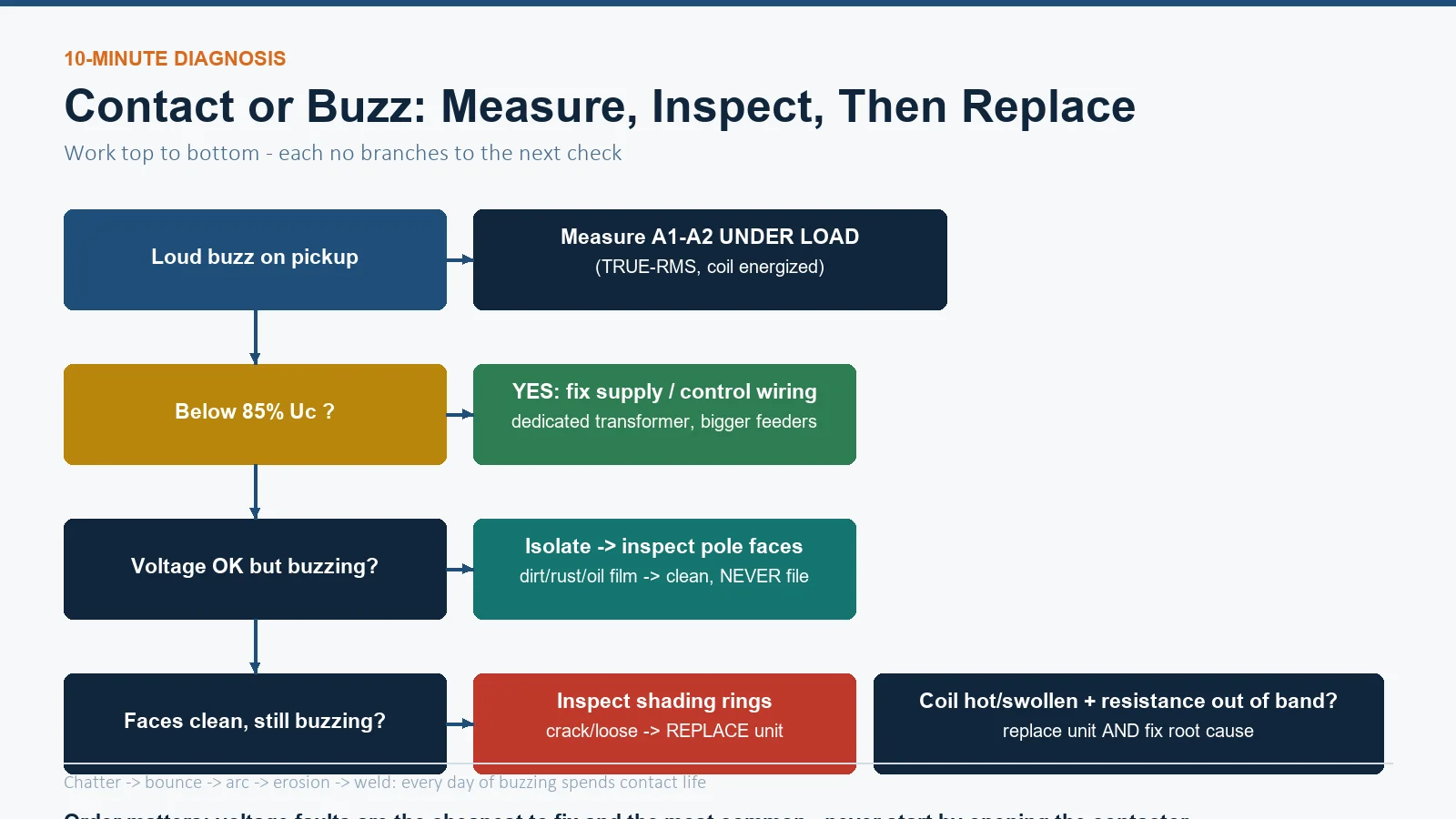
The buzz is not just noise — it is the mechanism bouncing. Each bounce separates and re-closes the main contacts under load, striking a small arc each time. The sequence is predictable: chatter → contact bounce → arcing → material transfer and erosion → contact welding or single-phasing. A 40 dB hum left unattended for a season routinely ends as a welded contactor and a stopped production line. The symptom-to-fix chain for the resulting faults is mapped in contactor troubleshooting: buzzing, chattering and coil failure, and if you inherit a machine that has already buzzed for months, the no-instrument checks in three no-tool contactor tests will tell you how much damage the contacts have already taken.
Two sounds are not faults. First, a single firm clack at pickup is the normal armature seating transient — louder on large frames, brief, and not repeated. Second, AC contactors inherently murmur at twice mains frequency; a low, steady murmur from a healthy 100+ A frame is normal. What is never normal: a buzz that starts suddenly, grows over time, or coincides with the contactor running hot. One more distinction worth knowing: a DC coil in an electronic or rectified coil module is essentially silent — if a “DC” contactor buzzes, its rectifier or economy circuit has failed, and the internal construction behind it is explained in inside an AC contactor: components and materials.
Most often the coil voltage at A1–A2 is below the 85 % pickup window, so the armature cannot seat. Measure at the coil terminals while energized, not at the supply. If voltage is correct, inspect the pole faces and shading rings.
You are gambling with a welded contactor and an unplanned stop. Chatter erodes contacts with every cycle. If the buzz started suddenly, treat it as a priority fault.
Fix the cause, not the symptom: correct the coil voltage (dedicated control transformer or heavier control wiring), clean the pole faces, or replace the unit if the shading ring is cracked. Pads, wedges or “damping” on the armature only mask the noise and worsen the seating gap.
IEC 60947-4-1 requires reliable pickup between 85 % and 110 % of rated control voltage Uc, and drop-out between 20 % and 75 % Uc. Design the control circuit so the coil never sees less than 85 % under worst-case load.
Yes — a chattering coil repeatedly draws inrush current instead of settling at the small sealed holding current, and the repeated arcing wastes energy in the contacts. The coil usually overheats before anyone notices the watts.
Larger AC frames have a steady low hum — normal. What is abnormal is a harsh, rising or suddenly appearing buzz, especially one you can hear across the room. Compare with identical contactors in the same panel; a unit noticeably louder than its twins has a fault.
Replacing a buzzing contactor? The 3TF series AC contactor uses a sealed, precision-machined magnet system with factory-staked shading rings, quiet operation and full IEC 60947-4-1 operating-band compliance. Tell us your coil voltage and frame size and we will match the replacement within one working day.