AC-15 vs DC-13: Auxiliary Contact Ratings Explained
AC-15 gives a contact 4 A at 240 V; DC-13 gives the same contact 0.3 A at 250 V. The categories, the test duties behind them, and the PLC dry-circuit floor.
Read More
Most contactors are thrown away for one of two reasons: worn contacts, or a fouled arc chute. The contact part is well documented; the arc chute is not. Yet the arc chute decides whether the arc dies in 10 ms or lingers long enough to weld contacts, and a carbonized chute can quietly bridge insulation paths until the contactor fails in service. This page explains what arcing deposits do inside the chute, how to tell a cleanable chute from one that must be replaced, and how to set a cleaning interval that matches your environment instead of a generic schedule.
When the contacts part under load, the arc is drawn upward into a stack of steel splitter plates. The stack slices one long arc into a series of short arcs in series. Each gap contributes roughly 20–30 V of arc voltage, and the sum has to exceed the supply voltage for the current to force down toward zero and stay there. That voltage budget is the chute’s entire job — and arc by-products spend it:
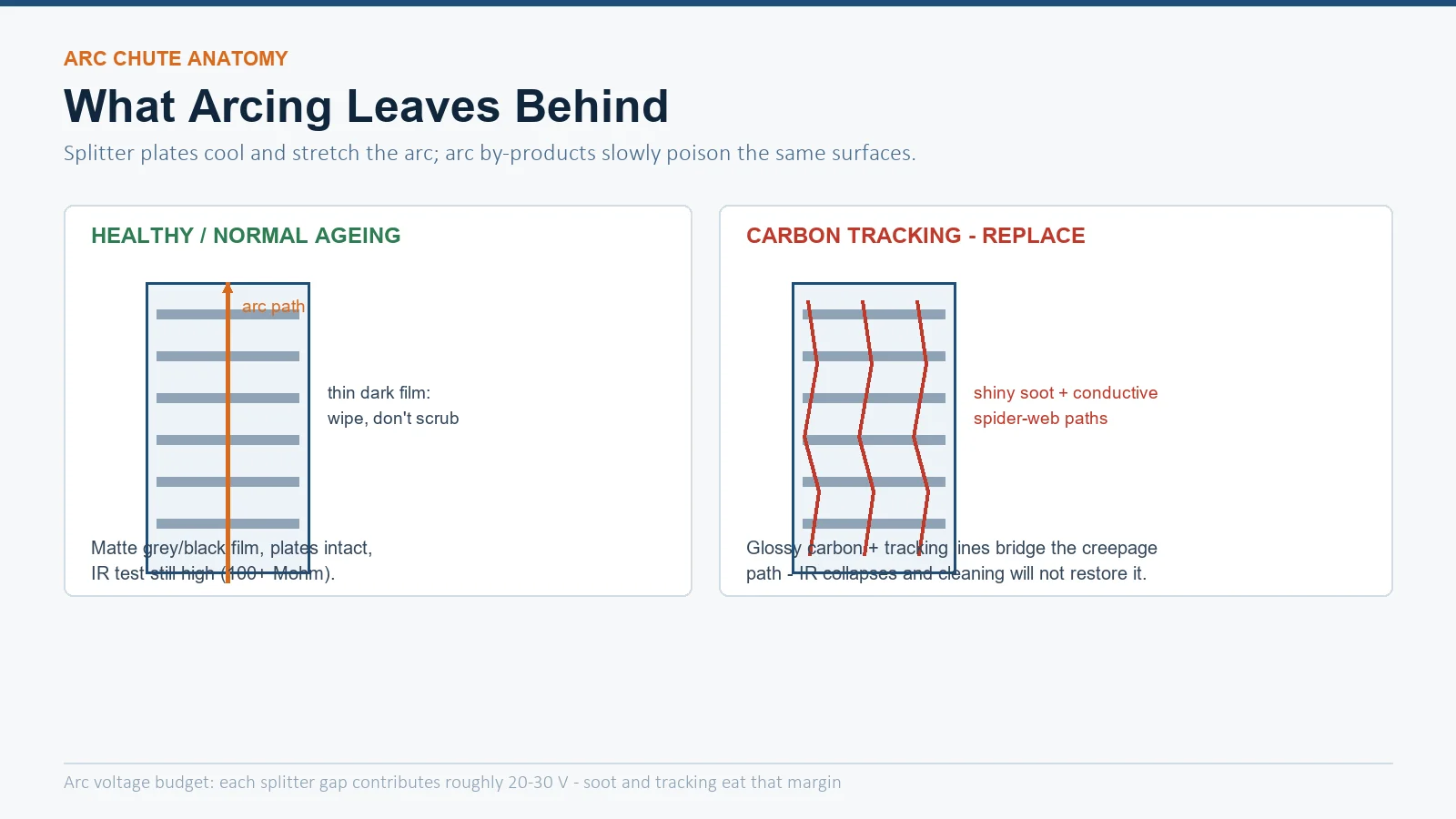
Inspection is about telling these apart, because the remedy is completely different.
| What you see | What it is | Action |
|---|---|---|
| Matte grey/black powder, uniform on plates | Normal arc by-product — surface film | Clean (dry air, soft brush) |
| Glossy, baked-on soot layer on plastic walls | Heavy service; film starting to carbonize | Clean carefully + shorten interval |
| Spider-web brown/black lines across barriers | Carbon tracking — conductive path | Replace chute or contactor; cleaning cannot restore tracking resistance |
| White/milky discoloration or blistered plastic | Overtemperature event (overload, stuck-closed) | Replace; insulation has been driven past its rating |
| Cracked, melted or missing splitter plates | Mechanical/thermal damage | Replace the chute — the arc voltage budget is gone |
The decisive test is insulation resistance. Pole-to-pole and pole-to-earth at 500 V DC megger: a clean, dry chute on a small contactor reads in the hundreds of megaohms; below about 10 MΩ, or a big drop versus its sister poles, the chute is no longer doing its insulating job. Trend the reading — the maintenance inspection checklist includes it as an annual task, and a falling IR curve is your earliest warning.
Generic schedules are useless because duty and atmosphere vary by orders of magnitude. Use the environment to set the baseline, then let test results override it:
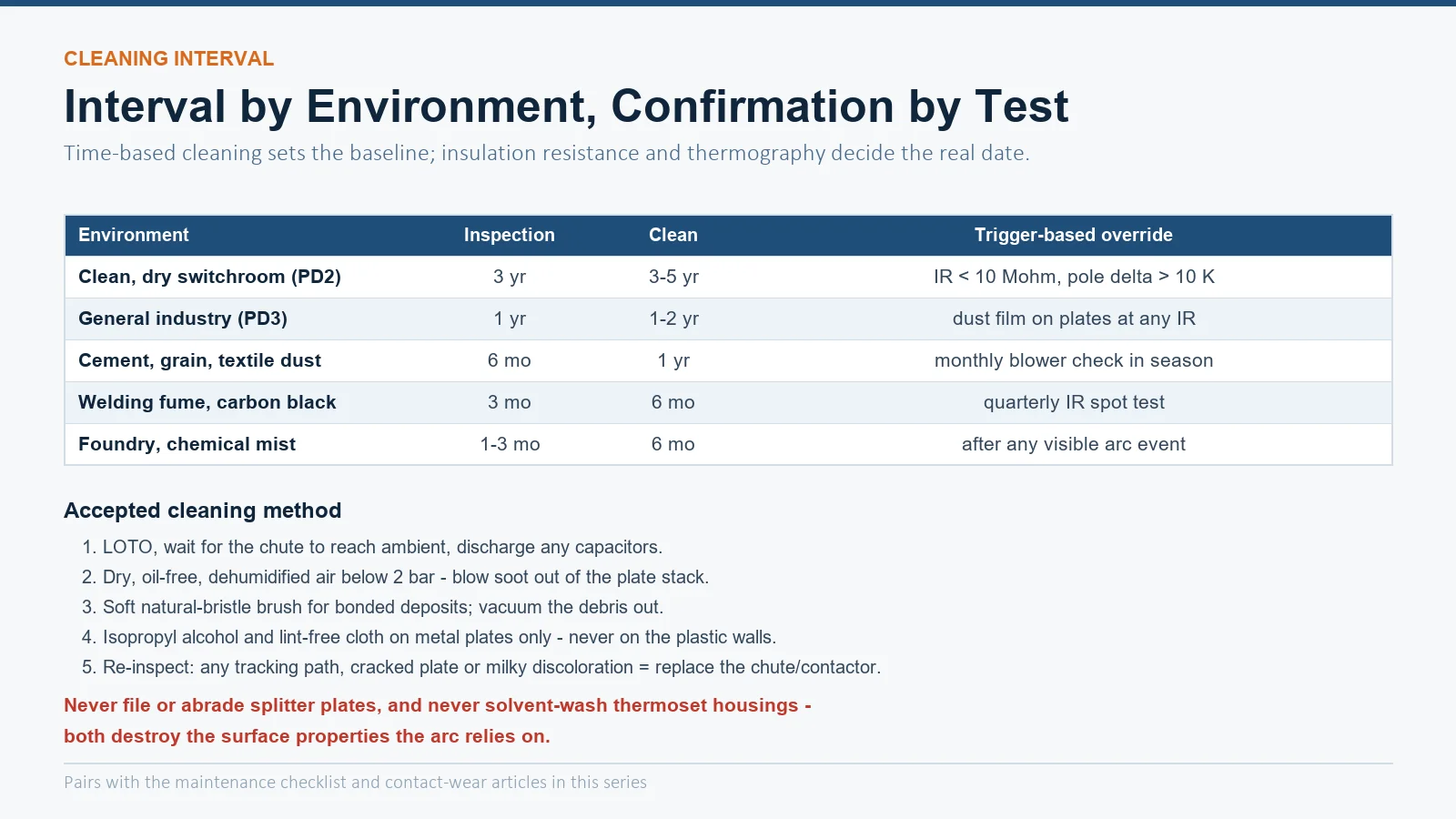
| Environment | Inspection | Clean | Override triggers |
|---|---|---|---|
| Clean, dry switchroom | 3 yr | 3–5 yr | IR < 10 MΩ; pole delta > 10 K on thermography |
| General industry | 1 yr | 1–2 yr | visible dust film on plates at any IR value |
| Cement, grain, textile dust | 6 mo | 1 yr | monthly blower check in dusty season |
| Welding fume, carbon black | 3 mo | 6 mo | quarterly IR spot test |
| Foundry, chemical mist | 1–3 mo | 6 mo | after any visible arc event or trip under load |
Two frequency multipliers matter as much as the atmosphere. First, operations count: a feeder started fifty times a day lays down arc products fifty times faster — high-cycle contactors need the aggressive row of the table regardless of how clean the room is (frequency limits are covered in our duty cycle guide). Second, load type: AC-4-style plugging and jogging duty arcs harder per operation than AC-3 running current switching, and DC loads are harder again because the arc never crosses zero — see our DC arc extinction guide for why DC chutes suffer most.
Safety interlocks are part of the job too: a chute fouled badly enough to fail may coincide with the other end-stage faults (welded contacts, humming magnet system) listed in our troubleshooting index.
Chutes on small frames (up to ~32 A) are generally not economical to service — replacement contactors are cheap and the labor is the same. On large frames (115 A and up) and on contactor contact sets for CJX2/CJX4/CJ35-265F class frames, replaceable chutes and contacts are the rule; weigh chute condition, contact wear and coil health together, since all three age at similar rates. Our contact wear thresholds and the replacement cost breakdown give the economic side of that decision.
It is worth quantifying why a fouled chute fails the way it does. Splitting a 400 V AC arc needs enough series gaps that the summed arc voltage exceeds the instantaneous supply voltage; at roughly 20–30 V per gap, that is around 8–10 gaps in the worst case, which is why even small contactors carry stacks of a dozen plates. Now subtract from each gap: a carbonized wall that lets the arc burn along a surface instead of resting between clean plates contributes far less voltage. The sum no longer reaches the supply voltage, the arc keeps burning past the current zero it should have extinguished at, and the contact separates another few millimeters per half-cycle until something fails — usually the contacts, sometimes the chute walls, occasionally the neighbor phases.
This is also why chute condition changes your effective utilization category headroom. The same frame that passes an AC-3 break test with a clean chute can hang an arc on a fouled one at half the current. If your troubleshooting log shows unexplained contact welding on a feeder that has run for years without changes, inspect the chute before blaming the coil or the load — the pattern matches, and it costs nothing to look. Pair the inspection with the coil-side checks in our coil test guide to close out both failure directions in one visit.
Finally, remember the environment can be engineered, not just tolerated. Panel filters, sealed-and-pressurized enclosures, and simple rain hoods on outdoor cabinets move a “foundry-grade” contactor back toward the clean-room row of the interval table — sometimes a cheaper fix than doubling inspection frequency.
There is no universal number. Start from the environment table above (annually in general industry, down to quarterly in fume-heavy plants), then adjust with insulation-resistance trends and thermography — a pole running more than 10 K hotter than its sisters is telling you the chute or contacts need attention now.
No. Tracking is a carbonized, conductive path grown into the insulation surface itself. Cleaning removes the loose soot but the track remains and re-establishes conduction almost immediately. The barrier or chute must be replaced.
Not by itself. A thin matte film is the normal by-product of switching. It becomes a defect when it turns glossy and baked-on, when it clogs the plate gaps, or when insulation resistance drops — all three are visible or measurable in a five-minute inspection.