Contactor Derating for Temperature, Altitude and Dust
Published: Author: Lisa
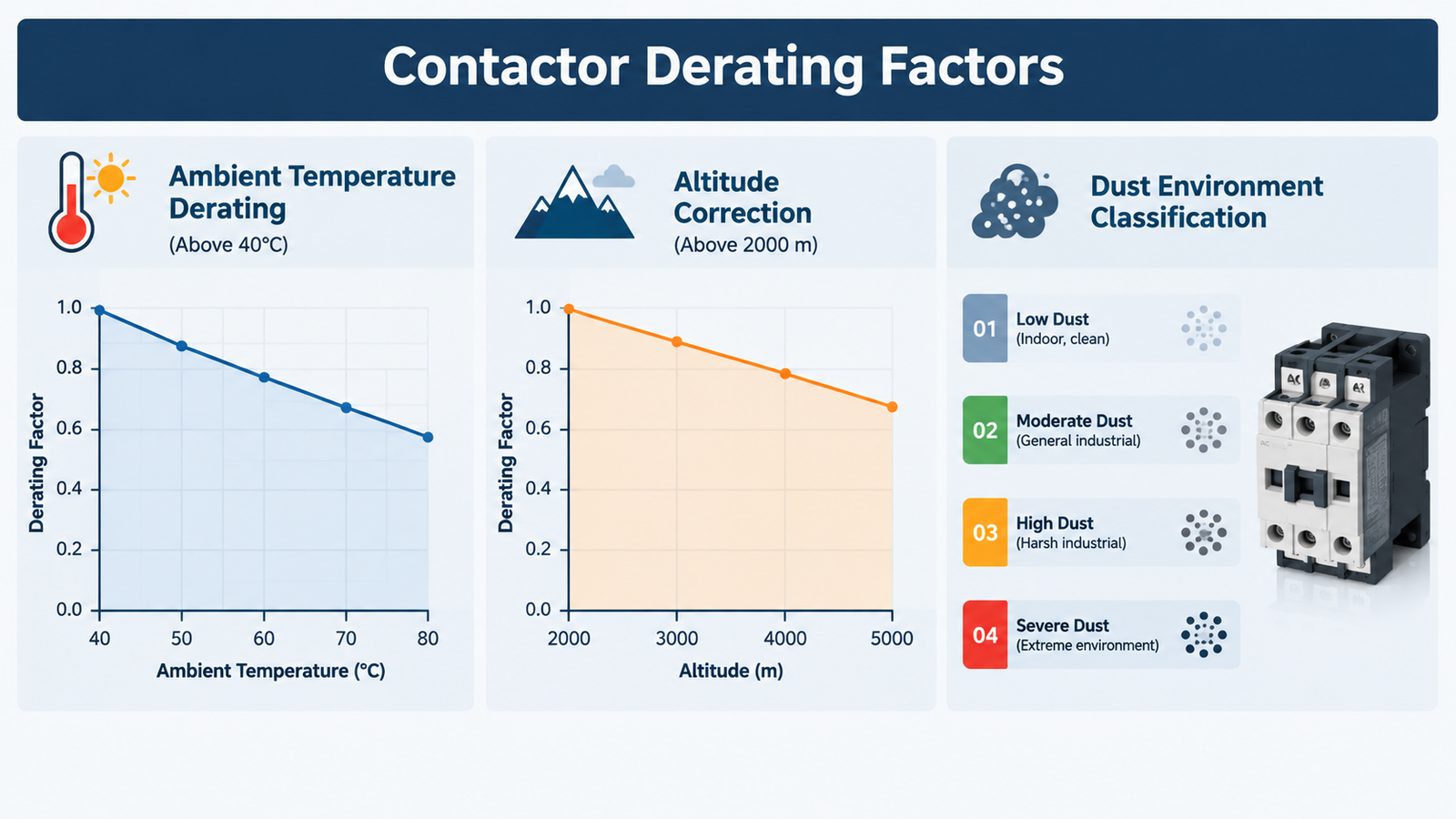
Every contactor derating question starts the same way: the datasheet says the frame is good for 115 A, the panel runs hot, the site sits at 2,300 m, and the air is full of cement dust. Which of those numbers still applies? The honest answer is that the 115 A was never a single number — it was a rating at a reference temperature, a reference altitude, in clean air, mounted with specified clearances. Change any of those conditions and you are buying a different contactor.
This guide puts numbers on the three conditions that quietly shrink a contactor’s rating: ambient temperature, altitude, and airborne dust. Competitor catalogs usually mention each in one sentence; the tables below give working correction factors, the physics behind them, and the sequencing for stacking them when more than one applies. If you have not yet confirmed the utilization category of your load, do that first in the AC-1 to AC-4 utilization categories guide — derating factors multiply the category rating, they do not replace it.
Quick Answer: Which Condition Cuts Which Rating
コンディション
What it reduces
Typical correction
Where it is specified
Ambient above 40 °C
AC-1 / AC-3 current rating, coil life
Roughly 1% per °C above 40 °C for AC-1; coil rated to +55 °C storage but Class B/F insulation ages faster
IEC 60947-4-1 reference ambient 40 °C
Altitude above 2,000 m
Thermal rating and dielectric strength (working voltage)
Below 2,000 m: none. Above: current and voltage correction per manufacturer curves; roughly −0.5% current and −1% dielectric per 100 m
Read the table as three different mechanisms, not one. Heat attacks the current-carrying parts and the coil insulation. Altitude attacks both cooling (thinner air carries less heat) and insulation (lower breakdown voltage). Dust does not change the contactor’s rating at all — it changes the environment the rating was assumed in, and therefore how fast the real device drifts away from the catalog.
Temperature Derating: The 40 °C Reference
IEC 60947-4-1 rates contactor current at an ambient of 40 °C. Below that, you gain nothing meaningful in AC-3 duty — motor-switching margins are set by contact economics, not cooling. Above 40 °C, the manufacturer’s derating curve is the authority, but the physics gives you the slope: contact and terminal heating is roughly proportional to I², and the margin to the 40 °C reference is what you are spending.
Ambient inside enclosure
AC-1 heater/capacitor loads
AC-3 motor loads
≤ 40 °C
100% of rating
100% of rating
50 °C
≈ 90–92%
≈ 95–97% (consult curve)
55 °C
≈ 85–88%
≈ 93–95% (consult curve)
60 °C
≈ 80–84%
≈ 90% or frame upsize — verify with curve
70 °C
Do not size by factor; upsize frame and verify terminal temperature limits
Frame upsize mandatory
The reason AC-3 loses less than AC-1 is that AC-3 ratings already carry headroom for the locked-rotor and starting duty that dominates a motor contactor’s thermal life, while AC-1 continuous heater duty sits right at the thermal limit. That is also why heater panels are the ones that cook contacts shut in summer.
Two practical points most specifiers miss:
Measure the ambient at the contactor, not the room. A 35 °C plant room with a 20 W coil and three 100 A poles in a sealed enclosure can easily hold 55 °C at the device. The coil itself adds 10–20 W continuously — sealed-rated coils more than resistive ones.
Coil insulation ages on its own clock. A Class B coil is good for 130 °C internally; at high ambient plus sealed current, the winding sits closer to that limit, and every additional 8–10 °C roughly halves insulation life. In hot cabinets, specify Class F (155 °C) coils — most CJX2-F frames offer them — before you spend money on a bigger frame.
Worked Example: 45 kW Pump in a Hot Rooftop Plant Room
A 45 kW / 400 V pump draws about 86 A in AC-3. The datasheet answer is a CJX2-F115. The plant room reaches 50 °C in summer and the enclosure is flush-mounted against a sun-facing wall. Working the factors:
AC-3 at 50 °C: apply ≈ 0.95 → 115 A × 0.95 ≈ 109 A usable. Still above 86 A, but the margin has dropped from 34% to 27%.
Coil: choose the Class F coil option; standard Class B would age visibly faster at 50 °C ambient.
Enclosure: verify the enclosure itself is rated for the internal rise — a device that passes but cooks its neighbors is still a failure. The thermal grouping effect inside multi-device enclosures is covered in the modular contactor system design guide.
Result: the same frame stays, but with a documented 27% margin and a hotter coil spec. Without the derating pass, the panel ships looking correct and fails on the first 40 °C week.
Altitude Derating: Why 2,000 m Is the Cliff
IEC 60947-1 specifies operation up to 2,000 m without correction. Two things change above that line, and they pull in the same direction:
Cooling: air density falls roughly 1% per 100 m, so convection carries proportionally less heat away from the contacts and coil.
Dielectric strength: breakdown voltage across open contacts and clearance paths falls with pressure. IEC 60664-1 provides the correction factors; below 2,000 m the margins in 60947 designs absorb it, above that they do not.
Altitude
Relative air density
Typical current correction
Typical working-voltage correction
≤ 2,000 m
100%
None
None
3,000 m
≈ 90%
≈ 0.95 × rating
≈ 0.95 × rated insulation voltage
4,000 m
≈ 82%
≈ 0.90 × rating
≈ 0.90 × rated insulation voltage
5,000 m
≈ 74%
≈ 0.85 × rating, verify with manufacturer
≈ 0.85 × rated insulation voltage
Two consequences matter for export projects into highland markets (Andean, East African, Central Asian sites):
The voltage correction bites before the thermal one. A contactor rated 690 V insulation may only support 620–650 V working at 4,000 m. For 690 V motor circuits at altitude, step up to the next insulation class or confirm the manufacturer’s altitude-corrected voltage table — this is a certification question as much as a thermal one.
Arc behavior changes. Interruption relies partly on deionizing the gap; at low pressure the arc runs longer and the arc chute works harder. Devices pushed to their AC-3 limit at sea level lose that margin first. Severe-duty DC switching at altitude compounds this — the DC contactor arc extinction guide covers the low-altitude physics that altitude then degrades.
Dust and Pollution: It Is an Enclosure Decision
Dust is the one derating topic with no correction factor, because the failure modes are not thermal. Three separate mechanisms are in play:
Non-conducting dust (wood flour, grain, textile fiber) insulates. It packs into arc chutes and coil ventilation paths, holds heat in, and — the expensive one — bridges creepage distances over months. The contactor’s rating stands; its pollution degree assumption does not.
Conducting dust (carbon dust, metal grinding swarf, some mineral dusts) can bridge clearances directly. IEC 60947-1 pollution degree 3 environments — conductive pollution, or non-conductive pollution that becomes conductive through condensation — take the contactor out of its assumed environment entirely.
Abrasive dust (cement, foundry sand) erodes pole faces and wears mechanism bearings, showing up as humming and chatter long before an electrical fault.
環境
Pollution degree (IEC 60947-1)
Enclosure choice
Maintenance consequence
Clean control room, HVAC-filtered
Pollution degree 2
IP20 device in IP44 cabinet
Standard inspection intervals
General factory floor, non-conductive dust
Pollution degree 2–3
IP54 cabinet, filtered vents
Quarterly internal cleaning; check creepage paths
Cement / mineral / grinding swarf
Pollution degree 3 (conducting)
IP54 minimum, IP65 where washdown; positive-pressure filter for control sections
Monthly checks; treat pole-face wear as a wear item
Outdoor, rain + dust
Environmental, not device
IP65/IP66 with condensation management
Seal and breather checks each season
The enclosure choice interacts with the temperature section above: the tighter you seal against dust, the less convection the cabinet has, and the hotter the contactor runs. Dust protection and thermal derating are not independent decisions — specify them together, and if the sealed cabinet pushes the internal ambient past 50 °C, revisit the current derating with that number.
Stacking the Factors: The Order That Matters
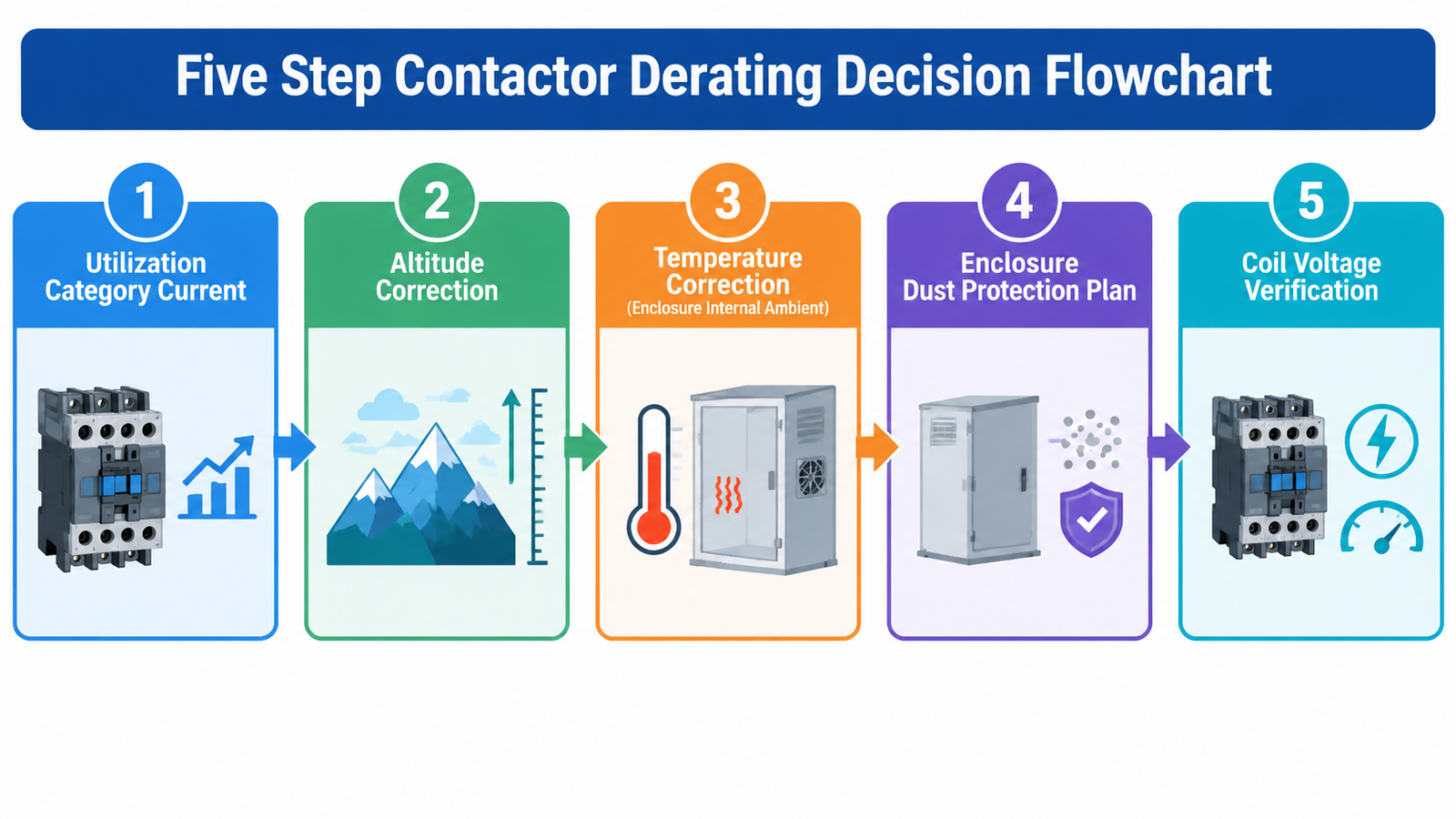
When a site has two or three of these conditions, apply them in this sequence and stop at the first decision that forces a frame change:
Start from the actual utilization category current at your voltage — AC-1, AC-3 or AC-4, not a blended guess.
Apply the altitude correction first (current and working voltage), because it also constrains which frames remain certified for the site.
Apply the temperature correction second, using the enclosure internal ambient, not the room ambient.
Then check the enclosure and dust plan — if the result forces a higher IP cabinet, loop back to step 3 with the new thermal reality.
Finish with the coil: control voltage at the coil terminals must stay within 85–110% of rated under these conditions; long control runs in hot cabinets erode that margin. The pickup and drop-out windows are quantified in the contactor coil test guide.
Applying factors in the wrong order usually means applying them twice to the same margin — for example, derating for dust with an oversized enclosure and then derating again for the enclosure’s higher internal temperature. Pick one owner for each mechanism.
The Frame-Up Decision: When a Factor Just Means the Next Size
Correction factors are for margin accounting. In procurement, three situations should simply trigger the next frame up, because the arithmetic saves nothing:
Situation
Why the factor approach fails
アクション
AC-4 duty in a hot or dusty site
AC-4 ratings are already deep into contact erosion; no thermal margin left to spend
Contactor derating is not one multiplier — it is three different mechanisms attacking three different parts of the rating. Temperature spends thermal margin, altitude spends both thermal and dielectric margin, and dust invalidates the environment the rating assumed. Apply them in the order above, use enclosure-internal temperature as the input, and let the hard cases (AC-4, high starting frequency, conductive dust) push you to the next frame instead of pretending a percentage covers them. For frame selection fundamentals, start with how to size and select a contactor, and browse the full AC contactor range for the frames and coil options referenced here — the CJX2-F series contactors cover the 115–630 A frames where most hot-site and high-altitude upsizing lands.
よくあるご質問
Does a contactor need derating below 40 °C ambient?
Not for current rating. Cold environments raise concerns about condensation and coil performance at startup, but the current rating applies in full below the 40 °C reference.
How much does altitude reduce contactor rating?
Nothing below 2,000 m. Above that, manufacturers apply roughly 5% current and 5% insulation-voltage reduction per 1,000 m as a working figure, but the exact curves are device-specific — always use the manufacturer’s altitude table for certification purposes.
Can I just put the contactor in a bigger enclosure instead of derating?
Sometimes. A larger or ventilated enclosure lowers internal ambient, which is the real input to the temperature curve. It does nothing for altitude or conductive dust, and it must not become an unsealed opening in a dust environment.
Does dust damage the contacts themselves?
Non-conductive dust mostly harms through heat retention and creepage bridging. Abrasive dust erodes pole faces and causes noise. Conductive dust can bridge contacts and clearances directly — that is the case where enclosure IP is non-negotiable.
Do coil ratings need derating at high temperature?
The coil’s operating range is fixed (typically 85–110% of rated voltage), but its life is not. At high ambient, specify Class F insulation coils and verify the control voltage at the terminals, since long runs and hot cabinets erode the pickup margin.
Is derating cumulative if I have both heat and altitude?
The factors apply to the same rating and stack, but they are not simply multiplied in every catalog — some manufacturers provide a combined curve. Apply altitude first, then temperature, and confirm the final combination against the manufacturer’s data rather than multiplying two independent factors.
Input side sees harmonics, output side sees PWM — and neither contactor should do the drive's job. Selection margins, sequencing rules, bypass interlocking, and the DC paths where AC contactors must not go.
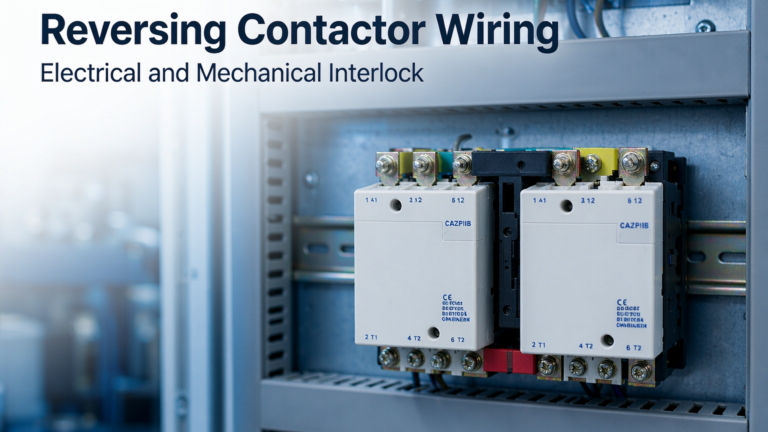
The full reversing starter: power wiring with two phases swapped, cross-coupled NC electrical interlock, mechanical interlock backstop, 50–100 ms dead time, and why weld detection is the layer no interlock provides.
Resistance screens the winding, pickup voltage proves it will seat on a sagging bus, drop-out proves it will release. Reference bands, IEC windows, and the five root causes behind burnt coils.