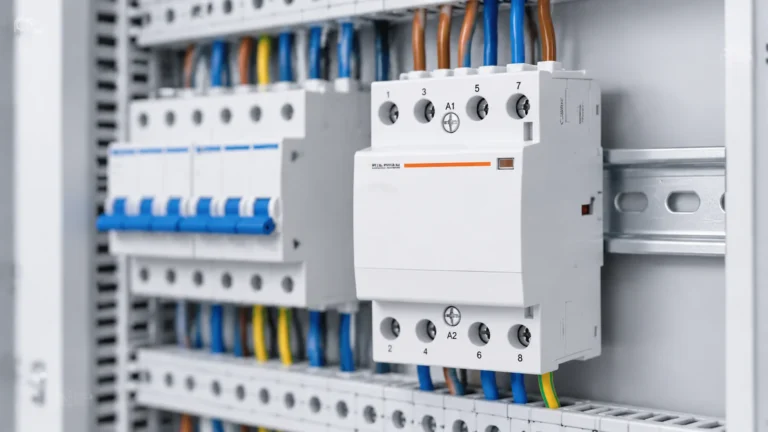
Bypass Contactor and Soft Starters: Wiring, Sizing and When You Need One
Published: Author: Lisa
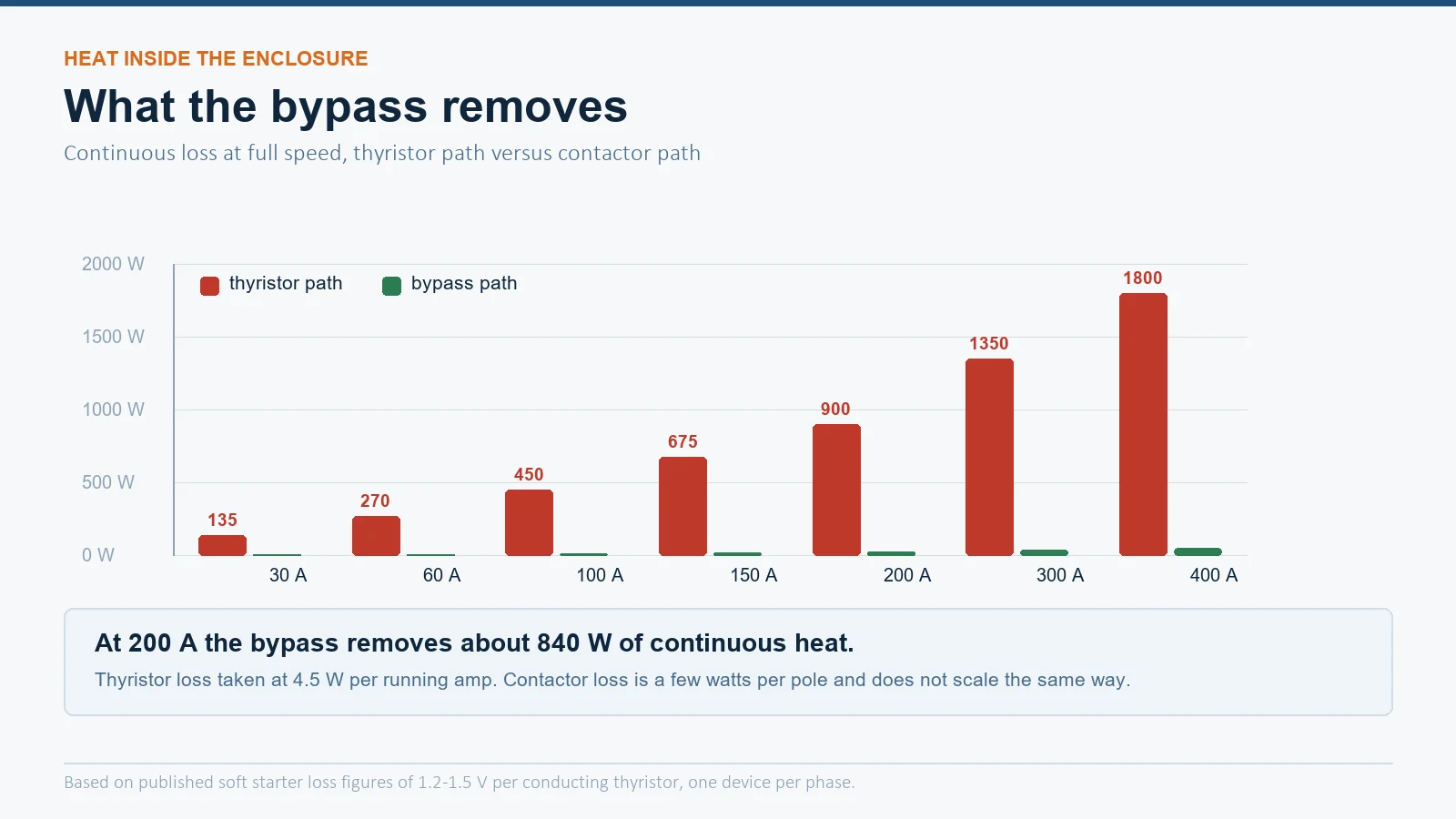
Quick answer: A bypass contactor shorts across a soft starter’s thyristors once the motor reaches full speed, so running current stops passing through the SCRs. That saves roughly 4.5 W per running amp — about 840 W on a 200 A motor — as heat inside the cabinet. Size it on the motor’s full-load current: AC-1 at FLA when the starter sequences the transfer so the contactor never makes or breaks motor current, or AC-3 at FLA × inrush multiple ÷ 6 when it might have to. Never size it below the motor FLA either way.
Soft starters are usually sold on the ramp. The bypass contactor is the part that decides whether the installation survives its first summer.
Three things go wrong repeatedly. The bypass is sized on the starter’s rating instead of the motor’s, so it cooks in a 50 °C panel. The control sequence is left to default, so the contactor closes onto a spinning motor and cycles. Or the current transformer is mounted inside the bypass path, and the starter goes blind to the current it is supposed to be protecting.
This page covers what the bypass does, why it can be lightly rated in one arrangement and must be fully rated in another, how the wiring and control sequence should look, and when a bypass is the wrong answer. If you are still choosing the frame itself, the AC contactor range is the starting point.
What the bypass contactor is actually for
Once a motor is at full speed, a soft starter is not controlling anything. The thyristors are held in full conduction and the device is an expensive set of closed switches. But closed switches still drop voltage, and unlike a contactor, they drop it continuously.
Each conducting thyristor falls about 1.2 to 1.5 V. One device conducts in each phase at any instant, so the total drop is roughly 1.4 V per phase times the line current, across three phases. The dissipation figures published by soft starter makers land in the same place: around 4.5 W per running ampere. A 200 A motor therefore dumps roughly 840 W into the enclosure, permanently, for no functional benefit.
That heat drives heat sink size, fan requirements, cabinet ventilation and derating. A silver-alloy contact pair drops millivolts rather than volts, so closing a contactor across each phase cuts the loss by more than an order of magnitude. In a sealed enclosure the bypass is not an efficiency option — it is the only way to build the panel at all.
Why the bypass can be lightly rated
The reason a bypass can be AC-1 rated is sequencing, not optimism. In a correctly configured starter:
Closing: the bypass closes while the thyristors are already conducting fully. The voltage across the closing contacts is only the thyristor drop, so current transfers with essentially no arc.
Opening: the starter re-establishes thyristor conduction before releasing the bypass coil, so the contactor opens with the SCRs carrying the current.
Under that sequence the contactor never makes or breaks motor current. It carries current continuously and switches at near-zero current — which is what AC-1 describes. Several soft starter manufacturers state this directly: their internal bypass contactors are not fully rated to AC-3 precisely because they are designed not to make or break load current.
What AC-1 does not license is undersizing. The contacts still conduct the entire motor current, so the continuous rating must be at or above FLA after ambient and enclosure derating — a 60 A motor needs a contactor whose thermal current is 60 A in the conditions it will actually live in, not 60 A on a datasheet measured at 40 °C in open air.
When AC-1 is not enough
Situation
What the bypass has to do
Rating required
Normal start/stop, correctly sequenced
Carry running current, switch at near-zero current
AC-1 at motor FLA
Bypass may open under load (jam, fault, control dropout)
Break running current, possibly at locked-rotor values
AC-3, sized on inrush
Emergency bypass / HOA selector to run without the starter
Start the motor direct-on-line and break it under load
Full AC-3 or FVNR motor duty, plus external overload protection
The AC-3 sizing method for a bypass that may switch load current is arithmetic, not guesswork. Take the motor FLA, multiply by its starting-current multiple, and divide by six — the six-times making characteristic that defines AC-3:
Bypass rating = (FLA × inrush multiple) ÷ 6
A 200 A motor with a 10 times starting current needs (200 × 10) ÷ 6 = 333 A of AC-3 rating — substantially larger than the 200 A an AC-1 calculation would have given. The gap widens with higher-efficiency motors, which tend to draw more starting current.
The case that forces this calculation is a rock crusher or similar load where a jam spikes current while running. An internally bypassed starter detects the overload, drops out of bypass and returns to thyristor control — so the bypass opens under load every time a jam occurs. A contactor sized for AC-1 will not last a season in that duty.
There is a second failure mode worth knowing: a bypass that fails open. The motor keeps running, so nobody notices, but the thyristors are now carrying full running current continuously. They fail thermally within hours, and the replacement is a power stack rather than a contactor.
Wiring the power circuit
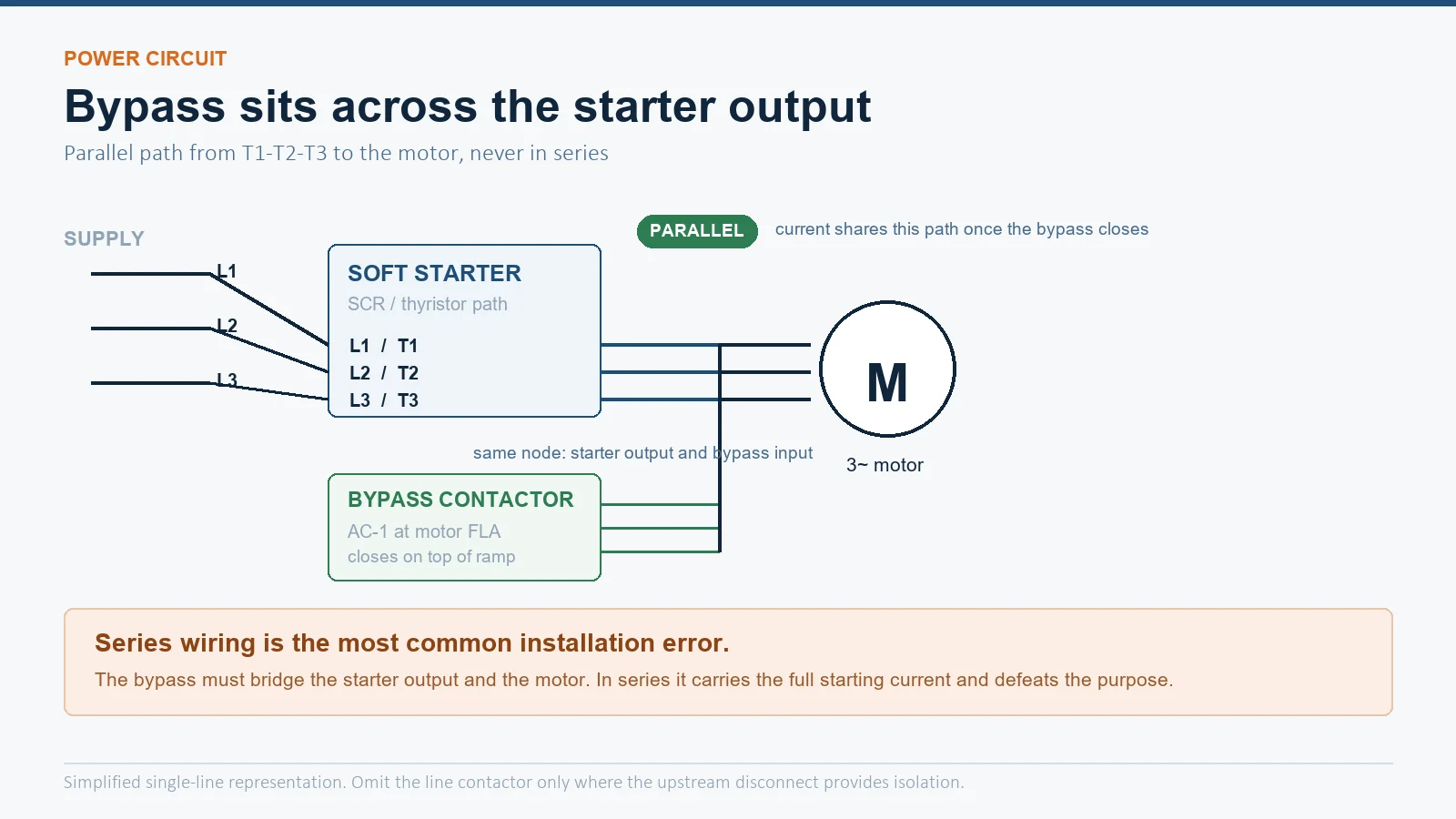
The bypass contactor connects in parallel with the soft starter’s output, not in series with it. Its input side lands on the starter output terminals (T1, T2, T3) and its output side lands on the motor, forming a separate low-impedance path around the SCRs. Wiring it in series anywhere in the main circuit defeats the purpose and usually trips on start.
Arrangement
Components
What it buys you
Bypass only
Disconnect + starter + bypass
Thermal relief. The upstream disconnect provides isolation. Smallest footprint and cost.
Line contactor + bypass
Line contactor + starter + bypass
Controlled disconnection, physical isolation of the SCRs when idle, protection from supply transients. The line contactor must be AC-3 because it makes starting current.
Emergency bypass
Line + starter + bypass + HOA selector
A direct-on-line fallback if the starter fails. The contactor must be fully AC-3 and the motor needs external overload protection, since the starter is out of circuit.
Note the asymmetry in ratings between the two contactors. The line contactor sees starting current every time the motor starts, so it is an AC-3 device at motor FLA. The bypass usually is not. Panels using the same part number in both positions are either overpaying on the bypass or under-specifying the line contactor.
Control side: top of ramp, auto-bypass and CT placement
Close on top of ramp, not on a timer. The bypass is driven by a programmable relay configured as “top of ramp” or “bypass relay”, which only picks up when the ramp has completed and motor terminal voltage equals line voltage. Do not drive the coil from an external timer set to “about the ramp time” — if it is short, the contactor closes onto a partly energised motor and makes current it was not rated for.
Auto-bypass must be enabled. Starters with a bypass option have a parameter telling the controller a bypass is present. With it off, the handover is not managed correctly and thyristor faults follow. It is a commissioning setting, and it is routinely missed when a bypass is added to an existing starter.
Put the current transformer outside the bypass path. If the starter uses an external CT for current trips and monitoring, mount it in the L3–T3 phase outside the bypass circuit. A CT inside the bypassed path reads zero once the bypass closes, so the starter loses overload, undercurrent and phase-loss protection exactly when the motor is running. Some starters also need a bypass-mode protection setting, such as start-plus-bypass rather than start-only.
Sizing the starter, and why the bypass does not fix it
The bypass carries running current; the starter carries starting current, and that is what sets its rating. For short starts at low frequency the motor FLA is close enough. For high-inertia loads, long ramps or frequent starts it is not, and the equivalent thermal current is:
Ie = Is × √(ts × n ÷ 3600)
where Is is starting current in amps, ts the ramp time in seconds and n the starts per hour. A 360 A motor started at 5 times FLA for 25 seconds, eight times an hour, gives 1,800 × √(25 × 8 ÷ 3600) = 425 A of equivalent thermal current against an FLA of 360 A. The starter must be rated for 425 A in continuous-duty terms, or you accept the bypassed rating and size the SCRs for 360 A. That is the practical meaning of the two IEC 60947-4-2 categories: AC-53a for a starter that conducts continuously, AC-53b for one that is bypassed during run. The rating string spells out the duty — AC-53a:3.5-30:99-1 reads as 350% current limit, 30 second start, 99% on-load factor, one start per hour.
Derating applies on top: roughly 0.8% per °C above 40 °C ambient and 1% per 100 m above 1,000 m altitude, so a 250 A unit in a 50 °C cabinet at sea level behaves like a 230 A unit. The same corrections apply to the bypass contactor’s continuous rating, and they are why a bypass that “worked in the workshop” fails on site. The principles in contactor derating apply unchanged.
Bypass versus a VFD
A VFD does not need a bypass in normal operation — it controls the motor continuously and there is nothing to short out. What a VFD installation sometimes gets is a drive bypass: a contactor arrangement that lets the motor run direct-on-line if the drive fails. That is a redundancy feature, and the contactor must be fully AC-3 rated because it starts the motor.
Soft starter with bypass — controlled acceleration and deceleration with full-speed running and no power electronics in circuit. Pumps, fans, conveyors, compressors. Lowest run losses, smallest panel.
VFD — you need to change running speed, not just the ramp. The drive stays in circuit, so its losses are permanent.
VFD with bypass — speed control plus a fallback path. Costs panel space and needs interlocking so the drive output and the bypass can never both be connected.
Mistakes worth checking before you close the panel
Mistake
Consequence
Correction
Bypass sized on starter rating, not motor FLA
Runs hot, contacts erode, nuisance failures
Size on nameplate current after derating
AC-1 bypass in a process that can jam
Opens under load repeatedly; short life
AC-3 sized on FLA × inrush ÷ 6
External timer driving the bypass coil
Closes before ramp completes; makes motor current
Use the starter’s top-of-ramp relay
Auto-bypass parameter left off
Handover not managed; thyristor faults
Enable at commissioning and record the setting
CT mounted inside the bypass path
No current reading, no overload protection in run
Mount CT in L3–T3 outside the bypass circuit
Same contactor used for line and bypass
Either overspend or an undersized line contactor
Line AC-3 at FLA; bypass per duty
Bypass omitted in a sealed enclosure
SCR heat has nowhere to go; thermal trip in summer
Fit bypass for NEMA 12/4 or IP65 panels
よくあるご質問
What does a bypass contactor do on a soft starter?
It closes a metallic path across the thyristors once the motor reaches full speed, so running current bypasses the SCRs. That removes the continuous thyristor voltage drop — roughly 4.5 W per running amp — from inside the enclosure and lets the starter be built into a sealed panel.
Can I use an AC-1 contactor as a bypass contactor?
Yes, when the starter sequences the transfer so the contactor closes and opens at near-zero current, and when its continuous rating at the actual enclosure temperature is at least the motor’s full-load current. If the bypass might make or break motor current — jams, faults, emergency run — the minimum is AC-3, sized on inrush.
How do I size a bypass contactor?
Start from the motor nameplate full-load current at the site voltage, not from horsepower and not from the starter’s rating. For AC-1 duty that figure is the answer once derating is applied. For AC-3 duty, multiply FLA by the starting-current multiple and divide by six: a 200 A motor at 10 times inrush needs 333 A of AC-3 rating.
Does a soft starter need both a line contactor and a bypass contactor?
Not always. A bypass alone gives thermal relief and relies on the upstream disconnect for isolation. A line contactor adds controlled disconnection and physical separation of the SCRs when idle, and some local codes require it. The line contactor must be AC-3 rated because it makes starting current; the bypass usually need not be.
Why does my soft starter trip after the bypass closes?
Most often the current transformer is wired inside the bypassed path, so the starter reads zero current in run and its protection behaves unpredictably — or the auto-bypass parameter is disabled and the handover is not managed. Check CT location first: it belongs in L3–T3 outside the bypass circuit.
Is a bypass worth it on a small motor?
Below roughly 30 A the saving is a few tens of watts and the panel is usually ventilated anyway, so a non-bypassed starter is often cheaper. Above 100 A the loss reaches several hundred watts and the bypass pays for itself in panel size, cooling and energy. In sealed enclosures the crossover point is much lower.
What to do next
Write down three numbers before ordering anything: motor full-load current at the site voltage, the starting-current multiple from the motor data, and whether the process can jam or needs an emergency run mode. Those three decide the utilization category, and the category decides the frame.
For the bypass position, the CJX2 series three-phase contactor covers the AC-1 continuous duty most bypass arrangements need, and the CJX2-F range from 115 A to 800 A covers the larger frames where a jam-capable process pushes you into AC-3 sizing. Send the motor nameplate, the ramp time and the starts per hour, and we will size both the starter duty and the bypass frame against real numbers rather than the horsepower label.
AC-6a and AC-6b are the IEC 60947-4-1 categories for transformer and capacitor switching. Why a standard AC-3 contactor can serve one and must never serve the other.
Contactors ship to India under HSN 8536 - usually 8536 50 10 or 8536 49 00 - at 18% GST, with 8 digits required on export invoices. Here is how to pick the right line.
AC-7a and AC-7b are the household load categories in IEC 61095. One explains why a 63 A modular contactor is only a 25-32 A motor device - and how to read the label before you order.