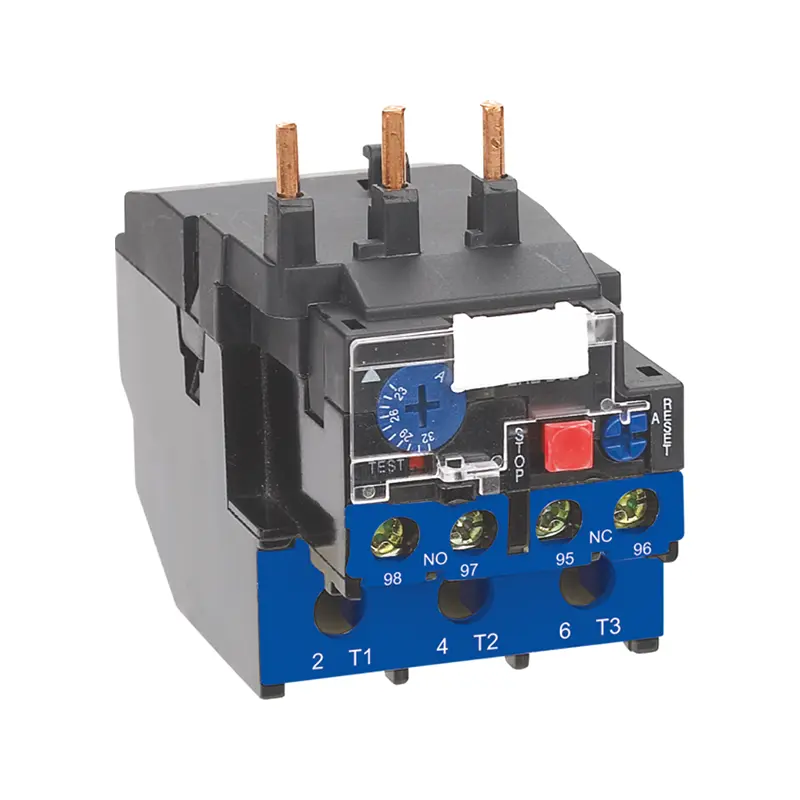








EKMF7 16-125A AC/DC Modular Contactor
Some loads have to be switched by something other than a hand. A car park light that comes on at dusk, a heater that starts before the building opens, a pump that runs to a timer — in each case a control signal makes the decision, and something has to turn that signal into a closed set of contacts. The EKMF7 modular contactor is that something: a coil-operated switch built to the width of a distribution board module, made in ratings from 16 A to 125 A.
Installers group it with the devices they call the modular contactor family. It takes its place on the same rail as the breakers around it, is wired the same way, and lives inside the same enclosure. The only real difference is who moves the contacts.
Switching a Load With Nobody Standing at the Board
Inside the housing sit a small electromagnet and a set of main contacts, separated by a moving armature. Energise the coil and the magnetic field drags the armature across, closing the contacts and passing supply to the load. Take the control voltage away and a spring returns them to open. That is the whole mechanism, and it has been the basis of automatic switching for as long as contactors have existed.
Where the Quiet Comes From
The EKMF7 runs an AC/DC universal coil, and the way that coil is driven is what makes it noticeably quieter in service than a conventional AC contactor. A standard AC coil is held closed by a magnetic circuit re-made fifty or sixty times a second, and the laminations buzz in sympathy — a hum that nobody minds on a factory floor but which is unwelcome in a hotel corridor or beside a bedroom wall.
What the Control Signal Has to Match
The coil is not interchangeable once the device is built. Its rated voltage has to match the supply that will energise it, and a 230 V coil driven from a 24 V control circuit will never pull in. Settle the control voltage before choosing the variant, not after the panel has been drilled.
Coil, Contact and Pole Options Across the Series
The series is offered as a matrix, and two choices define most of it: the coil voltage the control circuit will provide, and the number and type of main contacts the load needs.
Coil versions
Five nominal coil voltages are available — 12 V, 24 V, 48 V, 110 V and 230 V — and every one is built as an AC/DC universal coil, so the same device works whether the control circuit is fed with alternating or direct current. A control design that began on 24 V DC can therefore be stocked without a parallel 230 V AC line, and a panel converted from one control voltage to another keeps its existing switching devices.
Pole and contact arrangements
Main contacts come in one, two, three and four poles, in the combinations lighting and heating duty usually calls for: 1P with one normally open and one normally closed contact; 2P as 2NO, 2NC or 1NO+1NC; 3P as 3NO or 3NC; and 4P as 4NO, 4NC, 2NO+2NC or 3NO+1NC. Auxiliary contacts in NO and NC form extend the range for control and signalling circuits. Rated operational voltage follows the pole count — 250 V AC on the one- and two-pole versions, 400 V AC on three- and four-pole.
Ratings From 16 A to 125 A, and What Each Size Serves
Conventional thermal current across the series runs from 16 A to 125 A, divided into three size groups: 16/20/25/32 A, 40/63 A, and 80 to 125 A. The housing grows with the current, so the smallest units occupy the fewest modules and the largest take proportionally more rail width.
Sizing is a question of what the load draws in normal service, not what it draws for a moment at switch-on. Resistive loads such as heating elements sit close to their nameplate figure, while motors and pumps pull a multiple of it during acceleration and are governed by utilisation category instead. This series is rated for AC-1 and AC-3 duty, and for the AC-7a and AC-7b categories that apply to household and similar appliances. Where a motor is the load, size from the category that matches it rather than from thermal current alone.
The Loads a Modular Contactor Is Expected to Switch
They are the ordinary building services a distribution board controls:
- External and amenity lighting on time clocks or photocells
- Electric heating elements and underfloor heating circuits
- Ventilation fans and air handling equipment
- Pumps and small booster sets
- Motors driven from an automatic control circuit
- Water heaters and similar domestic loads on timed control
- Shopfront, signage and decorative lighting
- Building services grouped onto a sensor or BMS output
Most of these finish up in the same enclosure as the protective devices serving them, so a project that specifies this contactor usually needs a miniature circuit breaker on the same outgoing way, and a residual current device at the head of the group where shock protection is required.
Mounting and the Conditions It Expects
Like every modular contactor, the housing is a single moulding that clips onto 35 mm DIN rail, so it shares the rail with the breakers around it and needs no separate mounting plate. Terminals face forward and stay accessible with the rail populated — which matters when a device is added to a board already in service.
The environmental envelope is stated plainly: IP20 protection to IEC 60529, pollution degree 2, and an operating range of −5 °C to +60 °C with storage between −40 °C and +70 °C. None of this suits an outdoor or wash-down location — it is an indoor distribution-board component. Impulse withstand rating is 2.5 kV, rising to 4 kV on the 12 V, 24 V and 48 V coil versions, and insulation is rated at 500 V AC.
Endurance is quoted as a million mechanical operations and a hundred thousand electrical ones, with a stated ceiling of 100 switching operations a day. That daily figure governs how hard a control scheme may cycle the device; a sequence exceeding it belongs on a semiconductor device rather than a mechanical contactor.
Where It Sits Among the Board’s Other Devices
Three separate jobs are easily confused on a single-line diagram, and the contactor holds only one of them. It switches the load; it does not protect it. Overcurrent and short-circuit duty sit elsewhere — in a molded case circuit breaker on a feeder, or in a miniature breaker on the outgoing way — and where a person may touch a live part, the leakage duty belongs to a residual current device.
Set against a conventional AC contactor, the difference is one of duty rather than function. Industrial contactors are built for the switching currents and mechanical endurance of motor starters and are normally bolted to a panel plate inside a machine cabinet. A modular contactor is built for building services, sized to the module system, and expected to sit among the breakers in a distribution board. Which one is right comes down to where the device is going and what it is switching, not to which is the better component.
Where the load is a pump or fan motor, the protective question is separate again: a manual motor starter carries overload and short-circuit duty on a three-phase motor circuit, with the contactor in front of it doing the switching.
Details to Settle Before the Order Is Placed
A modular contactor is ordered as a combination, and most mistakes can be traced to one of five decisions being left until later:
- Coil voltage, and whether the control supply is AC or DC
- Pole count and the contact arrangement the load requires
- The utilisation category that matches the load being switched
- Continuous current the circuit will really carry, and the rail width available for it
- Documentation or approval your market expects with the shipment
If the design is not yet frozen — 20 A or 25 A, three poles or four — describe the load and the control arrangement and we will recommend a configuration. Every figure we can verify about this model appears in the specification block beside this text.
Own-Brand Supply and Delivery Arrangements
The factory builds this series under buyer brands as ordinary production work rather than as a favour. Own-label marking from your artwork, packing to your own design, and paperwork drawn up for the market you are shipping into are all available under both OEM and ODM arrangements. Mixed pallets and containers can be assembled so one shipment covers a distributor’s full spread of ratings and coil voltages.
Goods ship from China. Delivery timing, packing method and the branding options available at your volume are all covered in the quotation.
Contact us for EKMF7 modular contactor price, technical specifications, datasheet, bulk quantity, and OEM supply information.
FAQ
What kind of loads can this contactor switch?
It handles loads that are commanded by a control signal rather than by hand. Typical duty covers exterior lighting on time clocks or photocells, electric heating circuits, ventilation fans and small pumps under timed control, plus domestic loads such as water heaters. Being a DIN rail device, it normally sits in the same board as the breakers serving those circuits.
How does a modular contactor differ from an AC contactor?
The switching principle is the same; the duty and the mounting are not. An industrial AC contactor is engineered for motor starter currents and long mechanical endurance, and is usually bolted to a panel plate inside a machine cabinet. A modular contactor is sized to the module system, clips to DIN rail and is aimed at building services inside a distribution board. Choose on where the device is going and what it switches.
Which coil voltage should I specify?
It has to match the control supply that will energise the coil, because the coil is not interchangeable once the device is built. Five nominal voltages are available: 12 V, 24 V, 48 V, 110 V and 230 V, each as an AC/DC universal coil. Tell us the control voltage and current type and we will confirm the matching variant.
Why does low-noise operation matter for a contactor?
A conventional AC coil is re-made with the supply frequency and its laminations hum in sympathy, which becomes distracting wherever people are close to the board. This series is built for low-noise switching, so it suits residential buildings, hotels, offices and commercial premises where the distribution board sits near occupied space.
Does the contactor protect the load against overload or short circuit?
No. It switches; it does not protect. Overcurrent and short-circuit protection must come from a breaker or fuse on the circuit, and earth leakage protection from a residual current device. Size the protective device to the cable and the load, and use the contactor only to make and break the circuit on command.
What current ratings and pole counts are available?
Conventional thermal current runs from 16 A to 125 A in three size groups, and main contacts are offered from one to four poles including 1NO+1NC, 2NO+2NC and 3NO+1NC arrangements. Rated operational voltage is 250 V AC on the one- and two-pole versions and 400 V AC on the three- and four-pole versions.
Can the EKMF7 be supplied under our own brand?
Yes. Own-label marking from your artwork, packaging to your specification and paperwork drawn up for the market you are shipping into are all available under OEM and ODM arrangements. Mixed pallets and containers can also be built so a single shipment covers a distributor's full spread of ratings and coil voltages.
Request Quote
Tell us your specifications, quantity, or application scenario and we will reply with a tailored quote.