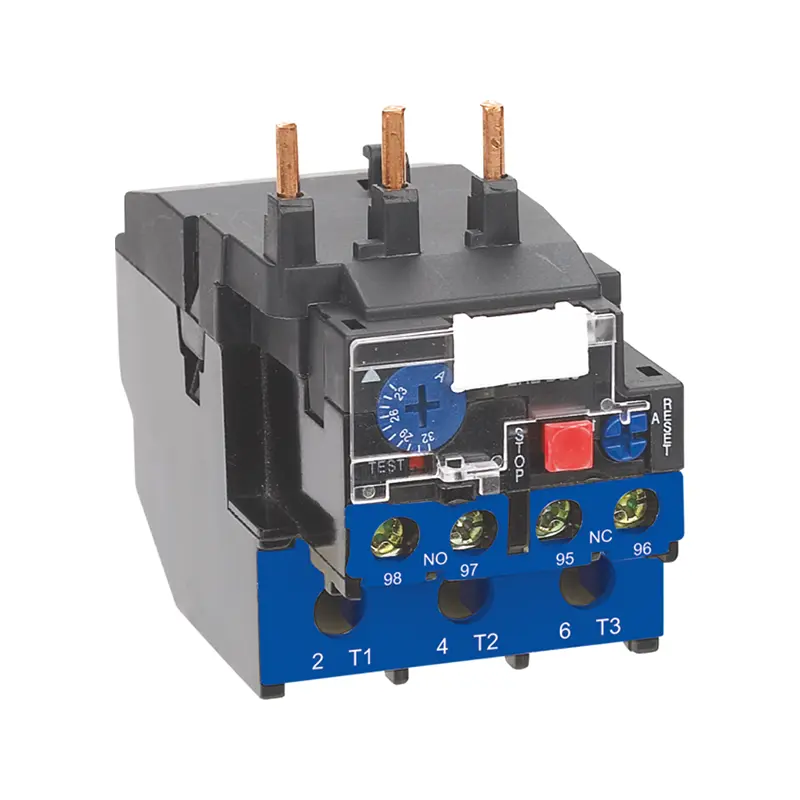








WW10-63 Residual Current Circuit Breaker
The WW10-63 is a residual current circuit breaker — an RCCB — built for a single purpose: detecting current that has found a return path it was never meant to take, and opening the circuit before that path runs through a person. It comes from ZHEJIANG YANTAI ELECTRIC, a manufacturer based in Yueqing, the Chinese city that supplies a large share of the world’s low-voltage protective equipment, and active in that trade since 2002.
Two supply arrangements are covered by the range: a single-phase version for 240 V~ circuits and a three-phase version for 415 V~ systems. In both cases the device sits in the final-circuit layer of a distribution board, handling shock risk rather than overload.
Reading the Fault This Device Is Built For
Under healthy conditions, the current that leaves a supply on the live conductor comes back on the neutral. An RCCB places a small toroidal core around those conductors, and while the two currents stay equal their magnetic fields cancel each other out. Nothing reaches the sensing winding.
That balance breaks as soon as some current escapes the intended circuit — through degraded insulation, a pinched cable, standing water, or a person. The difference between what went out and what came back induces a voltage in the secondary winding. The internal relay reads it, and the trip mechanism releases the contacts.
How the Sensing Coil Sees a Fault
Because the core measures a difference rather than an absolute value, the RCCB is blind to how much load the circuit is carrying. A lightly loaded socket outlet and a heavily loaded one produce the same reading as long as supply and return match. This is why leakage detection and overcurrent detection need two separate mechanisms — they are looking at fundamentally different quantities.
The Trip It Cannot Provide
The WW10-63 watches residual current and nothing else. It carries no thermal element to catch a slow overload and no magnetic element to clear a short circuit. Where a circuit needs both shock protection and overcurrent backup, the RCCB either pairs with a miniature circuit breaker or is replaced by a combined device.
Single-Phase and Three-Phase Variants in One Range
The two voltage ratings in this range follow the wiring systems they serve. The 240 V~ variant is wired as 1P+N and covers the socket and lighting circuits of an ordinary single-phase board. The 415 V~ variant is wired as 3P+N and takes its place in three-phase distribution, where it supervises all three phases plus neutral at once.
The distinction matters at selection time. A device configured for one arrangement is not interchangeable with the other, and the pole configuration has to match the board it is going into. Tell us which supply you are working on and we will quote the matching version.
Circuits That Benefit From a Dedicated RCCB
The device earns its place wherever the risk being managed is contact with live parts rather than cable damage:
- Final socket circuits in homes and rented accommodation
- Wet rooms — bathrooms, kitchens, laundries and utility areas
- Outdoor sockets, garden supplies and yard lighting
- Small commercial premises where staff plug in portable tools
- Workshops and maintenance bays with hand-held equipment
- Pumping and irrigation points fed from a remote board
- Temporary distribution on construction sites
- Any final circuit in a building where shock protection is a design requirement
Panel builders and distributors working across the wider circuit protection family will find the rest of the modular range in our main circuit protection catalogue.
Its Place Beside MCBs, RCBOs and MCCBs
These device families are often spoken about interchangeably, and the confusion costs projects time. The dividing line is simple: one measures current imbalance, the others measure current magnitude.
RCCB Against an MCB
A miniature circuit breaker is a magnitude device. It trips when the current through it is too large for too long, protecting the cable. It has no opinion about leakage and will pass a small earth fault all day without noticing. The two devices answer different questions and are frequently installed side by side.
RCCB Against an RCBO
An RCBO merges both functions into one enclosure: leakage sensing plus overcurrent tripping, on a single outgoing way. It saves board width and simplifies wiring, at a higher unit cost. Where space is not tight and the budget is watched, a shared RCCB upstream with miniature breakers downstream is the more economical arrangement — provided the resulting discrimination is acceptable to the designer.
A molded case breaker sits further upstream again, at the incoming end of a larger board, where the currents and fault levels sit beyond what a modular device can handle.
Fitting and First-Energisation Notes
Installation follows the usual modular convention. The device clips to the rail alongside the other outgoing ways, supply is brought in at the marked terminals, and the outgoing conductors leave from the opposite side. Polarity matters — live and neutral enter the designated terminals, not whichever pair happens to be nearest.
Before the board is closed up, three checks are worth the two minutes they cost. Confirm the neutral is not borrowed from a neighbouring circuit, since an RCCB reading a shared neutral will trip at random. Check that nothing downstream bridges neutral to earth. And press the test button once the supply is live — it should trip immediately, and it is the only field test that proves the mechanism still works.
Specification Questions We Ask Every Buyer
Several parameters decide whether the delivered device actually fits your application, and not all of them are visible on a datasheet. Send us these and the quotation will be right the first time:
- Supply arrangement and voltage — 240 V~ single-phase or 415 V~ three-phase
- The residual current at which the device must trip
- Whether the circuits feed socket outlets, fixed loads, or a mix of both
- Rail width available in the board, and how many ways each device may occupy
- Any type approval or certification your market requires
- Quantity, destination port and required delivery window
Where a parameter is not yet fixed, our engineering team can advise on normal practice for the application. Custom parameter adjustment is something the factory does as routine work rather than as a special favour.
Devices Bought Alongside This Breaker
Most orders that include an RCCB also include its neighbours in the board. Buyers sourcing this device frequently add:
- Residual current breakers with overcurrent protection — for outgoing ways that need both functions in one module
- YTNU4-40 miniature circuit breakers — the overcurrent layer sitting downstream of a shared device
- Molded case circuit breakers — for the incoming end of larger distribution boards
Consolidating these on one purchase order keeps the modular devices dimensionally consistent and cuts the number of inbound shipments a project has to track.
Private Label and Container-Load Supply
The factory produces under buyer brands as a matter of course. Marking can be applied from your artwork, packaging produced to your specification, and documentation prepared for the market the goods are destined for. Both OEM and ODM arrangements are supported, and mixed-model containers can be built so that a single shipment covers a distributor’s full modular range.
Goods ship from China to Europe, the Americas, Southeast Asia and Africa. The manufacturer states that the wider RCCB series is CCC, CE and SEMKO certified, and that the production base runs a quality system audited to ISO 9001.
Contact us for WW10-63 RCCB price, technical specifications, datasheet, bulk quantity, and OEM supply information.
FAQ
What does the WW10-63 RCCB protect against?
It protects people and animals from electric shock caused by earth leakage. The device monitors the difference between the current leaving on the live conductor and the current returning on the neutral, and trips when that difference becomes dangerous. It does not protect the cable against overload or short circuit.
Can an RCCB replace an MCB or an RCBO?
No, and this is the most common source of confusion. An MCB responds to current magnitude and protects the cable; an RCCB responds to current imbalance and protects people. An RCBO combines both in one module. Most boards need the leakage device and the overcurrent device together, either as two separate units or as one combined unit.
Which voltage version do I need for my board?
The 240 V~ version is wired as 1P+N and suits ordinary single-phase distribution boards. The 415 V~ version is wired as 3P+N for three-phase systems, where it monitors all three phases and the neutral together. Confirm your supply arrangement before ordering, as the two are not interchangeable.
Where is an RCCB normally installed?
It belongs on final circuits where contact with live parts is the risk being managed: socket outlets, bathrooms and kitchens, outdoor sockets, workshop benches, pumping points and temporary site distribution. It is also used as a shared upstream device protecting a group of final circuits.
How often should the test button be pressed?
Manufacturers generally recommend a monthly test on every residual current device. Pressing the button mechanically proves the trip mechanism still releases; it does not measure the actual tripping threshold. A device that fails to trip on the button should be replaced rather than kept in service.
Is the residual current threshold adjustable to my project?
The factory accepts custom parameter adjustment for OEM and ODM programmes, so tell us the value your design calls for rather than assuming a catalogue figure. For standard orders, share the application and we will confirm which configuration suits it.
Do you supply OEM marking and bulk quantities?
Yes. The factory produces under buyer brands with marking applied from your artwork, packaging to your specification and documentation for your destination market. Mixed-model containers are available so one shipment can cover a distributor's full modular range.
Request Quote
Tell us your specifications, quantity, or application scenario and we will reply with a tailored quote.