Contactor vs Circuit Breaker: Switching Duty vs Protection
Published: Author: Lisa
Contactor vs Circuit Breaker: Which One Does Your Circuit Need?
When designing or maintaining an electrical control system, one question comes up repeatedly: do I need a contactor or a circuit breaker? The short answer is that they serve fundamentally different purposes — a contactor controls the routine switching of loads, while a circuit breaker protects against faults. In practice, most motor circuits use both. This guide breaks down the differences, explains when each device is appropriate, and shows how they work together in a complete AC contactor motor starter assembly.
What Is a Contactor?
A contactor is an electromechanical switching device designed for frequent operation. When you energize its coil, the contacts close and allow current to flow to the load; de-energize the coil and the contacts spring open, breaking the circuit. Contactors are built for endurance — they handle thousands or even millions of operating cycles without significant wear.
In industrial applications, contactors typically switch motor loads, lighting banks, heating elements, and capacitor banks. Their switching capacity is defined by IEC 60947-4-1 utilization categories (AC-1 through AC-4), which specify the type of load and duty cycle the device can safely handle. For motor starting, AC-3 is the most common category, meaning the contactor can break an inductive load while the motor is running.
It is worth noting that contactors do not provide short-circuit or overload protection on their own. That role belongs to a separate protective device — which is where circuit breakers and thermal overload relays come in.
What Is a Circuit Breaker?
A circuit breaker is a protective device that automatically interrupts current flow when it detects a fault condition — typically a short circuit or an overload. Unlike a contactor, a circuit breaker is designed to operate infrequently and is not built for repetitive switching duty. Its core function is protection, not control.
Circuit breakers come in several varieties: thermal-magnetic (the most common in industrial panels), magnetic-only (often used in conjunction with a contactor for motor short-circuit protection), and electronic (which offer precise trip curves and adjustable settings). When a fault occurs, the breaker trips and must be manually reset or replaced, depending on the design.
Key Differences: Contactor vs Circuit Breaker
The table below summarizes the most important distinctions between the two devices:
パラメータ
Contactor
Circuit Breaker
Primary Function
Routine switching of loads
Protection against faults (short circuit, overload)
Operating Frequency
High — designed for millions of cycles
Low — trips only on fault
Control Method
Electromagnetic coil (remote controllable)
Manual or automatic trip; manual reset
Short-Circuit Protection
No
Yes
過負荷保護
No (requires separate overload relay)
Yes (thermal-magnetic types)
Typical Standard
IEC 60947-4-1 / UL 508
IEC 60947-2 / UL 489
Arc Suppression
Moderate (arc chutes for motor loads)
Heavy-duty (high breaking capacity)
When to Use a Contactor vs a Circuit Breaker
The decision between a contactor and a circuit breaker is not either/or — it is about applying the right device for the right function. Use a contactor when you need to:
Start and stop motors frequently (e.g., conveyor belts, pumps, fans)
Switch lighting or heating loads on a schedule or via a control signal
Enable remote or automated control of a circuit from a PLC or push-button station
Bypass or switch between power sources in a control panel
Use a circuit breaker when you need to:
Protect wiring and equipment from short-circuit damage
Provide overload protection for a circuit
Isolate a circuit for maintenance (when equipped with a padlock feature)
Comply with code requirements for branch-circuit protection
In most motor control applications, the two devices work side by side. The circuit breaker upstream provides short-circuit protection, while the contactor downstream handles the routine start/stop duty. A thermal overload relay attached to the contactor adds the missing overload layer.
The Three-Layer Motor Starter Synergy
A well-designed motor circuit follows a three-layer protection and control scheme:
Short-circuit protection (circuit breaker): A magnetic-only or thermal-magnetic breaker sits at the feeder. If a bolted fault occurs downstream, the breaker trips within milliseconds, limiting let-through energy and protecting the cable and components.
Switching control (contactor): The contactor handles everyday start/stop commands. It closes to start the motor and opens when the stop button is pressed or the control signal drops. Because it is rated for AC-3 duty, it can break the motor’s inductive current safely. Proper contactor wiring ensures the coil, main contacts, and auxiliary contacts are connected correctly for reliable operation.
Overload protection (thermal or electronic overload relay): Mounted directly beneath the contactor, the overload relay monitors motor current. If the motor draws more than its rated current for an extended period — say, due to a jammed load or undervoltage — the overload trips and signals the contactor coil to de-energize, disconnecting the motor before windings overheat.
This three-layer approach — breaker, contactor, overload relay — is the standard motor starter topology defined by IEC 60947. No single device can do all three jobs. Attempting to use a circuit breaker for routine switching will wear out its mechanism prematurely, while using a contactor without a breaker leaves the circuit unprotected against catastrophic faults.
Can a Contactor Replace a Circuit Breaker?
No. A contactor cannot interrupt a short-circuit current. Its contacts are designed to carry and break rated operational current, not the thousands of amps that a bolted fault can produce. If you wire a contactor without an upstream breaker or fuse, a short circuit downstream will weld the contacts closed or destroy the device entirely.
Conversely, using a circuit breaker for routine motor switching is equally problematic. Breakers are rated for a limited number of operations — often a few thousand at most — and their trip mechanisms are not designed for frequent cycling. The contactor’s coil control also allows remote and automated operation, something a standard breaker cannot do.
Choosing the Right Contactor for Your Application
If your circuit needs switching duty, selecting the right contactor involves more than matching voltage and current. You must consider the motor power and AC-3 rating, the utilization category, and the expected duty cycle. For most industrial motor applications, an AC-3 rated contactor is the minimum requirement.
For those comparing switching devices more broadly, understanding the difference between a contactor and a relay is also essential — relays handle lower currents and signal-level switching, while contactors are built for power-level loads.
If your project calls for a reliable, cost-effective contactor for motor starting duty, the LC1-E series AC contactor offers AC-3 rated performance across a wide range of current ratings, making it a solid choice for both OEM panel builders and end users.
よくある質問
Does a contactor provide overload protection?
No. A contactor only switches the load on and off. Overload protection requires a separate thermal or electronic overload relay, typically mounted directly below the contactor in a motor starter assembly.
Can I use a circuit breaker to start and stop a motor?
It is not recommended. Circuit breakers are designed for fault interruption, not frequent switching. Using a breaker as a motor switch will reduce its lifespan and may compromise its trip accuracy. Use a contactor for routine start/stop duty.
What is the difference between AC-3 and AC-4 utilization categories?
AC-3 covers the starting and running of squirrel-cage motors — the contactor breaks the motor’s rated current while running. AC-4 covers inching and plugging duty, where the contactor must break starting current frequently. AC-4 is more demanding and requires a larger or more robust contactor for the same motor. See our utilization categories guide for details.
Do I need both a contactor and a circuit breaker for a motor circuit?
In almost all industrial motor applications, yes. The breaker provides short-circuit protection, the contactor provides switching control, and an overload relay provides thermal protection. Together, they form a complete motor starter that meets both operational and safety requirements.
What size contactor do I need for my motor?
The contactor must be sized based on the motor’s full-load current, the utilization category (typically AC-3 for standard duty), and the operating voltage. Refer to the manufacturer’s AC-3 sizing chart to match the contactor’s rated operational current to your motor. Always apply a safety margin — typically 10–20% above the motor’s nameplate current.
結論
Contactors and circuit breakers are complementary, not competing. The contactor handles the work of switching — thousands of cycles, day in and day out — while the circuit breaker stands guard, ready to interrupt a fault the instant one occurs. Understanding this division of labor is the foundation of sound motor control design. By combining the right contactor, an appropriately rated breaker, and an overload relay, you build a circuit that is both functional and safe — exactly what IEC 60947 intends.
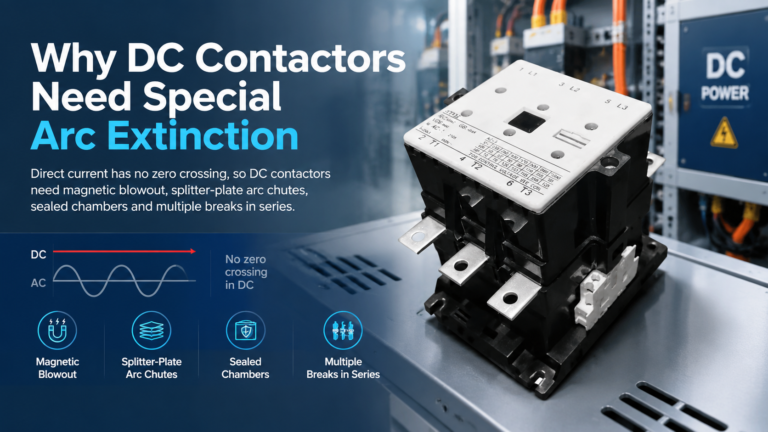
DC contactors need special arc extinction because DC current has no natural zero crossing. See how magnetic blowout, arc chutes and series breaks kill a DC arc — and how to specify one correctly.
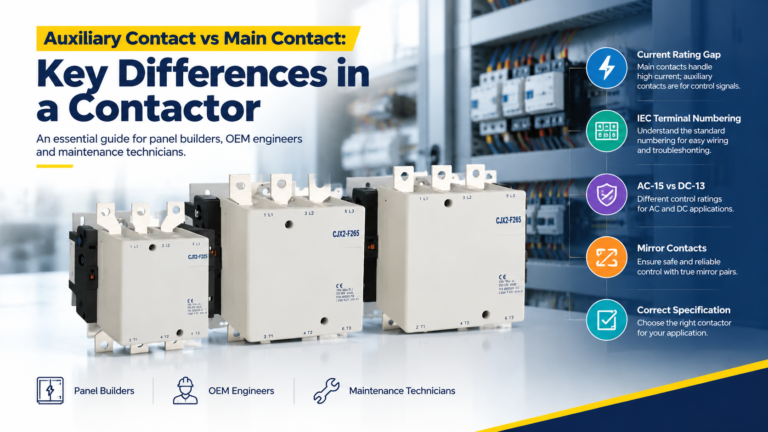
Main contacts carry the motor current; auxiliary contacts carry control signals. Learn the real rating gap, IEC terminal codes, and how to spec both correctly.
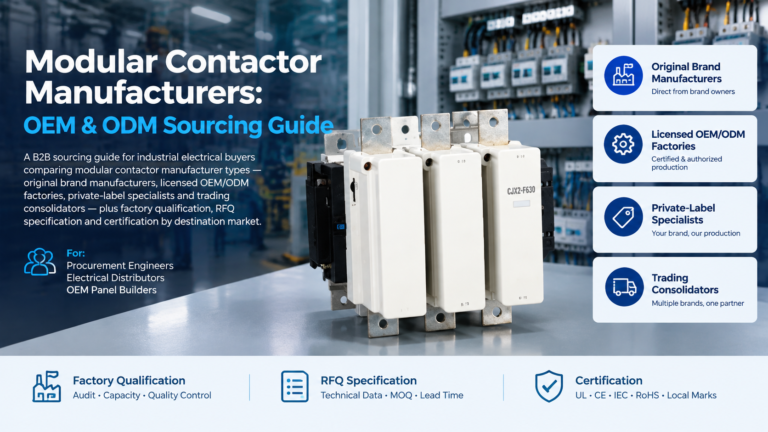
A sourcing guide to modular contactor manufacturers: match the four supplier archetypes, qualify any factory with a nine-point framework, and send an RFQ that gets comparable quotations.