Definite Purpose vs General Purpose Contactor: Ratings & Selection
Published: Author: Lisa
Two contactors can carry the same 40 amps on the nameplate, look similar from across the workshop, and still be built for completely different jobs. A definite purpose contactor is engineered around one family of loads — HVAC compressors, refrigeration and resistive heating — while a general purpose contactor is designed to switch almost anything up to its rating. Choosing the wrong one is not just a performance question: in North America the two families answer to different standards, and they are not freely interchangeable. This guide compares both types across ratings, standards, inrush capability, construction and cost, so you can specify the correct device the first time.
If you are new to contactors as a product family, start with the AC contactor overview for context on frames and ratings; this article stays focused on the definite purpose versus general purpose decision.
Quick Answer: The Core Differences
The two contactor types differ in scope, rating system, certification and economics. Here is the comparison in one table:
Attribute
Definite Purpose (DP)
General Purpose (GP)
Designed for
Specific load families: HVAC compressors, refrigeration, resistive heating, food-service equipment
Broad range: motors, lighting, heating, capacitor banks, general switching
Governing standards
UL 508 (Recognized component), ARI 780/790
UL 508 (Listed) or NEMA sizes; IEC 60947-4-1 for international builds
Rating system
FLA + LRA + resistive amps, listed per voltage
Motor HP (NEMA) or kW per utilization category AC-1 to AC-4 (IEC)
Inrush capability
Limited and voltage-dependent (the “six-five-four” rule)
Same inrush rating maintained up to 600 VAC
Typical range
1–4 poles, 20–90 A FLA standard frames
1–4+ poles, from small control frames to several hundred amps
Cost and life
Lower cost, shorter electrical life, matched to HVAC duty cycles
Higher cost, longer electrical life, heavier duty construction
Best fit
North American HVAC/R OEM equipment and like-for-like service replacement
Industrial panels, mixed loads, export equipment, long-duty motor service
Keep that last row in mind: DP contactors win where they are applied to the job they were designed for. Problems almost always start when one type is substituted for the other.
What Is a Definite Purpose Contactor?
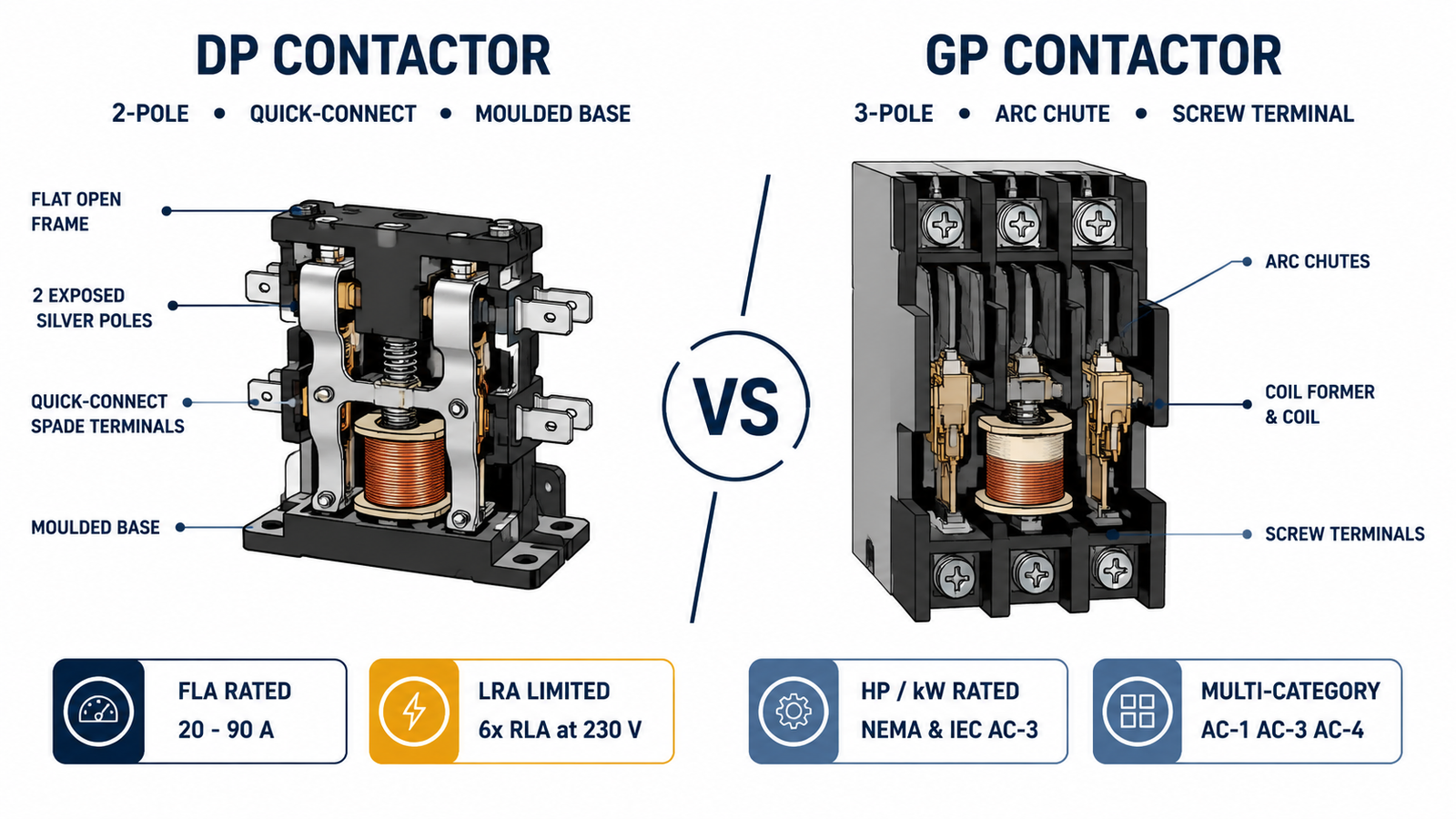
A definite purpose contactor is an economically engineered switching device built for a defined set of applications — most famously the hermetic compressor in HVAC and refrigeration systems, plus electric heating and food-service equipment. It is a component device: UL recognizes it under UL 508 as a Recognized component for use inside listed end equipment, and its performance profile follows ARI Standard 780/790, the HVAC industry’s specification for definite purpose contactors.
Three design choices set it apart:
Lighter duty cycles. HVAC compressors start a handful of times per hour, not in repeated inching duty. DP contactors are optimized for exactly that pattern, which lets manufacturers trim material cost.
Narrow, dense rating steps. Standard FLA ratings run 20, 25, 30, 40, 50, 60, 75 and 90 A, with resistive ratings typically 25–50% higher than the inductive rating. The narrow steps let an OEM pick a size that fits the compressor tightly instead of jumping up a whole frame.
Simple construction. Flat open frames, moulded bases, quick-connect spade terminals and 1-pole shunt-coil versions keep the device cheap and fast to install in a factory wiring harness.
On the datasheet, every rating is printed per system voltage — FLA, LRA and resistive amps at 240/277, 480 and 600 V — because, as you will see below, the inrush rating moves with voltage.
What Is a General Purpose Contactor?
A general purpose contactor is the opposite philosophy: one robust device rated for many load types. Two rating frameworks exist:
NEMA (North America): contactors are sized 00 through 9, each size corresponding to a motor horsepower range at a given voltage. A NEMA Size 1 device, for example, is expected to start a 7.5 HP motor at 230 V three-phase — whatever the duty cycle.
IEC 60947-4-1 (international): contactors are rated in kW or amps per utilization category — AC-1 for resistive, AC-2/AC-3 for squirrel-cage motors, AC-4 for plugging and inching. A single frame might carry 37 kW at AC-3 but only a fraction of that at AC-4, because each category describes a different severity of switching.
Because the whole device is built around surviving the worst duty it is rated for — including repeated inrush at any voltage up to 600 VAC — a GP contactor uses heavier contacts, larger arc chutes and a stronger magnetic system. That is why a 25 A GP frame often looks bulkier inside than a 25 A DP frame with a plastic cover on. If you want the full category breakdown, our guide to IEC utilization categories AC-1 to AC-4 covers it in detail.
The Rating Systems Diverge: FLA/LRA vs HP/kW
This is the difference that trips up most buyers: the two families literally speak different rating languages.
Label
Meaning
Used by
FLA (Full Load Amps)
Continuous current the contacts can carry while the motor runs
DP (governing), also printed on IEC frames
RLA (Rated Load Amps)
Compressor manufacturer’s running-current rating; UL tests establish it at the current drawn just before the motor protector trips
Compressors; matched against contactor FLA
LRA (Locked Rotor Amps)
Inrush current the contacts must close and carry during startup
DP (governing, per voltage); compressor nameplate lists its LRA
RES (Resistive Amps)
Rating for non-inductive loads such as heaters; always higher than the motor rating on the same device
Both families
HP (Horsepower)
Motor starting capability grouped into NEMA sizes
GP — NEMA framework
kW per AC-x category
Motor power the frame can switch per utilization category
GP — IEC framework
The practical consequence: a DP contactor sized by FLA and LRA hugs a compressor’s nameplate exactly, while a GP contactor sized in HP or kW already contains margin for worse duty than a compressor ever produces. That margin is what you pay the extra dollars for.
The Six-Five-Four Rule: Why DP Inrush Falls as Voltage Rises
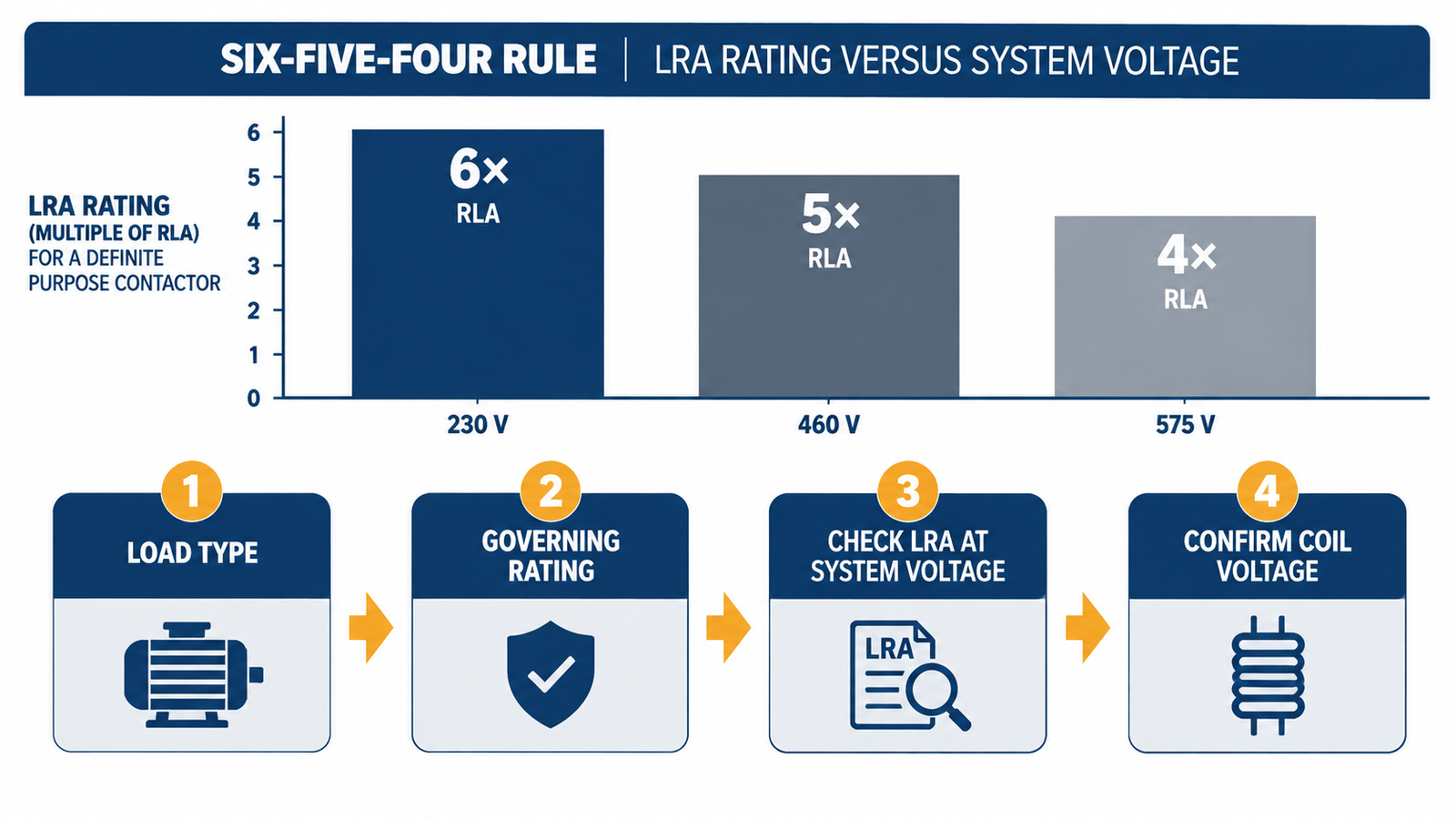
Here is the single most under-reported fact about definite purpose contactors, and the one that causes most misapplications. A DP contactor’s LRA rating is expressed as a multiple of its RLA/FLA rating, and that multiple shrinks as system voltage rises:
System voltage
Approximate LRA rating
Example: 40 A FLA frame
230 V
6 × RLA
LRA ≈ 240 A
460 V
5 × RLA
LRA ≈ 200 A
575 V
4 × RLA
LRA ≈ 160 A
A general purpose contactor does not play this game: its inrush and LRA capability stays essentially flat from low voltage all the way to 600 VAC. So the gap between the two families widens as voltage climbs — exactly the range where industrial motor loads live.
The rule also explains a common field failure pattern: a DP contactor that worked flawlessly on a 230 V unit gets reused in a 480 V machine, closes successfully on a compressor whose FLA it matches, and welds its contacts on the third or fourth start — because the inrush, not the running current, exceeded the device’s 460 V rating.
Standards and Certification: UL 508, ARI 780/790 and IEC
The certification split has real procurement consequences:
Framework
Device
What it means in practice
UL 508 — Recognized
DP contactor
Approved as a component only, for installation inside UL-listed end equipment by the OEM or a UL 508A panel shop; not independently listed for field installation as a standalone device
UL 508 — Listed (or NEMA size)
GP contactor (North America)
Evaluated as a complete device; the conventional choice for field-installed motor control
ARI 780/790
DP contactor
HVAC-industry performance standard covering contactor testing for compressor service, including closing at 80% of the lowest nameplate voltage
IEC 60947-4-1
GP contactor (international)
The global industrial standard; note that IEC does not recognize the “definite purpose” category at all
Two consequences worth stating plainly. First, because IEC has no DP category, equipment built to European or international specifications uses an IEC GP contactor with a suitable hermetic-motor rating instead — there is no “IEC definite purpose contactor” to specify. Second, the UL Recognized versus Listed distinction matters when a distributor or contractor installs a device in the field rather than inside a factory-built assembly; using a Recognized component outside listed equipment can void the assembly’s listing.
A modern footnote: as A2L refrigerants (mildly flammable classes such as R-32 and R-454B) replace older refrigerants, HVAC OEMs are re-validating switching components, and many DP contactors are now certified for A2L use. If you service newer condensing units, check that marking before ordering a replacement.
Construction: Where the Cost Difference Lives
Open the covers side by side and the engineering trade-offs are visible:
Contacts and arc management. A GP contactor carries arc chutes with deion plates because motor loads interrupt current anywhere on the sine wave at significant kA. A DP contactor switching a compressor at its rated duty gets by with a simpler contact system — legitimate within its defined envelope, undersized outside it.
Terminals. DP frames favour quick-connect spade terminals for automated harness assembly; GP frames use box lugs and screw terminals for field wiring flexibility.
Mechanical and electrical life. Typical DP devices specify around 1,000,000 mechanical operations but only 100,000–250,000 electrical operations. NEMA GP devices are built for extended service life, while IEC GP devices are designed for easy replacement over a long panel life — different strategy, both heavier-duty than the DP envelope.
Size. Counterintuitively, an IEC GP contactor at the same amp rating is usually physically smaller than a NEMA device but more substantial than a DP unit of equal FLA, once arc chutes and coil mass are counted.
Where Each Contactor Belongs: Application Matrix
申し込み
Correct choice
Why
Residential / light-commercial condensing unit (240 V single-phase compressor)
Rooftop unit or chiller compressor, 460 V three-phase
DP if OEM-specified, GP otherwise
Check the six-five-four LRA derating at 460 V before reusing any DP unit
Electric strip heaters, duct heaters
Either — size on RES rating
Resistive load; both families publish a resistive rating well above the motor rating
General motor control in an industrial panel (fans, pumps, conveyors)
GP (IEC AC-3 or NEMA)
Mixed duty, frequent starts, 480–600 V where DP inrush margin collapses
Lighting and distribution switching
GP
Load variety and higher switching counts favour GP construction
Export equipment to IEC markets
GP (IEC 60947-4-1)
No DP category exists in IEC; export builds need IEC-rated devices
Sizing Checklist: A Worked Example
Suppose a 460 V three-phase condensing unit carries a compressor with RLA 34 A and LRA 190 A, plus a condenser fan drawing 3 A through the same contactor:
Compute the total FLA requirement: 34 + 3 = 37 A.
Check DP candidates: the next standard size is 40 A FLA. But at 460 V, that frame’s LRA is roughly 5 × 40 = 200 A… on a good datasheet; many 40 A frames publish 160 A at 575 V and around 200 A at 460 V. The compressor’s 190 A LRA fits, barely — and with no margin for the fan motor’s contribution to inrush.
Check a GP alternative: an IEC frame rated 40 A AC-3 for 30 kW at 400–460 V closes into locked-rotor current as part of its normal AC-3 duty; its inrush capability is not derated by the six-five-four rule.
Decide: if the OEM datasheet explicitly lists a DP part validated for this compressor, keep it. If you are doing a service replacement or a field retrofit, the GP frame buys back the inrush margin the DP device spends.
The same logic in reverse: on a 230 V single-phase residential unit, a GP contactor is simply paying for capability the load never uses — the DP device is the honest, economical answer. For a deeper treatment of frame sizing and AC-3 duty, see how to size and select a contactor.
Replacement and Interchangeability: Six Mistakes to Avoid
Mistake
Consequence
Correct approach
Substituting a DP contactor into an IEC/NEMA industrial panel
Inrush undersizing at 480 V; shortened contact life; possible listing issues in UL assemblies
Match the original family; only cross over after verifying FLA そして voltage-specific LRA
Sizing DP units on the resistive (RES) rating for a compressor
Contact welding on startup — resistive ratings carry no inrush allowance
Always use the motor (FLA/LRA) columns for motor loads
Reusing a 230 V DP contactor at 460 V
Appears correctly rated on FLA but fails the five-times LRA check
Re-verify LRA at the new voltage every time voltage changes
Ignoring coil voltage and pickup spec
Chatter or failure to close; DP devices must close at 80% of the lowest nameplate voltage (166 V on 208/230 V equipment)
Confirm coil voltage, frequency and pickup/dropout band against the control transformer
Forgetting the contactor provides no overcurrent protection
A locked compressor passes fault current until the upstream device trips
Size the upstream breaker or fuses (HACR-rated in HVAC circuits) independently
Splitting a part-winding compressor across one undersized DP contactor
Half-winding LRA exceeds the contactor’s rating on each start
Each contactor’s part-winding LRA rating must meet or exceed the half-winding LRA of the compressor
Cost and Lifecycle: The Honest Trade-Off
On the invoice, a DP contactor typically costs a fraction of a NEMA GP device of comparable current — that is its entire reason for existing, and HVAC OEM economics are built on it. The trade is electrical life and margin: a DP device run inside its envelope delivers dependable service for the equipment’s design life, while a DP device stressed beyond its voltage-specific inrush rating fails early and sometimes destructively.
For a service decision on existing equipment, the question is not “which is better” but “which envelope does this load live in.” If you are weighing repair against replacement at the equipment level anyway, the cost breakdown in AC contactor replacement cost: parts, labor and downtime puts numbers on that decision. And whichever family you install, the service intervals in our contactor maintenance and inspection checklist apply equally — contact erosion, coil hum and terminal overheating do not respect rating philosophies.
Choosing Between DP and GP: The Decision in Four Steps
Identify the load type. Hermetic compressor or heating load inside an HVAC/R assembly → DP territory. Mixed or industrial motor loads → GP territory.
Identify the governing rating. DP: FLA and voltage-specific LRA. GP: HP (NEMA) or kW per AC category (IEC). Never mix the columns.
Check voltage. Above 240 V, apply the six-five-four rule to every DP candidate and compare against the compressor nameplate LRA.
Confirm certification context. Factory-built UL assembly → Recognized DP component is fine. Field installation or IEC-market export → Listed/NEMA or IEC 60947-4-1 GP device.
For most readers, that process lands on a DP contactor only inside North American HVAC/R equipment, and a GP contactor everywhere else. If you are sourcing either type, our CJX2 series general purpose contactors cover the IEC AC-3 range from 9 A to 115 A frames, and the CJX2-F225 そして LC1-D series extend coverage for larger motor duty — with OEM and private-label options for HVAC equipment builders who need both families qualified.
よくある質問
Can I use a general purpose contactor in place of a definite purpose contactor?
Yes, in most cases — a correctly sized GP contactor exceeds a DP contactor’s capability envelope on inrush and duty. The costs are size, terminal style and price. Verify FLA, coil voltage and pole configuration against the original, and expect a physically different footprint that may need mounting adaptation.
Can I use a definite purpose contactor in place of a general purpose one?
Generally no. A DP device sized to match the load’s FLA will usually fail the inrush check at 460–600 V, and a Recognized component installed as a field device can raise listing problems in North American assemblies. Only substitute after verifying the voltage-specific LRA rating covers the locked rotor current with margin.
Why are definite purpose contactors cheaper?
Because they are engineered for a narrow, predictable duty: HVAC compressors start infrequently, at known currents, at defined voltages. Trimming arc chutes, contact mass and terminal hardware to that envelope cuts cost — a legitimate saving as long as the load stays inside the envelope.
What do FLA and LRA mean on a definite purpose contactor?
FLA (full load amps) is the running current the contacts can carry continuously; LRA (locked rotor amps) is the much higher inrush current the contacts can close into during motor startup. On DP devices, the LRA rating is roughly six times FLA at 230 V, five times at 460 V and four times at 575 V, so both numbers must be checked at the actual system voltage.
Is a definite purpose contactor UL listed?
No — it is UL Recognized (a component certification under UL 508) and performance-tested to ARI 780/790. Recognition authorizes use inside listed end equipment; it is not the same as a Listed device approved for standalone field installation.
What is the IEC equivalent of a definite purpose contactor?
There is no direct equivalent: IEC 60947-4-1 does not define a “definite purpose” category. International equipment uses a standard IEC contactor, often with a rating suitable for hermetic refrigerant compressor duty, sized on its AC-3 (or applicable category) kW rating instead of FLA/LRA.
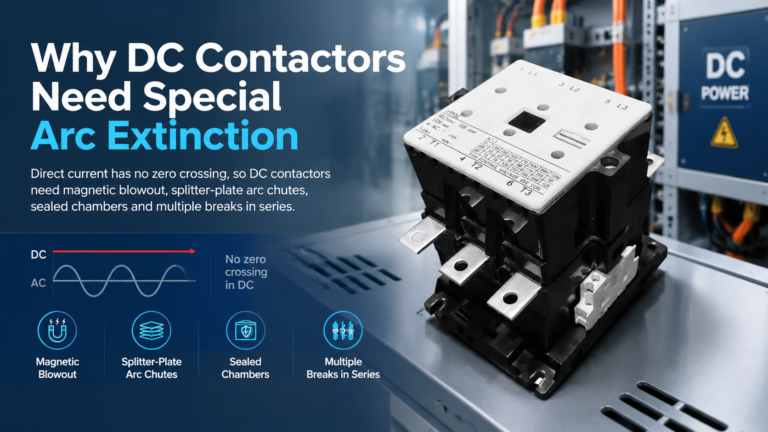
DC contactors need special arc extinction because DC current has no natural zero crossing. See how magnetic blowout, arc chutes and series breaks kill a DC arc — and how to specify one correctly.
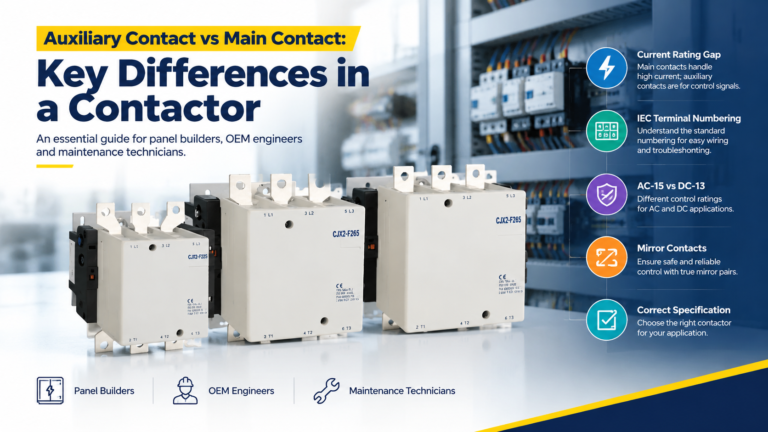
Main contacts carry the motor current; auxiliary contacts carry control signals. Learn the real rating gap, IEC terminal codes, and how to spec both correctly.
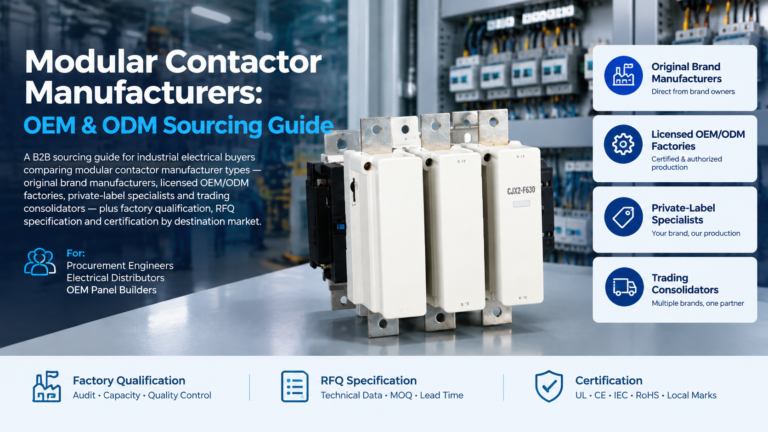
A sourcing guide to modular contactor manufacturers: match the four supplier archetypes, qualify any factory with a nine-point framework, and send an RFQ that gets comparable quotations.